Iranian Press Monitor - Tuesday, 22 September 2026 (Day 203)
Tuesday, 22 September 2026 · سهشنبه ۳۱ شهریور ۱۴۰۵ · 30 Rabi’ al-Thani 1448 - Nine Persian front pages and one English front page of 31 Shahrivar 1405, read alongside six outlet channels and three agency wires; Tehran Times was not available at the time of compilation.
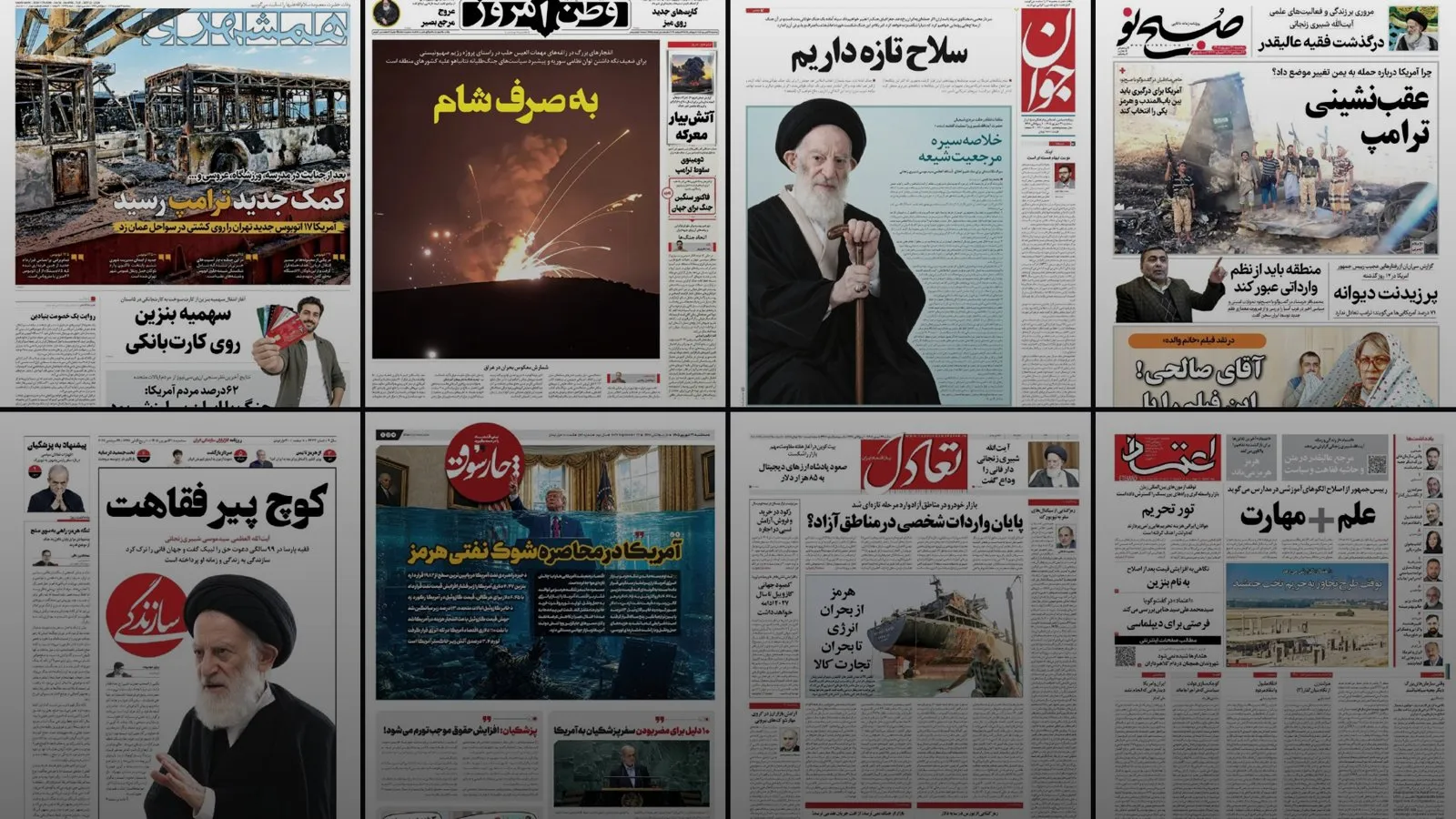
Bottom line: On the morning Iran opened Sacred Defense Week, the annual commemoration of the war it fought forty-six years ago, the case for ending the war it is fighting now appeared on two front pages: in English, from the government’s own daily, with a named mechanism, a named mediator and a named venue, and in Persian, on a reformist cover, under the byline of a journalist the state has repeatedly imprisoned.
Executive Summary
The lead judgment of this edition is that the de-escalation track did not disappear, it changed language. On 20 and 21 September this monitor recorded the Iran-Oman understanding on safe passage through the Strait of Hormuz appearing once on a single channel and then vanishing from every Iranian surface, and filed the silence as the pattern this file associates with an arrangement proceeding out of view. That reading is now superseded by better evidence. Iran Daily, the government’s English-language daily, leads today on «Diplomatic efforts underway to bring Iran, US back to negotiating table» and then prints the architecture beneath the headline in an interview with the international-affairs analyst Javad Heiran-Nia: Iran’s conditions are the release of frozen funds, the lifting of the naval blockade and the ending of the war on all fronts; the nuclear file is to be sequenced to a later phase; and, crucially, «Tehran therefore wants a mechanism involving Iran and Oman to be established first. The planned meeting in Salalah with the Arab countries of the Persian Gulf Cooperation Council and Iraq was based on this approach.» The mechanism has a name, a mediator and a venue, and all three check out against the external record: Iran and Oman agreed last month on a shipping route, mine clearing and short-term management of the Strait, and the Salalah meeting of Iran, five Gulf Cooperation Council states and Iraq was scheduled for 14 September and postponed indefinitely the day before.
What makes this a finding rather than a news item is where it was published. Nine Persian front pages went to press the same morning. Javan leads on the IRGC spokesman promising to change the geography of the war and to unveil weapons that will astonish the world. Sobh-e No leads on «عقبنشینی ترامپ», Trump’s retreat, over Yemeni fighters on aircraft wreckage. Chaharsoo gives its whole cover to «آمریکا در محاصره شوک نفتی هرمز», America besieged by the Hormuz oil shock, and its lower half to ten reasons why the President should not go to New York. Kayhan instructs him, in the imperative, to turn the General Assembly into a tribunal. Not one of the nine Persian covers prints the Oman mechanism, the Salalah venue, or the sequencing of the nuclear file. The split that this file spent two cycles reading as factional selection is not factional at all today: it runs along the language of publication.
The one Persian exception is the edition’s other significant page, and it is an op-ed rather than a news item. Sazandegi, whose cover is otherwise given to the death of Grand Ayatollah Shobeiri Zanjani, runs down its left column «تنگه هرمز؛ راهی بهسوی صلح», the Strait of Hormuz: a road toward peace, subtitled «پیشنهادی برای پایان دادن به جنگ از موضع قدرت», a proposal for ending the war from a position of strength. It is signed by Emadeddin Baghi, an Iranian journalist and human-rights campaigner who founded the Committee for the Defence of Prisoners’ Rights and has been imprisoned more than once for his writing. The piece concedes at the outset that talk of peace may seem meaningless while Iran’s commanders speak of moving from defence to offence, argues that this is exactly when the route must be looked for, and puts a conditional opening of the Strait as the concrete first step. The wrapper, from a position of strength, is what makes the proposal publishable; the byline is what makes it impossible to dismiss as a state trial balloon. This is the first time in this series that a concrete Hormuz reopening proposal has appeared on a Persian front page under any signature.
Against both, the state supplied its own counter-argument, and it did so through the calendar. Sacred Defense Week opens on 31 Shahrivar, the anniversary of the Iraqi invasion of 1980, and Jomhouri Eslami gives its lead to the start of the commemorations across the country. The framing is being worked, not merely observed: the defence agency’s channel runs a Persian Gulf naval history titled «از جنگ نفتکشها تا جنگ منطقهای», from the tanker war to a regional war, mapping the current maritime campaign directly onto the 1980s tanker war. That precedent is an argument, and its content is endurance: Iran absorbed years of attrition at sea and outlasted it. A state that opens its commemoration of a long war on the morning its press debates an off-ramp from the current one is supplying, in its most authoritative register, the reason not to take it.
Two standing threads closed this cycle, in opposite directions. The first is a correction the Iranian press made against itself without acknowledging it. On 20 and 21 September this monitor twice recorded a Saudi isolation list in which Britain was among the states refusing Riyadh military help, judged it assembled rather than reported, and noted that no British source had appeared on any Iranian surface across either cycle. Today Jam-e Jam, the state broadcaster’s own daily, carries on its channel that Britain is increasing military support to Saudi Arabia against Ansarullah attacks. The external record is precise: the British prime minister announced on 21 September that the Royal Air Force will provide air-to-air refuelling to Saudi aircraft on defensive missions, in addition to the Sky Sabre system already deployed. The isolation list was wrong, and the refutation was printed by an Iranian state outlet within forty-eight hours. The second closure is cleaner. Yesterday this file withheld the name of the IRGC spokesman because it could not be verified. Today it is printed on Javan’s cover as «سردار محبی» and it is externally corroborated: Hossein Mohebbi, speaking to the Al-Alam network on the night of 21 September, in the terms Javan reproduces.
The edition’s economics are unusually honest in both directions, which is itself the finding. Chaharsoo prices the American fuel shock at 4.67 dollars a gallon for petrol and 6.46 for diesel, with crude above 100 dollars, diesel stocks 13 percent below the five-year average and the strategic reserve at its lowest since 1983. Against the published American averages for 21 September, petrol was 4.478 dollars and diesel was 6.51, a record high. The page overstates petrol by about nineteen cents and understates diesel by about five, which means it understates the one figure that is actually a record. On 20 September this monitor judged that this press is most accurate when the number is Iranian and least when it is American; that judgment does not survive today. And the specialist Iranian press is now pricing the other half of the ledger: Ta’adol’s centre box reads «هرمز؛ از بحران انرژی تا بحران تجارت کالا», Hormuz: from an energy crisis to a crisis of goods trade, and Sobh-e No’s channel carries the governor of Hormozgan putting damage to fishing and port infrastructure at 4.5 billion tomans. Both economies are being priced correctly on the same morning, by different titles.
Three further items belong in the record. Hamshahri, the Tehran municipality’s own daily, gives its entire cover to «کمک جدید ترامپ رسید», Trump’s new aid has arrived, over gutted bus shells, reporting that America struck seventeen new Tehran buses aboard a ship off the Omani coast, and sequences it under the kicker «بعد از جنایت در مدرسه، ورزشگاه، عروسی و…», after the crime at the school, the stadium, the wedding. Those three referents are real and independently established: the Minab school strike, the Lamerd sports-hall strike and the Sirik wedding strike, all of them findings of the United Nations fact-finding mission published this month. The bus claim is not: it appeared one cycle ago only on Kayhan’s channel, it now leads the paper of the institution that owns the cargo, and it is still uncorroborated. Second, Lebanon returns to the batch after a full cycle of absence, corroborated, but only on a channel: Vatan-e Emrooz carries Israeli phosphorus munitions at Wadi al-Saluki sourced to Lebanon’s National News Agency, and the external record supports it. Third, Vatan-e Emrooz’s own cover takes the al-Eis ammunition-depot explosions in Aleppo, the fourth such unexplained blast in Syria this month and the third depot in eleven days, and converts them into a named Zionist project to keep Syria’s military capability weak; no cause for any of them has been established.
Net assessment: this is the first edition in this series in which the argument for ending the war is visible on front pages rather than inferred from absences, and it is also the edition in which the state supplies its fullest argument for continuing. The off-ramp is published twice, in English by the government and in Persian by a dissident, and both versions are concrete: a bilateral mechanism with Oman, a multilateral venue at Salalah, a conditional opening of the Strait. The case against is published nine times, and it has acquired its strongest form, which is no longer defiance but arithmetic: the closure is measurably hurting the adversary, American diesel is at a record, and the anniversary furnishes the precedent for outlasting the cost. The relevant question for the coming cycles is not whether the two tracks are in conflict but whether the English one ever crosses into Persian. Until it does, the mechanism that could end the blockade will be legible to every foreign government and to almost no Iranian reader.
Alongside all of it, the seminary buried a marja. Grand Ayatollah Seyyed Mousa Shobeiri Zanjani died on 21 September, aged 98 by the solar record and 99 as the Iranian pages print it, and he occupies the cover of five of the nine Persian papers. Not one of them prints a word about what his death means for the marja’iyat, for Qom, or for a Supreme Leader whose own clerical standing has never been established in public. Eight cycles into the serving Leader’s silence, the death of one of the last senior sources of emulation is covered as an obituary and nothing else.
Key Points
- KJ-1 [HIGH] KJ-1. The Iran-Oman de-escalation mechanism did not vanish, it was being published in English while the Persian press was silent on it, and it now carries a named venue. Iran Daily leads on «Diplomatic efforts underway to bring Iran, US back to negotiating table» and its interview with the analyst Javad Heiran-Nia states that Iran does not want the Strait or a transit mechanism to become an American instrument of pressure, that «Tehran therefore wants a mechanism involving Iran and Oman to be established first», and that «the planned meeting in Salalah with the Arab countries of the Persian Gulf Cooperation Council and Iraq was based on this approach». The external record supports every element: Iran and Oman agreed last month on a shipping route, mine clearing and short-term management of the Strait, and the Salalah meeting of Iran, five Gulf Cooperation Council states and Iraq was set for 14 September and postponed indefinitely the day before. On 20 and 21 September this monitor recorded the mechanism’s disappearance from every Iranian surface and filed it as an arrangement possibly proceeding out of view. That judgment is superseded: the arrangement is proceeding, and it is being described openly, in English. The significance is that the variable separating Iran’s two published postures is the language of publication, which means the withholding is aimed at the domestic audience rather than at the adversary.
- KJ-2 [HIGH] KJ-2. The government’s English daily published Iran’s negotiating conditions and their sequencing in plain terms, and no Persian front page in the batch carries any of it. The same interview gives the conditions as the release of frozen funds, the lifting of the naval blockade and the ending of the war on all fronts, describes them as the main conditions Iran has presented, and states that Iran is willing to discuss the nuclear issue «but wants such discussions to take place in a later phase, in line with what was emphasized in the understanding». It further asserts that after the understanding broke down, which Iran attributes to American action through the southern corridor, three ships were attacked and Washington then set the understanding aside and intensified the naval blockade. Across nine Persian covers the corresponding content is a new weapon, Trump’s retreat, an American fuel shock, and an instruction to the President to prosecute rather than negotiate. The significance is that the three disclosed terms have now been stated in the adversary’s language with a sequencing offer attached, which is the shape of a negotiating position rather than an ultimatum, and it is the first time in this series that the nuclear file has been explicitly deferred on an Iranian state surface.
- KJ-3 [HIGH] KJ-3. A concrete proposal to reopen the Strait of Hormuz reached a Persian front page for the first time in this series, and it carries the byline of a journalist the state has imprisoned. Sazandegi runs «تنگه هرمز؛ راهی بهسوی صلح», subtitled «پیشنهادی برای پایان دادن به جنگ از موضع قدرت», signed «عمادالدین باقی». Baghi is verifiable: an Iranian journalist and human-rights campaigner, founder of the Committee for the Defence of Prisoners’ Rights, repeatedly imprisoned in connection with his writing. The piece concedes that peace talk may seem meaningless while commanders speak of moving from defence to offence, argues that this is precisely when a route must be sought, and names a conditional opening of the Strait as the step. Every previous Iranian-side de-escalation item in this file has been either abstract commentary or a single-surface item that then disappeared. The significance is that the proposal is now both concrete and unownable: the state cannot present it as its own trial balloon, and it has not suppressed it. Watch for a principlist rebuttal, which would establish the proposal as live, as against silence, which would not.
- KJ-4 [HIGH] KJ-4. The state opened its annual commemoration of the 1980-88 war on the same morning, and it is being used as an argument against settling the present one. Sacred Defense Week begins on 31 Shahrivar, the anniversary of the Iraqi invasion; Jomhouri Eslami gives its lead to the nationwide programmes and Javan dates its edition to the week. The analogy is made explicit rather than left implicit: Defa Press, the IRGC-aligned defence agency, runs a Persian Gulf naval history headed «از جنگ نفتکشها تا جنگ منطقهای», from the tanker war to a regional war, covering the 1980s tanker war, international naval intervention and Iran’s asymmetric naval strategy. The significance is the precedent’s content. The tanker war is the one episode in Iranian state memory in which sustained maritime attrition was absorbed and outlasted, and invoking it in the week the Iranian press begins debating a conditional reopening supplies the counter-case in a register that cannot be argued with, because it is framed as remembrance rather than as policy.
- KJ-5 [HIGH] KJ-5. The IRGC spokesman’s identity, withheld in the last edition for want of verification, is now printed on a front page and independently confirmed. Javan leads on «سردار محبی سخنگوی سپاه پاسداران: اگر حملهای به ایران رخ دهد، جغرافیای جنگ را تغییر خواهیم داد», with the Corps ready for a long war, weapons to be unveiled that will astonish the world, and America defeated but lacking the courage to admit it. On 21 September this monitor carried the same substance from three channels and declined to name the speaker because an independent check did not confirm the name printed. The check now returns: the spokesman is Hossein Mohebbi, the remarks come from an interview with the Al-Alam network published the night of 21 September, and non-Iranian outlets carry them in the same terms, including the claim of new targets not yet struck. The claims themselves remain claims. The significance is procedural and favourable: a name this file withheld for one cycle has been resolved rather than quietly adopted, and the threat language can now be attributed to a specific serving official rather than to an anonymous command.
- KJ-6 [MODERATE-HIGH] KJ-6. The Saudi isolation list this monitor judged to be assembled rather than reported has been refuted by an Iranian state outlet within forty-eight hours, without acknowledgement. On 20 September Sobh-e No’s cover had America, Britain, Pakistan, Turkey and Egypt all refusing Saudi military help; on 21 September its channel had the requests going to France, Britain, Pakistan and Egypt. Britain was on both lists as a refuser and no British source appeared on any Iranian surface across either cycle. Today Jam-e Jam’s channel (28495) carries Britain increasing military support to Saudi Arabia against Ansarullah attacks. The external record is specific: the British prime minister announced on 21 September that the Royal Air Force will provide air-to-air refuelling to Saudi aircraft on defensive missions for a matter of weeks, in addition to the Sky Sabre air-defence system already deployed, following a Houthi missile aimed at Riyadh on Saturday. The significance is that the correction came from inside the same press and was printed without a retraction, which confirms the earlier judgment and establishes the mechanism: these lists are argument, and they are abandoned rather than withdrawn when the wire contradicts them.
- KJ-7 [MODERATE-HIGH] KJ-7. The Iranian press priced the American fuel shock accurately and understated the figure that is actually a record, inverting the accuracy pattern recorded two cycles ago. Chaharsoo’s cover puts American petrol at 4.67 dollars a gallon and diesel at 6.46, with crude above 100 dollars, diesel stocks about 13 percent below the five-year average and the strategic petroleum reserve at its lowest since 1983. The published American averages for 21 September are 4.478 dollars for regular petrol, up more than sixteen cents in a week, and 6.51 dollars for diesel, a record high. The page is nineteen cents high on petrol and five cents low on diesel. On 20 September this monitor judged that this press is most accurate when the number is Iranian and least when it is American; that judgment does not survive contact with this page. The significance is that the strongest available Iranian argument against trading the closure away is now an accurate one, and it is being made on the same cover that lists ten reasons why the President should not travel to the United Nations. Leverage that is real is harder to talk a state out of than leverage that is imagined.
- KJ-8 [MODERATE-HIGH] KJ-8. An uncorroborated claim was promoted from a single channel to two front pages in one cycle by being sequenced behind three independently verified atrocities. Hamshahri gives its entire cover to «کمک جدید ترامپ رسید» over «آمریکا ۱۷ اتوبوس جدید تهران را روی کشتی در سواحل عمان زد», under the kicker «بعد از جنایت در مدرسه، ورزشگاه، عروسی و…»; Kayhan’s cover runs the same construction. The three kicker referents are established: the Minab elementary-school strike of 28 February, the Lamerd sports-hall strike of the same day and the Sirik wedding strike of 1 September, all of them among the findings of the United Nations independent fact-finding mission published this month and all of them dismissed by the White House. The bus-ship claim is not established; it appeared on 21 September only on Kayhan’s channel, this monitor filed it then as uncorroborated, and no non-Iranian maritime reporting records the vessel. The significance is the technique and the venue: the paper making the claim the lead is the municipality’s own daily, the institution that owns the cargo, and the unverified item is being carried on the credibility of verified ones. This is a more durable method than the screenshot laundering recorded on 21 September, because the borrowed cases will survive checking.
- KJ-9 [MODERATE-HIGH] KJ-9. Negative evidence: an eighth consecutive cycle of total silence from the serving Leader, and his own daily now sources its authority to his predecessor. Across ten front-page scans and nine channels there is no statement, speech, decree or directly quoted remark attributed to Seyyed Mojtaba Khamenei. The office’s publication site was unreachable at compile time and an independent search returns nothing attributed to him later than a July 2026 message on «وحدت مقدس», sacred unity. In the same edition Kayhan, supervised by his office, publishes Hossein Shariatmadari’s «زاویهدارها وصلههای ناجور وفاق», which grounds its operative rule, that officials inclined even slightly toward the West must not hold key posts, in the guidance of the martyred predecessor, and attacks «وفاق», the Pezeshkian administration’s own governing slogan, in its title. On the front page the same masthead escalates from yesterday’s warning to an imperative: «آقای پزشکیان! سازمان ملل را به دادگاه جنایات آمریکا تبدیل کنید». Confidence is held rather than raised, because eight cycles of absence across eleven surfaces remains consistent with a communications posture as well as with an incapacity. The significance is that the substitution has hardened: the Leader’s own newspaper no longer needs him even as a citation.
- KJ-10 [MODERATE] KJ-10. Lebanon returned to the batch after a full cycle of absence, the item is corroborated, and it is still not on any front page. Vatan-e Emrooz’s channel carries the Israeli army striking Wadi al-Saluki in south Lebanon with phosphorus munitions, sourced to Lebanon’s National News Agency; the external record supports both the strike reporting and the pattern, with Human Rights Watch and Harvard’s International Human Rights Clinic having documented twenty-three verified white-phosphorus incidents in south Lebanon between March and May 2026. On 21 September this monitor recorded, for the first time in the series, a complete batch with no Lebanese item and filed it as a change of shape rather than a quiet day. The change is partially reversed and the reversal is instructive: nine Persian covers still carry nothing from Lebanon, and the Levant survives in this edition only on a channel and inside a Syrian story. The significance is that the Iranian front pages remain reorganised around the Gulf, the Red Sea and Washington, and the Levant is being handled as feed material rather than as a front.
- KJ-11 [MODERATE] KJ-11. A senior source of emulation died and five of nine Persian covers carry him, but not one prints a word about what his death means for religious authority. Grand Ayatollah Seyyed Mousa Shobeiri Zanjani died on 21 September; the external record gives his birth as 2 March 1928, which is 98 solar years against the 99 the Iranian pages print. Sazandegi leads on it («کوچ پیر فقاهت»), Javan gives it the page’s main photograph, Sobh-e No and Ta’adol banner it, Jomhouri Eslami and Kayhan carry it, and Etemad alone places him «در متن و حاشیه فقاهت و سیاست», in the text and the margins of jurisprudence and politics. Beyond that phrase, the coverage is uniformly obituary: biography, scholarly lineage, official condolences. No page addresses the thinning of the senior marja’iyat, the succession of emulation, or the relationship between clerical authority and a Supreme Leader whose own religious standing has never been publicly established. The significance is that the one subject on which this press is reliably voluble, the standing of the clergy, has gone silent in the same eight cycles as the Leader himself, which suggests the silence is bounded by a single sensitivity rather than by the news.
- KJ-12 [MODERATE] KJ-12. Unexplained explosions in Syria are being converted on Iranian front pages into a named Israeli programme with a stated objective. Vatan-e Emrooz gives its cover to «به صرف شام», a pun reading both as ‘just for dinner’ and as ‘at Sham’s expense’, over a deck asserting that the al-Eis ammunition-depot explosions in Aleppo serve «پروژه رژیم صهیونیستی برای ضعیف نگه داشتن توان نظامی سوریه و پیشبرد سیاستهای جنگطلبانه نتانیاهو علیه کشورهای منطقه». The blasts are real and occurred in the early hours of 21 September, injuring at least four; the external record establishes no cause, records the Syrian government calling it an accident, notes that claims of an Israeli strike were reported as false at the time, and counts it the fourth such incident this month with three Defence Ministry depots destroyed in eleven days. One security analyst is cited abroad raising an Israeli hypothesis, which is a hypothesis. The significance is that the Iranian page does not offer a suspicion but a strategy, complete with objective and beneficiary, and a strategy travels further and checks less easily than a suspicion. Confidence is moderate because a single cover cannot establish a practice; the item to watch is whether the remaining three blasts acquire the same attribution retrospectively.
- KJ-13 [MODERATE] KJ-13. The mediation channel acquired a framework name, a visiting minister and an open question, all on the same morning. Sobh-e No’s channel (116114) describes Tehran’s seven conditions as built on «چارچوب اسلامآباد», the Islamabad framework, insisting Iran demands practical implementation rather than political promises. The government daily’s channel reports President Pezeshkian receiving Pakistan’s interior minister in Tehran and saying Iran and Pakistan can meet their needs through regional capacities. Sazandegi’s right rail asks «وزیر کشور پاکستان برای چه به ایران آمد؟», what did Pakistan’s interior minister come to Iran for, under the heading «از هرمز تا یمن». On 21 September this monitor recorded the terms being conveyed to Washington «از مسیر قطر و پاکستان»; the route now has a name attached to one of its two ends. The significance is that the Pakistani leg has moved from a transit description to a named framework in one cycle while its content remains entirely unstated, and that the only Iranian surface treating the visit as requiring explanation is a reformist one. Whether «چارچوب اسلامآباد» acquires substance or remains a label is the tracking cue.
Macro Trends
- The negotiating track is separated from the escalation track by language, not by faction. For two cycles this file read the gap between the published terms and the withheld ones as factional discipline operating through selection. Today the gap runs somewhere else. The government’s English daily prints the three conditions, the nuclear sequencing, the Iran-Oman mechanism and the Salalah venue on one page. Nine Persian covers print none of the four. The same government owns both surfaces. A state that publishes its off-ramp only in the language its adversaries read, and its resolve only in the language its citizens read, is running two audiences rather than two policies, and the operational consequence is that no Iranian reader can evaluate the terms being offered in their name.
- The seven conditions acquired an origin to go with their route. On 20 September the count of seven sat only on the channels. On 21 September it crossed onto the covers with a route attached, through Qatar and Pakistan. Today Sobh-e No’s channel gives it a framework: the conditions are described as built on «چارچوب اسلامآباد», the Islamabad framework, with the paper insisting Iran wants practical implementation rather than political promises. On the same morning the government daily’s channel reports the President receiving Pakistan’s interior minister in Tehran, and Sazandegi’s rail asks openly what he came for. Three surfaces touch the Pakistani channel in one batch and only the reformist page treats it as unexplained. The four withheld terms are still withheld.
- The anniversary is being recruited to the present war. Sacred Defense Week opened on 31 Shahrivar, and the state did not leave the analogy to the reader. Jomhouri Eslami leads on the commemorations; Javan dates its edition to the week; Defa Press runs the Persian Gulf naval history explicitly as «از جنگ نفتکشها تا جنگ منطقهای», from the tanker war to a regional war. The 1980s tanker war is a precedent with a specific moral: Iran absorbed years of maritime attrition and outlasted it. Deployed in the week the press begins arguing about reopening the Strait, that precedent is not commemoration, it is the counter-argument, delivered in the state’s most authoritative register and immune to rebuttal because it is about the past.
- A concrete de-escalation proposal reached a Persian front page, under a dissident byline. Everything this series has recorded on the Iranian side of the Hormuz file has been either abstract (commentaries arguing that Iran holds two arteries and should convert them into a settlement) or deniable (a single-surface item about safe-passage routes that then vanished). Emadeddin Baghi’s front-page piece in Sazandegi is neither: it names the step, a conditional opening of the Strait, and it is signed by a man the state has imprisoned for his writing. The state cannot own it and has not suppressed it. Whether principlist titles answer it or ignore it is the most informative thing the next cycles can produce, because rebuttal would mean the proposal is live and silence would mean it is not worth the oxygen.
- The Saudi isolation list collapsed, and an Iranian state outlet printed the refutation. Across 20 and 21 September the Iranian press twice assembled a list of states refusing Saudi military help, with Britain on it both times and no British source anywhere. Today the state broadcaster’s daily carries Britain increasing military support to Riyadh against Ansarullah, which matches the external record exactly: Royal Air Force air-to-air refuelling for Saudi defensive missions, announced 21 September, on top of the Sky Sabre battery already deployed. No Iranian surface notes the contradiction. This is the cleanest demonstration this file has recorded of the difference between what this press asserts about third countries and what it reports when the wire obliges it, and it retrospectively settles the judgment that the list was placement rather than reporting.
- Both economies are now being priced correctly, by different titles. Chaharsoo’s American fuel figures sit within twenty cents of the published averages in both directions, and it understates the record diesel price rather than inflating it. Ta’adol reframes the Strait as a crisis of Iran’s own goods trade rather than of world energy. Sobh-e No’s channel carries the Hormozgan governor’s damage figure for fishing and port infrastructure. Etemad runs the collapse of inbound tourism and the coming petrol-price rise. The pattern this monitor recorded on 20 September, accuracy on Iranian numbers and distortion on American ones, does not hold today; what holds instead is that the specialist and reformist press price costs and the political press prices leverage.
- An uncorroborated claim keeps gaining institutional weight without gaining a source. The strike on a ship carrying seventeen Tehran municipal buses off Oman appeared on 21 September only on Kayhan’s channel. Today it leads Hamshahri, the municipality’s own daily, and appears on Kayhan’s cover. Its promotion from a channel item to the lead of the institution that owns the cargo has added no source, and no non-Iranian maritime reporting records the vessel. What has been added instead is company: the kicker places the buses after Minab, Lamerd and Sirik, three strikes an independent United Nations mission has in fact found to be indiscriminate attacks on civilians. Borrowing the standing of verified cases for an unverified one is the specific technique to watch, and it is more effective than the screenshot laundering recorded on 21 September because the borrowed cases are real.
- Unexplained events in Syria are being closed into a named campaign. Four ammunition depots have exploded in Syria this month, three Defence Ministry sites in eleven days, with no established cause and the Syrian government calling the latest an accident. Vatan-e Emrooz gives its whole cover to the al-Eis blasts and supplies a purpose: a Zionist regime project to keep Syria’s military capability weak and to advance Netanyahu’s policies against the region’s states. The blasts are real; the programme is the page’s construction. This matters beyond Syria because it is the template: where causation is genuinely open, the Iranian hardline press is supplying not a suspicion but a strategy, complete with an objective, and the strategy then circulates as though it were the reporting.
- The Leader’s office is now furnishing its authority from the dead predecessor. An eighth consecutive cycle passes with no statement, speech or quoted remark from Seyyed Mojtaba Khamenei across ten scans and nine channels. In that silence, Kayhan, supervised by his office, publishes an editorial whose central rule, that officials ‘angled’ toward the West must not hold key posts, is grounded in the guidance of the martyred predecessor. The serving Leader is not cited in his own daily. Meanwhile the same paper issues the President a brief for New York for the second consecutive cycle, escalating from last cycle’s warning to today’s imperative, and attacks «وفاق», the administration’s own governing slogan, by name in the editorial’s title.
- Lebanon returns, corroborated, and only on a channel. One cycle ago Lebanon was absent from every front page in the batch for the first time this monitor had recorded. Today it is back, and the item is real: Israeli phosphorus munitions at Wadi al-Saluki, sourced by Vatan-e Emrooz to Lebanon’s National News Agency and supported by the external record, including Human Rights Watch’s documentation of twenty-three verified white-phosphorus incidents in south Lebanon earlier this year. But it sits on a channel, not a cover. Nine Persian front pages still carry no Lebanese item. The Levant has not re-entered the frame; it has re-entered the feed.
Front-Page Snapshot
- Iran Daily (English) - “Diplomatic efforts underway to bring Iran, US back to negotiating table” (English-language government daily (IRNA)) - Negotiation architecture, Iran-Oman mechanism, Salalah venue [LOW - de-escalation architecture published in full]
- Sazandegi - “The departure of the elder of jurisprudence (with ‘The Strait of Hormuz: a road toward peace’ on the rail)” (Reformist (Kargozaran)) - Clerical succession; a named proposal to reopen the Strait [LOW-MODERATE - dissident byline argues for an opening]
- Chaharsoo - “America besieged by the Hormuz oil shock” (Title outside the standing reference set; anti-negotiation by content) - American fuel shock as proof the closure is working [MODERATE-HIGH - accurate leverage claim used against diplomacy]
- Kayhan (from its own channel) - “Mr Pezeshkian! Turn the United Nations into a court for America’s crimes” (Hardline, supervised by the Supreme Leader’s office) - Instruction to the President; attack on the concord doctrine [HIGH - maximalist brief aimed at the President in transit]
- Javan - “We have a new weapon” (Hardline, IRGC-affiliated) - Named IRGC threat to change the war’s geography; nuclear ambiguity on the rail [HIGH - dual escalation ladders on one page]
- Sobh-e No - “Trump’s retreat” (Principlist) - Cancelled American strike on Yemen read as deterrence success; America must choose between the two straits [MODERATE-HIGH - chokepoint dilemma turned back on Washington]
- Vatan-e Emrooz - “Just for Sham (at the Levant’s expense)” (Hardline principlist) - Aleppo depot blasts attributed to a named Israeli campaign; Lebanon phosphorus on the channel [MODERATE-HIGH - unexplained events closed into a strategy]
- Hamshahri - “Trump’s new aid has arrived” (Tehran municipality, centrist) - Uncorroborated bus-ship strike sequenced behind three verified atrocities [MODERATE - grievance consolidation on borrowed credibility]
- Jomhouri Eslami - “Special programmes commemorating Sacred Defense Week begin across the country” (Traditional clerical establishment) - The 1980-88 war anniversary opened on the morning the present war is debated [MODERATE - endurance precedent supplied in the authoritative register]
- Ta’adol - “The end of personal imports in the free zones?” (Economic daily) - Hormuz repriced as a crisis of Iran’s own goods trade [LOW-MODERATE - domestic cost of the closure on a front page]
- Etemad - “Knowledge + skill” (Reformist) - School year, Persepolis, the tourism collapse; G7 and Macron on the channel [LOW - domestic cost and an opening for diplomacy]
Compiled from Iranian front pages and outlet channels via open-source monitoring. Translations are editorial; named-figure attributions are verified against the source pages where possible.