Iranian Press Monitor - Monday, 21 September 2026 (Day 202)
Monday, 21 September 2026 · دوشنبه ۳۰ شهریور ۱۴۰۵ · 9 Rabi’ al-Thani 1448 - Nine Persian front pages of 30 Shahrivar 1405, read alongside six outlet channels and three agency wires; the English government daily available was two cycles old and Tehran Times was not available at the time of compilation.
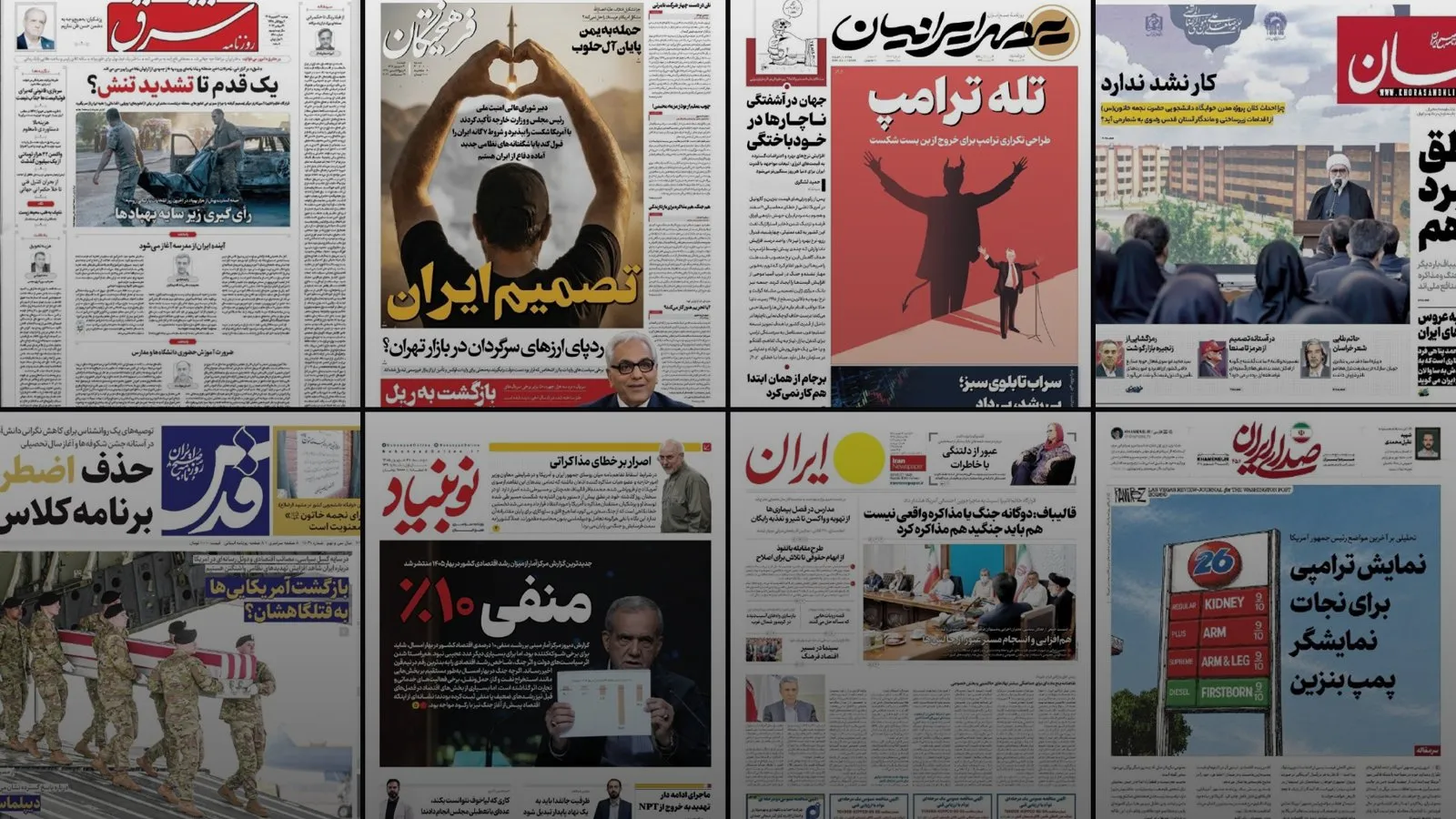
Bottom line: Iran put the number seven on a front page this morning and put every neighbour on a target list in the same edition, and a third set of covers printed the doctrine that makes the two one policy: terms conveyed through Qatar and Pakistan, a threat to any state that helps the government those terms are addressed to, and the formula that Iran must fight and negotiate at once.
Executive Summary
The lead judgment of this edition is that the negotiating position and the threat have been published together, deliberately, and that the Iranian press has printed the doctrine that reconciles them. One cycle ago this monitor recorded that every front page printed three of Iran’s conditions while the count of seven sat only on the outlet channels, and filed the four withheld terms as the part of the file that open sources could not reach. This morning the count crossed onto the page. Farhikhtegan gives its whole cover to «تصمیم ایران», Iran’s decision, over a deck in which the Secretary of the Supreme National Security Council, the Speaker of Parliament and the Foreign Ministry speak as one: «یا آمریکا شکست را بپذیرد و شروط ۷ گانه ایران را قبول کند یا با شگفتانههای نظامی جدید آماده دفاع از ایران هستیم», either America accepts defeat and accepts Iran’s seven conditions, or we are ready to defend Iran with new military surprises. Qods prints the same count with the route attached: «ایران شروط هفتگانه آغاز مذاکره را از مسیر قطر و پاکستان به واشنگتن رسانده است», Iran has conveyed the sevenfold conditions to Washington by way of Qatar and Pakistan. The count is now public. The four withheld terms are not, and that has not changed.
On the same morning, and on five separate surfaces, the Khatam al-Anbia Central Headquarters put the neighbours on the list. Kayhan gives it the full banner: «کشورهای منطقه اگر با آمریکا همراهی کنند هدف قرار میگیرند», the countries of the region, if they go along with America, will be targeted. Iran carries it as the kicker above its own lead, Shargh as the sub-kicker under a question mark, Seda-ye Iran as a right-rail box, Sobh-e No on its channel with the scope spelled out as continuous strikes on all American basing centers and interests in the region. The statement is corroborated in outline by non-Iranian reporting of 20 September. Only Kayhan adds a venue for the meeting it alleges, Germany, and that detail appears nowhere else on any surface, Iranian or foreign. Read against the record, the substance is not new: the targeting of states that host American bases was in Mojtaba Khamenei’s only published statement, in March. What is new is who is saying it, and to whom. The terms went to Washington through Qatar and Pakistan. The threat went to the region that contains them.
The third group of covers is the one that makes this a policy rather than a contradiction. The government daily leads on the Speaker: «قالیباف: دوگانه جنگ یا مذاکره واقعی نیست، هم باید جنگید هم مذاکره کرد», the war-or-negotiation dichotomy is not real, one must both fight and negotiate. Khorasan states the same thing as its own analysis rather than as a quotation, «منطق نبرد و تفاهم», the logic of battle and understanding, arguing that the recent statements of Rezaei and Ghalibaf reveal war and negotiation to be two complementary instruments of the national interest. Sobh-e No’s own front page for the day, carried on its channel, reads «میجنگیم و مذاکره میکنیم», we fight and we negotiate. Four surfaces, three factions, one formula, on the morning a fifth set prints the terms and a sixth prints the threat. That is not editorial convergence on a news event; it is the publication of a doctrine, and the doctrine’s function is to make the terms and the target list legible as a single posture rather than as a split.
The chokepoint file moved in the direction this monitor named one cycle ago, and further. On 20 September this file judged that the Hormuz bypass was being closed at its Red Sea outlet and that Bab al-Mandab had displaced the Aramco restoration timetable as the decisive variable. Vatan-e Emrooz’s channel now carries the chair of Yemen’s Supreme Political Council saying Bab al-Mandab is safe for everyone except Saudi vessels, and external reporting confirms a declared closure aimed at Saudi shipping alone, framed as a blockade for a blockade, with American ships expressly exempted. A second chokepoint is under selective closure, and the selection is the finding: the Yemeni instrument exempts the United States while the Iranian front pages threaten any regional state that assists the United States. Two coercion theories are running on one axis, and they point at different targets. Meanwhile the Iran-Oman understanding on safe passage through Hormuz, which this monitor recorded on 20 September as the first mechanism capable of unwinding the closure without a concession, appears today on no front page and on no channel at all.
The edition’s one unambiguous fact is a domestic one, and it is the state’s own. Nobonyad gives its entire cover to «منفی ۱۰٪», minus ten percent, over a photograph of President Masoud Pezeshkian holding a sectoral chart to a conference room, reporting the Statistical Center’s finding that real output in the quarter ending 20 June fell by about a tenth against the year before, with oil and gas down roughly a quarter. That quarter is the first full quarter of the war, and the figure is confirmed by international reporting of the same release. What the page does with it is the point: directly above the number runs «اصرار بر خطای مذاکراتی», insistence on the negotiating error, and a rail column keeps the threat of leaving the Non-Proliferation Treaty alive. A principlist title printed the war’s cost in full and argued on the same page against the exit from it, which is only coherent if the cost is offered as the price of endurance rather than as an argument.
Two things are missing and both are findings. Lebanon appears on no front page in this batch, and the only Lebanon-adjacent voice anywhere in the day’s material is Mojtaba Amani, who served as Iran’s ambassador in Beirut until February, talking about regional security architecture on the government daily’s channel. For a file whose standing brief puts Israel, the United States and Lebanon first, a full batch with no Lebanese item is a change of shape worth recording. And for a seventh consecutive cycle the serving Leader publishes nothing: no message, no speech, no quoted remark on any of ten scans or nine channels, while the operational command restates his March policy across the factional press, Kayhan’s boxed note warns the President to beware the pro-Western current’s prescriptions when he reaches New York, and the national succession campaign that led Kayhan’s rail yesterday is gone from Kayhan today.
Net assessment: this is a fully assembled negotiating posture published in one edition, and the assembly is now visible in a way it was not yesterday. Yesterday the terms and the nuclear ambiguity were split cleanly between factions and the split looked like discipline through selection. Today the parts are not split at all: the same batch carries the count of seven, the route through Qatar and Pakistan, the ultimatum wording, the threat to the neighbours, and the doctrine that says the two are complementary. A press that can print a demand, a threat and the formula reconciling them on one morning is not disagreeing about policy. The pressure, though, is on the page as well: the state’s own quarterly number, the school-year cost series, a second chokepoint whose closure exempts the adversary Iran is threatening the region over, and a de-escalation channel that has vanished from view for a cycle. What is being advertised is strength. What is being published alongside it is the price.
Key Points
- KJ-1 [HIGH] The count of seven crossed from the channels onto the front pages in a single cycle, and the four withheld terms did not. Farhikhtegan’s cover deck reads «یا آمریکا شکست را بپذیرد و شروط ۷ گانه ایران را قبول کند یا با شگفتانههای نظامی جدید آماده دفاع از ایران هستیم», attributing the sentence jointly to the Secretary of the Supreme National Security Council, the Speaker of Parliament and the Foreign Ministry. Qods’s box reads «ایران شروط هفتگانه آغاز مذاکره را از مسیر قطر و پاکستان به واشنگتن رسانده است» and adds the page’s own judgment that «شرایط برای مذاکره هنوز فراهم نیست», the conditions for negotiation are not yet in place. External reporting confirms three disclosed terms, four withheld, conveyed through Qatar, with Qatar and Pakistan both working the channel since the memorandum of understanding lapsed last month. On 20 September this monitor named the missing count as the gap between the page and the file; the gap closed in one cycle and closed only on the number. The significance is that Iran is now advertising the size of its demand to its own readers while keeping its content available only to Washington, which converts a negotiating position into a public ultimatum that no domestic audience can evaluate and no foreign analyst can read.
- KJ-2 [HIGH] The joint operational command extended the target list from American forces to any regional state that assists them, and five separate surfaces carried it on one morning. Kayhan gives the full banner to «قرارگاه خاتمالانبیا(ص): کشورهای منطقه اگر با آمریکا همراهی کنند هدف قرار میگیرند»; the government daily runs it as the kicker above its own lead; Shargh as the sub-kicker beneath a question; Seda-ye Iran as «خطا کنید هدف حملات دردناک قرار خواهید گرفت»; and Sobh-e No’s channel (116086) with the scope as continuous strikes on all American basing centers and interests in the region. Non-Iranian reporting of 20 and 21 September corroborates the statement in outline, describing intelligence of American planning after consultations with regional partners. The substance restates the policy in Mojtaba Khamenei’s only published statement, of March 2026. The significance is the addressee: the terms were sent to Washington through Qatar and Pakistan, and the threat was published to the region those two states sit in, which means the mediators are inside the target set of the message they are carrying.
- KJ-3 [HIGH] The Iranian press published the doctrine that makes the terms and the threat one policy, and it published it across the factional spectrum in a single batch. The government daily leads «قالیباف: دوگانه جنگ یا مذاکره واقعی نیست، هم باید جنگید هم مذاکره کرد»; Khorasan states it as its own analysis, «منطق نبرد و تفاهم», with the deck arguing that the recent statements of Rezaei and Ghalibaf show war and negotiation to be complementary instruments of the national interest; Sobh-e No’s own front page reads «میجنگیم و مذاکره میکنیم»; Farhikhtegan’s deck builds the same logic into an either-or. One cycle ago this monitor recorded a single interview split cleanly between camps and judged the discipline to be operating through selection. That reading is now superseded. The significance is that this edition does not need selection: the same batch carries the demand, the threat and the formula reconciling them, which indicates a message architecture confident enough to publish its own seams, and it removes the factional read as an explanation for what the covers print.
- KJ-4 [HIGH] A second maritime chokepoint is under declared selective closure, and its exemptions point away from the target set the Iranian covers are threatening. Vatan-e Emrooz’s channel (25729) carries the chair of Yemen’s Supreme Political Council saying Bab al-Mandab is safe for all but Saudi vessels; item 25743 has Ansarullah taking the Rasin heights west of al-Turbah. External reporting confirms the completed control of the Bab al-Mandab approaches, the Supreme Political Council’s declaration that navigation is secure except for ships of the Saudi enemy, the blockade-for-blockade framing, and the explicit exemption of American vessels. On 20 September this monitor judged that Bab al-Mandab had replaced the Aramco restoration timetable as the decisive variable in the bypass file; that judgment is now carried by the facts and further than it went. The significance is the asymmetry. The Yemeni instrument spares the United States and squeezes one Gulf government; the Iranian front pages spare no regional government that helps the United States. These are different theories of coercion running on the same axis, the narrower one is by construction the easier to trade, and no Iranian front page has yet printed the exemption.
- KJ-5 [HIGH] The war’s cost to the Iranian economy is now a front-page number, it is the state’s own, and it is the most verifiable fact in the edition. Nobonyad gives its whole cover to «منفی ۱۰٪» over «جدیدترین گزارش مرکز آمار از میزان رشد اقتصادی کشور در بهار ۱۴۰۵ منتشر شد», with President Masoud Pezeshkian photographed holding a sectoral chart. International reporting of the same Statistical Center release confirms a fall of about ten percent in real output for the quarter of 21 March to 20 June against the year before, with crude oil and natural gas down roughly a quarter and mining and manufacturing down roughly a seventh; that quarter is the first full quarter of the war. Etemad Online (534755) prices the same period domestically at 127.5 percent annual food inflation and a per-child monthly school cost running at a quarter to a half of a typical wage. The significance is in what the cover does next: directly above the number sits «اصرار بر خطای مذاکراتی», insistence on the negotiating error, and a rail column sustaining the threat to leave the Non-Proliferation Treaty. A principlist title has chosen to publish the full cost and argue against the exit on the same page, which reads the contraction as the price of endurance and is the clearest statement yet of what the hardline case now costs to make.
- KJ-6 [MODERATE-HIGH] Negative evidence: a seventh consecutive cycle of total silence from the serving Leader, with his policy being restated by the command and his President being instructed by his newspaper. Across ten scans and nine channels there is no message, speech, decree or directly quoted remark from Seyyed Mojtaba Khamenei; the office’s own publication site could not be reached, and an independent search returns nothing attributed to him in September 2026. In the same edition, the Khatam al-Anbia statement restates the targeting of states that host American forces, which was his March position; and Kayhan runs a boxed instruction, «آقای پزشکیان! در نیویورک مراقب نسخههای خطرناک جریان غربگرا باشید», Mr Pezeshkian, in New York beware the dangerous prescriptions of the pro-Western current, the only reference in the batch to the President’s presence at the United Nations. Yesterday’s national succession campaign, «برای پدر، به عشق پسر», is absent from Kayhan’s page today. Confidence is held rather than raised because absence across eleven surfaces is consistent with a communications choice as well as with an incapacity. The significance is that the office is no longer even furnishing the silence with liturgy: it is being spoken for by the command, by the Speaker and by its own daily, and that is a more durable arrangement than a campaign.
- KJ-7 [MODERATE-HIGH] Negative evidence: the one mechanism capable of unwinding the Hormuz closure without a concession has now vanished from the channels as well as the covers. On 20 September this monitor recorded the Foreign Ministry spokesman on Sobh-e No’s channel stating that Iran and Oman had reached an understanding on determining safe passage routes through the Strait, placed it against external reporting of an Iran-Oman corridor process running since late August, and filed its absence from every front page as a finding. Today it is absent from all nine channels and all nine covers. Nothing contradicted it; nothing advanced it; no Iranian surface returned to it. Sobh-e No’s own channel instead runs three commentaries arguing that Iran commands two energy arteries and should convert that position into a regional settlement before the window closes. The significance is that the corridor and the commentary are the same argument at different levels of deniability, and the disappearance of the concrete item while the abstract case for trading the chokepoints expands is the pattern this file associates with an arrangement proceeding out of view. Treat a second silent cycle as reinforcing, not as closing, this line.
- KJ-8 [MODERATE-HIGH] Negative evidence: Lebanon is absent from every front page in the batch, for the first time this monitor has recorded. Nine Persian covers carry no Lebanese item of any kind. The only Lebanon-adjacent voice anywhere in the day’s material is Mojtaba Amani, who served as Iran’s ambassador in Beirut until February 2026 and now appears on the government daily’s channel (507479) discussing regional security architecture and a shift away from American-dependent frameworks, without Lebanon as his subject. Against a standing brief that puts Israel, the United States and Lebanon first, and against a file in which Lebanon has been a live flashpoint since the memorandum of understanding, a clean absence is a change of shape rather than a quiet day. Israel itself survives on the covers only obliquely: Netanyahu inside Kayhan’s Yemen headline, American and Israeli-linked operatives in Nobonyad’s intelligence-ministry item, and a Haaretz-sourced piece on Defa Press. The significance is that the Iranian front pages have reorganized around the Gulf, the Red Sea and Washington, and the Levant has dropped out of the frame at the moment the Red Sea entered it. Whether this is displacement or de-prioritization is the thing the next cycles decide.
- KJ-9 [MODERATE] An Iranian wire claim was exported into English and re-imported onto an Iranian front page as a screenshot, on the same cover that sources a genuine American cartoon correctly. Seda-ye Iran illustrates «پهپادهای MQ-9 آمریکایی در تیررس نیروهای مسلح جمهوری اسلامی ایران» not with a photograph but with a picture of an English-language post on X which itself quotes a Fars News Agency item claiming the IRGC has downed its fifty-second American MQ-9 since the war began, set against a pre-war American inventory figure. The claim is uncorroborated outside the Iranian press. The same page reprints, with an accurate credit to Ramirez of the Las Vegas Review-Journal for the Washington Post, a real American editorial cartoon about American fuel prices, and builds its main headline on it. The significance is that the masthead is demonstrably capable of sourcing authentic adversary material when it exists, so the round trip on the drone item is a technique for manufacturing the appearance of foreign confirmation rather than a failure of access. Confidence is moderate because a single page cannot establish a practice; the item to watch is whether other titles begin illustrating Iranian claims with screenshots of English renderings of the same claims.
- KJ-10 [MODERATE] Kayhan hardened an official statement by one unshared detail, and runs its own war-day counter three days ahead of the calendar. Alone in the batch and alone in the available external record, Kayhan places the American, Israeli and Arab military meeting that allegedly authorized a resumption of action against Iran in Germany; Shargh, working from the same statement, prints only «یکی از کشورهای اروپایی», one of the European countries, and the external accounts name no venue at all. Separately, Kayhan’s right rail heads «گزارش روز دویست و پنجم جنگ», report of the two hundred and fifth day of the war, which implies a start date of 1 March 2026 against this series’ fixed count of Day 202. Neither item changes the statement’s substance. The significance is procedural and cumulative: this is the masthead whose specificity consistently exceeds its sourcing, the added detail is always the one that makes the threat more concrete, and an outlet keeping its own war clock is maintaining a frame as well as a number. Log the Germany claim as unconfirmed and watch for it appearing downstream as though it were sourced.
- KJ-11 [MODERATE] The Saudi isolation list turned over its membership for a second consecutive cycle without acquiring a single source. On 20 September Sobh-e No’s cover carried America, Britain, Pakistan, Turkey and Egypt all refusing Saudi military help, and this monitor judged the list assembled rather than reported. Today the same paper’s channel (116085) has Saudi air-defense requests going to France, Britain, Pakistan and Egypt, with Egypt refusing and the American supplier constrained by its own inventory, and France standing where America and Turkey stood a day earlier. Across both cycles no Saudi, French, British, Turkish or Pakistani source appears on any Iranian surface. The significance is that the turnover is itself the evidence: a real refusal list does not change three of its five members overnight, and the stable element across both versions is the conclusion rather than any of its parts. Iranian reporting of Riyadh’s diplomatic position should continue to be treated as argument, not as intelligence.
- KJ-12 [MODERATE] The most operationally specific claims of the day came from an Iranian official whose name this monitor could not verify, and none of them is corroborated. Nour News (396163, 396164, 396165), Fars News (463325, 463326) and Etemad Online (534754) all carry the IRGC spokesman saying that America has been defeated and lacks the courage to admit a historic and disgraceful defeat, that American bases in the region can no longer even protect themselves, and that, contrary to the picture painted, Washington’s intelligence centers in the Gulf and northern Iraq were reachable and were struck. The third is the most specific assertion in the day’s material and the least testable. An independent check of who currently holds the IRGC spokesman’s post did not return a confirmation matching the name one outlet printed, so no name is asserted anywhere in this edition. Separately, three surfaces carry the destruction of an American MQ-1 over the Strait of Hormuz and Kayhan’s channel (84533) claims an American strike on a vessel carrying seventeen public-transport buses; neither is corroborated outside the Iranian press. The significance is calibration: overstating these would manufacture an escalation the record does not support, and dismissing them would miss the fact that claims of penetrated American intelligence facilities are now being made on the record, by an official, on the morning Iran publishes its terms.
Macro Trends
- The count crossed onto the page, the content did not. One cycle ago the front pages printed three conditions and the channels printed seven, and this monitor filed the gap between them as the shape of the actual policy. Today «شروط ۷ گانه» leads Farhikhtegan and «شروط هفتگانه» sits in Qods’s box with the mediation route attached. What moved is the number, not the terms: three conditions remain the disclosed set and four remain withheld. A position advertised by its length rather than its content is being used to signal seriousness to a domestic audience while staying testable only in private, and the migration of the count from channel to cover in a single cycle shows how fast this press moves a figure once the decision to publish it is taken.
- The threat moved from the forces to the neighbours. For most of this series the targeting language has named American bases, ships and personnel. The Khatam al-Anbia statement carried on five surfaces this morning names states: any regional country that goes along with an American action is placed on the list, with continuous strikes on all American basing centers and interests promised in the fullest rendering. This is the military articulation of the policy Mojtaba Khamenei set out in March and it arrives in the same edition as terms conveyed to Washington through two of the region’s governments. The coercive target set and the diplomatic channel now overlap.
- Fight-and-negotiate became a stated doctrine rather than an implied one. Ghalibaf on the government daily’s cover, Khorasan as its own analysis, Sobh-e No as its front-page headline and Farhikhtegan as an either-or ultimatum all print the same formula within one batch: the choice between war and negotiation is false and Iran does both. Yesterday the terms and the nuclear ambiguity were allocated cleanly between factions and the discipline showed as selection. Today the same batch carries every part of the posture at once and supplies the sentence that holds them together, which is a more confident form of message management and a harder one to read as factional disagreement.
- A second chokepoint, closed selectively, and pointed elsewhere. Bab al-Mandab is now under a declared closure that exempts everyone but Saudi vessels, with American shipping explicitly excluded from the threat, at the same moment the Iranian front pages threaten any regional state that assists America. The Hormuz closure was general and aimed at world trade; this one is narrow and aimed at one government. Two instruments with different logics are running on one axis, and the narrower one is by construction easier to trade away. Track whether the Iranian press begins to print the Yemeni exemption, which it has so far not done.
- The de-escalation mechanism has disappeared rather than been argued with. On 20 September the Foreign Ministry spokesman was quoted on a principlist channel saying Iran and Oman had reached an understanding on safe passage routes through the Strait of Hormuz, and this monitor recorded it as the first mechanism capable of unwinding the closure without a concession, absent from every front page. Today it is absent from the channels as well. Nothing contradicted it and nothing advanced it. An item that appears once on a single surface and then vanishes is the pattern this file has previously seen around arrangements that are proceeding but are not to be discussed, and it should be watched for rather than written off.
- The domestic number is now the most verifiable thing on any cover. Nobonyad’s minus ten percent is the state’s own statistic, externally confirmed, and it is the hardest domestic figure this series has recorded on a front page. It arrives with the school-cost series on Etemad Online showing food inflation at 127.5 percent year on year and per-child monthly costs at a quarter to a half of a worker’s wage. The Iranian press is at its most accurate when the number is Iranian and at its least when the number is American, which inverts the asymmetry recorded on 20 September and suggests the domestic cost has passed the point where it can be managed by omission.
- Sourcing is being laundered in both directions on the same page. Seda-ye Iran reprints a genuine American editorial cartoon about American fuel prices, credited on the page, as evidence of the adversary’s distress, and on the same cover illustrates its drone claim with a screenshot of an English-language social-media post that is itself quoting Fars News. One Iranian wire assertion travels into English, acquires the appearance of foreign confirmation, and returns to an Iranian front page as a picture. The masthead demonstrably can source real adversary material, which makes the round trip a technique rather than a shortcut, and it is the clearest instance of the pattern this file has yet recorded.
- The Saudi isolation list keeps changing its members. Yesterday Sobh-e No’s cover had America, Britain, Pakistan, Turkey and Egypt all refusing Saudi requests. Today the same paper’s channel has the requests going to France, Britain, Pakistan and Egypt, with Egypt refusing, and France appearing where America and Turkey stood. No Saudi, French, British or Pakistani source has appeared on any surface across either cycle. A list whose membership turns over from one day to the next, with the refusals asserted and never sourced, is placement rather than reporting, and the second cycle of turnover is what makes that judgment safe to hold.
- Authority is being exercised by everyone except the Leader. A seventh consecutive cycle passes with no message, speech or quoted remark from Seyyed Mojtaba Khamenei on ten scans and nine channels. In that silence, the security council sets the terms, the Speaker states the doctrine, the operational command issues the threat, and the Leader’s own flagship daily prints a boxed instruction to the President about what to avoid in New York. Yesterday’s national succession campaign, «برای پدر، به عشق پسر», does not appear on Kayhan’s page today. The office is not filling the silence with liturgy this cycle; it is simply being spoken for.
Front-Page Snapshot
- Farhikhtegan - “Iran’s decision” (Principlist, Azad University) - The seven conditions on a front page for the first time, with military surprises as the alternative [HIGH]
- Qods - “Diplomacy behind the line of fire” (Conservative, Astan Quds Razavi, Mashhad) - Seven conditions conveyed to Washington via Qatar and Pakistan; conditions for talks not yet in place [MODERATE-HIGH]
- Kayhan - “Khatam al-Anbia Headquarters: regional countries that go along with America will be targeted” (Hardline, Supreme Leader’s office) - Target list extended to regional states; Yemen’s strike at Riyadh; a boxed warning to the President before New York [SEVERE]
- Seda-ye Iran - “A Trumpian show to save the gas-pump display” (Principlist, KHAMENEI.IR branding in the nameplate) - American fuel costs as proof of defeat; the targeting threat repeated; a drone claim laundered through social media [HIGH]
- Iran - “Ghalibaf: the war-or-negotiation dichotomy is not real; one must both fight and negotiate” (Official government daily) - The dual-track doctrine stated by the Speaker, with the military warning demoted to a kicker [MODERATE]
- Khorasan - “The logic of battle and understanding” (Conservative, Mashhad) - War and negotiation read as complementary instruments of the national interest; the batch’s only China column [MODERATE]
- Nobonyad - “Minus 10 percent” (Conservative / principlist) - The Statistical Center’s contraction for the war quarter, with the negotiating exit rejected on the same page [LOW-MODERATE]
- Shargh - “One step from an escalation of tension?” (Reformist) - Escalation posed as a question; the largest photograph on the page is Russia’s election under drone attack [MODERATE]
- Asr-e Iranian - “Trump’s trap” (Conservative) - Adversary decline as the driver of events; a full-page caricature in place of reported fact [LOW-MODERATE]
- Outlet channels and agency wires - “Ansarullah: Bab al-Mandab is safe for everyone except the Saudis” (Six newspaper channels, three agency wires) - A second chokepoint under selective closure; IRGC claims on American bases and intelligence centers; a senior marja’s death after the presses closed [HIGH]
- Iran Daily (English) - “US cannot escape responsibility for war crimes by leaving UN rights council: Deputy FM” (English-language government daily) - Edition two cycles old, recorded for coverage accounting only [LOW]
Full report
The complete edition - per-paper front-page analysis and full translation appendices - is available as a PDF: Download the full report.
Compiled from Iranian front pages and outlet channels via open-source monitoring. Translations are editorial; named-figure attributions are verified against the source pages where possible.