Iranian Press Monitor - Sunday, 20 September 2026 (Day 201)
Sunday, 20 September 2026 · یکشنبه ۲۹ شهریور ۱۴۰۵ · 8 Rabi’ al-Thani 1448 - Nine Persian front pages of 29 Shahrivar 1405, read alongside six outlet channels and three agency wires; the English government daily available was one cycle old and Tehran Times was not available at the time of compilation.
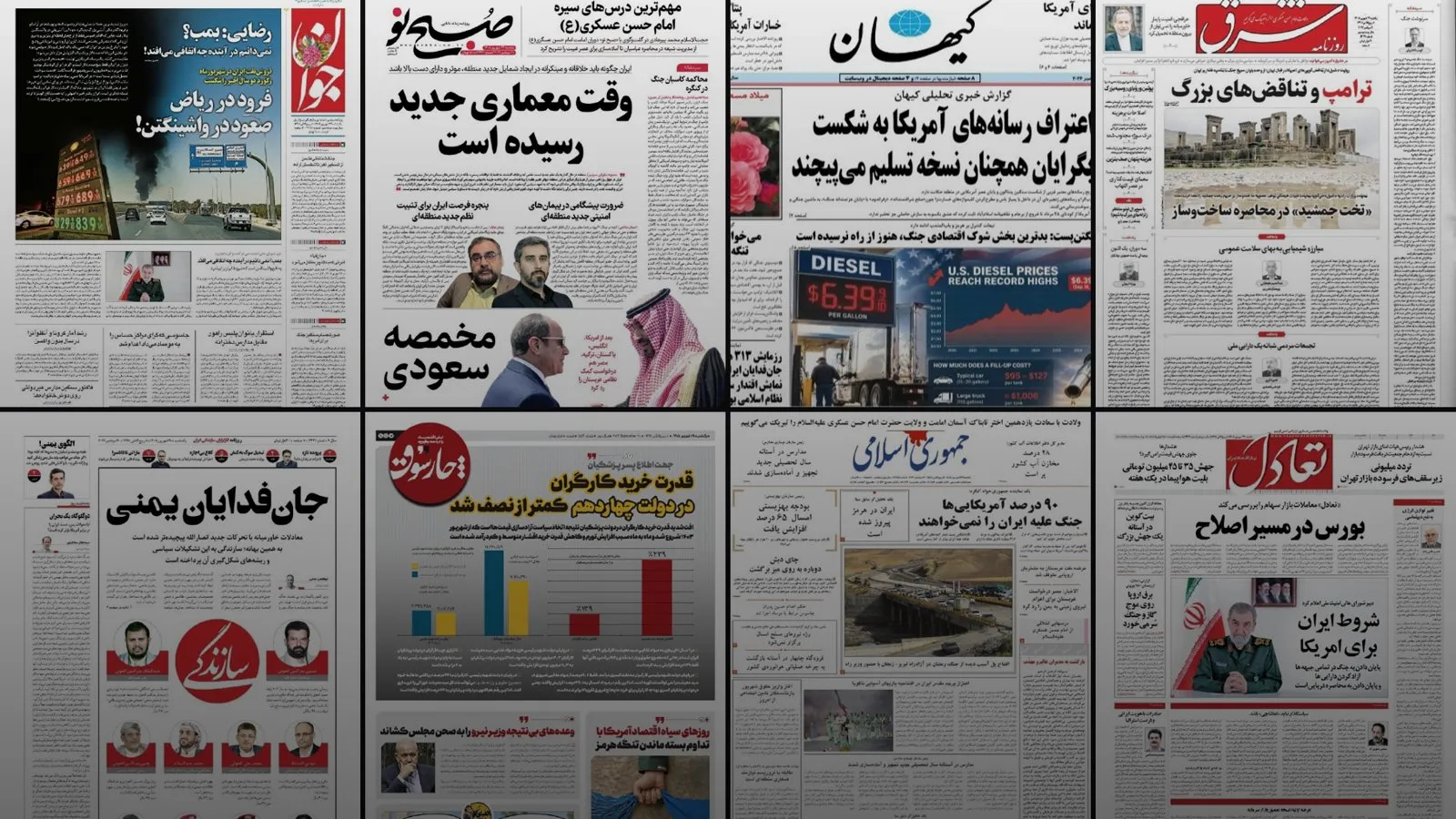
Bottom line: Iran put a price on ending the war this morning, on the front pages of a reformist daily and an economic one, and the same official who set the price refused in the same interview to say what Iran will do about a bomb: the Iranian press printed the terms and the ambiguity on different covers, which is how a policy looks when both halves are deliberate.
Executive Summary
The lead judgment of this edition is that the negotiation argument has acquired a sponsor. Twenty-four hours ago this monitor recorded, as its weakest-signal finding, that the case for ending the war by negotiation existed in the Iranian press and could not buy front-page space: a former diplomat on Etemad’s channel, a reformist party paper making the case obliquely through a legal mechanism, and no front page in the batch printing a direct argument for an exit. This morning Etemad leads its second column «دبیر شورای عالی امنیت ملی اعلام کرد: شروط مذاکره با امریکا», the Secretary of the Supreme National Security Council announced the conditions for negotiation with America; Ta’adol prints the same story with the conditions themselves in the deck, «پایان دادن به جنگ در تمامی جبههها، آزاد کردن داراییها و پایان دادن به محاصره دریایی»; and Javan carries the same interview across the top of its page. The space was not won by the reformist press. It was conferred by Mohsen Rezaei, in post as Secretary of the Supreme National Security Council since 9 August, whose authority no Iranian title can decline to print.
What the front pages did not print is the count. The Iranian channels, including the hardline flagship’s own, report seven conditions conveyed to the American government: «۷ شرط ایران برای آغاز هر مذاکرهای به دولت آمریکا اعلام شده است». Every front page in the batch prints three. External reporting of the interview confirms three disclosed publicly and the remainder withheld, conveyed through Qatari mediation after the memorandum of understanding lapsed last month. A negotiating position published at less than half its length is a position designed to be tested privately while being advertised publicly, and the four unpublished terms are the part of this file that no open-source reading can reach.
The second half of the same interview went to a different camp. Rezaei affirmed the fatwa prohibiting nuclear weapons and said the doctrine is unchanged, and then added that Iran does not know what will happen in the future; he said no decision to leave the Non-Proliferation Treaty has been taken and that American conduct may force one; and he said Iran is ready for a decisive war. Javan, the IRGC-affiliated daily, printed the second sentence and not the first, as the kicker across the top of its front page: «رضایی: بمب؟ نمیدانیم در آینده چه اتفاقی میافتد!». The reformist and economic titles printed the terms; the IRGC title printed the ambiguity. One interview, two front-page arguments, allocated cleanly along factional lines, which indicates a message designed to be disaggregated rather than an editorial disagreement about what was said.
Beneath both, the chokepoint file moved in a direction the front pages did not report. The Foreign Ministry spokesman is quoted on Sobh-e No’s own channel saying Iran and Oman have reached an understanding on determining safe passage routes through the Strait of Hormuz. That is the first mechanism in this series capable of ending the closure without anyone conceding anything, it is consistent with an Iran-Oman corridor process running externally since late August, and it appears on no front page in the batch, on the morning those front pages print an end to the naval blockade as a demand upon Washington. Meanwhile the bypass this monitor has been tracking since 17 September is being closed at its far end rather than argued about: Yemeni forces claim strikes on Aramco facilities at Yanbu, the terminus of the East-West pipeline; Fars News reports five Saudi cargo transits of the Red Sea in seven days against a weekly average roughly three times that, with flows down to about 3.4 million barrels a day from about 4.4 million; and Jomhouri Eslami reports Saudi supply to European customers halted.
The domestic page is where the edition’s cost sits. Charsoogh leads on Iranian workers’ purchasing power falling to less than half under the current government and places directly beneath it «روزهای سیاه اقتصاد آمریکا با تداوم بسته ماندن تنگه هرمز», black days for the American economy with the continued closure of the Strait of Hormuz, illustrated by a fist in Iranian military sleeve pinning the sea to a rock. Ta’adol reports air fares up by 35 to 45 million tomans in a week. Shargh’s rail carries the only reference in the batch to petrol queues inside Iran. And Charsoogh’s front-page cartoon ridicules the Foreign Minister by name over the cost of living, on the morning his ministry’s security counterpart set out Iran’s price for peace. Front-page mockery of a serving negotiator, from the commercial press rather than from a faction, is a register this series has not previously recorded.
Net assessment: this is the most legible edition of the last fortnight, because for once the Iranian press is arguing about something other than its own mobilisation. The number that stood on every cover yesterday, 313,000, appears on one page today and as a deputy’s quotation rather than as news; Sazandegi has transferred the word جانفدا itself to the Yemenis. The consecration campaign has not stopped, it has changed object: Kayhan’s right rail launches a national campaign called «برای پدر، به عشق پسر», for the father, out of love for the son, dated by the paper to the birth anniversary of the Imam who in Shia tradition is the father of the Hidden Imam, in the sixth consecutive cycle in which the serving Leader publishes nothing at all. Terms in public, four terms withheld, a nuclear question left open, a de-escalation corridor kept off the page, and the succession advanced by liturgy rather than by speech: what is on offer this morning is not a turn toward settlement but a fully assembled bargaining posture, and the assembly is what is new.
Key Points
- KJ-1 [HIGH] Iran published a price for ending the war, and the Iranian press printed less than half of it. Etemad’s second column leads «دبیر شورای عالی امنیت ملی اعلام کرد: شروط مذاکره با امریکا»; Ta’adol prints the conditions in full in its deck, «پایان دادن به جنگ در تمامی جبههها، آزاد کردن داراییها و پایان دادن به محاصره دریایی است»; Javan runs the same interview across its top. All three print three conditions. The Kayhan channel (84438) reports seven: «۷ شرط ایران برای آغاز هر مذاکرهای به دولت آمریکا اعلام شده است», and the Jam-e Jam channel (28279) has Rezaei saying «پیام تهران روشن و بدون ابهام است», Tehran’s message is clear and unambiguous. External reporting of the Al Jazeera interview confirms three disclosed, the rest withheld, and conveyed through Qatari mediation after the memorandum of understanding lapsed last month. One cycle ago this monitor’s weakest finding was that no Iranian front page would print a direct argument for negotiating an exit; the finding is now void, and it was voided by rank rather than by persuasion. The significance is that Iran is running a public and a private track at once and has told its own readers which is which by publishing the count nowhere near the terms: the four withheld conditions are the file, and they are not open-source readable.
- KJ-2 [HIGH] The official who published the terms declined in the same interview to foreclose the bomb, and the press divided the two halves between its camps. Rezaei affirmed the fatwa prohibiting nuclear weapons and said the doctrine is unchanged, then said Iran does not know what will happen in the future; said no NPT withdrawal has been decided and that American conduct may compel one; and said Iran is prepared for a decisive war, with responses encompassing American bases, commercial interests and companies operating in the region. Javan printed the uncertainty, not the affirmation, as the kicker across the top of page one: «رضایی: بمب؟ نمیدانیم در آینده چه اتفاقی میافتد!». Etemad and Ta’adol printed the terms and omitted the nuclear passage entirely. The benign reading is that each title selected the part its readers care about. That reading is weakened by the cleanness of the split: nine front pages, no overlap, no title carrying both halves. The significance is that the ambiguity is not a slip being managed but a second instrument being deployed, and the surface on which it was deployed is the one affiliated with the force that would have to execute it.
- KJ-3 [HIGH] Negative evidence: the first mechanism capable of ending the Hormuz closure without a concession exists, is Iranian-sourced, and reached no front page. Sobh-e No’s channel (116056) carries the Foreign Ministry spokesman stating that Iran and Oman have reached an understanding on determining safe passage routes through the Strait of Hormuz. External reporting places an Iran-Oman corridor process in train since late August, with the arrangement intended to be recorded with the International Maritime Organization. Not one of the nine Persian front pages carries it, including Sobh-e No’s own, which instead prints Saudi Arabia’s isolation and an unsourced warning that bigger attacks are coming. On the same morning, three front pages print an end to the naval blockade as a condition Washington must meet, and Defa Press (67923) has the IRGC deputy commander declaring the strait still under Iranian armed-forces control. The significance is that the closure is being sold to Iranian readers as a lever held at precisely the moment its managed unwinding is being arranged with a neighbour, and the gap between the channel and the page is where the actual policy is visible.
- KJ-4 [HIGH] The Hormuz bypass is now being attacked at its outlet, which overtakes the falsification test this monitor set two cycles ago. On 17 and 19 September this file tracked the Saudi East-West pipeline to Yanbu as the physical premise the coercion argument depends on, with Aramco restoration targeted for roughly late October, and named that timetable as the cleanest available falsification test. Today the Kayhan channel (84437) and the Sobh-e No channel (116061) both carry the Yemeni armed forces claiming two operations against sensitive targets in Riyadh and against Aramco facilities at Yanbu, with widespread fires. Fars News (463134) reports five Saudi cargo transits of the Red Sea in seven days, under a third of the weekly average, with flows down to about 3.4 million barrels a day from about 4.4 million. Jomhouri Eslami’s rail reports Saudi supply to European customers halted. The strike claims are armed-group claims and are not confirmed; the transit figures are an IRGC-linked wire’s and are not audited. The significance holds even discounting both: the route out of Hormuz runs to a Red Sea coast now inside the range of the war, so the restoration timetable has stopped being the decisive variable and Bab al-Mandab has replaced it.
- KJ-5 [MODERATE-HIGH] The succession has moved from a placard in a crowd to a national campaign in the Leader’s own daily, in the sixth consecutive cycle of his silence. Kayhan’s right-rail lead reads «همزمان با ایام ولادت امام حسن عسکری(ع): پویش ملی «برای پدر، به عشق پسر» آغاز شد», coinciding with the birth anniversary of Imam Hasan al-Askari, the national campaign ‘For the father, out of love for the son’ has begun. The dating is the paper’s own, and the fit is exact: Hasan al-Askari is, in Shia tradition, the father of the Hidden Imam, so a campaign organised around a father-to-son transmission is launched on the feast of the canonical father-to-son transmission, in the daily whose managing editor is appointed by the Leader’s office. One cycle ago the successor appeared as «لبیک یا سید مجتبی» on a rally placard in a photograph and as a name invoked in a reformist editorial. Today he is the object of a named national campaign. Across all eleven surfaces read this cycle there is still no message, speech, decree or directly quoted remark from Seyyed Mojtaba Khamenei, and the office’s own publication record could not be reached, which is why confidence is held here rather than raised. The significance is that the office is not ending the silence, it is furnishing it: authority is being transferred by liturgy and campaign rather than by the successor’s voice.
- KJ-6 [MODERATE-HIGH] Saudi Arabia’s isolation is being constructed on the page, and the construction is falsified inside the same batch. Sobh-e No’s second lead, «مخمصه سعودی», the Saudi predicament, carries the standfirst «بعد از امریکا، انگلیس، پاکستان، ترکیه، مصر هم درخواست کمک نظامی عربستان را رد کرد», a five-country refusal list, over a photograph of the Saudi Crown Prince greeting the Egyptian President. The Jam-e Jam channel (28276), the state broadcaster’s own, reports the same morning that the Turkish Foreign Minister is willing to examine Saudi Arabia’s military requirements within a trilateral framework including Pakistan. Kayhan’s masthead ear threatens Turkey separately, «خوشرقصی ترکیه برای آمریکا نباید بیپاسخ بماند». Only the Egyptian element carries a source anywhere in the batch, Jomhouri Eslami’s attribution to Al-Akhbar, and that is consistent with external reporting that Cairo advised Riyadh to open talks with Ansarullah during the Crown Prince’s visit; no Saudi, Pakistani, British or Turkish source appears on any page. The significance is that a list is a stronger claim than an anecdote and this one is assembled from four unsourced elements and one Lebanese-sourced element, with a contradiction available on an Iranian state channel: it is placement, not reporting, and Turkey’s real position is the item to watch.
- KJ-7 [MODERATE-HIGH] The economic press has stopped refusing the closure as a win and started pricing it as a chip. For three cycles the titles closest to the price data declined to book the Strait’s closure as an Iranian gain. Ta’adol today prints all three disclosed conditions in its headline deck, more completely than any political title, and runs a signed front-page column, «تغییر توازن انرژی به نفع دیپلماسی», the shift in the energy balance in favour of diplomacy, arguing that the change has moved the contest off the military field and onto the arteries of the world economy. Charsoogh runs both halves on one page: purchasing power halved under the current government in the banner, «روزهای سیاه اقتصاد آمریکا با تداوم بسته ماندن تنگه هرمز» directly beneath it. The significance is that the only part of the Iranian press consistently willing to treat the leverage as expendable rather than admirable is the part that publishes the domestic price series, and it is now making the trade argument explicitly, on the same page as the terms.
- KJ-8 [MODERATE] The audited American figures survived a second cycle intact, and the test set one cycle ago resolved in favour of the audit. On 19 September this monitor recorded a hardline title carrying the Pentagon’s audited $43.6 billion on its own channel and printing a $50 billion ‘black hole’ on its front page, and named which number the front pages carry next as a direct reading on editorial confidence. Today Jomhouri Eslami prints «اعتراف پنتاگون: ۴۳.۶ میلیارد دلار», the audited figure, on page one. Kayhan prints the American diesel record with the source named, the figure in English and the date on the page: a Washington Post lead with $6.39 per gallon, dated 18 September 2026, against an independently reported record in the $6.31 to $6.43 range that week. The significance is that the Iranian press is now more accurate about American costs than about Iranian ones, which is the expected asymmetry when the hostile number is the flattering number, and it means the drift recorded on 17 and 19 September was an editorial choice on one masthead rather than a systemic sourcing failure.
- KJ-9 [MODERATE] An Iranian front page ridiculed the serving Foreign Minister by name on the morning his government published its terms for peace. Charsoogh’s front-page cartoon has a reporter ask «آقای عراقچی، آیا شما هم به پویش پسر رئیسجمهور برای نصف کردن هزینه زندگی میپیوندید؟», will you also join the president’s son’s campaign to halve the cost of living, and has Araghchi reply that his wife’s exhibitions will be halved instead. The same page leads «جهت اطلاع پسر پزشکیان: قدرت خرید کارگران در دولت چهاردهم کمتر از نصف شد». The campaign itself could not be corroborated outside the Iranian press and is reported here only as two Iranian front pages describe it. The significance is the register rather than the target: this series has recorded factional attacks on negotiators before, but not commercial-press ridicule of the sitting Foreign Minister on a front page, and it arrives on the day the security council put his file back in play. Domestic economic anger is now cheap enough to spend on the negotiating team in public.
- KJ-10 [MODERATE] Negative evidence: the mobilisation figure that stood on every cover yesterday is gone from all of them today, and its vocabulary has been given to a foreign armed movement. On 19 September every surface in the batch printed 313,000 and the Leader’s office daily supplied its derivation from the 313 companions of the Imam of the Age. This monitor set the publication of any actual turnout count as the test of whether the number was ever meant to be measured. No count appeared, and neither did the number: no Persian front page in today’s batch leads on it, and Kayhan carries it once, low on the page, as a Tehran deputy’s quotation that Friday’s exercise displayed the system’s hard and soft اقتدار. Sazandegi meanwhile gives its entire cover to «جانفدایان یمنی», applying the state’s own martyrdom term to Ansarullah. Only Iran Daily still carries the drill prominently, and that edition is a cycle old. The significance is that the question was answered by disappearance rather than by measurement, which confirms the consecration reading: a figure that is never counted also never has to be defended, and the word it minted goes on doing work after the number stops.
Macro Trends
- The negotiation argument acquired an owner, and the owner is the security establishment. One cycle ago the case for an exit sat on a reformist channel in the mouth of a former diplomat and could not reach a front page. Today it leads Etemad’s second column, fills Ta’adol’s deck in full, and runs across the top of Javan. Nothing about the reformist argument changed; what changed is that the Supreme National Security Council said it, and the terms now carry an authority no Iranian title can decline to print. The lesson for this file is that front-page space in the Iranian press is not won by persuasion but conferred by rank, and the diplomacy thread should henceforth be tracked by who is speaking rather than by which camp is printing.
- One interview, split down the middle, along the exact factional line. Rezaei affirmed the fatwa and left the future open; said no NPT decision is taken and that American conduct may force one; said Iran is ready for a decisive war. The reformist and economic titles printed the terms and omitted the ambiguity. The IRGC-affiliated title printed the ambiguity as its kicker and put the terms inside. A single source, two incompatible front-page arguments, no contradiction of fact between them: this is message discipline operating through selection rather than through wording, and it is cheaper and harder to detect than the identical-figure convergence this monitor recorded a cycle ago.
- The Hormuz bypass is being closed at the other end. Since 17 September this file has tracked the Saudi East-West pipeline to Yanbu as the physical premise on which the closure’s coercive value depends, with Aramco restoration targeted for roughly late October. That timetable has been overtaken. Yemeni forces claim strikes on Aramco facilities at Yanbu; the IRGC-linked wire reports Saudi Red Sea transits at five in seven days against a weekly average roughly three times that and flows down to about 3.4 million barrels a day; Jomhouri Eslami reports Saudi supply to European customers halted. The bypass argument no longer needs to be won on the page, because the outlet is being attacked directly.
- A de-escalation mechanism exists and is being kept off the front pages. The Foreign Ministry spokesman is quoted on a principlist daily’s channel saying Iran and Oman have reached an understanding on safe passage routes through the Strait of Hormuz. External reporting places a corridor process in train since late August. Not one of the nine Persian front pages carries it, on the morning three of them print an end to the naval blockade as something Washington must concede. The closure is being presented to Iranian readers as a lever held, at the moment its managed unwinding is being negotiated with a neighbour.
- Riyadh’s isolation is being assembled rather than reported. Sobh-e No’s cover states that after America, Britain, Pakistan and Turkey, Egypt has now refused Saudi Arabia’s request for military help. The state broadcaster’s own channel, the same morning, reports the Turkish Foreign Minister willing to examine Saudi requirements within a trilateral framework including Pakistan; Kayhan’s masthead ear threatens Turkey for pandering to America. Only the Egyptian element carries a source anywhere in the batch, and the source is Lebanese. Three cycles ago Riyadh appeared in three mutually exclusive postures with no Saudi source; the postures have now consolidated into one, and the sourcing has not improved.
- The economic press moved from refusing the win to pricing the leverage. For three cycles the titles closest to the price data declined to book the closure as an Iranian gain. Ta’adol now goes further in the other direction: it prints all three disclosed conditions in its headline deck and runs a signed column, «تغییر توازن انرژی به نفع دیپلماسی», arguing the energy shift favours diplomacy. Charsoogh keeps both halves on one page, purchasing power halved in the banner and American black days beneath it. The economic press is the only part of this press that is treating the leverage as something to be spent rather than admired.
- The mobilisation number vanished and its vocabulary was re-assigned. Yesterday every surface in the batch printed 313,000, with the Leader’s office daily supplying its derivation from Shia eschatology. Today no Persian front page leads on it; Kayhan carries it once, low on the page, as a Tehran deputy’s quotation. Sazandegi has taken the state’s own word, جانفدا, life-sacrificer, and applied it on its front page to Ansarullah. A consecrated number does not fall when attendance does, and it does not need to: it simply stops being printed, while the vocabulary it created goes on working elsewhere.
Front-Page Snapshot
- Etemad - “The Secretary of the Supreme National Security Council announced: the conditions for negotiation with America” (Reformist daily of record) - The negotiation terms printed as news, under a lead arguing the crisis is to be converted rather than continued [MODERATE]
- Ta’adol - “Iran’s conditions for America: ending the war on all fronts, releasing the assets, ending the naval blockade” (Economic daily) - The three disclosed conditions in full, beside a signed column arguing the energy shift favours diplomacy [MODERATE]
- Javan - “Coming down in Riyadh, going up in Washington!” (Hardline principlist, IRGC-affiliated) - The same interview reduced to its nuclear ambiguity: «بمب؟ نمیدانیم در آینده چه اتفاقی میافتد!» [HIGH]
- Sobh-e No - “The time for a new architecture has arrived” (Principlist) - Saudi Arabia isolated by a five-country refusal list, while the paper’s own channel carries the Hormuz safe-passage understanding [MODERATE-HIGH]
- Sazandegi - “The Yemeni life-sacrificers” (Reformist, Kargozaran party) - Ansarullah profiled as the movement that changed the equation, with Iran’s hand cast as freed rather than committed [MODERATE]
- Jomhouri Eslami - “A Republican member of Congress: 90 percent of Americans do not want war against Iran” (Traditional clerical establishment, editorially independent) - Four borrowed American authorities, two anonymous; the audited $43.6 billion carried straight [LOW-MODERATE]
- Kayhan - “American media admit defeat; the Westernizers still prescribe surrender” (Hardline, managing editor appointed by the Leader’s office) - «برای پدر، به عشق پسر»: the succession launched as a national campaign, beside a threat to Turkey [HIGH]
- Shargh - “Trump and the great contradictions” (Reformist) - The counterparty framed as incoherent, the terms absent, and the domestic petrol queue in the rail [LOW]
- Charsoogh - “Workers’ purchasing power has fallen to less than half under the fourteenth government” (Economic daily) - Domestic hardship above the closure’s damage to America, with the Foreign Minister ridiculed by name [LOW-MODERATE]
- Iran Daily (19 September edition) - “US cannot escape responsibility for war crimes by leaving UN rights council: Deputy FM” (Government English-language daily (IRNA), one cycle old) - ‘Ansarullah advances pave way for talks’: the English surface selling the Yemen front as a road to negotiations [LOW]
- Channels and agency wires - “Iran’s seven conditions for the start of any negotiation have been conveyed to the American government” (Six daily channels and three agency wires) - Seven conditions on the wires against three on the pages, and an Iran-Oman Hormuz understanding on no page at all [HIGH]
Monitoring notes
- The four conditions nobody has published. The Iranian channels report seven conditions conveyed to Washington; every front page prints three. Whether any Iranian surface ever publishes the remaining four, and whether the published three change wording between cycles, is the cleanest read available on whether this is a negotiating position or a declaratory one.
- Whether the Iran-Oman safe-passage understanding reaches a front page. It is on the Foreign Ministry’s record via one principlist channel and on no cover. The day a Persian front page prints a Hormuz corridor is the day the closure stops being sold as a lever, and it will be visible before any change in shipping data.
- Whether any title carries both halves of the Rezaei interview. Nine covers, no overlap: the terms on the reformist and economic pages, the nuclear ambiguity on the IRGC-affiliated one. A single front page printing the fatwa affirmation and the conditions together would mean the split was editorial rather than directed.
- Turkey. A principlist cover lists Ankara among the refusers, the state broadcaster’s own channel reports its Foreign Minister willing to examine Saudi requirements within a trilateral framework with Pakistan, and the Leader’s office daily threatens it in the masthead ear. Three Iranian positions, one week; which one acquires a Turkish source is the test.
- Bab al-Mandab has replaced the pipeline timetable. The falsification test set on 19 September was whether any Iranian front page would report the East-West line restored around late October. It has been overtaken: the route’s Red Sea outlet is now itself under attack. Transit volumes through Bab al-Mandab, not pipeline capacity, are the number to watch.
- A seventh cycle of the Leader’s silence, against a campaign in his name. «برای پدر، به عشق پسر» is the successor’s first national campaign, launched in his office’s own daily on the feast of a father-to-son transmission. Whether he speaks, or the campaign continues to speak for him, is the succession thread.
- Whether the mobilisation figure returns. It stood on every cover on 19 September and on one page, as a quotation, today. A number that disappears without ever being counted is a number that was never meant to be.
Full report
The complete edition - per-paper front-page analysis and full translation appendices - is available as a PDF: Download the full report.
Compiled from Iranian front pages and outlet channels via open-source monitoring. Translations are editorial; named-figure attributions are verified against the source pages where possible.