Iranian Press Monitor - Saturday, 19 September 2026 (Day 200)
Saturday, 19 September 2026 · شنبه ۲۸ شهریور ۱۴۰۵ · 7 Rabi’ al-Thani 1448 - Ten front pages of 28 Shahrivar 1405, read alongside nine outlet channels; Tehran Times was not available at the time of compilation.
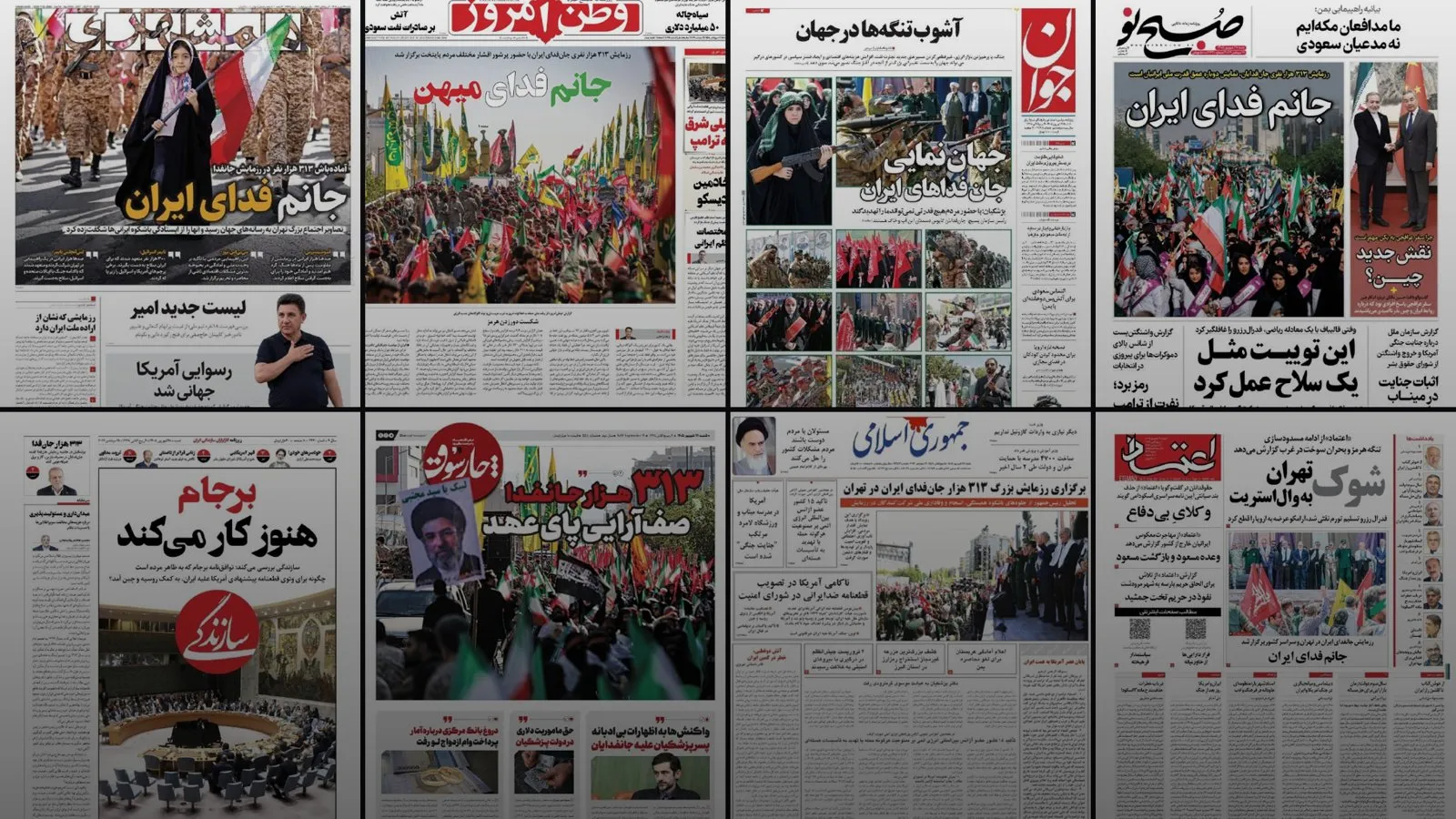
Bottom line: Every front page in Iran this morning printed the same mobilisation figure, 313,000, and the Leader’s own office daily printed the reason it is that figure: one thousand for each of the 313 companions who by tradition gather to the Imam of the Age, which means the number the entire press converged on is not a headcount at all.
Executive Summary
The lead judgment of this edition concerns arithmetic. Friday’s assembly in Tehran, the event this monitor flagged two cycles ago as the one hard forward indicator in the file, took place, and Saturday’s papers are the first to report it. Nine of the ten front pages lead on it. Every one of them prints the same figure: 313,000. Kayhan, the daily whose managing editor is appointed by the Leader’s office, prints the reason, «رزمایش ۳۱۳ هزار جانفدا در تهران به یاد ۳۱۳ یار امام زمان(عج)», the exercise of 313,000 life-sacrificers in Tehran in memory of the 313 companions of the Imam of the Age. In Shia tradition, 313 is the number of those who gather to the Mahdi at his return. A turnout figure that is also a theological constant is not a turnout figure, and the press printed it without variance across the hardline, principlist, reformist and economic titles alike.
That matters because of what it replaced. On 16 September the operative number was 600,000 registrations, sourced to a named IRGC commander. On 17 September it was 31 million, sourced to a campaign spokesman and to no register at all, and this monitor set Friday’s attendance against that claim as the edition’s one measurable test. The test cannot be run. The press did not publish a count on Saturday; it published a symbol, identical to the decimal place across eleven surfaces. Hamshahri prints 313,000 in its banner and, three inches below, an Associated Press paraphrase saying 300,000 pledged to take up arms, and reconciles neither. This is the signature of a centrally-issued figure rather than of eleven newsrooms counting.
The second finding closes a thread this monitor opened two cycles ago and closes it in the least informative direction available. On 17 September the sharpest negative evidence of the cycle was that Saudi Aramco’s restoration of the East-West pipeline, the physical premise of Iran’s chokepoint leverage, had reached Vatan-e Emrooz’s own Telegram channel and no Iranian front page. Today the pipeline finally reaches that paper’s front page, as «شکست دور زدن هرمز», the failure of bypassing Hormuz, a signed column on the consequences of the 10 September attack and the birth of new energy chokepoints. The paper that had the restoration printed its negation. In the masthead ear above it: «آتش بر صادرات نفت سعودی», fire on Saudi oil exports, with Aramco telling two European refineries they will receive no crude next month. Etemad leads the same fact from the other end of the spectrum, «فدرال رزرو تسلیم تورم نفتی شد، آرامکو عرضه به اروپا را قطع کرد».
Against all of this sits the one story in the batch with an external institutional finding behind it, and it is the government’s English-language surface that leads on it. Iran Daily’s cover is «US cannot escape responsibility for war crimes by leaving UN rights council: Deputy FM». The underlying sequence is verified independently: a United Nations fact-finding mission reported reasonable grounds to believe American forces were responsible for two strikes on civilian sites in Iran, the Shajareh Tayyebeh primary school at Minab and a sports complex and adjacent housing at Lamerd, and Washington announced its withdrawal from the Human Rights Council the following day. On the Persian covers that finding is a right-rail item on Sobh-e No and Jomhouri Eslami and a scandal headline on Hamshahri, filed beneath the drill. Hamshahri then extends it to a third incident, the Sirik wedding, that appears on no other surface and in no external report located at compile time, which takes a verified finding and degrades it.
Two smaller things are worth more than their column inches. Javan, the IRGC-affiliated daily that two cycles ago put the cost-benefit of the closed Strait of Hormuz on its own cover as a question, answers the question today: «آشوب تنگهها در جهان», the chaos of the straits in the world, with the disorder relocated from Iran to the belligerents and the energy market. And the serving Leader’s authority enters the cycle twice without his office speaking: once as a rally placard reading «لبیک یا سید مجتبی» in the foreground of Charsoogh’s cover photograph, and once in Sazandegi’s front-page editorial, where the head of the Kargozaran council invokes «آیتالله سید مجتبی» to argue that the hardline camp withholds submission from the system’s decisions as it withheld it from Khomeini’s acceptance of Resolution 598 in 1988.
Net assessment: this is a saturation edition, and saturation is a measurable state. One event, one number, one photograph on nine covers, with the number itself declared by the Leader’s office daily to be liturgical rather than empirical. The files where the Iranian position is strongest, an institutional war-crimes finding and a Security Council result, are printed as rail items and as three incompatible authorships of the same vote. The files where it is weakest, the Saudi pipeline and the domestic recession, are printed either inverted or, in the economic press, straight and unflattering. A press that converges this completely on a designed number while its own economic titles print a purchasing-managers’ index stuck in recession is not reporting a mobilisation; it is performing one, and the office in whose name it is performed has now been silent for five consecutive cycles.
Key Points
- KJ-1 [HIGH] The mobilisation figure the entire Iranian press printed this morning is a religious constant, not a count, and the Leader’s office daily says so on its own front page. Every title in the batch prints 313,000: Hamshahri’s «آمادهباش ۳۱۳ هزار نفر», Vatan-e Emrooz’s «رزمایش ۳۱۳ هزار نفری», Jomhouri Eslami’s «رزمایش بزرگ ۳۱۳ هزار جانفدای ایران», Charsoogh’s «۳۱۳ هزار جانفدا!», Sazandegi’s ear, Ta’adol’s single column. Kayhan’s headline supplies the derivation: «رزمایش ۳۱۳ هزار جانفدا در تهران به یاد ۳۱۳ یار امام زمان(عج)», in memory of the 313 companions of the Imam of the Age, the number who by Shia tradition gather to the Mahdi at his return. Two cycles ago the operative figure was 600,000 registrations attributed to a named IRGC commander; one cycle ago it was 31 million attributed to a campaign spokesman with no register. This monitor set Friday’s attendance against that 31 million as the edition’s one measurable test. The test cannot be run, because what was published is not a measurement. The alternative reading, that 313,000 is a genuine count which the organisers happened to round to a resonant number, is defeated by the absence of variance: eleven surfaces, no range, no method, no second figure except Hamshahri’s own Associated Press paraphrase of 300,000 printed three inches from its banner. The significance is that the campaign has crossed from recruitment into consecration, and consecrated numbers do not fall when attendance does.
- KJ-2 [HIGH] The IRGC-affiliated daily has answered its own chokepoint question, and the answer is to keep the Strait of Hormuz closed. On 17 September Javan gave its cover to «عاقبتاندیشی در تنگهها», thinking about consequences in the straits, under a standfirst asking directly whether the closure and the naval blockade press harder on Iran or on America and the world. This monitor recorded that as the strongest available indicator that the policy was being argued about above the paper, and named Javan’s follow-up as the cheapest read on whether it was being reconsidered. Today Javan runs «آشوب تنگهها در جهان», the chaos of the straits in the world, above its masthead: the war, by disrupting the energy market, rendering new oil-trade routes uncertain, raising economic costs and creating political pressure in the belligerent states, could push the world toward changes greater than were imagined at the war’s start. The subject of the disorder has moved from Iran to the world in two cycles, on the same masthead, in the same position on the page. The significance is that the strongest domestic constituency for the closure has published its conclusion rather than its question, which removes the reading that the policy was being softened from above and makes Javan’s next reversal, if one comes, a harder signal than this one.
- KJ-3 [HIGH] The fact that undercuts the chokepoint argument reached a front page at last, printed as its own opposite. On 17 September this monitor’s sharpest negative finding was that Bloomberg’s report of Saudi Aramco restoring about half the East-West pipeline’s capacity within days, with full capability targeted in roughly six weeks after the 10 September shutdown, had been posted to Vatan-e Emrooz’s Telegram channel and kept off its front page, with no other Iranian title carrying it at all. Today the pipeline is on that paper’s front page: «شکست دور زدن هرمز», the failure of bypassing Hormuz, a signed column describing the 1,200-kilometre line from the eastern fields to Yanbu as built precisely to escape Hormuz, citing Al Jazeera for 4 to 5 million barrels a day or about 5 percent of world supply, and treating the shutdown as proof that the escape route does not work. Directly above it the masthead ear reports Aramco telling two European refineries they will receive no crude next month; Etemad leads the same supply cut from the opposite camp. The paper therefore had both facts and printed the one that survives contact with its argument. The significance is that the coercion case is now being run on a premise its own carrier has verifiably seen contradicted, and the falsifiable date is the restoration timetable: full capability around late October. Whether any Iranian front page reports it is the test.
- KJ-4 [HIGH] The one story in the batch resting on an external institutional finding is led by the government’s English-language surface and buried on nine Persian covers. Iran Daily’s cover is «US cannot escape responsibility for war crimes by leaving UN rights council: Deputy FM». Independently verified: a United Nations fact-finding mission reported reasonable grounds to believe American forces were responsible for two strikes on civilian sites in Iran, a Tomahawk strike on the Shajareh Tayyebeh primary school at Minab that killed more than 160 people including around 120 children, and a strike on a sports complex and adjacent housing at Lamerd that dispersed tungsten pellets and killed 22 civilians; the United States announced its withdrawal from the Human Rights Council the following day, on 18 September. On the Persian pages it is a right-rail item on Sobh-e No, a right-rail item on Jomhouri Eslami which keeps «جنایت جنگی» inside its own quotation marks, and a headline on Hamshahri, «رسوایی آمریکا جهانی شد», that adds a third incident, the Sirik wedding, carried by no other surface and by no external report located at compile time. The significance is twofold and cuts against Tehran both ways: the file on which Iran holds a finding rather than a claim was subordinated to a domestic mobilisation on nine of ten Persian covers, and the one Persian paper that gave it a headline degraded its evidentiary value by extending it. A press that treats its best-sourced story as filler is telling you what it is actually optimising for.
- KJ-5 [MODERATE-HIGH] One uncontested Security Council vote produced four Iranian authorships, and the spread is a map of what each camp wants Iran to do next. The event is not in dispute: on 17 September the American draft to extend the mandate of the 1737 Committee’s panel of experts drew eleven votes in favour, Russia and China voted against, Somalia and Pakistan abstained, and the double veto defeated it. Vatan-e Emrooz prints «سیلی شرق به ترامپ», the East’s slap to Trump, which makes it a blow struck in a contest of wills. The government daily Iran prints «ضربه پکن و مسکو به قطعنامه آمریکا علیه ایران», which credits Beijing and Moscow and assigns Iran no agency whatever. Sazandegi leads its whole cover «برجام هنوز کار میکند», the nuclear agreement still works, asking how a deal that is apparently dead came to Russia and China’s aid. Jomhouri Eslami reports it by its actual subject, «ناکامی آمریکا در تصویب قطعنامه ضدایرانی», naming the panel of experts. Four readings, four implied policies: leverage, patronage, diplomacy, and institutional process. The significance is that the government’s own daily chose the version that makes the fewest demands on Iranian policy, which is what a surface prints when the win is not its own to spend.
- KJ-6 [MODERATE] The serving Leader’s authority was invoked twice this cycle by institutions that are not his office, in a fifth consecutive cycle without a word from him. No message, speech, decree or directly quoted remark attributed to Seyyed Mojtaba Khamenei appears on any of the ten front pages or in any of the nine channels; Kayhan’s «دو نور هدایت» carries archival remarks of the martyred predecessor, not of the successor. Against that silence: Charsoogh’s cover photograph is composed around a rally placard reading «لبیک یا سید مجتبی», labbayk ya Seyyed Mojtaba, the formula of answered allegiance addressed to him by name, which is the first appearance in this series of the successor as the object of the mobilisation’s allegiance imagery, on an assembly the Muhammad Rasulullah Corps advertised as recently as 17 September «به نیابت از آقای شهید ایران», on behalf of the martyred Aqa. And Sazandegi’s front-page editorial by Mohsen Hashemi Rafsanjani, head of the Kargozaran council, invokes «آیتالله سید مجتبی» to argue that the hardline camp withholds submission from the system’s decisions as it withheld it from Khomeini’s acceptance of Resolution 598 in 1988. Confidence is held at moderate because one placard in one photograph is a thin base and english.khamenei.ir could not be checked, so the absence rests on eleven Iranian surfaces rather than on the office’s publication record. The significance is that a reformist party paper and a Basij rally reached for the same successor’s authority in one morning while the successor himself said nothing, which is the shape of an authority being spent on someone’s behalf rather than exercised.
- KJ-7 [MODERATE-HIGH] Saudi Arabia appears in three mutually exclusive postures in a single cycle, and none of the three carries a Saudi source. Javan’s rail: «التماس سعودی برای آتشبس دوهفتهای با یمن!», the Saudi entreaty for a two-week ceasefire, exclamation mark printed. Jomhouri Eslami’s row: «اعلام آمادگی عربستان برای لغو محاصره یمن», Riyadh declaring readiness to lift the Yemen blockade. Vatan-e Emrooz: Riyadh accusing Ansarullah of an attack on Mecca and Medina, answered by deforming خادم الحرمین into «خادمین دیسکو», servants of the disco, and by Sobh-e No’s banner carrying the Yemeni march statement «ما مدافعان مکهایم نه مدعیان سعودی», we are the defenders of Mecca, not the Saudi claimants. Underneath, Fars News reports Saudi civil-defence alerts in Riyadh and Al-Kharj and Etemad’s channel carries video of an explosion heard in Riyadh, while Defa Press claims Ansarullah seized heights overlooking Bab al-Mandab. Supplication, concession and sacrilege cannot all be true of the same government in the same week; what they have in common is that each is the version most useful to the title printing it. The significance is that the Yemen-Saudi file is where Iranian coverage is escalating and sourcing is collapsing at the same time, and it is the file Beijing explicitly asked Tehran to contain three days ago.
- KJ-8 [MODERATE-HIGH] Iran’s own economic press printed the closure’s consequences with Iran as the exposed party, on the morning the political press printed them as a victory. Etemad leads «شوک تهران به والاستریت», Tehran’s shock to Wall Street, with the Federal Reserve surrendering to oil inflation and Aramco cutting European supply, and it names the continuing closure of the Strait of Hormuz as the cause. Ta’adol carries the same Federal Reserve turn as «تورم انرژی و چرخش انقباضی فدرال رزرو», filed as Washington’s monetary earthquake striking emerging markets, global debt and gold, with Iran among those struck, and leads its page on a purchasing-managers’ index that stayed in recession under «تولید جان گرفت، اما مشتری نیست», production revived but there is no customer. Charsoogh spends its front page on a Central Bank figure it says is false and on dollar-denominated travel allowances in the president’s government. One event, two subjects: the political press makes Iran the cause and the economic press makes Iran the recipient. The significance is that the titles closest to the price data are the ones declining to book the closure as a gain, and they are doing it on the same day the rest of the press books it twice.
- KJ-9 [MODERATE] An audited American cost figure reached Iranian surfaces intact for the first time in several cycles, and one masthead inflated it anyway between its channel and its front page. The Pentagon’s estimate to congressional oversight panels, current as of 3 September 2026, is $43.6 billion, comprising $11.2 billion obligated for operations and $32.4 billion in unfunded replacement costs, and excluding damage to American facilities in eight regional countries. Jam-e Jam’s channel (post 28170), Nour News (395556) and Vatan-e Emrooz’s own channel (25510) all carry that number correctly. Vatan-e Emrooz’s front page carries «سیاهچاله ۵۰ میلیارد دلاری», the $50 billion black hole, on astonishing figures for the unexpected costs of the war’s first six months. On 17 September this monitor recorded the same drift running from $33.4 billion audited to $38 billion printed. The significance is that the inflation is now measurable inside a single masthead within a single morning, from its own Telegram channel to its own page one, which makes it an editorial decision rather than a sourcing failure, and it is the state broadcaster, not the independent title, that got the number right.
- KJ-10 [MODERATE] Negative evidence: the claim that Beijing asked Tehran to reopen the Strait of Hormuz was neither repeated nor denied on the morning it had its best peg. On 17 September Sazandegi’s day-column by a former diplomat was the only Iranian surface carrying Wang Yi’s remarks as including «ضرورت بازگشایی تنگه هرمز», the necessity of reopening the strait; no other title carried it in any form and the wire record of the meeting does not contain the formulation. Today Sobh-e No devotes its right rail to a photograph of Araghchi with Wang Yi under «چرا سفر عراقچی به پکن مهم است» and «نقش جدید چین؟», why Araghchi’s Beijing trip matters and what China’s new role is, which is the precise occasion on which a reopening request would be either confirmed or rebutted. It is neither. Sazandegi itself, leading its whole cover on the Security Council and crediting the nuclear agreement, does not repeat its own columnist. The significance is that a claim only one surface ever made has now survived two cycles without corroboration or contradiction, which is what a formulation deliberately left to a columnist looks like, and the confidence recorded on 17 September should not be raised.
- KJ-11 [MODERATE] The case for ending the war by negotiation exists in the Iranian press and still cannot buy front-page space. Etemad’s channel (post 534368) carries the former diplomat Kourosh Ahmadi saying it is in Iran’s interest to end the war through negotiation. It is a named figure, on a reformist daily’s own channel, on a day when that daily’s front page leads on the closure’s effect on the Federal Reserve and gives the mobilisation a photograph. Sazandegi’s cover argues that the nuclear agreement still works, which is the diplomacy case made obliquely, through a legal mechanism rather than through a proposal. No front page in the batch prints a direct argument for negotiating an end to the war. The benign reading is that a single analyst’s remark is not front-page news on any day. The significance is comparative: an unsourced Saudi entreaty, a tweet credited with surprising the Federal Reserve and a mobilisation number derived from Shia eschatology all reached page one this morning, and the only named Iranian advocating an exit did not.
Macro Trends
- The mobilisation number stopped growing and started signifying. 600,000 registrations sourced to a named commander on 16 September; 31 million sourced to a spokesman and no register on 17 September; 313,000 on every surface on 19 September, with Kayhan stating on its own front page that the figure is chosen in memory of the 313 companions of the Imam of the Age. The sequence is not inflation followed by correction. It is a campaign moving from recruitment to consecration, and the last step is the one where the number becomes unfalsifiable by design. The only internal variance in the batch is Hamshahri’s own page, which carries 313,000 and 300,000 three inches apart.
- The chokepoint argument closed its own question. Javan opened the cost-benefit of the closed Strait of Hormuz as a page-one question on 17 September, «عاقبتاندیشی در تنگهها». Today the same paper runs «آشوب تنگهها در جهان» above its masthead, with the war’s disruption of the energy market and of new oil-trade routes pushing the world toward changes greater than were imagined at the war’s start. The cost has been relocated from Iran to the belligerents, which is the interrogative resolved in favour of maintaining the closure. Etemad, from the opposite camp, states the same causal claim in the vocabulary of price: «شوک تهران به والاستریت».
- The restoration story reached page one only as its negation. Aramco’s work to restore about half the East-West pipeline’s capacity within days of the 10 September shutdown, with full capability targeted in roughly six weeks, sat on Vatan-e Emrooz’s channel and on no Iranian cover two cycles ago. Today that paper’s lower lead is «شکست دور زدن هرمز», the failure of bypassing Hormuz, and its masthead ear is Aramco cutting two European refineries off next month. The premise the coercion argument depends on is being removed and reported as intact, by the same masthead, in the same week.
- One Security Council vote, four authorships. Vatan-e Emrooz makes it «سیلی شرق به ترامپ», the East’s slap. The government daily Iran makes it «ضربه پکن و مسکو», Beijing and Moscow’s blow, which assigns Iran no agency at all. Sazandegi makes it «برجام هنوز کار میکند», the apparently dead nuclear agreement coming to Russia and China’s aid. Jomhouri Eslami reports it by its actual subject, the mandate of the United Nations panel of experts. Each authorship is a claim about what Iran should do next, and the spread maps onto camps rather than onto facts: the vote itself is uncontested.
- The successor’s authority is being claimed by others while his office is silent. Five consecutive cycles with no message, speech or quoted remark from the serving Leader on any surface read. In the same cycle his authority is invoked twice by institutions that are not his office: a rally placard reading «لبیک یا سید مجتبی» in the foreground of Charsoogh’s cover photograph, the first appearance in this series of the successor as the object of the mobilisation’s allegiance formula, and Sazandegi’s front-page editorial invoking «آیتالله سید مجتبی» to discipline the hardline camp. The mobilisation’s own advertising copy named the martyred predecessor as recently as 17 September.
- Riyadh is printed in three incompatible postures, none of them sourced. Javan has Saudi Arabia entreating a two-week ceasefire with Yemen, with an exclamation mark and no Saudi source. Jomhouri Eslami has Riyadh declaring readiness to lift the Yemen blockade. Vatan-e Emrooz has Riyadh accusing Ansarullah of attacking Mecca and Medina and answers it by deforming the Custodian of the Two Holy Mosques into «خادمین دیسکو»; Sobh-e No banners the Yemeni reply, «ما مدافعان مکهایم نه مدعیان سعودی». Beneath the covers, Fars News carries Saudi civil-defence alerts in Riyadh and Al-Kharj and Etemad’s channel carries video of an explosion in Riyadh. The English-language government surface, alone, sells the same file as a path to talks.
- The economic press is still refusing to book the closure as a win. Ta’adol leads on a purchasing-managers’ index stuck in recession under «تولید جان گرفت، اما مشتری نیست», production revived but there is no customer, and files the Federal Reserve’s contractionary turn as Washington’s monetary earthquake striking emerging markets, global debt and gold, with Iran among the exposed. Etemad prints the same central-bank decision as Tehran’s shock to Wall Street. Charsoogh spends its page on a central-bank figure it says is false and on dollar-denominated travel allowances. Three economic surfaces, and none of them treats the war as an Iranian gain.
Front-Page Snapshot
- Kayhan (channel) - “The exercise of 313,000 life-sacrificers in Tehran, in memory of the 313 companions of the Imam of the Age” (Hardline, managing editor appointed by the Leader’s office) - The mobilisation number declared to be a religious constant, not a count [HIGH]
- Javan - “Iran’s life-sacrificers on display to the world” (Hardline principlist, IRGC-affiliated) - The chokepoint question answered: «آشوب تنگهها در جهان», the disorder is the world’s [HIGH]
- Vatan-e Emrooz - “My life a sacrifice for the homeland” (Hardline principlist) - The Hormuz bypass reported as a failure, above Aramco cutting two European refineries [HIGH]
- Hamshahri - “My life a sacrifice for Iran” (Tehran municipality daily, centrist) - The drill validated by four named Western outlets; a UN finding extended to an unsourced third incident [MODERATE-HIGH]
- Sobh-e No - “My life a sacrifice for Iran” (Principlist) - Araghchi in Beijing and «نقش جدید چین؟», beside the Minab and Lamerd findings [MODERATE-HIGH]
- Etemad - “Tehran’s shock to Wall Street” (Reformist daily of record) - The continuing closure priced in Federal Reserve and Aramco decisions [MODERATE-HIGH]
- Jam-e Jam (channel) - “The great “313,000 life-sacrificers” exercise” (Daily of the state broadcaster (IRIB)) - The Pentagon’s audited $43.6 billion carried straight, beside an unconfirmed espionage execution [MODERATE-HIGH]
- Jomhouri Eslami - “The great exercise of Iran’s 313,000 life-sacrificers held in Tehran” (Traditional clerical establishment, editorially independent) - The Security Council item reported by its actual subject; «جنایت جنگی» kept in quotation marks [MODERATE]
- Iran Daily - “US cannot escape responsibility for war crimes by leaving UN rights council: Deputy FM” (Government English-language daily (IRNA)) - The UN finding pressed diplomatically; Yemen framed as a path to talks; no Hormuz position for a sixth cycle [MODERATE]
- Iran (channel) - “Beijing and Moscow’s blow to the American resolution against Iran” (Official government daily) - The veto credited to great-power patronage rather than to Iranian diplomacy [MODERATE]
- Charsoogh - “313,000 life-sacrificers! Forming ranks in keeping with the covenant” (Economic daily) - «لبیک یا سید مجتبی» on a rally placard: the successor enters the mobilisation’s allegiance imagery [MODERATE]
- Sazandegi - “The JCPOA still works” (Reformist (Kargozaran party)) - The Security Council veto credited to the nuclear agreement, over an editorial against the super-revolutionaries [LOW-MODERATE]
- Ta’adol - “The economy’s PMI stayed in recession” (Economic daily) - Production without customers, and the Federal Reserve turn as a shock arriving at Iran [LOW]
Monitoring notes
- Whether any Iranian surface ever publishes a turnout count. The batch converged on 313,000 with no range, no method and no second figure except Hamshahri’s own 300,000 paraphrase. A later count, from any surface, would tell us whether the number was ever meant to be measured. Continued silence confirms it was not.
- The Aramco restoration timetable, roughly late October. Full capability on the East-West pipeline was targeted about six weeks from the 10 September shutdown. Vatan-e Emrooz has now printed the bypass as a failure on page one while carrying the restoration on its own channel. Whether any Iranian front page reports the line coming back is the cleanest falsification test in this file.
- Whether Javan reopens the chokepoint question. The IRGC-affiliated daily moved from an interrogative headline to a declarative one in two cycles. A return to the question form would be a harder signal than the first one was.
- A sixth cycle of the Leader’s silence, against his image in the crowd. No text from the office for five cycles, on the cycle in which a rally placard reading «لبیک یا سید مجتبی» reached a front page and a reformist editorial invoked him by name. Whether the office speaks, or continues to let others speak for it, is the thread.
- Whether the $43.6 billion or the $50 billion survives. Vatan-e Emrooz carried the audited Pentagon figure on its channel and the inflated one on its page. Which number the front pages carry next is a direct reading on editorial confidence.
- Riyadh’s three postures. Entreaty, concession and sacrilege cannot all hold. Which of the three acquires a Saudi source, or disappears, will show which was reporting and which was placement.
Full report
The complete edition - per-paper front-page analysis and full translation appendices - is available as a PDF: Download the full report.
Compiled from Iranian front pages and outlet channels via open-source monitoring. Translations are editorial; named-figure attributions are verified against the source pages where possible.