Iranian Press Monitor - Wednesday, 16 September 2026 (Day 197)
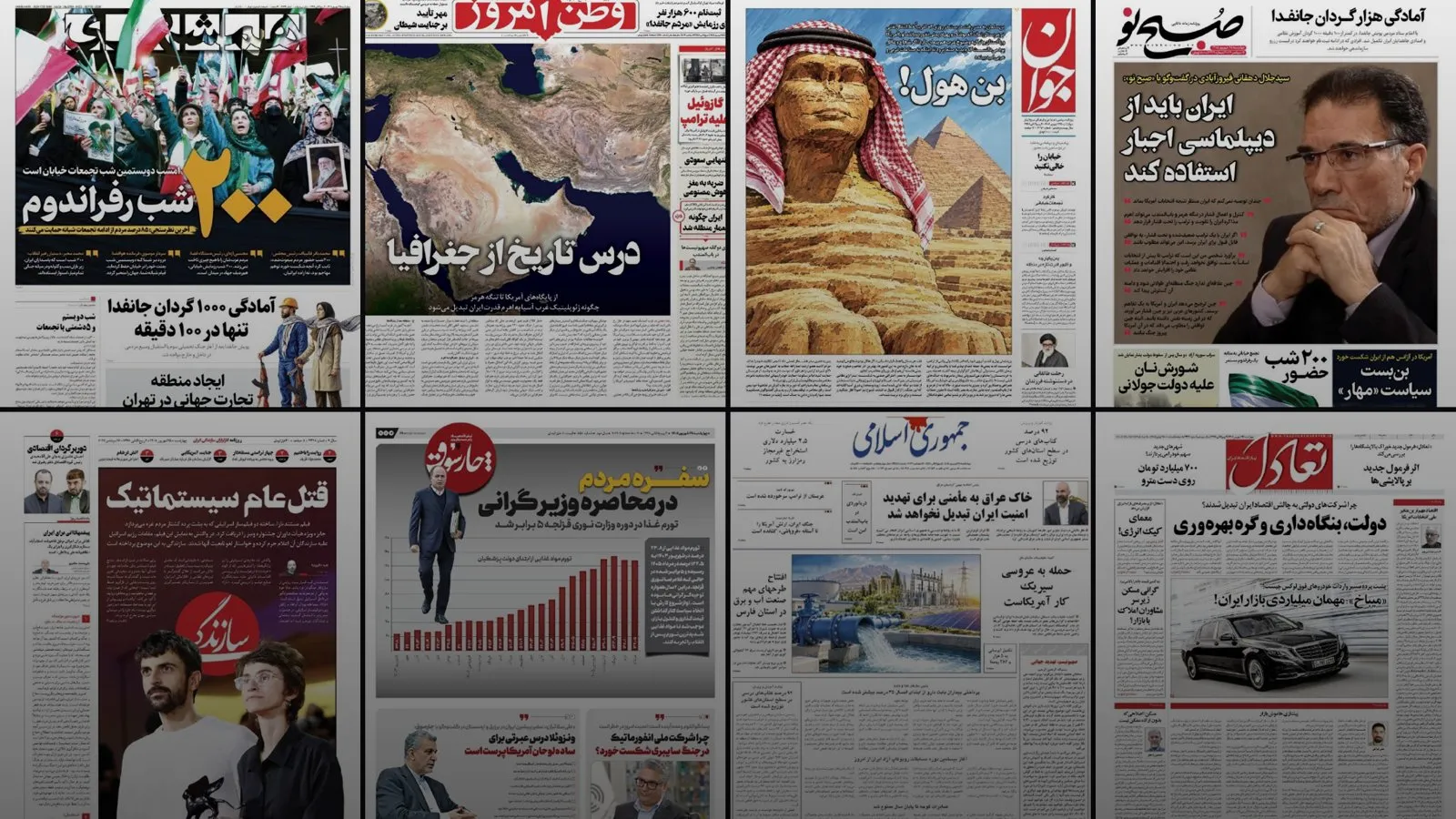
Wednesday, 16 September 2026 · چهارشنبه ۲۵ شهریور ۱۴۰۵ · 4 Rabi’ al-Thani 1448 - Ten front pages of 25 Shahrivar 1405, read alongside nine outlet channels; Tehran Times was not available at the time of compilation.
Bottom line: Every institutional family in the Iranian press led this morning on the same American document, the Pentagon Inspector General’s first audit of the war, and in adopting its authority they inherited counts that their own outlets exceed by a wide margin.
Executive Summary
The lead judgment of this edition is about sourcing rather than about escalation. On 16 September the reformist daily of record, a hardline principlist front page, the state broadcaster’s daily and the government’s English-language paper all led on the same document: the Pentagon Inspector General’s first public review of the war, delivered to Congress on 14 September and covering 28 February to 30 June. That report records damage to hundreds of buildings and structures at American bases across eight countries, about 184 million dollars of damage to US diplomatic facilities, 33.4 billion dollars of spending of which 22.3 billion was expended munitions, strategic inventory shortfalls with industrial-base bottlenecks, and losses including four F-15s destroyed and up to thirty MQ-9 Reapers destroyed. Nothing in this monitor’s window has previously produced that spread of institutional agreement on a single verifiable text. The agreement, however, is on the document and not on its meaning: Etemad reads it as the collapse of the American narrative, Vatan-e Emrooz as an admission extracted from liars, Jam-e Jam as political and materiel exhaustion joined, and Iran Daily relays its findings flat. That is an outlet of opportunity being taken by four newsrooms independently, which looks different from the centrally-guided convergence this monitor identified on 15 September, when six titles attacked one American broadcast in the same terms on the same morning.
Taking the audit’s authority has a cost that the Iranian press has not priced. The same cycle carries a claim, posted within two hours by Fars, Nour News and Defa Press and repeated on Kayhan’s channel, that a fifty-second American MQ-9 was destroyed over Qeshm Island at 02:29. The audit the front pages are citing counts up to thirty destroyed through 30 June. The two figures are not formally contradictory, since the audit’s window closes in June and the Iranian tally runs past it, but a further twenty-two aircraft in eleven weeks is far outside the tempo the audited period implies. The pattern repeats: the government daily’s channel puts the war’s cost to Washington at 38 billion dollars against the report’s 33.4 billion, and Fars asserts that 80 percent of American air-defence reserves are depleted, a figure that appears nowhere in the audited material. An outlet that adopts a document’s authority inherits its arithmetic, and by tomorrow the discrepancy is available to anyone who reads both.
The domestic half of the edition is the two hundredth consecutive night of the nightly gatherings, counted from the assassination of 28 February, and it is being marked as a set-piece rather than reported as an event. Hamshahri gives its whole front page to «۲۰۰ شب رفراندوم», two hundred nights of referendum, with four quotation panels and an unsourced claim that 85 percent of the public supports continuing. Vatan-e Emrooz banners 600,000 registrations for the «مردم جانفدا» exercise, sourced to the IRGC’s Tehran commander. Hamshahri and Sobh-e No both carry a thousand Janfada battalions ready in a hundred minutes. Kayhan’s day-column is «۲۰۰ شب در سنگر خیابان». Javan’s masthead strip marks the occasion. Five titles across four institutional families do not independently choose the same anniversary, the same campaign and the same battalion figure: this was scheduled.
What the scheduling does not explain is the register. An IRGC-affiliated daily prints «خیابان را خالی نکنید», do not empty the street, as an instruction, and runs a column on the کارکرد, the function, of the gatherings. Hamshahri’s managing director Mohsen Mahdian writes a page-one enumeration of five hostilities toward the gatherings, which is a defence rather than a celebration. The most quotable number on the anniversary page carries no pollster, no sample and no field date. Read together these are the features of a campaign being shored up, not one being enjoyed, and the operative forward indicator is physical: a paid advertisement from the IRGC’s Muhammad Rasulullah Corps of Greater Tehran, running at the foot of Etemad’s front page, calls a drill and mass assembly for Friday 27 Shahrivar at 8 a.m., from Imam Hossein Square to Navvab Crossroads. That is a date, an hour and a route.
The succession thread reaches its sharpest evidence in this edition. No message from the Leader appears on any of the ten front pages or in any of the nine channels read. Hamshahri fills four quotation panels from the Speaker of the Majlis, the head of the judiciary, an Aerospace Force commander and an aide to the Leader, using the aide’s voice where the principal’s would carry more. The photograph above them shows the crowd holding the assassinated predecessor’s portrait. And the IRGC corps’ own advertisement dedicates the Friday mobilisation «به نیابت از آقای شهید ایران», on behalf of Iran’s martyred Aqa. A municipal daily and a Guard corps, on the same morning, anchor the same campaign to the dead Leader and name the living one nowhere.
On the chokepoints, the argument advanced in volume and not in substance. Vatan-e Emrooz gives its entire front page to a satellite map of the Gulf and the Red Sea under «درس تاریخ از جغرافیا», a history lesson from geography, with the standfirst running from America’s bases to the Strait of Hormuz; Sobh-e No devotes its page to an interview with Seyyed Jalal Dehghani Firouzabadi arguing that control and pressure at Hormuz and Bab al-Mandab strengthen Iran’s negotiating hand against a weakened Trump; Iran Daily carries a signed analysis titled «Two straits, one war». Against that, Jomhouri Eslami boxes an Ansarallah statement that navigation in Bab al-Mandab is safe. The coercion advertisement and the navigation reassurance are now printed on the same morning by different titles, which is the same asymmetry the IRGC’s political bureau set out on 15 September as command of Bab al-Mandab and understanding at Hormuz. Notably, the government’s own English surface prints no Hormuz position for the fourth consecutive cycle, and leads instead on an American document that commits Tehran to nothing.
Two smaller findings are worth carrying forward because they cut against standing threads rather than confirming them. First, Sobh-e No, a principlist title, argues under «بنبست سیاست «مهار»» that Iran’s election to an IAEA General Conference committee shows American strategic fatigue and that Washington was beaten at the Agency: a paper cannot run the Agency as a trap to be escaped and as a forum Iran is winning, and this is the first evidence in the series that the front-page campaign for NPT withdrawal is contested inside its own camp. Second, Kayhan’s day-column spends itself on the street and again mentions neither Hormuz nor blood-vengeance for the assassinated Leader, the third consecutive cycle in which the office’s own daily has had that frame available and declined it.
The concrete diplomatic result of the cycle is Iraqi and it is verifiable. Jomhouri Eslami leads, and Iran Daily seconds, on the president of the Patriotic Union of Kurdistan pledging that Iraqi soil will not become a haven for threatening Iran’s security; Bafel Talabani met Abbas Araghchi in Tehran on 15 September and said exactly that. In the same window Araghchi arrived in Beijing to meet Wang Yi, and Nour News relayed China’s foreign minister saying continued Washington-Tehran conflict benefits nobody. Riyadh, meanwhile, is being handled as an isolate rather than as a party to any settlement: Javan caricatures the Saudi leadership as the Sphinx in a keffiyeh under the pun «بن هول», Vatan-e Emrooz runs «تنهایی سعودی» on the failure of Saudi attempts to widen the Yemen war, Jomhouri Eslami relays a New York Times account of Saudi disillusion with Trump, Etemad interviews on the Gulf monarchies caught in «تله امنیت وارداتی», the trap of imported security, and Etemad’s channel carries an American advisory against travel to Saudi Arabia. The state that the Salalah track ran through is being written out of it.
Domestically, the economic press is running a separate war. Charsoogh names a sitting minister on its front page and prints the arithmetic: food inflation from 23.8 percent in Shahrivar 1403 to 127.5 percent in Mordad 1405, a fivefold rise it attributes to Gholamreza Nouri Qazaljeh abandoning price-setting and market control, and it calls the result the sharpest food inflation since the revolution. The same page carries a ministerial claim that the blackouts are over printed directly above a table of scheduled power cuts for the coming weeks. Ta’adol runs the structural version, state enterprise ownership as the economy’s central problem, and a luxury-import investigation headlined on a Maybach. On the reformist side, Sazandegi confirms from the opposite camp what a principlist page reported on 15 September, that Ehsan Khandouzi has replaced Ali Aghamohammadi at the head of the economic group in the Leader’s Office, and carries Mohammad Javad Zarif under the headline «روایت را باختیم», we lost the narrative.
Net assessment: this is an edition about holding, not about moving. Its external material is an audit of what the adversary has spent and lost, its domestic material is the two hundredth repetition of the same nightly event, and its chokepoint material is argument about leverage rather than any change in the leverage itself. The genuinely new information in it is small, dated and physical: a mobilisation with a route and an hour on Friday, an Iraqi security pledge with a verifiable text behind it, an IAEA argument that contradicts its own camp, and a food-inflation series with month labels on it. The risk of overreading is that anniversaries are loud by design and this one was scheduled; the risk of underreading is that a campaign whose own carriers are writing instructions and defences rather than accounts is a campaign under strain, and that strain is the condition in which the chokepoint argument stops being an argument.
Key Points
- KJ-1 [HIGH] The Pentagon Inspector General’s audit is the first document in this monitor’s window to be led on by every institutional family at once, and the convergence is opportunistic rather than directed. Etemad, a reformist daily, leads on «شکست روایت امریکایی», the defeat of the American narrative, under the kicker that Washington’s own oversight bodies disclosed it; Vatan-e Emrooz posts it as lies exposed and a severe munitions shortage; Jam-e Jam joins it to congressional votes as political and materiel exhaustion; Iran Daily relays the damage and depletion findings flat in the government’s English voice. Four newsrooms, four conclusions, one text. The significance is definitional: on 15 September this monitor read six titles carrying one identical attack as evidence of central guidance, and the correct reading of today is the opposite, because outlets acting on instruction do not disagree about what the instruction means. The indicator that would change this reading is the appearance of a single shared formulation about the audit across titles in the next cycle.
- KJ-2 [HIGH] In adopting the audit’s authority the Iranian press has inherited counts that its own outlets exceed, and the discrepancy is now on the record in the same cycle. The report counts up to thirty MQ-9 Reapers destroyed through 30 June; Fars, Nour News, Defa Press and Kayhan’s channel all posted the destruction of a fifty-second MQ-9 over Qeshm on the morning of 16 September. The government daily’s channel puts the war’s cost to Washington at 38 billion dollars where the report totals 33.4 billion. Fars asserts that 80 percent of American air-defence reserves are gone, a figure absent from the audited material. The audit’s window closing on 30 June explains part of the aircraft gap and cannot explain twenty-two further losses in eleven weeks, nor the cost figure, which covers the same period the report does. The significance is that Tehran has spent a scarce asset, an adversary document it can cite without qualification, and has left its own arithmetic standing beside it where the comparison is trivial to make.
- KJ-3 [HIGH] The two hundredth night was a scheduled set-piece across at least five titles and four institutional families. Hamshahri gives its entire front page to «۲۰۰ شب رفراندوم» with four quotation panels; Vatan-e Emrooz banners 600,000 Janfada registrations sourced to the IRGC’s Tehran commander; Hamshahri and Sobh-e No both carry a thousand battalions ready in a hundred minutes; Kayhan’s day-column is «۲۰۰ شب در سنگر خیابان»; Javan’s masthead marks the occasion. Independent newsrooms do not select the same anniversary, the same campaign name and the same battalion figure on the same morning. The significance is that the mobilisation campaign, not the war and not the chokepoints, is what the system chose to coordinate this cycle, and coordination spent on cohesion is coordination not spent on the diplomatic file.
- KJ-4 [MODERATE-HIGH] The anniversary coverage is written in a defensive register, which indicates a campaign being shored up rather than one being enjoyed. Javan prints «خیابان را خالی نکنید», do not empty the street, as an instruction and runs a column on the کارکرد, function, of the gatherings; Hamshahri’s managing director Mohsen Mahdian gives the front page a five-part enumeration of hostilities toward the gatherings, a defence rather than an account; and the campaign’s most quotable figure, 85 percent support, is printed with no pollster, no sample and no field date. The alternative reading is that a two hundredth night invites rhetorical escalation for its own sake and that the imperative mood is merely festival language. The evidence for weighting the first reading is that instruction, functional analysis and rebuttal all appear on the same morning across two titles from different institutional families. The significance is that turnout is being treated internally as an asset that can fall, and Friday’s attendance is the test.
- KJ-5 [HIGH] A dated, routed mass mobilisation is called for Friday 27 Shahrivar (18 September) at 8 a.m., from Imam Hossein Square to Navvab Crossroads, advertised by the IRGC’s Muhammad Rasulullah Corps of Greater Tehran as a «رزمایش و اجتماع بزرگ مردم», an exercise and grand popular assembly under the title «جان فدای ایران». The advertisement runs as paid space at the foot of Etemad’s front page, which is the reformist daily of record. The significance is that this is the edition’s one hard forward indicator with a time and a route attached, that it converts a nightly gathering campaign into a single mass event with an exercise component, and that the Guard is buying space on a reformist surface to reach an audience its own titles do not hold.
- KJ-6 [MODERATE-HIGH] The succession’s legitimacy is being carried by proxies, and today an IRGC corps made that explicit in its own advertising copy. No message from the Leader appears on any of the ten front pages or in any of the nine channels read. Hamshahri’s four quotation panels are filled by Mohammad Bagher Ghalibaf, Gholamhossein Mohseni-Ejei, an officer printed as «سردار موسوی، فرمانده هوافضا», and Mohammad Mokhber under the title «دستیار رهبر انقلاب», aide to the Leader of the Revolution; the crowd photograph shows the assassinated predecessor’s portrait; and the Friday rally is dedicated «به نیابت از آقای شهید ایران», on behalf of Iran’s martyred Aqa. Until now this monitor has read the absence as an editorial pattern. The significance of today’s evidence is that a Guard corps, paying for space, chose the dead Leader’s name and not the living one’s, which makes the pattern institutional. The caveat is that khamenei.ir was not reachable at compile time, so this rests on the absence of any relay across eleven Iranian surfaces rather than on a check of the office’s publication record.
- KJ-7 [MODERATE-HIGH] Chokepoint advocacy rose in volume and fell in institutional weight, which is what a position looks like when it is being sold rather than implemented. Vatan-e Emrooz gives its whole front page to a satellite map under «درس تاریخ از جغرافیا» with the standfirst running from American bases to the Strait of Hormuz, and cites the Washington Post on the Gate of Tears as Iran’s greatest strategic victory; Sobh-e No carries Seyyed Jalal Dehghani Firouzabadi arguing that control and pressure at Hormuz and Bab al-Mandab strengthen Iran’s hand against a weakened Trump; Iran Daily confines the file to a signed analysis offering three paths. On 15 September the same case was made by the IRGC political bureau’s own weekly in its own voice. Cartography, an academic interview and a foreign citation are all deniable in a way an institutional statement is not. The significance is that the argument is being widened to a domestic audience while the commitment behind it is being kept reversible, and the phrase «تفاهم در هرمز» has still not appeared in any official language.
- KJ-8 [MODERATE-HIGH] The government has now gone four consecutive cycles without printing a Hormuz position on its English surface, and today it filled the space with an adversary document. Iran Daily’s front page carries no Strait of Hormuz item, no Oman item and no Salalah item outside a signed Yemen analysis, and leads instead on the Pentagon audit. For three cycles before 15 September the English surface was where concessions were introduced before being domesticated in Persian; it is now where the file stays silent while the paper banks an evidentiary win that commits Tehran to nothing. The significance is that the silence is a choice with a substitute rather than an absence of material, which strengthens the reading that the government’s position is unsettled rather than withheld. The reappearance of a Hormuz formula in English remains the earliest available signal that it has been settled.
- KJ-9 [MODERATE] The front-page campaign for withdrawal from the Non-Proliferation Treaty is now contested from inside the principlist camp. Sobh-e No’s page-one item «بنبست سیاست «مهار»», the dead end of the containment policy, argues that Iran’s election to an IAEA General Conference committee proves American strategic fatigue and that «آمریکا در آژانس هم در ایران شکست خورد», America was beaten over Iran at the Agency too. On 15 September the state broadcaster’s daily, a principlist front page and the Leader’s office daily all carried arguments for leaving the treaty, each resting on the Vienna visa refusal. A camp cannot run the Agency as a trap to escape and as a forum it is winning. The significance is that the withdrawal case now has to answer a principlist counter-argument rather than only a reformist one, and this monitor holds the case at moderate confidence pending any adoption by an office.
- KJ-10 [MODERATE] Negative evidence, and it is the most consistent finding across three cycles: the blood-vengeance frame has been available, cheap and unused. Kayhan’s day-column on 14 September attached vengeance for the assassinated Leader to any reopening of the Strait of Hormuz, alongside American withdrawal and reparations. On 15 September the column spent itself on expatriate artists. On 16 September, with an anniversary that is itself counted from the assassination and with the audit handing the paper an American defeat to celebrate, the column is «۲۰۰ شب در سنگر خیابان» and mentions neither Hormuz nor vengeance. The benign reading remains that a won argument needs no repetition. The alternative, now better supported, is that the condition list was a newspaper’s bid that no office took up. The significance is that the succession’s legitimacy debt has failed three times running to attach to the maritime file on the office’s own daily.
- KJ-11 [HIGH] The concrete gain of the cycle is Iraqi, it is verifiable, and it is being front-paged in both languages. Jomhouri Eslami leads on «خاک عراق به مأمنی برای تهدید امنیت ایران تبدیل نخواهد شد» and Iran Daily seconds with a Kurdish leader vowing Iraqi soil will not be used against Iran; the underlying event is Bafel Talabani’s meeting with Abbas Araghchi in Tehran on 15 September, at which he said Iraq and the Kurdistan Region would never allow their territory to become a haven for harming or threatening regional states, Iran in particular. In the same window Araghchi arrived in Beijing to meet Wang Yi, and Nour News relayed Chinese calls for dialogue frameworks to be rebuilt on existing agreements. The significance is that while the maritime file stalls, the land-border and great-power files are producing printable results, and that the Iranian press is willing to lead on diplomacy when it has a text to quote.
- KJ-12 [MODERATE-HIGH] Saudi Arabia is being handled across the spectrum as an isolate rather than as a party to any settlement, which matters because the stalled Salalah track ran through Riyadh. Javan devotes its entire cover to the Sphinx in a keffiyeh under the pun «بن هول», read as a caricature of the Saudi leadership; Vatan-e Emrooz reports «تنهایی سعودی», the failure of Saudi attempts to draw others onto the Yemen battlefield; Jomhouri Eslami relays a New York Times account of Saudi disillusion with Trump; Etemad interviews Morteza Makki on Gulf monarchies caught in «تله امنیت وارداتی», the trap of imported security, a phrase the army’s spokesman used the same day about Iran-Pakistan cooperation; and Etemad’s channel carries an American advisory against travel to Saudi Arabia. Five surfaces from four camps. The significance is that the actor Tehran would need at a Hormuz table is being written up as an actor with nothing to bring, which lowers the probability that the Salalah track restarts on its previous terms.
- KJ-13 [MODERATE-HIGH] Two front pages from opposite camps made their strongest hostile claims by citing non-Iranian authorities, which is a change of method worth tracking. Jomhouri Eslami’s «حمله به عروسی سیریک کار آمریکاست» rests on the United Nations Independent International Fact-Finding Mission on Iran, which did hold the United States responsible for the 1 September strike on a wedding at Kuhestak in Sirik county, Hormozgan, and called for an immediate cessation of hostilities. Sazandegi’s «قتل عام سیستماتیک» rests on NAZA, a documentary by the Israeli directors Yuval Abraham and Rachel Szor that took the Venice Special Jury Prize, and on the Israeli culture minister’s threat to revoke their citizenship. Printed in the same masthead as Zarif’s «روایت را باختیم», we lost the narrative, the choice reads as a thesis about instruments. The significance is that externally-sourced Iranian claims are harder to dismiss and harder to walk back, and their frequency is a better indicator of confidence than the volume of asserted ones.
- KJ-14 [HIGH] The economic press is printing a distributional indictment in labelled numbers while the political press prints mobilisation. Charsoogh’s front page names Gholamreza Nouri Qazaljeh and gives the series: food inflation from 23.8 percent in Shahrivar 1403 to 127.5 percent in Mordad 1405, a fivefold rise it attributes to his abandonment of price-setting and market control, and it calls the result the sharpest food inflation since the revolution. The same page prints a ministerial claim that the blackouts are over directly above a table of scheduled power cuts. Ta’adol runs the structural version, state enterprise ownership as the economy’s central problem, with a luxury-import investigation headlined on a Maybach. The significance is that the material context for enrolling a thousand volunteer battalions is 127 percent food inflation, that the two economic dailies in the batch will print that context with month labels on it, and that a delivery claim contradicted by its own accompanying table is the cleanest available measure of how much the promises are worth.
- KJ-15 [MODERATE] Negative evidence: the killing of a second Sunni cleric in under a week did not reach a single front page in this batch, for the second consecutive cycle. Molavi Yousef Gorgij, a Sunni prayer leader in Zahedan, was shot dead on 14 September, five days after Mamosta Mohammad Nezhati in West Azerbaijan; no group has claimed either killing. The IRGC commander-in-chief’s response, calling it a cowardly assassination by mercenary terrorists and pledging retaliation, ran on the defence agency’s wire, and nowhere else in the material read here. On 15 September only two of nineteen front pages carried the Zahedan killing; today none of ten does. The significance is that the Sistan-Baluchistan file is being kept off the front pages while being handled on security wires, which is a containment decision rather than an editorial coincidence, and a third killing or a claim of responsibility would test whether it holds.
- KJ-16 [MODERATE] The reallocation of economic authority inside the Leader’s Office now has cross-camp confirmation. Sazandegi, a reformist daily, reports under «دور برگردان اقتصادی» that Ehsan Khandouzi has replaced Ali Aghamohammadi as head of the economic group in the Office of the Leader of the Revolution; the same appointment appeared on the principlist front page Nobonyad on 15 September. Two titles from opposing camps reporting the same personnel change within a cycle raises it from a claim to a fact on the record. The significance is that an economy minister of the Raisi government is taking an advisory post at the centre during a period in which the government’s own economic delivery is being attacked on the front pages of two economic dailies, and the appointment is the kind of institutional detail that usually precedes a change in economic line rather than following one.
Macro Trends
- Convergence on a source, divergence on its meaning. Four institutional families led on one American document and drew four different conclusions from it. This is materially different from the message discipline of 15 September, when six titles attacked a single American broadcast in identical terms. Convergence produced by an opportunity looks like disagreement about meaning; convergence produced by instruction does not. The distinction is worth holding because it changes what a shared Iranian front page is evidence of.
- Mobilisation as anniversary, and the defensive register inside it. Five titles carried the two hundredth night, the Janfada campaign and the thousand-battalion figure on one morning, which was scheduled. But the same pages write instructions (do not empty the street), functional analysis (the function of the gatherings) and enumerated defences against critics, and the campaign’s headline statistic has no provenance. Celebration in the imperative mood is the tell.
- The succession is still being carried by proxies. No Leader’s message on any surface; four quotation panels filled by a Speaker, a judiciary chief, a commander and an aide; a crowd photograph of the assassinated predecessor’s portrait; and an IRGC corps’ own rally advertisement dedicated to the martyred Aqa. The absence has now hardened from an editorial pattern into an institutional one, because a Guard corps paying for advertising space chose the dead Leader’s name for it.
- Chokepoint advocacy moved down-market while the file stood still. On 15 September the coercion case was carried in institutional voices; today it is carried as cartography, as an academic interview and as a Washington Post citation, while Jomhouri Eslami prints an Ansarallah reassurance that Bab al-Mandab is safe and the government’s English page prints no Hormuz position for the fourth cycle. Volume rose, commitment did not.
- Riyadh written out of the settlement. Five surfaces handled Saudi Arabia as an isolate: ridicule of its leadership, a report on its failure to widen the Yemen war, a relay of its disillusion with Trump, an analysis of Gulf states trapped by imported security, and an American travel advisory against it. Riyadh is the state the Salalah track ran through, and the press is now describing it as a party with nothing to bring.
- The economic press is running an independent indictment. Two economic dailies led on domestic failure while nine political front pages led on mobilisation and American attrition. One named a sitting minister and printed a labelled inflation series from 23.8 to 127.5 percent; the other named a structure and ran a luxury-import investigation. Distributional grievance now has front pages of its own, and it is being printed in numbers rather than moods.
- External verification adopted as method by both camps. Jomhouri Eslami made its central atrocity claim by citing a United Nations fact-finding mission rather than an Iranian statement, and Sazandegi argued the Gaza case with an Israeli-made, Venice-awarded film. Two titles at opposite ends of the spectrum reached for non-Iranian sourcing on the same morning, and Zarif’s «روایت را باختیم» in the same masthead reads as the argument for why.
Front-Page Snapshot
- Iran Daily - “War on Iran damaged hundreds of US facilities, depleted key munitions: Pentagon” (Government English-language daily, IRNA group) - The Pentagon audit as the government’s English lead, with Hormuz still absent [MODERATE]
- Hamshahri - “200 Nights of Referendum” (Tehran municipality daily, centrist) - Two hundredth night of the gatherings, framed as a plebiscite already won [MODERATE]
- Vatan-e Emrooz - “A History Lesson From Geography” (Hardline principlist) - Geography as leverage: the two straits and American bases on one map [HIGH]
- Javan - “Bin Hawl!” (Hardline, IRGC-affiliated) - Saudi leadership caricatured as immobile; an instruction not to empty the street [MODERATE-HIGH]
- Sobh-e No - “Iran Must Use Coercive Diplomacy” (Principlist) - The straits as negotiating leverage, and the IAEA as a forum Iran is winning [MODERATE-HIGH]
- Sazandegi - “Systematic Massacre” (Reformist, Kargozaran orbit) - The Venice-awarded Gaza documentary, and a former foreign minister on losing the narrative [LOW-MODERATE]
- Charsoogh - “The People’s Table Besieged by the Minister of High Prices” (Economic daily) - Food inflation from 23.8 to 127.5 percent, with a sitting minister named [LOW]
- Jomhouri Eslami - “Iraqi Soil Will Not Become a Haven for Threatening Iran’s Security” (Traditional establishment daily) - Kurdish security pledge; a UN mission blamed for the Sirik wedding strike; Bab al-Mandab called safe [MODERATE]
- Ta’adol - “The Government, Enterprise Ownership and the Productivity Knot” (Economic daily) - State enterprise ownership as the economy’s central problem; a luxury-import channel exposed [LOW]
- Etemad - “The Defeat of the American Narrative” (Reformist daily of record) - The Pentagon audit read as a credibility collapse; Gulf monarchies trapped by imported security [MODERATE]
- Kayhan - “200 Nights in the Trench of the Street: Humiliating America and Defending Iran” (Hardline, published under the Supreme Leader’s office; read from its channel, no scan in the album) - Two hundred nights as the humiliation of America; the fifty-second MQ-9 claimed [HIGH]
- Jam-e Jam - “A Third Rejection of the War on Iran by the US House of Representatives” (State broadcaster IRIB daily; read from its channel, no scan in the album) - American political exhaustion joined to the munitions audit; Iran-Pakistan security cooperation [MODERATE]
- Agency register (Fars, Nour News, Defa Press) - “Fifty-second MQ-9 claimed over Qeshm; 80 percent of US air-defence reserves said depleted” (Wire services: IRGC-affiliated, SNSC-linked and defence-establishment) - Unverified attrition claims, a retaliation pledge over the Zahedan killing, and a Chinese call for dialogue [HIGH]
What to Watch
- Friday 27 Shahrivar (18 September), 8 a.m., Imam Hossein Square to Navvab Crossroads. The one indicator in this edition with a date, an hour and a route on it. The IRGC’s Muhammad Rasulullah Corps of Greater Tehran has bought space at the foot of the reformist daily of record to call a drill and mass assembly under the title «جان فدای ایران». Attendance is the direct test of whether the two hundredth night marked a campaign at strength or a campaign being shored up.
- Whether any Iranian outlet reconciles its own attrition counts with the audit it is now citing. The Pentagon Inspector General’s report counts up to thirty MQ-9s destroyed through 30 June; Iranian wires claimed the fifty-second on 16 September. A single shared Iranian formulation about the audit in the next cycle would also indicate that a line has been issued where today there was only an opportunity.
- Whether the IAEA argument spreads. Sobh-e No is the first principlist front page in this series to argue that Iran is beating Washington inside the Agency. If a second principlist title takes that line, the NPT-withdrawal campaign of 15 September is in trouble inside its own camp; if Sobh-e No drops it, it was a one-off.
- The phrase «تفاهم در هرمز», understanding at Hormuz. It has still not appeared in any official language, only in the IRGC political bureau’s weekly. Its first use by an office would be the clearest signal that the settlement track is expected to restart.
- Whether the government’s English surface prints a Hormuz position. Four cycles of silence, now filled with an American document. The file’s reappearance in English remains the earliest available tell.
- A third Sunni cleric, or a claim of responsibility for the first two. The Zahedan killing reached no front page in this batch and no front page in the previous one beyond two of nineteen. Either development would test whether the containment decision holds.
Full report
The complete edition - per-paper front-page analysis and full translation appendices - is available as a PDF: Download the full report.
Compiled from Iranian front pages and outlet channels via open-source monitoring. Translations are editorial; named-figure attributions are verified against the source pages where possible.