Iranian Press Monitor - Saturday, 12 September 2026 (Day 193)
Saturday, 12 September 2026 · 21 Shahrivar 1405 · 30 Rabi al-Awwal 1448 - Ten front pages (nine Persian from the Saturday 21 Shahrivar Tasnim kiosk album and Iran Daily from the English kiosk), plus the Kayhan, Vatan-e Emrooz, Jam-e Jam, Etemad, Iran and Sobh-e No channels and the Defa Press, Fars and Nour News wires; Tehran Times and the leadership websites did not respond at the time of compilation
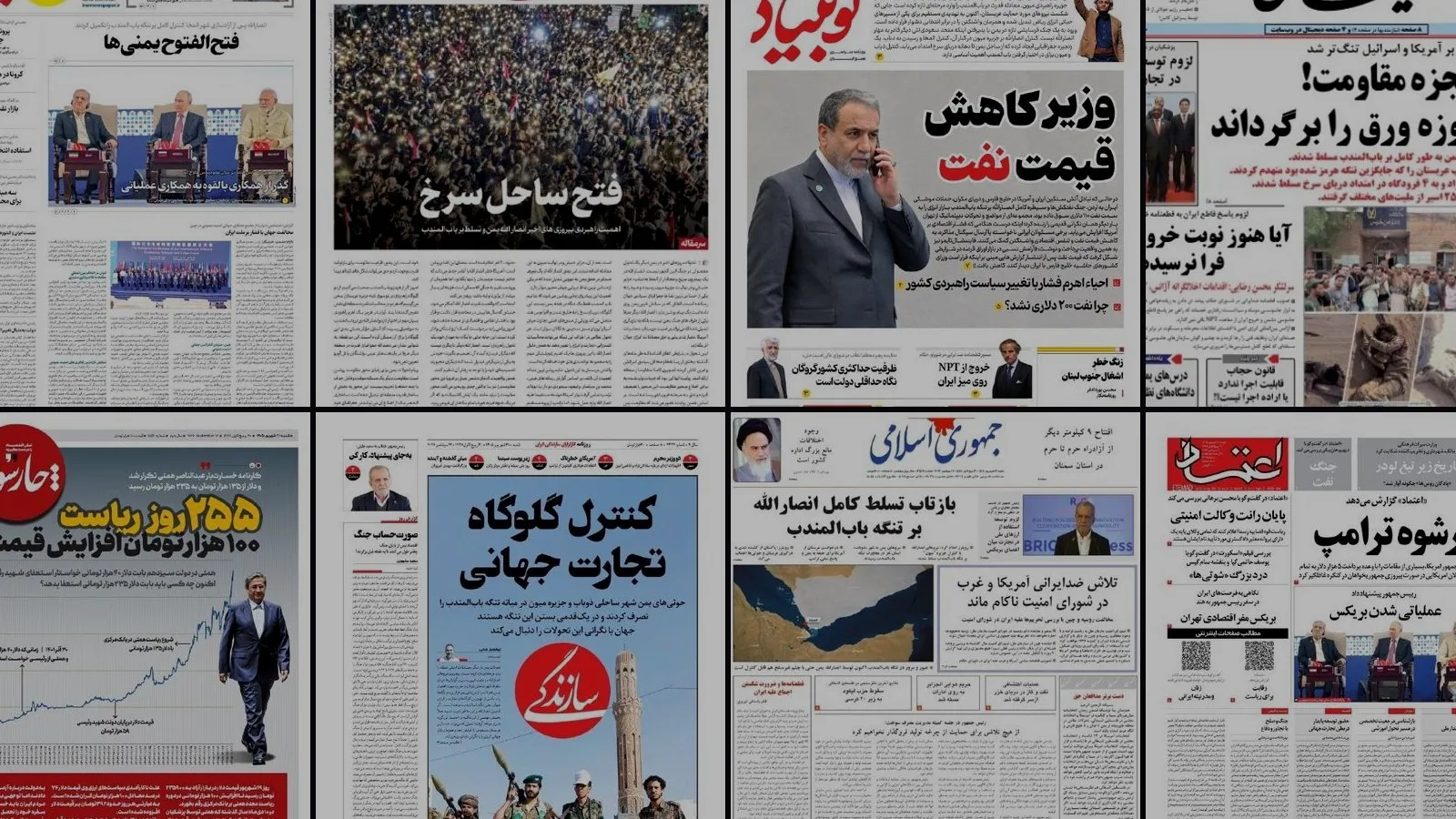
Bottom line: The Iranian press spent this morning celebrating control of a second maritime chokepoint and the closure of the pipeline built to bypass the first, which leaves no Gulf export route outside Iranian-aligned reach; the same pages carry, without reconciling it, a presidential offer to reopen the Strait of Hormuz, a Gulf littoral meeting convening in Muscat on Monday, and an English-language front page from which the strait is entirely missing.
Executive Summary
The lead judgment of this cycle is that the Iranian-aligned position at sea became structurally complete, and that the Iranian press understood the achievement as the pipeline rather than the island. Six of the ten front pages lead on Yemen. Kayhan puts it as ‘معجزه مقاومت! یمن یک روزه ورق را برگرداند’ (‘the miracle of the resistance! Yemen turned the page in a single day’) and lists four claims beneath it, of which the load-bearing one is not territorial: ‘خط لوله نفتی شرق به غرب عربستان را که جایگزین تنگه هرمز شده بود مسدود کردند’ (‘they blocked Saudi Arabia’s east-to-west oil pipeline, which had been the substitute for the Strait of Hormuz’). That is the correct reading of the week. Non-Iranian reporting confirms both halves: Houthi forces took the port of Mocha, the coastal town of Dhubab and Mayyun island, also called Perim, in the middle of Bab al-Mandab, after government forces withdrew; and Saudi Arabia’s energy ministry shut the East-West pipeline from Abqaiq to Yanbu as a precaution after attacks that lit fires at six points along its route, with the foreign ministry attributing the drones to launch from Iraq. Roughly five million barrels a day had been rerouted through that line since Hormuz was shut. With the line down and the southern strait held, there is no longer a physical route by which Gulf crude reaches a market without passing a point that Iran or an Iranian-aligned force controls.
The three descriptions of who struck the pipeline do not agree, and the disagreement is not a detail. Kayhan’s front page and its channel present it as an Ansarullah operation, the first against that infrastructure. Saudi Arabia says drones were launched from Iraq. The Fars wire reports that Iraq’s prime minister dismissed the commander of Maysan operations over precisely that allegation. Three attributions of one attack, one of which involves a sovereign state sacking an officer over the launch point, describe a campaign whose authorship is deliberately unsettled. For a monitor tracking escalation thresholds, the relevant fact is not which account is true but that Tehran is content to let all three stand: the effect is claimed, the address is not.
The register in which the advance was described splits the press more cleanly than the facts do. Iran, the government daily, and Sobh-e No, a principlist paper, reach for the same rare religious superlative on the same morning, ‘فتحالفتوح’ (the conquest of conquests), one printing ‘فتحالفتوح یمنیها’ and the other ‘فتحالفتوح انصارالله’. Nobonyad banners ‘بابالمندب زیرپای انصارالله’ (‘Bab al-Mandab under Ansarullah’s feet’). Seda-ye Iran runs ‘فتح ساحل سرخ’ (‘the conquest of the Red Coast’). Sazandegi, the Kargozaran party daily, writes the same events in a different language: ‘حوثیهای یمن شهر ساحلی ذوباب و جزیره میون در میانه تنگه بابالمندب را تصرف کردند و در یک قدمی بستن این تنگه هستند؛ جهان با نگرانی این تحولات را دنبال میکند’. Houthis rather than Ansarullah, captured rather than liberated, one step from closing rather than closed, and the world worried rather than the enemy cornered. Two papers separated by faction cannot independently arrive at the same unusual honorific on the same morning; the convergence indicates a distributed formulation, and the reformist deviation from it indicates where the distribution stops.
Against that celebration, the edition carries an offer, and the offer was not made on any hardline page. The Etemad and Iran channels both carry the president’s line that the strait will open on condition that America abandons the blockade and the aggression, given to India Today at the BRICS summit in New Delhi. The Nour News wire adds a harder detail: an Iran-Oman agreement to establish a shared corridor in the Strait of Hormuz, notified to international maritime authorities. The government daily’s front page and the Sobh-e No channel independently report that the foreign ministry spokesman has announced a meeting of Iran and the Persian Gulf littoral states in Oman on Monday 23 Shahrivar, with safe passage through Hormuz on the agenda. This monitor recorded on 10 September that Iran had converted an open-ended blockade into six published conditions; the movement in this cycle is from a price list to a venue, a counterparty and a date.
The state’s own voice supplied the edition’s sharpest contradiction and did not notice it. Jam-e Jam, the broadcaster’s daily, quotes Pezeshkian at the BRICS summit saying the bloc ‘should create space where no country can disrupt others’ legitimate trade’. That principle was published on the morning two Iranian-aligned closures removed the last unimpeded route for Saudi crude, and beside a Sobh-e No line calling Iran ‘دروازه تجارت بریکس’ (‘the gateway of BRICS trade’). Ta’adol, the economic daily, is the only paper to price the position forward rather than backward, running ‘شبح بشکههای ۲۰۰ دلاری و شعبده پکن’ (‘the spectre of 200-dollar barrels and Beijing’s conjuring trick’) and naming the variable that actually decides whether closure produces revenue or only isolation, which is Chinese purchasing behaviour.
The nuclear file moved in two opposite directions on two conservative pages. Kayhan’s left column asks ‘آیا هنوز نوبت خروج ایران از NPT فرا نرسیده است؟!’ under the strapline that the Agency’s amoral conduct will drive states out of the treaty; Nobonyad prints ‘خروج از NPT روی میز ایران’ (‘NPT withdrawal is on Iran’s table’). Both are framed as responses to the Board of Governors resolution. The government daily answers the same resolution from inside the law, giving front-page space to Mohsen Abdollahi, professor of international law at Shahid Beheshti University, on ‘سه مبنای حقوقی ایران برای محدود کردن همکاری’ (‘Iran’s three legal bases for limiting cooperation’), while the Nour News wire reports Mohammad Eslami travelling to Vienna for the Agency’s 70th General Conference. Two front pages arguing for exit, a third arguing the terms of restricted cooperation, and the head of the atomic energy organisation flying to the Agency’s own conference is not a position; it is three positions running at once.
Two pages did the work of splitting the adversary coalition, and they did it in different languages for different readers. Jomhouri Eslami sources its lead outward, reporting that Saudi Arabia asked the United States to strike Yemen and that Trump refused, and relaying Reuters that Pakistan is avoiding the Saudi-Houthi conflict. Iran Daily, the government’s English paper, gives its analysis slot to an interview with Afifeh Abedi arguing that the Mecca defence pact signed by Saudi Arabia, Turkey and Pakistan on 7 August is ‘essentially anti-Israel’, with Iranian participation raised as a possibility. Read together on the morning Iranian-aligned forces completed the defeat of Saudi-backed defenders at a strait, the two pages are one message: detach the Sunni powers from Washington and from Israel while the pressure is applied to them elsewhere.
The counter-current inside the principlist camp is now about Lebanon and about money, not about Yemen. Nobonyad, which banners the Yemen victory, gives its front page to an argument that added oil supply is defeating Iran’s leverage, and runs a signed column titled ‘زنگ خطرِ اشغال جنوب لبنان’ (‘the alarm bell of the occupation of southern Lebanon’) warning that unless a deterrent response halts the creeping change in field reality, the next negotiations will be about under what title Israel remains in parts of the south, including the Ali al-Taher heights. The same page carries Saeed Jalili, in his capacity as the Leader’s representative on the Supreme National Security Council, on ‘ظرفیت حداکثری کشور گروگان نگاه حداقلی دولت است’. Sazandegi answers him by name on its own front page in the president’s voice: ‘بهجای پیشنهاد، کار کن!’ (‘instead of proposals, work!’). The argument over whether Iran should accept any bounded settlement is now conducted openly between front pages, with an office-holder on one side and the president on the other.
The household file kept its place and got worse. Chahar Sough gives its entire front to a single annotated chart under ‘۲۵۵ روز ریاست، ۱۰۰ هزار تومان افزایش قیمت دلار’, recording the free-market dollar at about 239,000 tomans on 19 Shahrivar and asking who should resign over it, using a named official’s own past demand for a resignation as the instrument. Ta’adol leads on a district map of Tehran house prices and closes with ‘بورس زیر چتر دلار’ (‘the bourse under the dollar’s umbrella’), stating that the equity record is a currency phenomenon. Two economic dailies with no shared faction reach the same conclusion by different routes: domestic capital is moving into anything that is not the rial while the chokepoints are being closed.
Net assessment: this is a completion edition, not a breakthrough edition, and its most important content is the mismatch between what was completed and what was offered. The physical position is now as strong as it can get without a general war at sea, and it was reached largely by an ally rather than by Iran, which is why the flagship must convert it into doctrine (‘درسهای یمن برای دانشگاههای نظامی جهان’) rather than into a claim of Iranian action. At the same moment the diplomatic position moved from a published price list toward a venue: a conditional presidential offer, an Iran-Oman corridor notified to maritime authorities, and a Gulf littoral meeting in Muscat on Monday. The Leader published nothing for the sixth consecutive edition, and the government’s English front page omits the strait entirely. A maximal physical position, an unratified diplomatic opening, two front pages arguing for treaty exit and no leadership voice arbitrating between them is a configuration in which the next move is likely to be made by whoever acts first rather than by whoever decides.
Key Points
- KJ-1 [HIGH] KJ-1. The last physical route by which Gulf crude could reach a market without passing an Iranian-aligned control point has been removed, and the Iranian press has identified that, rather than the island, as the achievement. Houthi forces took Mocha, the coastal town of Dhubab and Mayyun island, also called Perim, at the centre of Bab al-Mandab after government forces withdrew, corroborated across Al Jazeera, CNN, NBC News and Reuters-sourced reporting on 10 and 11 September; Saudi Arabia’s energy ministry shut the East-West pipeline from Abqaiq to Yanbu as a precaution after attacks lit fires at six points along its route, with roughly five million barrels a day having been rerouted through it since Hormuz was closed. Kayhan’s front page states the significance without ambiguity: the pipeline ‘جایگزین تنگه هرمز شده بود’. Significance: until this week the closure of Hormuz was an expensive inconvenience with a land bypass and a southern exit; it is now a closure with neither. That raises the value of any Iranian concession on passage, which is why a conditional presidential offer and a Muscat meeting appear in the same edition, and it simultaneously raises the probability of direct action against the forces holding the southern gate, since the bypass can no longer absorb the pressure.
- KJ-2 [HIGH] KJ-2. The authorship of the pipeline attack is being left deliberately unresolved, and that ambiguity is the operative fact rather than a reporting gap. Three incompatible attributions stand in the same cycle: Kayhan’s front page and channel present it as an Ansarullah operation and the first against that infrastructure; Saudi Arabia’s foreign ministry says the drones were launched from Iraq; and the Fars wire reports that Iraq’s prime minister dismissed the commander of Maysan operations over that allegation. Vatan-e Emrooz relays CNN on the fires and adds a throughput figure of six million barrels a day, above the 4 to 5 million reported elsewhere, and a claim that Saudi production is at its lowest since 1990 that appears on no independent surface retrieved. Significance: an attack whose effect is claimed while its address is left open is a deniable escalation, and the dismissal of an Iraqi officer shows a third state absorbing the attribution cost. For warning purposes the indicator to watch is whether any Iranian official surface ever accepts the address; continued silence on authorship alongside continued celebration of effect indicates the pattern will be repeated.
- KJ-3 [MODERATE-HIGH] KJ-3. Iran’s settlement track advanced from published terms to an identified venue, counterparty set and date, while the hardline press printed nothing about it. The president told India Today at the BRICS summit that the strait will open on condition America abandons the blockade and the aggression, carried on both the Etemad and Iran channels; the Nour News wire reports an Iran-Oman agreement to establish a shared corridor in the Strait of Hormuz, notified to international maritime authorities; and the government daily’s front page and the Sobh-e No channel independently report the foreign ministry spokesman announcing a meeting of Iran and the Persian Gulf littoral states in Oman on Monday 23 Shahrivar with safe passage on the agenda. Neither Kayhan nor Nobonyad nor Seda-ye Iran mentions any of it. Significance: a corridor notified to maritime authorities is an operational act that creates a verifiable fact at sea, unlike a list of conditions, and it can be tested independently of anything either side says. Whether that meeting convenes on Monday is the single most informative near-term indicator in this file, and it is checkable.
- KJ-4 [MODERATE-HIGH] KJ-4. The Iranian message apparatus is running two incompatible accounts of the same week for two audiences, and the separation is by language. Six Persian front pages lead on Bab al-Mandab, two of them with the identical rare superlative ‘فتحالفتوح’ printed by a government daily and a principlist daily on the same morning. The government’s own English paper, Iran Daily, carries no Bab al-Mandab headline at all: it leads on a forum rejecting the politicisation of Iran’s public security, promotes Pezeshkian’s call for BRICS financial mechanisms, and gives its analysis slot to an interview arguing that the Mecca defence pact of 7 August among Saudi Arabia, Turkey and Pakistan is essentially anti-Israel and might accommodate Iran. Significance: the omission is not editorial economy, because the event is the largest of the week; it indicates Tehran does not wish to own strait closure in the language its foreign counterparts read, which in turn indicates the closure is understood internally as a bargaining asset with a cost rather than as a durable achievement to be defended diplomatically.
- KJ-5 [MODERATE-HIGH] KJ-5. A relayed foreign claim that this monitor recorded being edited two cycles ago is now being asserted by an Iranian diplomatic mission, which demonstrates that handling-layer excisions propagate into official positions. On 10 September four hardline Iranian surfaces published a CBS-sourced sentence about an A-10 losing a wing and about eight F-15s damaged at Muwaffaq Salti air base in Jordan, each with the concluding clause ‘ولی به چرخه عملیاتی بازگشتند’ (‘but they returned to the operational cycle’) removed, while the Etemad channel preserved it. This cycle, Seda-ye Iran’s front page reproduces a post from the Islamic Republic’s embassy in Zimbabwe carrying the truncated claim with aircraft photographs as a taunt about American air superiority. Significance: the interval from edited relay to diplomatic assertion was two publication cycles, which is short enough that the excision cannot be treated as an artefact of hasty reprinting. It also gives this monitor a working rule with predictive value: an edited hardline relay should be expected to surface as an official Iranian claim, and the reformist channel version is the place to recover what was cut.
- KJ-6 [MODERATE-HIGH] KJ-6. Withdrawal from the Non-Proliferation Treaty has moved from a single front-page argument to a two-paper conservative position, and the government is answering it with legal process rather than with refusal. Kayhan’s left column asks ‘آیا هنوز نوبت خروج ایران از NPT فرا نرسیده است؟!’ under the strapline that the Agency’s amoral conduct will drive states out of the treaty; Nobonyad prints ‘خروج از NPT روی میز ایران’ beneath a kicker on the Board of Governors resolution. On 10 September the case appeared on one front page, Asr-e Iranian’s. Against it, the government daily runs Mohsen Abdollahi of Shahid Beheshti University on Iran’s three legal bases for limiting cooperation, and the Nour News wire has Mohammad Eslami travelling to Vienna for the Agency’s 70th General Conference. Significance: the procedural win at the Security Council, reported by Kayhan as a fruitless session and by Jomhouri Eslami as a failed Western effort, has not slowed the exit argument, which means the advocacy is not contingent on how the diplomatic track performs. The indicator to watch is whether any official body rather than a newspaper puts withdrawal on a record; until then this is factional pressure, not policy.
- KJ-7 [MODERATE] KJ-7. Tehran is running a coordinated effort to detach the Sunni powers from Washington and from Israel, using relayed third-party claims in Persian and direct advocacy in English. Jomhouri Eslami’s front-page bullets report that Saudi Arabia asked the United States to strike Yemen and that Trump refused, and relay Reuters that Pakistan is avoiding the Saudi-Houthi conflict; its main graphic is a map rather than fighters. Iran Daily’s exclusive interview with Afifeh Abedi argues the Mecca pact was constituted with Saudi Arabia as its focal point, reflects a gap in regional security institutions, and is essentially directed at Israel, with Iranian participation raised. The Sobh-e No channel adds that the commander of American Central Command travelled to Saudi Arabia to coordinate over the Ansarullah advance. Significance: the approach is being made to states whose forces Iranian-aligned fighters have just defeated and whose export infrastructure has just been shut, which is either a serious attempt to convert military pressure into a realignment or an attempt to pre-empt one. Both readings imply Tehran expects the Sunni bloc’s response to Bab al-Mandab to be the decisive variable of the coming weeks, and neither is supported yet by any reciprocal signal from Riyadh, Ankara or Islamabad in the monitored set.
- KJ-8 [MODERATE] KJ-8. The dispute over whether Iran may accept any bounded settlement is now a named, public quarrel between a serving security-establishment figure and the president, conducted on front pages with no leadership arbitration. Nobonyad prints Saeed Jalili, identified as the Leader’s representative on the Supreme National Security Council, arguing that ‘ظرفیت حداکثری کشور گروگان نگاه حداقلی دولت است’ (‘the country’s maximum capacity is hostage to the government’s minimalist outlook’), the same maximalist formula Asr-e Iranian gave its entire front to on 10 September. Sazandegi answers on its own front page in the president’s voice, by name: ‘رئیسجمهور خطاب به سعید جلیلی: بهجای پیشنهاد، کار کن!’. Significance: Jalili holds no negotiating brief but does hold an office that carries the Leader’s name, which makes his intervention harder to dismiss than a factional op-ed and harder to answer than one. An Iranian delegation arriving in Muscat while the maximalist case is being pressed from inside the Supreme National Security Council has reduced authority to conclude anything, which lowers the probability that the Monday meeting produces more than an agenda.
- KJ-9 [MODERATE] KJ-9. Negative evidence, sixth consecutive edition: the Leader published nothing traceable, on the cycle that crossed a strategic threshold and produced two front-page arguments for treaty withdrawal. No dated message, speech, photograph or direct quotation appears on any of the ten front pages or on any of the six newspaper channels and three wires monitored. The only leadership surfaces are on one front page, Seda-ye Iran’s: an undated column presented as adapted from the Leader’s remarks on American enmity, titled ‘ایرانِ مستقل؛ دلیل دشمنی آمریکا’, and a reproduction of an @Khamenei_fa post that could not be transcribed at kiosk resolution. Both khamenei.ir sites were unavailable at compilation, as on 10 September. Significance: the office that would ordinarily ratify a chokepoint doctrine, endorse a negotiating venue, or rule on treaty withdrawal has done none of the three across six editions, which leaves the president, the IRGC spokesman and the Leader’s own representative on the Supreme National Security Council advancing three incompatible positions without visible arbitration. Record also that the succession itself still rests in this monitor’s sourcing on printed honorific usage rather than on any primary leadership publication.
- KJ-10 [MODERATE] KJ-10. The domestic cost of the coercion strategy is now being measured and published by outlets with no stake in either war camp, and the numbers are deteriorating faster than the strategy is advancing. Chahar Sough gives its whole front to a chart recording the free-market dollar moving from 135,000 to about 235,000 tomans across 255 days, dating a print of about 239,000 tomans to 19 Shahrivar, and frames it as a personal accountability case against Abdolnaser Hemmati using his own earlier demand for a resignation at 40,000 tomans. Ta’adol leads on Tehran house prices, gives front-page weight to bitcoin’s move from about 60,000 to 80,000 dollars, and states plainly that the equities record is a currency effect. Sazandegi’s report of the day, ‘صورتحساب جنگ’, asks how long the economy needs to return to its pre-war point. Significance: Brent above 100 dollars is the strategy’s intended output, but it is not reaching Iranian households, and three economically focused pages converging on capital flight into any non-rial asset indicates the coercion is producing measurable domestic cost ahead of any measurable domestic benefit. That gap, not the price of oil, is the constraint most likely to shape how long the closure can be sustained.
Macro Trends
- The bypass closes, and the coercion becomes total by subtraction. The standing Hormuz thread this monitor has tracked from the prohibited-zone declaration through the extraterritorial warnings to crews and the six published conditions reached its structural end point this cycle, and not at Hormuz. Saudi Arabia’s East-West pipeline, running from Abqaiq on the Gulf to Yanbu on the Red Sea and carrying roughly the five million barrels a day rerouted since the strait was shut, was closed by its own operator as a precaution after attacks lit fires at six points along the route. Kayhan names the significance exactly: the line ‘جایگزین تنگه هرمز شده بود’. With Bab al-Mandab now held at its narrowest point and the overland bypass down, the residual export capacity outside Iranian-aligned reach is close to zero. The instrument was completed by subtraction rather than by a new Iranian action, which is why no Iranian military claim is attached to it.
- An ally’s victory has to be converted into Iranian doctrine. Nothing in this cycle’s decisive events was done by Iran under its own name. The ground was taken by Ansarullah, the pipeline was struck by drones Saudi Arabia attributes to Iraq, and the only named Iranian institutional voice attached to any of it is the IRGC spokesman calling the western-coast victories ‘روایتی از یک پیروزی الهی’ (‘an account of a divine victory’), carried identically by Fars, Vatan-e Emrooz and Kayhan. The flagship’s answer to that attribution gap is to universalise the method: its editorial of the day is titled ‘درسهای یمن برای دانشگاههای نظامی جهان’ (‘Yemen’s lessons for the world’s military academies’). An ally’s tactical success is being written up as transferable doctrine, which is how a camp claims credit for an outcome it did not execute and signals, without asserting, where the method applies next.
- From a price list to a venue. On 10 September this monitor recorded the conversion of an open-ended blockade into six published conditions. This cycle adds the missing elements of a negotiation. The president told India Today at the BRICS summit that the strait will open on condition America abandons the blockade and the aggression, a formulation the Etemad and Iran channels both carry. The Nour News wire reports an Iran-Oman agreement on a shared corridor in the Strait of Hormuz, notified to international maritime authorities, which is an operational act rather than a statement. The government daily and the Sobh-e No channel independently report the foreign ministry spokesman announcing a meeting of Iran and the Persian Gulf littoral states in Oman on Monday 23 Shahrivar with safe passage on the agenda. Terms, a mediator, a counterparty set and a date now exist. What does not exist is any hardline front page acknowledging them.
- Message discipline shows itself in a shared superlative and in a missing story. Two indicators in this edition isolate the handling layer. The first is convergence on a rare formulation: the government daily prints ‘فتحالفتوح یمنیها’ and the principlist Sobh-e No prints ‘فتحالفتوح انصارالله’ on the same morning, a religious superlative that two papers on opposite sides of the factional line do not independently select. The second is omission: Iran Daily, the government’s own English paper, carries no Bab al-Mandab headline at all, leading instead on financial multilateralism and giving its analysis slot to an argument that a Sunni defence pact is really anti-Israel. The Persian audience receives a conquest and the English audience receives a trade agenda. This is the same excision logic recorded on 10 September, applied to a whole story rather than to a clause.
- A truncated claim hardens into an official one. The Muwaffaq Salti thread has now completed the passage this monitor flagged as a risk. On 10 September a relayed CBS sentence about an A-10 losing a wing and about eight F-15s damaged at the Jordanian base was published by four hardline surfaces with its concluding clause, ‘ولی به چرخه عملیاتی بازگشتند’ (‘but they returned to the operational cycle’), removed, and preserved by one reformist channel. The truncated version is now circulating from the Islamic Republic’s embassy in Zimbabwe as a taunt about American air superiority, and Seda-ye Iran reprints the embassy post on its front page with the aircraft photographs. An editing decision at the relay stage has become a diplomatic assertion in two cycles, which is the practical reason this monitor records excisions when it finds them.
- Two conservative answers on the treaty, and a third from the government. The Board of Governors resolution produced withdrawal advocacy on two front pages this cycle rather than one. Kayhan asks ‘آیا هنوز نوبت خروج ایران از NPT فرا نرسیده است؟!’ under the claim that the Agency’s conduct will drive states out of the treaty, and Nobonyad prints ‘خروج از NPT روی میز ایران’. The government daily answers from inside the law with a professor of international law on the three legal bases for limiting cooperation, and the Nour News wire has the head of the atomic energy organisation, Mohammad Eslami, travelling to Vienna for the Agency’s 70th General Conference. Meanwhile the Security Council track closed in Tehran’s favour on procedure: Kayhan calls the session ‘بیحاصل’ and Jomhouri Eslami reports the Western effort failed against Russian and Chinese opposition. Winning the procedural round has not settled which track Iran is on.
- The settlement argument is now a named quarrel between front pages. The maximalist case this monitor first recorded on Asr-e Iranian’s front page on 10 September has acquired an office and an answer. Nobonyad prints Saeed Jalili, identified as the Leader’s representative on the Supreme National Security Council, arguing that ‘ظرفیت حداکثری کشور گروگان نگاه حداقلی دولت است’. Sazandegi answers him by name on its own front page in the president’s voice: ‘رئیسجمهور خطاب به سعید جلیلی: بهجای پیشنهاد، کار کن!’. A serving security-establishment figure and the president are now conducting a public argument about whether any bounded settlement is acceptable, conducted through front pages on the morning a negotiating venue was announced, with no leadership arbitration visible in any monitored surface.
- The domestic price of the strategy is being published by papers with no faction to defend. Chahar Sough records the free-market dollar at about 239,000 tomans on 19 Shahrivar and builds an entire front page around the question of who resigns for it, using Abdolnaser Hemmati’s own earlier demand for a resignation at 40,000 tomans as the lever. Ta’adol leads on Tehran house prices, runs bitcoin’s move from about 60,000 to 80,000 dollars at front-page weight, and states that the equities record is a currency effect. Sazandegi’s report of the day is titled ‘صورتحساب جنگ’ (‘the bill for the war’) and asks how long recovery to the pre-war point will take. Three economically focused pages, none of them aligned with the reformist or hardline blocs on the war itself, are converging on the same measurement of what the coercion costs at home.
- Absences that are findings. Three silences carry information this cycle. The Leader published nothing traceable for the sixth consecutive edition, on a morning that crossed a strategic threshold and produced two front-page arguments for leaving the Non-Proliferation Treaty; his authority appears only as an undated adapted column and an unread social-media reproduction on one front page. No front page or wire in the monitored set mentions the cost of Red Sea closure to Egypt except the Etemad channel, which carries Egyptian statements on Suez Canal losses; Bab al-Mandab and Suez are one system, and the loss falls on a state that is neither belligerent nor adversary. And the Jam-e Jam channel, which two cycles ago published state opinion polling showing negotiation still the plurality preference, carries no follow-up series and nothing on the Security Council outcome.
Front-Page Snapshot
- Kayhan - “The miracle of the resistance! Yemen turned the page in a single day” (Hardline, the Leader’s flagship daily) - Bab al-Mandab seizure framed as doctrine, with the Hormuz bypass pipeline named as the prize [SEVERE]
- Vatan-e Emrooz - “The strategic dimensions of complete control over Bab al-Mandab” (Hardline / principlist (channel only, no scan in the day’s album)) - Maximal pipeline and production claims, beside unglamorous evidence of friction at Shalamcheh and Jask [SEVERE]
- Sobh-e No - “Ansarullah’s greatest conquest” (Principlist (channel only, no scan in the day’s album)) - The same ‘greatest conquest’ formula as the government daily, plus the Muscat littoral meeting and a CENTCOM visit to Riyadh [HIGH]
- Seda-ye Iran - “The conquest of the Red Coast” (Principlist; carries khamenei.ir material on its front page) - Bab al-Mandab as proof the axis was never degraded, with a truncated battle-damage claim now carried by an Iranian embassy [HIGH]
- Nobonyad - “The minister for lowering the price of oil” (Conservative / principlist morning daily) - Oil supply as the counter-coercion weapon, with a front-page alarm over creeping Israeli control in southern Lebanon [HIGH]
- Iran - “The Yemenis’ greatest conquest” (Official government daily) - Dual chokepoints named openly, answered with BRICS and a Gulf littoral meeting in Oman [MODERATE-HIGH]
- Jam-e Jam - “Satellite-scale smoke from the pipeline strike, and a presidential complaint about disrupted trade” (State daily of the IRIB (channel only, no scan in the day’s album)) - Physical evidence for the pipeline strike, beside the contradiction of complaining about interference with legitimate trade [MODERATE-HIGH]
- Sazandegi - “Control of the chokepoint of world trade” (Reformist, Kargozaran-e Sazandegi party daily) - Bab al-Mandab described without the victory register, plus Pezeshkian’s named rebuke of Jalili [MODERATE-HIGH]
- Jomhouri Eslami - “The reverberation of Ansarullah’s complete control over the Bab al-Mandab strait” (Traditional conservative establishment daily) - Bab al-Mandab as a coalition-fracture story, with the Security Council effort reported as failed [MODERATE]
- Etemad - “Trump’s bribe” (Reformist) - American electoral politics led over the chokepoints, with the conditional offer to reopen Hormuz carried on the channel [MODERATE]
- Iran Daily - “Global forum rejects politicization of Iran’s public security” (English-language government daily) - Bab al-Mandab absent in English, with the Mecca defence pact reframed as anti-Israel and open to Iran [MODERATE]
- Ta’adol - “The strange map of house prices in Tehran” (Economic daily) - The 200-dollar barrel weighed against Chinese buying, over a housing-market lead [LOW-MODERATE]
- Chahar Sough - “255 days in office, a 100,000-toman rise in the price of the dollar” (Economic daily) - The dollar at 239,000 tomans, presented as a named official’s accountability case [LOW-MODERATE]
Compiled from Iranian front pages and outlet channels via open-source monitoring. Translations are editorial; named-figure attributions are verified against the source pages where possible.