Iranian Press Monitor - Thursday, 10 September 2026 (Day 191)
Thursday, 10 September 2026 · 19 Shahrivar 1405 · 21 Rabi al-Awwal 1448 - Ten front pages (nine Persian from the Thursday 19 Shahrivar Tasnim kiosk album and Iran Daily from the English kiosk), plus the Kayhan, Vatan-e Emrooz, Jam-e Jam, Etemad, Iran and Sobh-e No channels and the Defa Press, Fars and Nour News wires; Tehran Times and the leadership websites did not respond at the time of compilation
Bottom line: On the morning the hardline press printed a four-to-one naval exchange as proof that the blockade is working, the IRGC’s own spokesman published six finite conditions for ending the war and reopening the Strait, and it was the reformist party daily, not the flagship, that put that list on a front page: Iran has moved from open-ended coercion to a priced demand, and the paper that most loudly claims the coercion is succeeding did not mention the price.
Executive Summary
The lead judgment of the cycle is that Iran’s maritime coercion acquired a published price, and that the price was carried by the reformist press rather than by the camp that built the instrument. Sazandegi, the daily of the Kargozaran-e Sazandegi party, gives its front to the captured American undersea vehicle under the two-word headline ‘شکار زهپاد’ (the zahpad hunt), and puts beneath it the line that matters: ‘سردار حسین محبی سخنگوی سپاه پاسداران شروط ششگانه ایران برای توقف جنگ را اعلام کرد’ (‘Sardar Hossein Mohebbi, spokesman of the IRGC, announced Iran’s six conditions for halting the war’). The six, verified against four separate outlets, are: complete cessation of the war; no renewed threats against Iran; withdrawal of Israeli forces from Lebanon; an end to the blockade of Yemen; release of 24 billion dollars in frozen Iranian assets; and no interference in Iran’s nuclear and missile capabilities. Three of the six concern third parties. One is an administrative act with a number attached. Until this morning the prohibited-zone policy this monitor has tracked since its declaration had no stated terms of termination; it now has six.
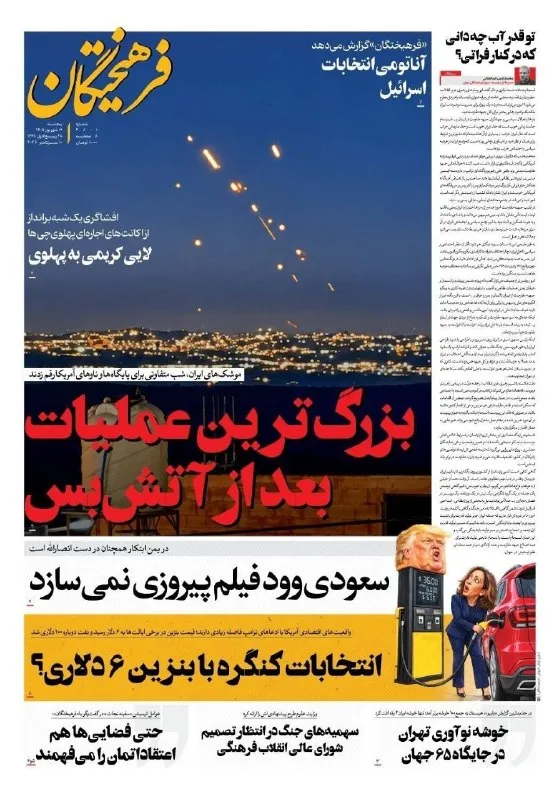
The hardline fronts spent the same morning on arithmetic, and their arithmetic does not agree. Kayhan leads on a ratio, ‘۲۰ کشتی در مقابل ۵ کشتی؛ پاسخ مقتدرانه ایران به تجاوزگری آمریکا’ (‘twenty ships against five: Iran’s authoritative response to American aggression’), and its political-service report states that at dawn on Wednesday the IRGC targeted twenty tankers and destroyers plus the basing site of F-35, F-16 and F-15 fighters in response to an American attack on five Iranian ships. Vatan-e Emrooz, under ‘شب روشن’ (bright night), prints eight violating tankers, two American military vessels and one base in Jordan. The same channel’s own earlier bulletin printed twelve ships. Farhikhtegan declines to count at all and instead ranks: ‘بزرگترین عملیات بعد از آتشبس’ (the largest operation since the ceasefire), set over a night photograph of missile trails above a lit city. Three hardline counts of one night, no released target list, and a superlative in place of a number.
The claim that outranks all of them appears on exactly one surface and is sourced to nobody. Vatan-e Emrooz alone reports that three Americans were killed and five soldiers wounded in the attacks on Jordan, that two American warships were hit and took casualties, and that an aircraft overhaul centre was struck. No other front page, no other channel and no wire carries an American death. The verifiable residue of the Jordan strike is narrower and is second-hand throughout: Iranian outlets quoting CBS that at Muwaffaq Salti air base an A-10 lost a wing and about eight F-15s were damaged, and that American forces fired more than thirty Patriot interceptors. Etemad’s channel alone preserved the second half of the CBS sentence, that the damaged aircraft ‘به چرخه عملیاتی بازگشتند’ (‘returned to the operational cycle’). Four other Iranian channels published the same sentence with that clause removed. Identical excision across four surfaces is the cleanest evidence of centrally-guided message discipline in this edition, and it indicates coordination rather than independent editorial judgment.
A legal defeat arrived alongside the military claim and split the conservative press into two incompatible answers. The IAEA Board of Governors adopted the American and European resolution on the night of Wednesday 18 Shahrivar and referred Iran’s file to the Security Council. Jam-e Jam, the state broadcaster’s daily, answers by attacking the category: ‘خرافهای به نام حقوق بینالملل’ (‘a superstition called international law’), under the kicker ‘رونمایی غرب وحشی از سبک وقاحت’. Jomhouri Eslami, the traditional establishment title, answers from inside the category: ‘ارجاع موضوع ایران به شورای امنیت فاقد مبنای حقوقی است’ (‘the referral of the Iran question to the Security Council lacks a legal basis’), attributed to a joint Iranian, Russian and Chinese statement. Kazem Gharibabadi wrote on X that the Security Council too would yield nothing. Mikhail Ulyanov told the Board that resuming full verification in Iran would require credible guarantees from the United States and Israel on the non-use of force. Two conservative papers, one denying that law exists and one invoking it, are not a message-discipline failure so much as a division of labour between a domestic and a diplomatic audience.
Jomhouri Eslami made the most deliberate framing choice of the morning, and it was not about Iran. Its dominant photograph is a South Korean street protest, Korean placards beside English ones reading ‘NO NAVAL DEPLOYMENT TO HORMUZ!’, captioned ‘به جنگ غیرقانونی علیه ایران وارد نشوید’ (‘do not enter the illegal war against Iran’). An establishment conservative daily giving its main image to an American ally’s domestic dissent rather than to Iranian force is arguing that the coalition is fraying at home. The same page prints ‘نفت ۱۰۰ دلاری شد’ (oil became 100 dollars) as plain fact rather than as the scoreboard two hardline papers fought over on 9 September; the Sobh-e No channel dates it precisely, Brent reaching 100 dollars a barrel for the first time in about 48 days.
The argument against the six conditions appeared on the same morning, in a principlist paper, without naming them. Asr-e Iranian gives its whole front to Saeed Jalili walking through a crowd under the headline ‘نگاه حداقلی ممنوع!’ (‘the minimalist view is forbidden!’) and the quotation ‘اگر نظر به حداکثرها نداشته باشید به حداقلها هم نمیرسید’ (‘if you do not aim at the maximums you will not even reach the minimums’). Beneath it sits ‘هزینه عدم خروج از NPT’ (‘the cost of not leaving the NPT’), the sharpest withdrawal advocacy on any front page in this run, and an op-ed by Masoud Barati titled ‘اگر آتشبس نبود؛ محاصره هم نبود’ (‘had there been no ceasefire, there would have been no blockade’). A maximalist doctrine, an NPT-exit calculation and an attack on the June pause, printed the morning after the IRGC published a finite list, compose a coherent refusal of any bounded settlement.
Two attempts to strip Iranian office-holders of standing ran the same week from opposite directions, and both surfaced in print this morning. Sazandegi reports ‘طرح پنهانی تندروها علیه پزشکیان’ (‘the hardliners’ hidden plan against Pezeshkian’), a Majlis move toward a motion of presidential incompetence. Sobh-e No spent the previous afternoon defending Mohammad Bagher Ghalibaf’s control of the negotiating file against a push to transfer it to Mohsen Rezaei, marshalling three named principlists in one afternoon to do it: Esmail Kowsari, commission chairman Ebrahim Azizi, and Mohsen Kouhkan. Its unsigned commentary makes the accusation directly: ‘مساله شان انتخابات است نه مذاکره’ (‘their issue is the election, not negotiation’). The negotiating file has become an object of pre-electoral capture while the negotiation itself is being conducted.
The economic and civil pages ranked the war below the household. Chahar Sough leads on ‘شکست سیاست تکنرخی کردن ارز’ (‘the failure of the single-rate currency policy’) and names the sitting economy minister in its kicker, charting a free-to-Nima dollar spread that has widened to roughly 68,000 tomans since the change of government; it boxes ‘پایگاههای آمریکا زیر آتش موشکهای ایران’ beneath the chart. Ta’adol leads on housing stagflation and gives its photograph to a Mahan Air 747 under ‘تحریم ۲۷ ایرلاین؛ پروازها فعلا برقرارند’ (‘27 airlines sanctioned; flights are operating for now’). Shargh, the most-read reformist title, leads on the northern floods under ‘آوار سیلاب’ and titles its editorial ‘جنگ مجازی و حقیقی’ (‘the virtual war and the real one’). Etemad photographs a car carried off by floodwater in Mazandaran, where 772 housing units are recorded as damaged.
Net assessment: this is a terms-of-settlement edition disguised as an operations edition. The strike claims are loud, mutually inconsistent and uncorroborated; the document underneath them is quiet, specific and verifiable, and it converts an open-ended blockade into a demand with six line items and one dollar figure. The instructive pattern is who carried what. The camp that built the coercion instrument printed arithmetic and did not mention the price; the camp that opposes the war printed the price and audited it; a principlist daily printed the case for refusing any price at all; and the state broadcaster’s own channel published polling showing negotiation still the plurality preference at 45 per cent against 38 for confrontation. The gap this monitor flagged on 9 September, between what the fronts argue and what the wires threaten, has been replaced by a sharper one: between an offer Iran has now made in public and a flagship that will not acknowledge it exists.
Key Points
- KJ-1 [HIGH] Iran has converted the closure of the Strait of Hormuz from an open-ended coercive posture into a priced demand, and has done so in public. The IRGC spokesman, Sardar Hossein Mohebbi, announced six conditions for halting the war and reopening the Strait: complete cessation of the war; no renewed threats against Iran; withdrawal of Israeli forces from Lebanon; an end to the blockade of Yemen; release of 24 billion dollars in frozen Iranian assets; and no interference in Iran’s nuclear and missile capabilities. The list is carried on Sazandegi’s front page of 19 Shahrivar and was reported the same day by Euronews Persian, Asr-e Iran, Eghtesad News and Rahbord-e Moaser. It was published alongside an extension of the prohibited zone from the Strait into parts of the Sea of Oman and the Arabian Sea from Chabahar. Significance: an open-ended blockade cannot be negotiated away because it has no stated terminating condition, whereas a six-item list can be partially satisfied, tested and split. Three items concern third parties and one is an administrative act with a number attached, which means the cheapest available de-escalation move for Washington is now identifiable, and the point of leverage has shifted from what Iran can sink to what Iran has said it will accept.
- KJ-2 [HIGH] The hardline press is publishing mutually inconsistent counts of the same night’s operation, which indicates claimed effects are being generated for effect rather than reported from a common source. Kayhan’s front page and political-service report state twenty tankers and destroyers plus a fighter basing site, in response to an American attack on five Iranian ships. Vatan-e Emrooz states eight violating tankers, two American military vessels and one base in Jordan. That paper’s own channel bulletin a few hours earlier stated twelve ships. Farhikhtegan substitutes a superlative, calling it the largest operation since the ceasefire, and prints no count. No target list has been released, and the only independent maritime confirmation retrieved is from Britain’s UK Maritime Trade Operations, which confirmed incidents involving commercial vessels but could not verify casualties or environmental damage. Significance: the divergence is too large to be reporting lag and too patterned to be error, and it means battle-damage figures from any single Iranian front page carry little evidentiary weight; the corroborated core of the night is damage to commercial shipping and to aircraft at one Jordanian base, not the ratios being printed.
- KJ-3 [MODERATE-HIGH] A single quotation was excised identically across four Iranian channels, which is direct evidence of centrally-guided message handling rather than of organic editorial convergence. CBS reported that at Muwaffaq Salti air base in Jordan an A-10 lost a wing and about eight F-15s were damaged. Etemad’s channel published that sentence with its concluding clause intact, ‘ولی به چرخه عملیاتی بازگشتند’ (‘but they returned to the operational cycle’). Kayhan, Vatan-e Emrooz, Jam-e Jam and Fars News each published the identical sentence with that clause and only that clause removed. Significance: shared headlines prove only shared news, but an identical cut at an identical point in a relayed foreign quotation, preserved by one reformist outlet and removed by three hardline ones and a wire, isolates the handling layer. It also supplies a practical rule for this monitor: where a claim’s mitigating half is missing from hardline surfaces, the reformist channel relay is the place to look for it.
- KJ-4 [MODERATE-HIGH] The IAEA referral has produced two incompatible conservative positions on the standing of international law, and Tehran now has no single published line on the institution seized of its file. Jam-e Jam, the state broadcaster’s daily, leads with ‘خرافهای به نام حقوق بینالملل’ (‘a superstition called international law’). Jomhouri Eslami leads with the opposite move, arguing that the referral ‘فاقد مبنای حقوقی است’ (‘lacks a legal basis’), attributed to a joint Iranian, Russian and Chinese statement, and prints a South Korean anti-deployment protest as its main image. Kazem Gharibabadi says the Security Council will yield nothing; Mikhail Ulyanov tells the Board that resumed verification requires American and Israeli guarantees against the use of force. Significance: the legalist track and the delegitimation track cannot both be pursued at the Security Council, and the choice between them will indicate whether Tehran intends to contest the referral procedurally, which implies engagement, or to treat it as the trigger for the NPT-exit argument that Asr-e Iranian is already making on its front page.
- KJ-5 [MODERATE-HIGH] The refusal of any bounded settlement now has a front-page champion inside the principlist camp, published the morning after the IRGC’s list appeared. Asr-e Iranian gives its entire front to Saeed Jalili under ‘نگاه حداقلی ممنوع!’ (‘the minimalist view is forbidden!’) with the maxim that aiming below the maximum forfeits even the minimum, places ‘هزینه عدم خروج از NPT’ (‘the cost of not leaving the NPT’) beneath it, and runs Masoud Barati’s op-ed ‘اگر آتشبس نبود؛ محاصره هم نبود’ (‘had there been no ceasefire, there would have been no blockade’). Kayhan’s front page does not mention the six conditions at all. Significance: the list is contested inside the camp that produced it, not merely between camps, and Jalili holds no office in this file, which makes the page a factional intervention rather than a report. The near-term indicator to watch is whether the flagship acknowledges the conditions in any form; continued silence would suggest the announcement was made over the objection of part of the security establishment rather than as an agreed position.
- KJ-6 [MODERATE] Two simultaneous attempts to strip Iranian office-holders of standing indicate that the negotiating file is being contested as pre-electoral property while the negotiation is under way. Sazandegi reports a hardline Majlis effort toward a motion of presidential incompetence against Masoud Pezeshkian. Sobh-e No, from the other flank, spent an afternoon defending Mohammad Bagher Ghalibaf’s control of the negotiating file against a proposal to transfer it to Mohsen Rezaei, publishing interviews with Esmail Kowsari, commission chairman Ebrahim Azizi and Mohsen Kouhkan, and framing the challenge in an unsigned commentary as ‘مساله شان انتخابات است نه مذاکره’ (‘their issue is the election, not negotiation’). Significance: needing three named parliamentarians and an invocation of the Leader’s authorisation in a single afternoon indicates the challenge is credible, and an Iranian negotiating team whose leadership is publicly in play has reduced authority to conclude anything, which lowers the near-term probability that the six conditions can be converted into an actual negotiation even if a counterparty engages them.
- KJ-7 [MODERATE] The state’s own published opinion data supports the hardline trend and contradicts the hardline level, and it was published by a state outlet. The head of the Majlis Research Center, quoted on the Jam-e Jam channel, reports that preference for ceasefire and negotiation fell from 60 per cent between Ordibehesht and Tir to 45 per cent between Tir and Shahrivar, that support for confrontation and pre-emptive attack rose about ten points to 38 per cent, and that only 20 per cent would relinquish the Strait to end the war. The same official calls the Islamabad memorandum text strong and in Iran’s favour and says more than 300 specialist reports and an operational package for lifting the naval blockade were delivered to officials. Significance: negotiation remains the plurality preference by seven points on the state’s own numbers, which is why the six conditions can be published without political cost, and the fifteen-point erosion is why they were published as demands rather than as an offer. Both facts sit in the same series, and the first numeric domestic-opinion series this monitor has seen from a state outlet in this run should be tracked for whether it is repeated.
- KJ-8 [MODERATE] Negative evidence, fifth consecutive edition: the Leader published nothing, and his authority circulated today only as a unity formula used to settle a factional dispute. No message, speech, photograph or direct quotation from the Leader appears on any of the ten front pages or on any of the six newspaper channels and three wires monitored. He is referenced three times, all indirectly, all in Sobh-e No’s defence of the negotiating team: an unsigned commentary asserting that talks proceeded with the Leader’s permission ‘both in the period of the martyred Leader and in the period of the Supreme Leader of the revolution’, and Kowsari and Azizi each invoking his repeated emphasis on unity. Significance: on the morning the IRGC published terms for ending the war, the office that would ordinarily ratify or veto such terms issued nothing, which leaves the six conditions without visible leadership endorsement and leaves Asr-e Iranian free to argue the opposite case on a front page. Note also that the succession itself remains, in this monitor’s sourcing, established by inference from printed honorific usage rather than by any primary leadership publication.
- KJ-9 [MODERATE] The 27-airline designation is being treated in Tehran as a durable structural constraint rather than a symbolic one, on the evidence of a coordinated three-track response. Ta’adol gives its main photograph to a Mahan Air 747 under ‘تحریم ۲۷ ایرلاین؛ پروازها فعلا برقرارند’ (‘27 airlines sanctioned; flights are operating for now’); Jomhouri Eslami carries the airlines association’s formal protest; and the government daily’s channel carries Iran’s letter to the UN Security Council calling the measure economic terrorism, collective punishment and a crime against humanity. Iran Daily makes it the English lead: ‘Sanctions will not ground Iran’s flights’. Significance: a sanctions action answered simultaneously in the economic press, the conservative press, an industry body and a formal Security Council filing, and led on in English for foreign readers, is not being managed as propaganda but as a legal and operational problem, and the qualifier ‘for now’ on the state economic daily’s own front page is the closest thing to an admission of vulnerability in the edition.
Macro Trends
- Coercion acquires a price list. The Hormuz thread this monitor has tracked from the prohibited-zone declaration through last cycle’s extraterritorial warning to crews in Kuwaiti and Bahraini berths reached a different kind of milestone this morning. The IRGC spokesman published six finite conditions for halting the war and reopening the Strait: complete cessation of the war, no renewed threats, Israeli withdrawal from Lebanon, an end to the blockade of Yemen, release of 24 billion dollars in frozen assets, and no interference in Iran’s nuclear and missile capabilities. The same announcement extended the prohibited zone from the Strait into parts of the Sea of Oman and the Arabian Sea from Chabahar, with coordinates to follow. Terms and escalation were published together, which is the structure of a bargaining position rather than of a threat.
- The reformist press treats hardline documents as texts to be read back. For the second consecutive edition the sharpest analytic act came from a reformist front page working on hardline material rather than against it. On 9 September Sazandegi audited the 100-dollar oil claim and named the states that capped it; this morning it put the IRGC’s own six conditions on its front page and examined them, while its signed editorial by Jahanbakhsh Khanjani pleads ‘ما دشمن نیستیم! سخن ما را بشنوید’ (‘we are not the enemy! hear our word’). Etemad reports a domestic consensus forming around returning to the Islamabad understanding. Neither paper disputes the war’s conduct; both treat it as a matter with terms.
- Message discipline is now visible by excision rather than by convergence. Five Iranian channels published the same CBS sentence about damaged aircraft at Muwaffaq Salti air base. Etemad’s alone retained the clause ‘ولی به چرخه عملیاتی بازگشتند’ (‘but they returned to the operational cycle’); Kayhan, Vatan-e Emrooz, Jam-e Jam and Fars all published the sentence with that clause removed. Identical subtraction at the same point in one relayed quotation across four surfaces indicates centrally-guided handling rather than four independent editorial judgments, and it is a more reliable indicator than shared headlines, which can be explained by shared news.
- The conservative camp splits on whether international law exists. The Security Council referral produced two irreconcilable conservative answers on the same morning. Jam-e Jam calls international law a superstition and the West’s conduct a style of shamelessness. Jomhouri Eslami argues jurisdiction, attributing to a joint Iranian, Russian and Chinese statement the position that the referral lacks a legal basis, and gives its main photograph to South Korean protesters rather than to Iranian force. The state broadcaster addresses believers; the establishment daily addresses governments. The division is functional, but it leaves Tehran without a single published position on the standing of the institution now seized of its file.
- The negotiating file becomes pre-electoral property. Two simultaneous attempts to remove Iranian office-holders from the negotiation surfaced in print. Sazandegi reports a hardline Majlis move toward a motion of presidential incompetence against Masoud Pezeshkian; Sobh-e No defends Ghalibaf’s control of the negotiating file against a proposal to hand it to Mohsen Rezaei, recruiting Kowsari, Azizi and Kouhkan in a single afternoon and invoking the Leader’s authorisation of talks under both the martyred predecessor and the present office-holder. Its own verdict on the challengers is unambiguous: the issue is the election, not the negotiation.
- The state publishes its own opinion data, and the data cuts against the front pages. The Jam-e Jam channel carried a numeric series from the head of the Majlis Research Center: preference for ceasefire and negotiation fell from 60 per cent in the Ordibehesht to Tir period to 45 per cent from Tir to Shahrivar, support for confrontation and pre-emptive attack rose about ten points to 38 per cent, and only 20 per cent would give up the Strait to end the war. The same official called the Islamabad memorandum text strong and in Iran’s favour and said an operational package for lifting the naval blockade had been delivered to officials. The trend favours the hardline reading; the level does not, and it was a state outlet that published both.
- The household file has displaced the war on the civilian fronts. Four of the ten front pages rank domestic conditions above the night’s operation. Shargh leads on flood wreckage and titles its editorial on distinguishing the virtual war from the real one; Chahar Sough leads on a currency spread near 68,000 tomans and names the economy minister; Ta’adol leads on housing stagflation and boxes the 27-airline aviation designation; Etemad photographs the Mazandaran floods, where 772 housing units are recorded damaged. Three separate papers carry the same official thanks to the public for accepting the petrol change, which is the sound of a government checking whether a price rise has been absorbed.
Front-Page Snapshot
- Farhikhtegan - “The largest operation since the ceasefire” (Principlist, Islamic Azad University) - The night’s missiles ranked as the biggest strike since June, tied on the same page to American pump prices and the midterms [SEVERE]
- Kayhan - “Twenty ships against five: Iran’s authoritative response to American aggression” (Hardline, the Leader’s flagship daily) - A four-to-one exchange ratio published as doctrine, with named-leader retribution language in the institutional voice [SEVERE]
- Vatan-e Emrooz - “Bright night” (Hardline / principlist) - Strikes on tankers, two US warships and a Jordanian base, carrying the edition’s only claim of American dead [SEVERE]
- Sobh-e No - “Knock-out!” (Principlist) - The undersea capture documented in full, beside a principlist defence of who controls the negotiating file [HIGH]
- Asr-e Iranian - “The minimalist view is forbidden!” (Conservative morning daily) - Jalili maximalism and NPT-exit advocacy set against the day’s published list of six conditions [HIGH]
- Etemad - “Naval war” (Reformist) - The maritime confrontation named without inflation, beside a claimed domestic consensus on returning to Islamabad [MODERATE-HIGH]
- Jam-e Jam - “A superstition called international law” (State daily of the IRIB) - The Security Council referral answered by delegitimising law itself, while the channel publishes state opinion polling [MODERATE-HIGH]
- Jomhouri Eslami - “The referral of the Iran question to the Security Council lacks a legal basis” (Traditional conservative establishment daily) - The referral contested as jurisdictionally void, illustrated by South Korean protest against Hormuz deployment [MODERATE]
- Sazandegi - “The zahpad hunt” (Reformist, Kargozaran-e Sazandegi party daily) - The captured undersea drone as the frame for publishing Iran’s six conditions for stopping the war [MODERATE-HIGH]
- Iran Daily - “Sanctions will not ground Iran’s flights” (English-language government daily) - Aviation sanctions resilience led in English, the strikes boxed as retaliation, a rupee-rial channel argued to foreign readers [MODERATE]
- Iran - “American sanctions against 27 Iranian airlines constitute economic terrorism” (Official government daily) - The airline designation taken to the Security Council, with a Yemeni amnesty decree and an interceptor-depletion argument [MODERATE]
- Ta’adol - “The housing market in the stagflation trap” (Economic daily) - Housing stagflation and the 27-airline designation, with the bourse record described as approaching equilibrium [LOW-MODERATE]
- Chahar Sough - “The failure of the single-rate currency policy” (Economic daily) - The currency spread charted at about 68,000 tomans and the minister named, with the missile strike boxed below the chart [LOW-MODERATE]
- Shargh - “The wreckage of the flood” (Reformist) - Flood damage led over the tanker war, with an editorial on telling the virtual war from the real one [LOW-MODERATE]
Compiled from Iranian front pages and outlet channels via open-source monitoring. Translations are editorial; named-figure attributions are verified against the source pages where possible.