Iranian Press Monitor - Tuesday, 8 September 2026 (Day 189)
Tuesday, 8 September 2026 · 17 Shahrivar 1405 · 26 Rabi al-Awwal 1448 - Ten front pages (nine Persian from the Tuesday 17 Shahrivar Tasnim album and Iran Daily from the English kiosk), plus the Vatan-e Emrooz front page from its own channel, the Kayhan, Vatan-e Emrooz, Jam-e Jam, Iran, Etemad and Sobh-e No channels and the Defa Press, Fars and Nour News wires; Tehran Times was unavailable at the time
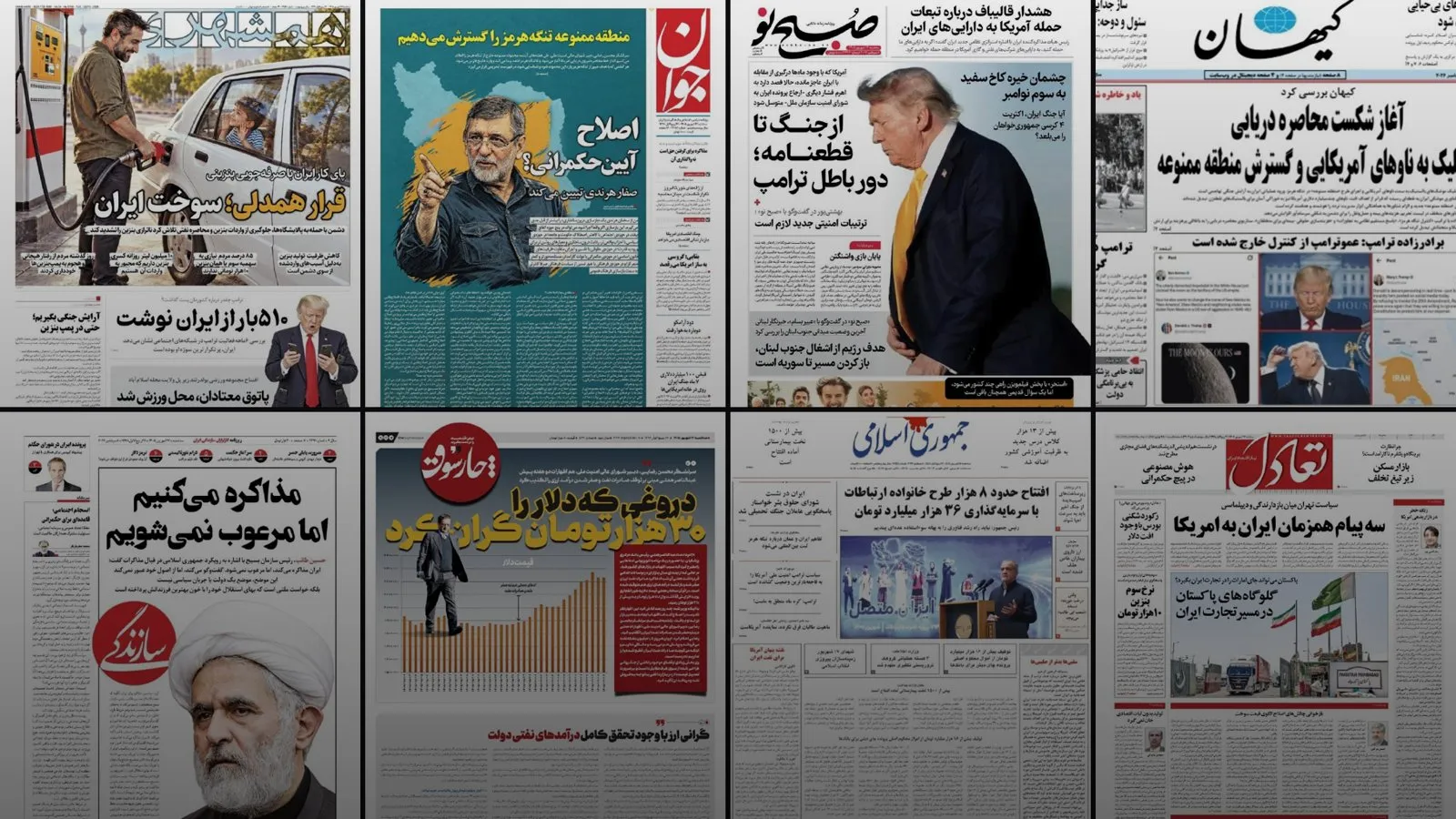
Bottom line: The Hormuz prohibited zone stopped being a threat and became a regime this morning, with Javan printing its geometry (from the American blockade line through the Strait into the Gulf) and its enforcement mechanism (a sanctions list for ships intending to transit), while the same official who authored it, the SNSC secretary, was also enlisted to settle a domestic argument about the exchange rate and Kayhan’s editor returned the campaign at home to two named former presidents with a renewed demand that the judicial and security organs act.
Executive Summary
The lead judgment of the cycle is that the maritime zone has been converted from a declaration into an administrable regime, and that its details were published this morning by the IRGC-affiliated daily rather than by a ministry. Javan gives its top banner, over a map of Iran, to Major General Mohsen Rezaei, secretary of the Supreme National Security Council: ‘in the coming weeks we will announce the prohibited zone outside the Strait of Hormuz, which begins at the line of the American naval blockade and continues to the Strait of Hormuz and enters the Persian Gulf. Any ship that enters this zone with the intention of transiting the Strait will be identified and placed on the sanctions list.’ The geometry, the enforcement mechanism and the conditionality are all reported identically outside the Iranian press, so the substance is verified even though the formal text has not been issued. Kayhan’s front makes the same move in doctrinal language, leading with ‘the breaking of the naval blockade begins, with the firing at American warships and the expansion of the prohibited zone’ and printing a signed analysis that claims detection and targeting of moving naval targets from shore at 180 to 300 kilometres and describes Iran’s formal entry into anti-access and area denial. The test this monitor set on 7 September, whether a written zone declaration would follow the verbal one, is not yet met: what exists is a schedule (‘in the coming weeks’) and a mechanism, which is more than a threat and less than an instrument.
The most consequential structural finding is jurisdictional. The same SNSC secretary who authored the zone is quoted on the Defa Press wire saying that ‘the operational posture against the ships and military bases of the United States has been fundamentally revised’, which extends the maritime doctrine to land targets and appears on no front page, and he is simultaneously the authority Chahar Sough uses to settle a domestic economic dispute: the economic daily leads with ‘the lie that made the dollar 30,000 toman more expensive’, reporting that Rezaei has denied the central bank governor’s statement of two weeks ago that oil exports had stopped and currency income had gone to zero. In one morning the security council’s secretary is the author of a maritime regime, the author of a revised posture toward American bases, and the arbiter of the exchange rate. That is a wider grant of jurisdiction than the naval escalation itself, and it is being conferred by the press rather than announced by the state.
Against the zone, a second and quieter track was advancing on the same pages. Jomhouri Eslami’s rail reports, from the Foreign Ministry, that ‘the Iran-Oman understanding on the Strait of Hormuz is to be registered internationally’, which outside reporting describes as days away and intended to be lodged with the International Maritime Organization; Etemad reports ‘Tehran’s initiative for a Hormuz architecture’; Vatan-e Emrooz’s channel records that Iran’s conditions for reopening the Strait were reviewed at the Majlis National Security Commission with Foreign Minister Araghchi present; and Sobh-e No prints the Qatari foreign ministry spokesman telling CNN that Doha’s ‘main priority is the reopening of the Strait of Hormuz’ and that it does not want ‘a temporary halt’ to be returned to in a few months. Four separate institutions, a ministry, a parliament, a mediator and a UN agency, are being attached to the same waterway that the security council proposes to administer by sanctions list. The Hormuz file now has two owners and two instruments, and which one is used first is the most consequential near-term question in this edition.
At home the flagship reversed the softening this monitor recorded yesterday. Kayhan’s ‘Yadasht-e Rooz’, bylined Hossein Shariatmadari and translated in full in Appendix B, returns to named individuals after a day of naming no one: it accuses Hassan Rouhani and Mohammad Khatami of Quranic-style ‘distortion’ for substituting ‘war’ for ‘defense’ and ‘peace’ for ‘surrender’, calls the two proposals ‘dishonorable and abject surrender’, states that their concordance with America’s declared demands ‘cannot be accidental’, and closes with the demand that ‘the judicial and security centres must not pass over it easily, because an error, when it settles into repetition, is a line and not an error’. The tracking cue set on 7 September, whether the flagship would return to names, is therefore answered inside 24 hours and in the harder direction: the ask has moved back from ‘acceptance of responsibility’ to action by the organs, and the column is marked ‘to be continued’. The establishment paper drifted the same way: Jomhouri Eslami, whose editorial on 7 September argued the Prophet’s treaty of Hudaybiyyah toward settlement, this morning runs ‘the negativists are worse than the Crusaders’, attributing the internal spreading of despair to the direction of the CIA and Mossad, while re-printing at the foot of its page, for a second consecutive day, Ayatollah Beheshti’s warning that political matters must not be brought into judicial ones.
The reply from the settlement camp was to move the argument off vocabulary and onto a text. Etemad leads with ‘the American bluff’, argues that the sanctions architecture merely diverts activity into less transparent channels, and prints ‘the memorandum, without addition or subtraction’, reporting political activists who describe a roadmap back to the ‘14-article agreement’. That is a deliberate lowering of the target profile: a signed text is harder to designate as enemy code than the word ‘peace’. Sazandegi does the opposite and borrows the establishment’s own register, leading with Hossein Taeb, described on the page as head of the Basij Organization, saying ‘we will negotiate, but we will not be intimidated’, and treating the IAEA director general as an interlocutor with a ‘proposal for cooperation with Tehran’ on the same morning that Javan’s rail carries the Foreign Ministry spokesman’s line that ‘Grossi dances to America’s tune’. Two Iranian front pages describing the same man in opposite terms on the day his Board meets is the sharpest single divergence in this edition.
The Speaker’s two hats were printed on one page for the first time. Sobh-e No, the paper closest to his camp, introduces Mohammad-Baqer Ghalibaf as ‘head of Iran’s negotiating delegation’ and quotes him warning that ‘if you attack our assets, we will attack the assets of the American oil and gas companies in the region’, a statement verified outside the Iranian press as his reply to the American war secretary’s threat to destroy and sink Iran’s tanker fleet. Directly beneath it the same front carries an interview with Hassan Beheshtipour arguing that ‘new security arrangements are necessary’. Kayhan carries the same threat on its rail. The man who would sign any settlement is now also the most quotable author of the threat to widen the war to energy infrastructure, and his own paper prints both without treating them as a contradiction.
On the economy the price decision passed and the personnel campaign hardened. The third gasoline tier rose from 5,000 to 10,000 toman at midnight, with the 1,500 and 3,000 toman tiers untouched, exactly as announced. Hamshahri leads with ‘a pact of solidarity: Iran’s fuel’, attributing the shortfall to enemy strikes on refineries and the oil blockade, citing a 10-million-litre daily gap, praising the public for not rushing the pumps, and running its own managing director’s column, ‘let us take a war formation, even at the gas pump’. The First Vice-President’s channel line is that only 15 percent of consumption is affected and that a fourth tier implemented in Kerman was done without permission and will not stand. Against that cushioning, Chahar Sough’s second day on the central bank governor moves from demanding removal to alleging a market-moving falsehood, and its cartoon shows the First Vice-President asking what to do about the dollar and the communications minister proposing to unblock Telegram and Twitter for state bodies ‘to keep the people entertained’. Ta’adol reads the whole day benignly, as ‘Iran’s three simultaneous messages to America’ between deterrence and diplomacy, and is alone in flagging Pakistan’s chokepoints on Iran’s eastern trade route.
Two lanes moved against the escalation. On Lebanon, the SNSC-linked wire itself deflated the story: Nour News states that Israel’s claim of operational control over Ali al-Taher has not been independently confirmed, that Hezbollah has issued no official reaction, and that a senior Israeli official cast doubt on the presence of any Iranian officer or adviser in the tunnels, reading the operation as compensatory narrative-building before Netanyahu’s October election; Defa Press’s analyst says the front line has moved to Nabatieh and al-Jarmaq and that claims of a complete clearing cannot be accepted without independent evidence. An Iranian security wire arguing against an Iranian presence is the reverse of the boast pattern, and it is the fourth distinct handling of the ridge in four days. In English, the government’s own paper carried no naval story at all: Iran Daily leads with a record 6.9 million points on the Tehran exchange, then the Human Rights Council demand from Geneva, an IAEA retaliation warning and an interview arguing that the American push to refer Iran’s file signals strategic confusion because Russia and China would veto any new measure. The strongest evidentiary item of the day is on Vatan-e Emrooz’s channel: the UN High Commissioner for Human Rights, named, on the 10 Shahrivar American strike on a house in Kuhestak, Sirik county, during a wedding, with four to five civilians including children killed and about 68 to 70 wounded.
Net assessment: this is a jurisdiction edition. The naval escalation of 5 September has now produced an administrable regime with a published geometry and an enforcement mechanism, a claimed revision of posture toward American land bases, and a security-council secretary whose authority has visibly extended into exchange-rate politics, all while a second architecture for the same waterway is being built through Oman, the IMO, the Majlis and Qatari mediation. At home the flagship has resolved the ambiguity of the last two editions in the direction of names and organs, and the establishment paper has followed part of the way, while the settlement camp has retreated to the safer ground of a signed text. The consequential findings are that the zone is scheduled but still unwritten; that the posture claim about American bases is single-source and unrepeated; that Kayhan has restored the demand for judicial and security action against two former presidents; that the SNSC secretary is now arbitrating economic disputes; and that the Iranian security wires are themselves deflating the Lebanon claim and denying an Iranian presence at Ali al-Taher. The threads to watch are whether the zone is issued as a written text or a notice to mariners, whether the Oman understanding is actually lodged with the IMO and how the zone is reconciled with it, whether any prosecutor acts on Kayhan’s demand, whether the Board of Governors adopts its resolution before it closes on 11 September and what Iran’s promised reciprocal step turns out to be, and whether the Leader, silent now for a seventh edition, speaks before any of these are settled.
Key Points
- KJ-1 [HIGH] The Hormuz prohibited zone has moved from declaration to administrable regime, with a published geometry, an enforcement mechanism and a stated schedule, but it remains unwritten. Evidence: Javan’s banner quoting the SNSC secretary that the zone begins at the American blockade line, continues through the Strait and enters the Gulf, and that any ship entering it intending to transit will be identified and placed on a sanctions list, with an announcement promised ‘in the coming weeks’; the same geometry, mechanism and conditionality reported outside the Iranian press; Kayhan’s lead treating the zone’s expansion as already under way; against it, no formal text, notice to mariners or Foreign Ministry instrument has appeared, and the government daily prints nothing of it. Significance: a sanctions-list regime administered against shipping is a legal and insurance instrument rather than a purely military one, and it would bind third-country carriers rather than the United States, which is why the written text is the thing to watch and not the rhetoric.
- KJ-2 [HIGH] Kayhan has reversed its one-day softening and restored the demand that the judicial and security organs act, now against two named former presidents, which resolves the ambiguity this monitor flagged on 7 September in the harder direction. Evidence: Shariatmadari’s signed column naming Hassan Rouhani and Mohammad Khatami, charging Quranic-style distortion, characterizing their proposals as dishonorable surrender, asserting that their concordance with American demands cannot be accidental, and closing that the judicial and security centres ‘must not pass over it easily, because an error, when it settles into repetition, is a line and not an error’; the column marked ‘to be continued’; Jomhouri Eslami’s editorial converging on an internal enemy directed by foreign services. Significance: the formula converts repeated speech into a standing offence and supplies a prosecutable frame; the tracking cue is now whether any prosecutor or security body acts on it, since a demand printed twice and ignored twice would itself be evidence of the flagship’s limits.
- KJ-3 [MODERATE-HIGH] A second and competing architecture for the Strait was advancing on the same pages, and Iran is running a legal-diplomatic track and a coercive track over the same water simultaneously. Evidence: Jomhouri Eslami’s Foreign Ministry line that the Iran-Oman understanding is to be registered internationally, matched outside Iran by reporting that the understanding is days away and intended for lodging with the International Maritime Organization; Etemad’s ‘Tehran’s initiative for a Hormuz architecture’; the Majlis National Security Commission reviewing Iran’s conditions for reopening the Strait with Araghchi present; Qatar’s stated priority of reopening the Strait and its rejection of a temporary halt. Significance: the two tracks are not compatible instruments, since an IMO-lodged corridor implies admitted traffic while a sanctions-list zone implies denied traffic, so which is issued first will indicate whether the security council or the ministry holds the file; confidence is moderate-high because the Oman text has not been published and the zone has not been written.
- KJ-4 [MODERATE-HIGH] The Supreme National Security Council’s secretary has visibly acquired jurisdiction beyond the maritime file, including over a domestic economic dispute, which is a structural change larger than the naval escalation that produced it. Evidence: the same official authors the zone on Javan’s banner, is quoted on the Defa Press wire that the operational posture toward American ships and military bases ‘has been fundamentally revised’, and is used by Chahar Sough as the authority whose denial refutes the central bank governor’s account of halted oil exports and zeroed currency income, in a lead that attributes a 30,000 toman move in the dollar to that statement; against it, none of this is stated by the council as an institution, and the base-posture claim appears on one wire only. Significance: an economic policy dispute settled by the security council’s secretary rather than by the government or the bank changes who can be held responsible for the exchange rate; the tracking cue is whether the council issues anything under its own name.
- KJ-5 [MODERATE-HIGH] The Speaker is now printed simultaneously as chief negotiator and as the author of the threat to widen the war to energy infrastructure, and his own camp’s paper presents the two as one policy. Evidence: Sobh-e No’s banner introducing Ghalibaf as ‘head of Iran’s negotiating delegation’ while quoting his warning that American oil and gas company assets in the region would be attacked if Iranian assets are struck; the same threat on Kayhan’s rail; verification outside the Iranian press that the warning was posted on Monday in reply to the American war secretary’s threat to destroy and sink Iran’s tanker fleet; the Beheshtipour interview calling for new security arrangements printed directly beneath it. Significance: the threat is reciprocal and conditional rather than initiatory, which leaves an exit, but it names a target class, regional American energy assets, that no Iranian official had put in writing in this monitor’s record; the tracking cue is whether any operational body repeats the target class.
- KJ-6 [MODERATE] The Iranian security wires are deflating rather than inflating the Lebanon story, and are now actively denying an Iranian presence at Ali al-Taher, which lowers the probability that Iran is preparing a Lebanon move. Evidence: Nour News, linked to the security council, stating that Israel’s claim of operational control is not independently confirmed, that Hezbollah has issued no official reaction, and that a senior Israeli official cast doubt on the presence of any Iranian officer or adviser in the tunnels, and reading the operation as compensatory narrative before Netanyahu’s October election; Defa Press’s analyst moving the front line to Nabatieh and al-Jarmaq and refusing the clearing claim without independent evidence; Sobh-e No’s Lebanese interviewee framing the objective as a corridor to Syria; no repetition on any front or wire of the conditional Iranian-entry formulation recorded on 6 September. Significance: a security wire arguing against its own side’s presence is a de-escalatory tell about intent in Lebanon even as the maritime lane escalates; confidence is moderate because a denial of presence is also the expected line if a presence had been lost.
- KJ-7 [MODERATE] The government is fighting the IAEA Board with a legal case in English and a delegitimization case in Persian, and the split is deliberate rather than incidental. Evidence: Iran Daily’s front carrying an IAEA retaliation warning, the Geneva accountability demand and an interview arguing that referral signals strategic confusion because Russia and China would veto any new measure, with no naval content at all; Javan’s rail carrying the Foreign Ministry spokesman’s ‘Grossi dances to America’s tune’; Sazandegi’s rail treating the same director general as offering cooperation; Kayhan’s rail that Grossi demands answers while staying silent about the attack on the nuclear facilities; the director general’s own statement, carried by Sobh-e No, that since June there has been no interaction and no information and that Iran will not cooperate until a broader political agreement is reached. Significance: the English case is built for the Board’s undecided members and the Persian case for domestic legitimacy, and the two can be run together only until Iran has to name its promised reciprocal step; the tracking cue is what that step is if the resolution passes before the Board closes on 11 September.
- KJ-8 [MODERATE] Negative-evidence finding: the Leader has now been silent for a seventh consecutive edition, through the zone’s publication, the Speaker’s energy threat, the flagship’s naming of two former presidents and the opening of the Board, and no front page records any message, decree or audience. Evidence: no Leader text on ten front pages, six newspaper channels or three wires; his 6 Shahrivar cohesion instruction still cited by competing camps against one another; Jomhouri Eslami’s re-printing of Beheshti on keeping politics out of judicial matters serving as the nearest thing to an adjudicating voice; khamenei.ir was not reachable at compile time, so the finding rests on the printed and broadcast record. Significance: with no Leader text, the highest authorities on record for the escalation remain the security council’s secretary and the Speaker, and the argument about naming and prosecuting former presidents is proceeding without the only figure who can close it; confidence is moderate because the Leader’s own site was not read directly.
Macro Trends
- The zone becomes a regime: geometry, enforcement and a schedule. Javan’s banner publishes what a declaration lacked: the zone runs from the American naval blockade line through the Strait and into the Persian Gulf, any ship entering it intending to transit is identified and placed on a sanctions list, and the announcement is promised ‘in the coming weeks’. Kayhan converts the same thing into doctrine, leading on ‘the breaking of the naval blockade’ and describing formal entry into anti-access and area denial, and Chahar Sough carries ‘American warships within range of Iran’s missiles’ on an economic front. Continuing the standing Hormuz-as-coercion thread: what was a verbal claim on 7 September now has an administrable form, though no written instrument has been issued.
- One office, three jurisdictions: the security council secretary as maritime authority, military planner and economic arbiter. Rezaei authors the zone on Javan’s banner; on the Defa Press wire he says the posture toward American ships and military bases ‘has been fundamentally revised’, extending the doctrine to land targets in language no front page repeats; and on Chahar Sough’s front he is the authority whose denial refutes the central bank governor’s account of oil exports and currency income. The concentration is being performed by the press as much as claimed by the office, and it is a more durable development than any single escalation.
- A second architecture for the same waterway: Oman, the IMO, the Majlis and Qatar. Jomhouri Eslami reports the Iran-Oman understanding on Hormuz to be registered internationally, verified outside Iran as days away and intended for the IMO; Etemad reports ‘Tehran’s initiative for a Hormuz architecture’; Vatan-e Emrooz’s channel records the Majlis National Security Commission reviewing Iran’s conditions for reopening the Strait with Araghchi present; and Sobh-e No prints Qatar’s line that reopening the Strait is its main priority and that it does not want a temporary halt. The same water is being claimed by a sanctions-list regime and by a treaty-and-agency architecture on the same morning.
- Back to names: the flagship restores the demand for judicial and security action. Shariatmadari’s column names Hassan Rouhani and Mohammad Khatami, charges them with Quranic-style distortion for exchanging ‘war’ for ‘defense’ and ‘peace’ for ‘surrender’, calls their proposals surrender, asserts their concordance with American demands ‘cannot be accidental’, and asks the judicial and security centres not to pass over it, ‘because an error, when it settles into repetition, is a line and not an error’. Continuing the Marashi-to-Rouhani-to-vocabulary thread: the softening recorded on 7 September lasted one day, and the column is marked ‘to be continued’.
- The settlement camp retreats from vocabulary to text, and borrows the register of dignity. Etemad answers not by defending the words Kayhan attacked but with ‘the memorandum, without addition or subtraction’ and a roadmap back to the 14-article agreement, alongside its argument that the sanctions architecture is a bluff. Sazandegi leads with a security figure’s ‘we will negotiate, but we will not be intimidated’ and treats Grossi as offering cooperation, the exact inverse of Javan’s ‘Grossi dances to America’s tune’ on the same day his Board meets. The contest over settlement is migrating from adjectives to instruments.
- The Speaker’s two hats printed on one page. Sobh-e No introduces Ghalibaf as head of Iran’s negotiating delegation while quoting his threat to strike American oil and gas companies in the region if Iranian assets are attacked, verified outside Iran as his reply to the American war secretary’s threat to sink Iran’s tanker fleet, and runs an analyst directly beneath it calling for new security arrangements. Kayhan carries the same threat on its rail. The negotiator and the escalation voice are now the same by-line on the same front page.
- The fuel decision cushioned and weaponized at once. The third tier rose to 10,000 toman at midnight with the lower tiers untouched. Hamshahri charges the shortfall to enemy strikes and the blockade, cites a 10-million-litre daily gap, praises the public for not rushing the pumps and runs its own editor’s ‘war formation at the gas pump’; the First Vice-President’s channel says only 15 percent of consumption is affected and disowns a fourth tier implemented in Kerman. Simultaneously Chahar Sough escalates from demanding the central bank governor’s removal to alleging a falsehood that moved the dollar by 30,000 toman. The same decision is being absorbed by the municipal press and used as ammunition by the principlist economic press.
- The wires deflate Lebanon, and the English lane carries no war. Nour News, linked to the security council, states that Israel’s Ali al-Taher claim is unconfirmed, that Hezbollah has not reacted and that a senior Israeli official doubted any Iranian officer was in the tunnels; Defa Press’s analyst moves the front line to Nabatieh and al-Jarmaq and refuses the clearing claim without independent evidence; Sobh-e No’s Lebanese interviewee supplies a different objective, a corridor to Syria. Meanwhile Iran Daily leads on a record bourse, Geneva accountability and the IAEA, with no naval story, so the legal and economic case is made in English while the doctrine is declared in Persian.
Front-Page Snapshot
- Javan - “We will expand the Strait of Hormuz prohibited zone” (Hardline, IRGC-affiliated) - The zone’s geometry and sanctions-list enforcement published; governance reform aired below it [HIGH]
- Kayhan - “The breaking of the naval blockade begins, with the firing at American warships and the expansion of the prohibited zone” (Ultra-hardline flagship) - Naval doctrine ratified; Rouhani and Khatami named and referred to the judicial and security organs [SEVERE]
- Sobh-e No - “From war to resolution: Trump’s vicious circle” (Principlist, Speaker’s camp) - Ghalibaf as negotiator and as the author of the threat to American energy assets; new security arrangements urged [MODERATE-HIGH]
- Vatan-e Emrooz - “The equation-making strategy” (Hardline principlist) - Multi-domain pressure strategy; the UN human rights chief on the Sirik wedding strike; Majlis conditions for reopening the Strait [HIGH]
- Jomhouri Eslami - “Around 8,000 communications-family projects inaugurated, with 36 trillion toman of investment” (Traditional establishment) - Iran-Oman Hormuz understanding to be registered internationally; editorial turns on the internal ‘negativists’; Beheshti caution reprinted [MODERATE-HIGH]
- Etemad - “The American bluff” (Reformist) - Sanctions as diversion rather than closure; a roadmap back to the 14-article memorandum; the Hormuz architecture; CENTCOM’s blockade figures [LOW-MODERATE]
- Sazandegi - “We will negotiate, but we will not be intimidated” (Reformist, Kargozaran) - A security-lane voice for negotiation; Grossi as interlocutor; the end of house arrest kept on the front [LOW]
- Chahar Sough - “The lie that made the dollar 30,000 toman more expensive” (Economic, principlist-leaning) - Central bank governor accused of a market-moving falsehood, with the SNSC secretary as arbiter; warships within missile range [MODERATE]
- Hamshahri - “A pact of solidarity: Iran’s fuel” (Tehran municipality, centrist) - Fuel shortfall charged to enemy strikes and the blockade; public praised for calm; a war formation at the pump [LOW-MODERATE]
- Ta’adol - “Iran’s three simultaneous messages to America” (Economic) - Deterrence and diplomacy read as one designed signal; Pakistan’s chokepoints on the eastern trade route [LOW]
- Iran Daily (English) - “Tehran stocks hit record 6.9m points on strong buying” (State English-language daily) - No naval story; Geneva accountability demand, IAEA retaliation warning, referral called strategic confusion [LOW-MODERATE]
- Defa Press / Fars / Nour News (wires) - “Washington has received a clear warning from Iran’s new missiles; the economic war will be answered by a prohibited maritime zone across the Persian Gulf” (IRGC-aligned and SNSC-linked wires) - Posture toward American bases said to be fundamentally revised; Ali al-Taher claims deflated and an Iranian presence denied; the 10,000 toman tier confirmed in force [MODERATE-HIGH]
Full report
The complete edition - per-paper front-page analysis and full translation appendices - is available as a PDF: Download the full report.
Compiled from Iranian front pages and outlet channels via open-source monitoring. Translations are editorial; named-figure attributions are verified against the source pages where possible.