Iranian Press Monitor - Monday, 7 September 2026 (Day 188)
Monday, 7 September 2026 · 16 Shahrivar 1405 · 25 Rabi al-Awwal 1448 - Twelve Persian front pages (nine from the Monday 16 Shahrivar Tasnim batch, three from the Vatan-e Emrooz, Sobh-e No and Jam-e Jam channels), plus the Kayhan, Vatan-e Emrooz, Jam-e Jam, Iran, Etemad and Sobh-e No channels and the Defa Press, Fars and Nour News wires; the English kiosk re-posted the 6 September Iran Daily and Tehran Times was unavailable at the time
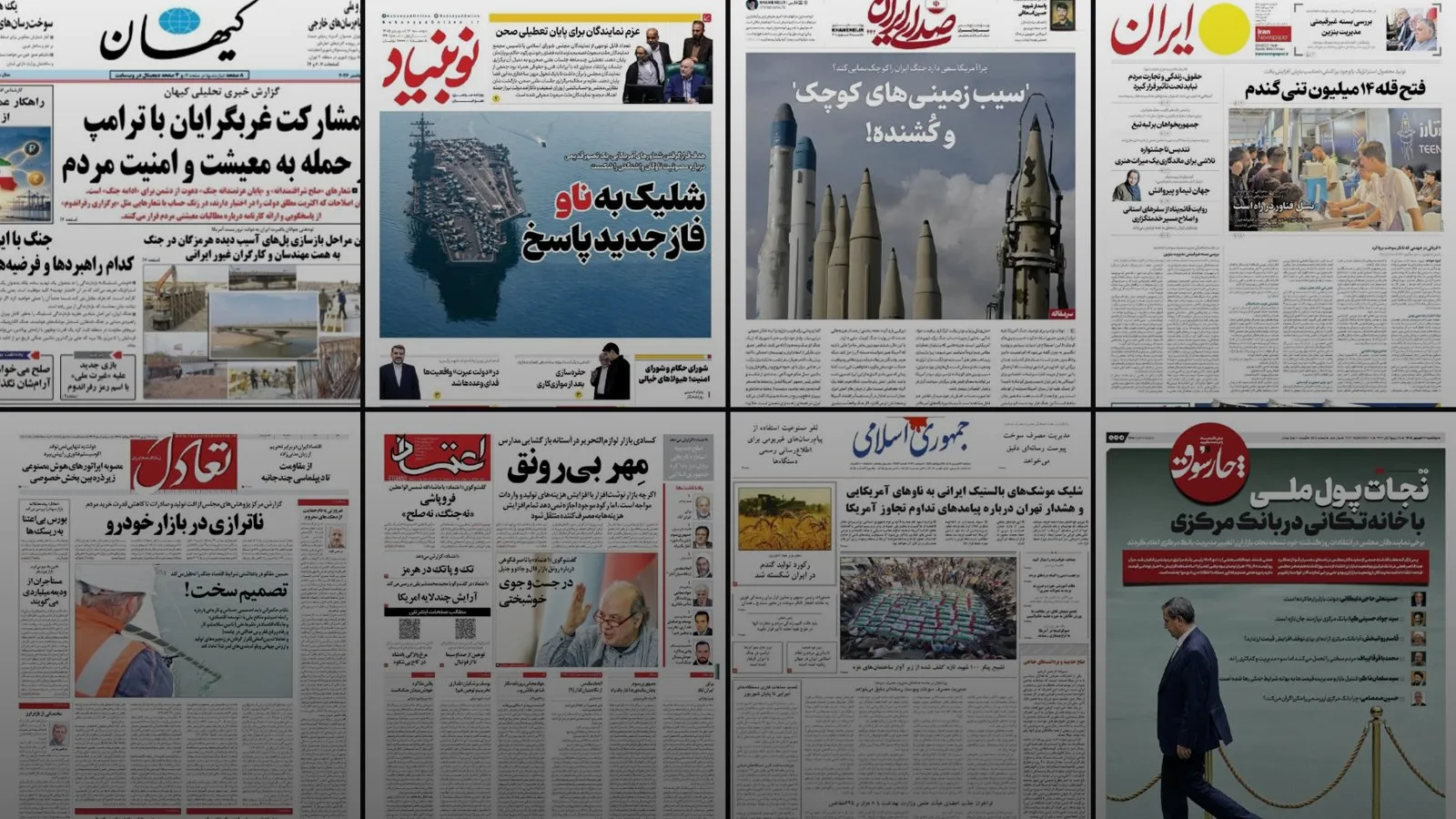
Bottom line: The Monday fronts convert the 5 September exchange of fire into doctrine, with the Speaker declaring the era of proportionate responses over and the new SNSC secretary claiming a missile ‘test’ over a US warship and a prohibited zone beyond the Strait, while Kayhan’s lead moves the domestic campaign from persons to words by defining ‘referendum’ and ‘honorable peace’ as the enemy’s line: the escalation is now being written by civilian authorities, and the argument over ending the war has moved onto scripture, where only the silent Leader can settle it.
Executive Summary
The lead judgment of the cycle is that the naval exchange of 5 September has been promoted from an incident to a doctrine, and that the promotion has been ratified within 24 hours by two civilian authorities rather than by the IRGC alone. Nobonyad leads ‘Firing at the carrier: a new phase of the response’, Qods ‘Warships within range of the missiles’, with the deck that the confrontation ‘has entered a new stage’, Vatan-e Emrooz ‘Changing the equation’ over ‘Iran’s successful missile attack’, and Jomhouri Eslami prints the IRGC’s damage-and-flight claim and the Foreign Ministry’s warning as a straight two-claim lead. Around the pages sit the two ratifications: Speaker Ghalibaf’s Sunday statement, carried by Kayhan, Iran and Sobh-e No, that ‘the era of appropriate responses has ended’ and ‘the rules of the game have changed’, and Mohsen Rezaei’s remark, printed by Seday-e Iran and verified against Asr-e Iran and Mashregh, that ‘48 hours ago, for the first time, we tested the Iranian anti-destroyer missile over the head of an American warship; this special missile created hell for the Americans and they fled’, together with his announcement that a prohibited zone (منطقه ممنوعه) will be declared beyond the Strait for sanction-violating ships. Rezaei has been secretary of the Supreme National Security Council since 9 August, so the ‘zone’ formula that this monitor recorded on 6 September as IRGC-only language now has a civilian-security author. CENTCOM’s account, that both ships evaded the missiles and that three Iranian tankers were destroyed or disabled, appears on no Persian front except as the tanker strikes in Qods’s body text and in the Foreign Ministry’s ‘war crime’ warning on Jomhouri Eslami.
The most consequential domestic item is Kayhan’s unsigned page-one lead, ‘Westernizers’ partnership with Trump in the attack on the people’s livelihood and security’, translated in full in Appendix B. On 6 September the flagship asked why the security organs had not ‘wiped out’ the reformist current; today it names no one and instead defines the current’s vocabulary: ‘honorable peace’, ‘dignified end to the war’ and ‘referendum’ are ‘the enemy’s line for continuing the war’, the reformists’ description of the economy sends ‘dangerous and treasonous signals to the Western side’ and shares ‘a common denominator with the enemy’s economic war room in New York and Tel Aviv’, and a ‘far more toxic’ tier exists whose function is ‘beautifying America’s satanic face’. The boxed kicker gives the day’s label, ‘a new game against national zeal under the code name referendum’. The contest is explicit because the other side printed the words the same morning: Sazandegi’s daily note by the former diplomat Kourosh Ahmadi is titled ‘A referendum is not for war’ and calls for public dialogue on ending the war; Etemad’s interview with Mashallah Shamsolvaezin is headlined ‘the collapse of neither war nor peace’, a phrase that also headlined a Khabaronline interview the same day; and Vatan-e Emrooz’s column rejects the ‘bread versus standing firm’ binary in Kayhan’s own terms. The sequence since 4 September has run from a party secretary to a former president to the current as a whole to the vocabulary; the target has broadened and the ask has softened from action by the organs to ‘acceptance of responsibility’.
The argument over ending the war has moved onto scriptural ground. Three papers contest the Treaty of Hudaybiyyah on one morning: Kayhan carries a contributed article, ‘Hudaybiyyah: a truth distorted in the name of compromise’; Etemad reports ‘the peace of Hudaybiyyah: a historical metaphor on the Islamic Republic’s negotiating table’, following Ali-Akbar Salehi’s interview with IBNA that ‘the Prophet reached the conquest of Mecca by way of the peace of Hudaybiyyah’; and Jomhouri Eslami’s unsigned house editorial, translated in Appendix C, rebukes clergy of both camps for ‘attributing their factional inclinations to the Quran’, then states that the treaty was signed from weakness with 1,400 companions, that the Prophet conceded ‘even the attributes of God and the title of his own mission’ to get it signed, and that the ‘manifest victory’ of Sura al-Fath is the growth of the faith afterward, not the conquest of Mecca. The editorial’s posture is even-handed and its substance favors settlement. Its foot-of-page quotation from Ayatollah Beheshti, that ‘political matters must not be brought into judicial matters’, printed the morning after Kayhan asked the organs to act, reads as a deliberate caution. The significance is that the settlement question is now being argued in the register where the Leader’s authority sits, and the Leader has not spoken for a sixth edition.
Ghalibaf is carrying three roles at once, and the principlist camp is dividing around him. He is the escalation voice (‘faster, heavier, more painful’), the brake on the Paydari camp’s counter-infiltration bill (Sazandegi’s lead, ‘Let us not lock the country’: ‘we must write a law that does not create harassment, does not enter the domain of individuals’ personal security… the country cannot be locked for such a mechanism’, said in reply to a Paydari-aligned MP with ‘you cannot decide for me’), and the epigraph of the central bank campaign (‘the people endure hardship, but not mismanagement and negligence’, printed by both Sobh-e No and Chahar Sough). Against him, Nobonyad reports that ‘a notable number of MPs’ have founded an Assembly of the Nation’s Representatives to end the ‘closure of the chamber’ and ‘settle accounts with the weak and inefficient government’, a body that held its first session on 1 September with 124 members; and for him, Sobh-e No charges unnamed rivals with ‘electoral formation instead of military formation’, ‘contrary to national cohesion’, while the Independents’ MP Hamidreza Goudarzi says on the Etemad channel that ‘a minority of MPs, contrary to the Leader’s instruction, inflame society’. The shape is three-cornered: the flagship attacks reformists, the Speaker’s paper attacks the Paydari front, and the Paydari front organizes against the Speaker’s management of parliament, all invoking the same 6 Shahrivar cohesion instruction.
Economic pressure has produced its second personnel target in three days. Chahar Sough, which on 4 September montaged the energy official Saghab Esfahani and on 6 September reported him sidelined, today leads with ‘Saving the national currency with a house-cleaning at the central bank’, a full-height photograph of Abdolnaser Hemmati walking alone and six MPs quoted with portraits, from Haji-Deligani’s ‘the government has abandoned the currency market’ to Zaker’s ‘market control has been abandoned on the pretext of wartime conditions’; the red box recalls the MPs’ 31 August letter asking the heads of the branches to remove him. Vatan-e Emrooz’s ‘Will market stability be achieved?’ makes the campaign cross-outlet, and Sazandegi’s ‘The end of Saghab?’ closes the earlier thread. The gasoline decision, by contrast, was executed with discipline: the third tier goes to 10,000 toman from 17 Shahrivar with the 1,500 and 3,000 quotas untouched, and the fronts divide only in framing, the government daily and Jomhouri Eslami on the President’s ‘media attachment’, Sobh-e No on ‘the quota stayed’, Qods praising ‘a valuable media experience’. Chahar Sough’s second item mocks the energy minister’s ‘I’ll say it a hundred more times, the power won’t be cut again’ against Tavanir’s new outage schedule the next day. Ta’adol’s Hossein Haghgoo names the underlying choice a ‘hard decision’ between security and integration into ‘global value and power blocs’, the technocratic press’s implicit vote for settlement.
Lebanon, Hormuz and the exhaustion frame continue on their tracks with one change each. Ali al-Taher has now had three handlings in three days: silence on 5 September, denial on 6 September, and today Sobh-e No’s ‘Has Israel really taken Ali al-Taher? Retreat toward the border’, an asserted Israeli pullback for which no evidence is printed; Israel’s 3 September claim of operational control stands, Hezbollah has neither confirmed nor denied, and it has rejected Lebanese government overtures to withdraw. Defa Press’s Lebanese commentator Abbas Zalzali calls the ridge ‘part of a bigger battle over who owns the security decision in the south’. The channels carry a two-month-old infant killed in Kafr Rumman, a medic killed by a drone, ten wounded pulled from rubble, and a strike on Deir al-Zahrani. No commander repeated the ‘if Hezbollah requests it’ entry line recorded on 6 September. On Hormuz, Vatan-e Emrooz’s channel supplies the verified numbers, Kpler’s transit count at its lowest since May and oil at 97 dollars, and Nour News, the SNSC-linked wire, argues that ‘Trump’s attempt to belittle the Strait and present alternative routes does not negate its strategic importance’ and that Iran’s responses have moved ‘from strategic patience to punishing the aggressor’. The exhaustion frame again rests on checkable American facts: Leon Panetta’s ‘he has trapped himself’ on Jomhouri Eslami, William Hartung’s Forbes column on Kayhan’s rail, Gallup’s widest party-identification gap since 2008 on the government daily, Chris Murphy and Tammy Baldwin on the Kayhan channel, and Kayhan’s banner that ‘one Iranian warning was enough’ to remove American refuelers from Bulgaria, where the checkable core is that two KC-135s left Bezmer on 21 August and the causal claim is Kayhan’s. The escalation ceiling was voiced on state television by Foad Izadi, whose proposal that the twelve SNSC members who voted for the memorandum should decide to ‘hit all the region’s infrastructure’ so that ‘Trump ends the war fast’ was carried by Etemad’s channel as ‘strange’.
The Leader is absent for a sixth consecutive edition and the international lanes are quiet. No message accompanies the exchange of fire, the Rezaei claim, the Kayhan lead or the IAEA Board, which opens in Vienna today and is mentioned on one front only, Nobonyad’s column dismissing the Board and the Security Council as ‘imaginary monsters’. The Leader’s 6 Shahrivar cohesion instruction is invoked by three parties in three directions. Sobh-e No prepares the ground for Xi Jinping’s 24 September state visit to Washington with ‘Iran-China relations: moving forward’, warning that Beijing’s balancing ‘should not be turned into a lever of pressure’. Qods watches the eastern flank with ‘the crystallization of political militarism in Pakistan’ under Asim Munir’s portrait. The English lane is empty: the kiosk re-posted the 6 September Iran Daily and Tehran Times was unavailable, its indexed 7 September items showing no naval story.
Net assessment: this is a codification edition. The exchange of fire that resumed the naval war on 5 September has, within 48 hours, been written into doctrine by the Speaker and the SNSC secretary rather than left to IRGC statements, and the zone regime over the Strait now has a civilian author. At home, the flagship’s campaign has reached the level of vocabulary, which broadens the target to anyone who uses the words of settlement, while the principlist camp splits around the Speaker and the establishment paper argues, through the Prophet’s treaty, for a peace signed from weakness. The consequential findings are that Rezaei’s claim is single-source and contradicted by CENTCOM; that Kayhan’s lead names no one and asks for less than it did on 6 September; that the Hudaybiyyah argument places the decision with the silent Leader; that Hemmati is the second official targeted in three days; and that the gasoline decision passed without a front-page revolt. The threads to watch are whether the SNSC or the Foreign Ministry issues a formal zone declaration, whether any official repeats ‘referendum equals enemy code’, whether the Assembly of the Nation’s Representatives forces a vote on open sessions, whether the Leader speaks before the Board closes on 11 September, and whether the tanker war produces a fourth Iranian loss or a second American target.
Key Points
- KJ-1 [HIGH] The 5 September naval exchange has been converted into declared doctrine by civilian authorities, not only by the IRGC, and the Iranian press has fixed the reading as a ‘new phase’ in which the notion of American fleet immunity is broken. Evidence: Nobonyad’s and Qods’s ‘new phase’ and ‘new stage’ leads and Vatan-e Emrooz’s ‘changing the equation’; Ghalibaf’s verified ‘era of appropriate responses has ended, the rules of the game have changed’, carried on three fronts; Rezaei’s verified remark, as SNSC secretary, of a first anti-destroyer missile ‘test over the head of an American warship’; Jomhouri Eslami’s two-claim lead. Significance: a doctrine declared by the Speaker and the SNSC secretary is harder to walk back than an IRGC statement, which narrows the memorandum’s path; overstating it would adopt the ‘hit’ claim that CENTCOM contradicts, understating it would miss that the political leadership has now signed the naval escalation.
- KJ-2 [HIGH] Kayhan’s campaign has shifted from named persons to the vocabulary of settlement, designating ‘referendum’, ‘honorable peace’ and ‘dignified end to the war’ as the enemy’s line, which broadens the target to anyone who uses the words while softening the ask from security-organ action to ‘acceptance of responsibility’. Evidence: the unsigned lead’s ‘treasonous signals’, ‘economic war room in New York and Tel Aviv’ and ‘far more toxic’ tier; the kicker ‘code name referendum’; the absence of any named target; Vatan-e Emrooz’s parallel rejection of the ‘bread versus standing firm’ binary; Sazandegi’s and Etemad’s use of exactly those words the same morning. Significance: the contest is now lexical and therefore total; the tracking cue is whether the Speaker, who negotiates, or any official adopts ‘referendum equals enemy code’, and whether Kayhan returns to names.
- KJ-3 [MODERATE-HIGH] The Hormuz zone regime recorded on 6 September as IRGC-only language now has a civilian-security author, and the test set by this monitor yesterday has been met: Rezaei, as SNSC secretary, announced a prohibited zone beyond the Strait for sanction-violating ships. Evidence: Seday-e Iran’s front-page Rezaei item; the Mashregh and Asr-e Iran reports of the same remarks with the zone announcement; IRGC statement No. 11’s ‘protected zone’; Nour News’s insistence on the Strait’s ‘strategic importance’; against it, no formal SNSC or Foreign Ministry declaration has been seen, and the government daily prints nothing of it. Significance: a formal declaration would change the legal character of the confrontation and the coalition calculus; confidence is moderate-high because the announcement is verbal and single-source, and the next test is a written text from the SNSC or the Foreign Ministry.
- KJ-4 [MODERATE-HIGH] The principlist camp is dividing along a Speaker-versus-Paydari line while the flagship attacks reformists, giving the domestic contest a three-cornered shape in which every camp invokes the Leader’s cohesion instruction against the others. Evidence: Sazandegi’s lead on Ghalibaf’s ‘Let us not lock the country’ and ‘you cannot decide for me’ (verified); Nobonyad’s report of the Assembly of the Nation’s Representatives, real and 124 strong, organizing to end virtual sessions and ‘settle accounts’; Sobh-e No’s ‘electoral formation instead of military formation’; Goudarzi’s ‘minority of MPs against the Leader’s instruction’; Kayhan’s ‘national unity’. Significance: a Speaker who is simultaneously chief negotiator, escalation spokesman and target of his own camp is the single point on which both the settlement track and the domestic balance depend; the tracking cue is a vote on open sessions or on article 12 of the infiltration bill.
- KJ-5 [MODERATE] The Hudaybiyyah debate marks the settlement question’s migration onto religious ground, and the establishment paper’s reading favors a peace signed from weakness while rebuking both camps. Evidence: Kayhan’s ‘distorted in the name of compromise’; Etemad’s ‘metaphor on the negotiating table’ after Salehi’s verified IBNA interview; Jomhouri Eslami’s editorial, translated in Appendix C, on the treaty signed with 1,400 against an ambush and the ‘manifest victory’ as the faith’s growth; its Beheshti quotation on politics and courts. Significance: arguments from the Prophet’s practice can be closed only by the Leader, who has not spoken; his first intervention on the treaty, in either direction, would be decisive for the memorandum’s return. Confidence is moderate because the editorial’s closing paragraphs were not retrieved.
- KJ-6 [HIGH] Economic pressure from the principlist side has produced a second personnel target in three days, now the central bank governor, and the campaign is cross-outlet, while the gasoline decision was executed without a front-page revolt. Evidence: Chahar Sough’s Hemmati lead with six quoted MPs and the verified 31 August removal letter; Vatan-e Emrooz’s ‘Will market stability be achieved?’; Sazandegi’s ‘The end of Saghab?’; the verified 10,000-toman third tier from 17 Shahrivar with quotas untouched, framed as ‘media attachment’, ‘the quota stayed’ and ‘a valuable media experience’ on four fronts; Tavanir’s schedule against the minister’s promise. Significance: the government is losing officials to press campaigns at the rate of one every two days, but it has shown it can pass a price decision when the quota is protected and the Speaker’s paper is aboard; the tracking cue is whether the heads of the branches answer the Hemmati letter.
- KJ-7 [MODERATE] The resistance lane has moved Ali al-Taher from denial to an asserted Israeli retreat without evidence, and, as negative evidence, no commander repeated the conditional Iranian-entry line of 6 September. Evidence: Sobh-e No’s ‘Retreat toward the border’; Zalzali on Defa Press calling the ridge ‘part of a bigger battle over who owns the security decision in the south’; Israel’s standing claim of operational control and Hezbollah’s rejection of Lebanese overtures; strikes on Kafr Rumman, Deir al-Zahrani and a medic on every channel; no Iranian-entry formulation on any front or wire. Significance: the ‘retreat’ claim is the third handling in three days and prepares the ground either for a claimed Hezbollah recovery or for absorbing a confirmed loss; the entry line’s non-repetition lowers, for now, the probability that Iran is preparing a Lebanon move.
- KJ-8 [MODERATE] Negative-evidence finding: the Leader remains silent for a sixth edition through the codification of naval doctrine, the flagship’s vocabulary campaign and the opening of the IAEA Board, and the American version of the exchange is absent from every Persian lead. Evidence: no message on twelve fronts, six channels or three wires, with khamenei.ir unreachable and secondary indexing showing nothing new; the cohesion instruction of 6 Shahrivar used by three camps in three directions; the Board mentioned only by Nobonyad as an ‘imaginary monster’; CENTCOM’s ‘evaded’ and the three tanker losses missing from every Persian lead; the English lane unseen. Significance: consistent with the pattern of the Leader acting through intermediaries, and it leaves the Speaker and the SNSC secretary as the highest authorities on record for the escalation; a Leader text before the Board closes on 11 September would be the first test of whether he owns the doctrine, the zone or the domestic campaign. Confidence is moderate because khamenei.ir was not read directly.
Macro Trends
- From incident to doctrine: the exchange becomes a ‘new phase’. Nobonyad’s ‘a new phase of the response’, Qods’s ‘a new stage’, Vatan-e Emrooz’s ‘changing the equation’ over a ‘successful’ attack, Jomhouri Eslami’s straight two-claim lead. Ratified by Ghalibaf (‘the era of appropriate responses has ended; the rules of the game have changed’) and by Rezaei, as SNSC secretary, claiming a first anti-destroyer missile ‘test over the head of an American warship’ and announcing a prohibited zone beyond the Strait. CENTCOM’s ‘evaded’ and the three tanker losses are absent from every lead. Continuing the resumption thread of 6 September: the naval war now has civilian authors.
- The vocabulary war: ‘referendum’ and ‘honorable peace’ as enemy code. Kayhan’s unsigned lead defines ‘honorable peace’, ‘dignified end to the war’ and ‘referendum’ as ‘the enemy’s line’, calls the reformists’ economic description ‘treasonous signals’ and posits a ‘far more toxic’ tier; its kicker names ‘the code name referendum’. The same morning Sazandegi prints Kourosh Ahmadi’s ‘A referendum is not for war’, Etemad prints Shamsolvaezin’s ‘collapse of neither war nor peace’, and Vatan-e Emrooz’s column rejects the ‘bread versus standing firm’ binary in Kayhan’s terms. Continuing the Marashi-to-Rouhani thread: the target has broadened from persons to words, the ask has narrowed from action by the organs to ‘acceptance of responsibility’.
- Hudaybiyyah: the settlement argument moves onto scripture. Kayhan’s contributed article calls the treaty ‘a truth distorted in the name of compromise’; Etemad calls it ‘a historical metaphor on the negotiating table’ after Salehi’s IBNA interview; Jomhouri Eslami’s house editorial rebukes both camps for attributing factional positions to the Quran, then reads the treaty as signed from weakness with the ‘manifest victory’ being the faith’s growth, not Mecca’s conquest, and prints Beheshti on keeping politics out of the courts. The debate now sits in the register where the Leader’s authority lies, and the Leader is silent.
- The Speaker’s three roles and the principlist split. Ghalibaf is the escalation voice, the brake on the Paydari counter-infiltration bill (‘Let us not lock the country’, ‘you cannot decide for me’, Sazandegi’s lead) and the epigraph of the central bank campaign (‘people endure hardship, but not mismanagement’). Nobonyad reports the Assembly of the Nation’s Representatives organizing to end virtual sessions and ‘settle accounts with the government’; Sobh-e No charges rivals with ‘electoral formation instead of military formation’; Goudarzi says ‘a minority of MPs’ defy the Leader’s instruction. Three camps invoke the same 6 Shahrivar cohesion message against each other.
- From Saghab to Hemmati: the personnel campaign reaches the central bank; gasoline passes quietly. Chahar Sough’s lead, six MPs with portraits and the 31 August removal letter, plus Vatan-e Emrooz’s ‘Will market stability be achieved?’, make the Hemmati campaign cross-outlet two days after the same paper’s Saghab montage preceded his sidelining; Sazandegi closes that thread with ‘The end of Saghab?’. The third-tier gasoline price of 10,000 toman from 17 Shahrivar, quotas untouched, drew no front-page revolt: the government daily and Jomhouri Eslami print the ‘media attachment’, Sobh-e No ‘the quota stayed’, Qods praise. The energy minister’s blackout promise is mocked as Tavanir re-issues its schedule. Ta’adol’s ‘hard decision’ names the security-versus-integration choice. Continuing the domestic-cost thread.
- Ali al-Taher from denial to ‘retreat’; Hormuz numbers as leverage; exhaustion on verified facts. Sobh-e No asserts an Israeli ‘retreat toward the border’ without evidence, the third handling of the ridge in three days; Israel’s control claim stands and Hezbollah has rejected Lebanese withdrawal overtures; no commander repeats the conditional-entry line. Vatan-e Emrooz’s channel carries Kpler’s lowest-since-May transit count and oil at 97 dollars; Nour News says Trump’s belittling of the Strait ‘does not negate its importance’. Panetta, Hartung, Gallup, Murphy and Baldwin supply checkable American facts; Kayhan’s Bulgaria banner attaches an Iranian cause to a verified departure. Foad Izadi’s ‘hit all the region’s infrastructure’ marks the escalation ceiling on state television.
- The Leader silent for a sixth edition; the Board opens unremarked; the English lane empty. No Leader text on the exchange, the Rezaei claim, the Kayhan lead or the IAEA Board, which opens in Vienna today and appears on one front only, as Nobonyad’s ‘imaginary monsters’. Sobh-e No prepares for Xi’s 24 September Washington visit; Qods watches Pakistan’s ‘political militarism’. The kiosk re-posted the 6 September Iran Daily and Tehran Times was unavailable, so the government’s English voice on the naval war is unseen for a second day.
Front-Page Snapshot
- Jomhouri Eslami - “Firing of Iranian ballistic missiles at American warships, and Tehran’s warning on the consequences of continued American aggression” (Traditional / establishment) - IRGC claims and Foreign Ministry warning printed as claims; Hudaybiyyah editorial; Panetta ‘trapped’ [MODERATE]
- Nobonyad - “Firing at the carrier: a new phase of the response” (Conservative / principlist) - Exchange promoted to doctrine; IAEA Board and UNSC as ‘imaginary monsters’; MPs’ assembly against virtual sessions [HIGH]
- Vatan-e Emrooz - “Changing the equation” (Hardline principlist) - ‘Successful’ carrier attack as strategic turn; Hormuz traffic and oil price; Hemmati under review [HIGH]
- Qods - “Warships within range of the missiles” (Conservative, Astan Quds Razavi) - ‘New stage’ with both sides’ claims; Pakistan’s militarism; gasoline handling praised [MODERATE-HIGH]
- Seday-e Iran - “‘Small potatoes’, and deadly!” (Principlist-leaning) - America ‘downplaying’ the war; Rezaei’s anti-destroyer missile claim and prohibited zone [HIGH]
- Kayhan - “Westernizers’ partnership with Trump in the attack on the people’s livelihood and security” (Ultra-hardline flagship) - ‘Referendum’ and ‘honorable peace’ as the enemy’s line; Bulgaria refuelers; Hudaybiyyah rebuttal [SEVERE]
- Sazandegi - “Let us not lock the country” (Reformist / Kargozaran) - Ghalibaf against the Paydari infiltration bill; ‘A referendum is not for war’; tanker war [LOW]
- Sobh-e No - “Iran-China relations: moving forward” (Principlist, Speaker’s camp) - China before Xi’s US visit; ‘electoral formation’ charge; Ali al-Taher ‘retreat’; quota preserved [MODERATE]
- Etemad - “A Mehr without bustle” (Reformist) - ‘Collapse of neither war nor peace’; Hudaybiyyah as negotiation metaphor; defense of the President’s son [LOW-MODERATE]
- Chahar Sough - “Saving the national currency with a house-cleaning at the central bank” (Economic, principlist-leaning) - MPs’ campaign to remove Hemmati; energy minister’s blackout promise mocked [MODERATE]
- Iran - “Conquering the 14-million-ton wheat summit” (Official government daily) - Food security; non-price gasoline package; Ghalibaf on rights and trade; Gallup [LOW-MODERATE]
- Ta’adol - “Imbalance in the car market” (Economic) - Majlis Research Center on the car market; Haghgoo’s ‘hard decision’ on security versus integration [LOW]
- Defa Press / Fars / Nour News (wires) - “Trump’s attempt to belittle the Strait does not negate its strategic importance; Iran has moved from strategic patience to punishing the aggressor” (IRGC-aligned and SNSC-linked wires) - Hormuz as leverage; Zalzali on Ali al-Taher as ‘a bigger battle’; two Guards killed in Zahedan; no numbered IRGC statement in the window [MODERATE-HIGH]
Full report
The complete edition - per-paper front-page analysis and full translation appendices - is available as a PDF: Download the full report.
Compiled from Iranian front pages and outlet channels via open-source monitoring. Translations are editorial; named-figure attributions are verified against the source pages where possible.