Iranian Press Monitor - Sunday, 6 September 2026 (Day 187)
Sunday, 6 September 2026 · 15 Shahrivar 1405 · 24 Rabi al-Awwal 1448 - Nine front pages (eight Persian, one English) from the Sunday 15 Shahrivar batches, plus the Kayhan, Vatan-e Emrooz, Jam-e Jam, Iran, Etemad and Sobh-e No channels and the Defa Press, Fars and Nour News wires; Tehran Times was available only as its 5 September edition
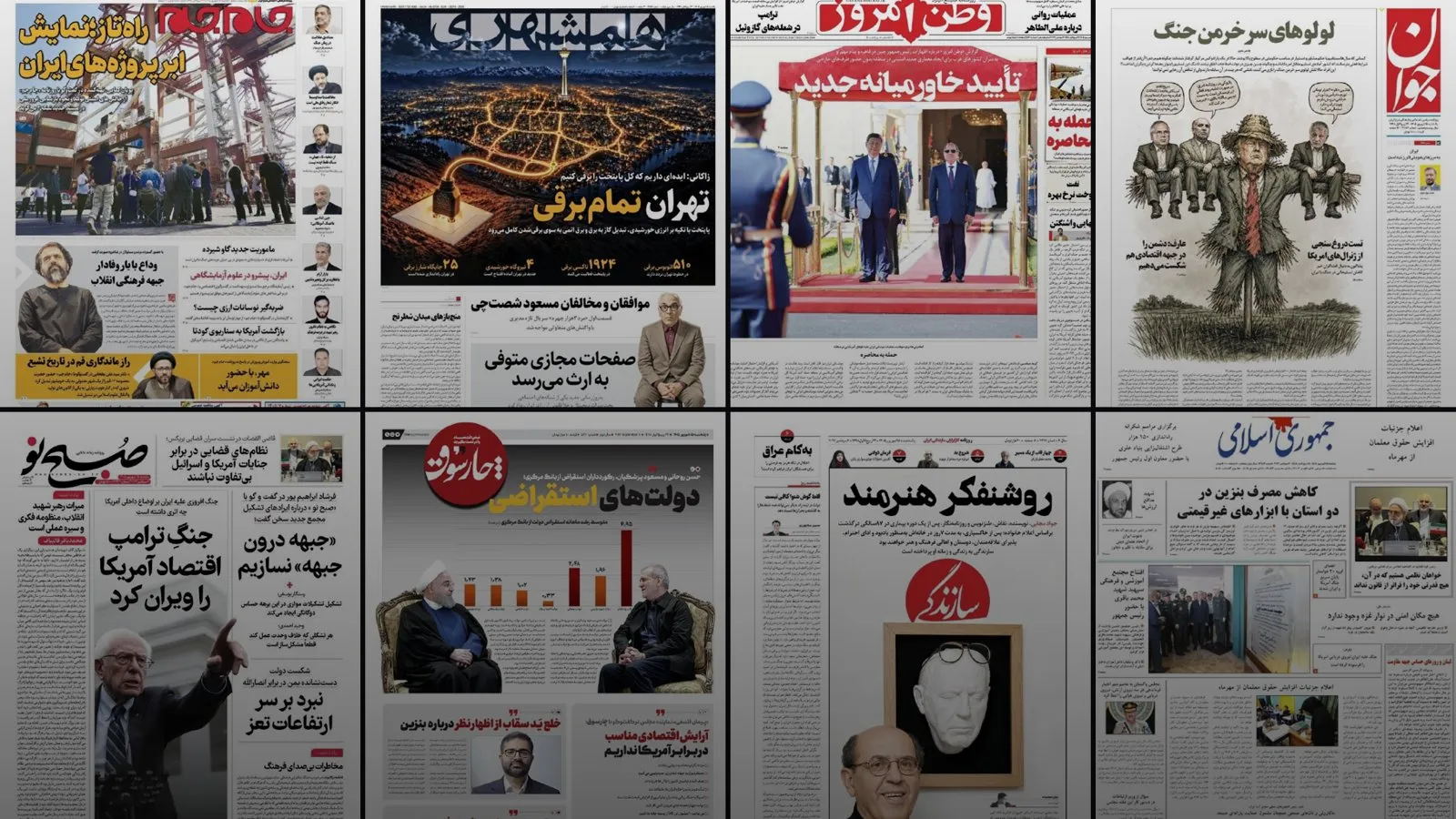
Bottom line: The Sunday fronts record the first missile exchange between the IRGC and a US carrier group since June as an Iranian ‘attack on the blockade’ that forced two warships to flee, a claim CENTCOM’s own statement contradicts, while Kayhan’s page-one lead asks why the security organs have not ‘wiped out’ the reformist current and Javan draws its leading economists and a former president’s party chairman as scarecrows preparing surrender: the war at sea has resumed in fact, and the war at home has moved from insult to a demand for action.
Executive Summary
The lead judgment of the cycle is that the naval war in the Gulf has resumed as an exchange of fire, and that the Iranian press has decided in advance how it will be read. On Saturday CENTCOM said an aircraft carrier and a guided-missile destroyer ‘successfully evaded multiple unprovoked Iranian attacks’ and that US forces then ‘permanently disabled’ the tankers Downy off Kharg and Stark 1 near Jask and ‘completely destroyed’ the unladen Kylo in the Gulf of Oman, with Admiral Brad Cooper’s line ‘if you fire on two of our ships, we will destroy three of yours’. Late that evening IRGC statement No. 10 inverted the sequence: the carrier and destroyer ‘had harassed Iranian ships and taken part in the naval blockade’, were struck by ‘several ballistic missiles’, ‘sustained damage’ and ‘fled the area out of fear of a second attack’, and CENTCOM’s ‘confession’ was ‘a living document of the enemy’s strategic defeat’. Vatan-e Emrooz’s right rail asks whether the tanker strikes were ‘because a missile hit the ship’; the Iran newspaper channel leads on the statement; Jam-e Jam, Fars, Defa Press and Kayhan carry it verbatim. Early Sunday statement No. 11 added an attack on an American unmanned surface vessel ‘intending to enter the protected zone of the Strait of Hormuz’, with the formula that the Strait ‘is under the management of the Islamic Republic’. The Khatam al-Anbiya spokesman warned that strikes on US vessels ‘will be more severe than before and may expand’, and the Foreign Ministry called the tanker strikes a ‘war crime’ and part of ‘the naval blockade and economic war’. Two facts are established by both sides: missiles were fired at a carrier group, and three Iranian tankers were hit. The damage-and-flight claim is Iranian only, and the ‘protected zone under management’ language is new.
The single most consequential domestic item is Kayhan’s unsigned page-one lead, ‘Despair and Division, the code name of America’s newest project’, which this monitor translates in full in Appendix B. It calls the reformist current ‘America’s errand boys’, says they ‘provided the enemy’s pretext for the assassination of the Leader’ by ‘creating the ground for the coup of Dey month’, accuses Rouhani of running ‘to the aid of Trump and the Epstein gang’ with his ‘strait without ships’ remark, and closes: ‘Why do the responsible organs take no step toward wiping out this network of traitors to Iran?’ Officials ‘must not forget the coup of Dey 1404 and must act on their duty in dealing with its main agents.’ On the same page Shariatmadari’s signed Nokteh (Appendix C) tells government spokeswoman Fatemeh Mohajerani that if she did not know the Dey rioters were CIA and Mossad agents ‘your position must be reconsidered’. Javan’s front is a full-page cartoon, ‘The Scarecrows of the War’, in which Trump is the scarecrow and Mohsen Hashemi, Mehdi Pazouki and Mahmoud Sariolghalam sit on his crossbar voicing, in traceable quotations, warnings about a 300,000-toman dollar, 600 percent inflation and post-midterm American operations; the kicker says they ‘frighten the people enough that the country is ready for surrender’. Jam-e Jam’s state front adds ‘America’s return to the coup scenario’. Three days ago the campaign’s target was a party secretary, two days ago a former president; today it is the current itself, its economists and its academics, and for the first time the flagship asks the state to act. Sazandegi, whose party chairman is on the crossbar, does not reply; it leads with an obituary of Javad Mojabi and lets Marashi criticize the government from the other side.
The American-exhaustion narrative is now the consensus frame and has acquired verified facts. Sobh-e No leads with Bernie Sanders under ‘Trump’s war destroyed America’s economy’; Vatan-e Emrooz runs ‘Trump in the flames of diesel’ and ‘Oil, the fuel of the interest rate’; Javan’s sub-lead, ‘Lie-detector test for America’s generals’, reports the polygraphing of some 50 Joint Staff members over munitions-depletion leaks, which the New York Times and CBS confirmed on 4 September; Kayhan cites the NYT’s 4 September report on US intelligence assessments of ‘a more confident Iran’, rendering it as concern at the ‘self-confidence of the Iranian people’; Jomhouri Eslami boxes a G20 call for a rapid end to the war and a Telegraph piece on a worn-out US Navy; three channels carry Elizabeth Warren’s ‘want lower gas prices? end Trump’s war in Iran’ and Vatan-e Emrooz a Navigator poll of Trump-voter regret. As on 5 September the facts are checkable and the inference is the outlets’. What changes today is the coupling: Kayhan’s lead uses Trump’s own ‘four more weeks of oil reserves’ remark to argue that Iran ‘must use all levers to keep the oil price high’, which turns the exhaustion frame into a doctrine for continued closure.
Ali al-Taher has moved from absorbed to contested. On 5 September this monitor found the ridge on no Persian lead. Today Kayhan’s front declares the hill ‘has neither fallen nor been occupied; the fighting continues’, Vatan-e Emrooz’s top-right item calls the capture ‘psychological operations’ and cites ‘multiple sources in Lebanon’ denying Israeli control, and a Jam-e Jam channel commentator, Sadrolhosseini, says Hezbollah ‘controls the heights’ and adds that ‘if Hezbollah requests it, Iran and the other resistance fronts will enter the battle with Israel’, the most forward Lebanon language of the cycle and from a commentator, not an official. Jomhouri Eslami’s editorial is the exception: the hill ‘has not completely fallen and is in the process of falling’. Israel’s 4 September announcement stands and Hezbollah has neither confirmed nor denied it. The channels carry the Ghandour hospital in Nabatieh al-Fawqa ‘completely destroyed’ and strikes on Kafr Rumman and Arab Salim. The handling has changed from silence to denial in two days, which usually precedes either a confirmed counter-attack or an admission.
Hormuz messaging has shifted again, from escort failure to an asserted regime. Statement No. 11’s ‘protected zone’ and ‘under the management of the Islamic Republic’ are the closest the IRGC has come to declaring a legal order over the Strait; Chahar Sough’s MP Peyman Falsafi says ‘the Strait will not open without Iran’s permission’; Hamshahri repeats Friday’s ‘failure of the American escort’ story as fact; Vatan-e Emrooz’s column on South Korea continues the coalition-deterrence thread. The counter-signals are also present: Araghchi’s Saturday-night calls with Faisal bin Farhan and Hakan Fidan on ‘removing the insecurity imposed on the Strait’, carried by the government daily 25 minutes after it posted the IRGC’s carrier claim; Sazandegi’s ‘To Iraq’s benefit’, asking whether the Hormuz dispute is handing Iran’s trade to its neighbors; and Tehran Times’s ‘flow versus territory’ essay, which concedes the argument has moved to whether oil is crossing. Vatan-e Emrooz’s lead, ‘Confirmation of the New Middle East’, places Xi Jinping’s Cairo call for a regional security architecture ‘without the presence of foreign parties’ as the strategic endorsement of the tactical picture; the word ‘confirmation’ is the paper’s.
Economic pressure on the government from its own side has produced its first personnel outcome. Chahar Sough, which two days ago montaged a fuel nozzle over energy official Esmail Saghab Esfahani’s face, reports him ‘stripped of the right to comment on gasoline’ by the Plan and Budget chief, and leads with a chart placing Pezeshkian above Rouhani as the record borrower from the central bank, ‘the borrowing governments’. Jomhouri Eslami’s lead reports consumption cuts ‘with non-price tools’ in two provinces, the operational form of the President’s ‘gradual’ instruction. Hemmati’s aide insists oil money still arrives, nine billion dollars this year, while the central bank hands gold-platform oversight to the anti-smuggling headquarters. Marashi, from the reformist side, says the government ‘at mid-course can no longer pin all its shortcomings on the past’. The government is thus criticized for borrowing by the principlist economic press and for indecision by the reformist party press on the same morning, while Kayhan attacks its spokeswoman: the middle is narrowing.
The diplomatic and legal lanes run on schedule and off the missile story. Iran Daily leads for foreign readers on the judiciary chief’s call at the BRICS judicial summit for ‘universal jurisdiction’ against Iran’s aggressors, an item also on Sobh-e No, Jomhouri Eslami and Kayhan; it interviews an analyst on Peru’s 1 September severance of relations and Chile’s embassy closure, and notes, self-critically, that the SCO’s Bishkek declaration condemned strikes on Iran without naming the United States or Israel. The English front carries nothing of the naval exchange. The Leader is absent for the fifth consecutive edition: no message accompanies the carrier claim, the tanker strikes or the Kayhan campaign; the only Leader texts on the fronts are Ghalibaf’s column and a Jam-e Jam rail piece on the martyred predecessor’s thought, and Kayhan’s lead borrows the Government Week message’s ‘despair’ vocabulary as its code name. Nour News, the SNSC-linked wire, did not carry the carrier claim in the window read but ran a video asking ‘how long must Iran wait to respond to the aggressor’, and Admiral Sayyari named ‘the Hormuz war’ alongside the 12-day and Ramadan wars as the Army’s learning base.
Net assessment: this is a resumption edition. At sea, both sides now acknowledge an exchange of fire between the IRGC and a carrier group for the first time since the June memorandum, and the Iranian press has fixed the reading as ‘attack on the blockade’ with a new claim of a legal regime over the Strait. At home, the hardline campaign that this monitor tracked from Marashi to Rouhani has reached the current as a whole and has, for the first time, asked the security organs to act, while the state broadcaster’s daily adopts the ‘coup’ vocabulary. The consequential findings are that the carrier-damage claim is Iranian only and the tanker losses are admitted; that Kayhan’s call is institutional and unsigned; that Ali al-Taher has moved from absorbed to denied; that the exhaustion frame is now a doctrine for keeping oil high; that the government is being squeezed from both camps and has begun sacrificing officials; and that the Leader remains silent through all of it. The threads to watch are whether any official repeats ‘protected zone under management’, whether Sazandegi or the government answers Kayhan and Javan, whether Sadrolhosseini’s ‘if Hezbollah requests it’ is echoed by a commander, and whether the IAEA Board, which meets this week, produces the first front-page lead on the referral.
Key Points
- KJ-1 [HIGH] The IRGC and a US carrier group exchanged fire on 5 September for the first time since the June memorandum, and the Iranian press has fixed the reading as an Iranian ‘attack on the blockade’ that damaged two warships, a claim that CENTCOM’s statement contradicts and that no Iranian outlet supports with evidence. Evidence: CENTCOM’s ‘evaded multiple unprovoked Iranian attacks’ and the named tankers Downy, Stark 1 and Kylo; IRGC statement No. 10’s ‘sustained damage’ and ‘fled’; Vatan-e Emrooz’s ‘was CENTCOM’s attack because a missile hit the ship?’; the statement carried as lead by the Iran channel, Jam-e Jam, Fars and Defa Press; the Khatam al-Anbiya ‘more severe and may expand’ warning. Significance: the exchange is real and admitted on both sides, the damage claim is Iranian only, and the Iranian tanker losses are conceded on the channels while absent from the English front; overstating the hit would adopt the IRGC’s claim, understating the exchange would miss that the memorandum’s naval restraint has ended in fact.
- KJ-2 [HIGH] The principlist campaign has escalated from discrediting named reformists to a public demand that the security organs act against the reformist current as such, and the flagship has made the demand in its own unsigned voice. Evidence: Kayhan’s lead ‘Despair and Division’ asking why ‘the responsible organs take no step toward wiping out this network of traitors’ and telling officials to ‘act on their duty in dealing with the main agents’ of ‘the coup of Dey 1404’; the accusation that reformists ‘provided the enemy’s pretext for the assassination of the Leader’; Shariatmadari’s Nokteh calling for the spokeswoman’s position to be ‘reconsidered’; Javan’s cartoon naming Hashemi, Pazouki and Sariolghalam; Jam-e Jam’s ‘coup scenario’. Significance: continuing the Marashi-to-Rouhani thread, the ask has changed in kind from argument to institutional action, and the coordinated ‘coup’ vocabulary across Kayhan and the state broadcaster’s daily indicates preparation of a narrative rather than one editor’s anger; the absence of a reply from Sazandegi is the tracking cue.
- KJ-3 [MODERATE-HIGH] Ali al-Taher is now being contested on the fronts rather than absorbed, and the resistance lane has introduced conditional Iranian entry into the Lebanon fight through a commentator. Evidence: Kayhan’s ‘neither fallen nor occupied’; Vatan-e Emrooz’s ‘psychological operations’ with unnamed Lebanese sources; Sadrolhosseini on the Jam-e Jam channel: Hezbollah ‘controls the heights’ and ‘if Hezbollah requests it, Iran and the other resistance fronts will enter the battle’; Jomhouri Eslami’s editorial conceding the hill is ‘in the process of falling’; Israel’s 4 September announcement unrebutted by Hezbollah. Significance: the move from silence to denial within two days suggests the loss is being prepared for either a counter-attack narrative or an admission, and the ‘if requested’ line is the first Iranian-entry formulation of the cycle; it carries weight only if a commander repeats it.
- KJ-4 [MODERATE-HIGH] The American-exhaustion narrative has been converted from observation into doctrine: the flagship now instructs that Iran ‘must use all levers to keep the oil price high’. Evidence: Kayhan’s lead citing Trump’s ‘four more weeks of oil reserves’ and Axios recession remark; Sobh-e No’s Sanders lead; Vatan-e Emrooz’s diesel and interest-rate pieces; Javan’s verified polygraph story; Kayhan’s verified NYT ‘more confident Iran’ item; Jomhouri Eslami’s G20 and Telegraph boxes; Warren on three channels. Significance: as long as the frame was descriptive it supported both a deal (Sobh-e No, Iran Daily) and continued closure; Kayhan’s formulation binds it to closure, which narrows the space for the memorandum’s return that this monitor recorded on 5 September.
- KJ-5 [MODERATE] IRGC statement No. 11’s ‘protected zone’ and ‘under the management of the Islamic Republic’ language marks a drift from coercive closure toward an asserted regime over the Strait, not yet adopted by any civilian authority. Evidence: the identical text on four channels; Falsafi’s ‘will not open without Iran’s permission’; Hamshahri’s escort-failure repetition; against it, Araghchi’s same-night calls to Riyadh and Ankara on ‘removing the insecurity imposed on the Strait by America’s aggressive actions’, Etemad’s transit-fee promo of 5 September and Rouhani’s ‘strait of security and prosperity’. Significance: a formal regime claim would change the legal character of the confrontation and the coalition calculus of South Korea and others; the test is whether the Foreign Ministry or the SNSC uses the phrase.
- KJ-6 [HIGH] Economic pressure on the government from within the principlist camp has produced its first personnel outcome and is now matched by criticism from the reformist party press, narrowing the government’s position from both sides. Evidence: Chahar Sough’s ‘borrowing governments’ chart and ‘Saghab stripped of the right to comment on gasoline’, the latter verified against Alef and Entekhab; Jomhouri Eslami’s non-price consumption cuts; Hemmati’s aide on oil revenue; the central bank’s withdrawal from gold-platform oversight; Marashi’s ‘only a listening ear is not enough’; Kayhan’s attack on the spokeswoman. Significance: the transmission chain toward instability still shows no observable link, but the government is losing officials to press campaigns and is being described as Rouhani’s continuation by the economic press on the same day the political press calls Rouhani an errand boy.
- KJ-7 [MODERATE] Negative-evidence finding: the Leader remains silent through the resumption of naval fire and the flagship’s call for action, and no official has repeated either the undersea-cable proposal of 3 September or the ‘protected zone’ formula in a civilian voice. Evidence: no message on nine scans, six channels or three wires; the khamenei.ir index showing nothing newer than the standing messages; the only Leader texts on the fronts concerning the predecessor; Nour News omitting the carrier claim while sustaining the retaliation question; no cable reference anywhere. Significance: consistent with the pattern of the Leader appearing through intermediaries, and it leaves Kayhan free to use the Government Week ‘despair’ vocabulary as authority for its campaign; a Leader statement before the IAEA Board meets, or on the naval exchange, would be the first test of whether he endorses either the regime claim or the domestic purge language. Confidence is moderate because khamenei.ir was read only through a cache.
- KJ-8 [MODERATE] The English and diplomatic lanes are being kept deliberately clear of the naval war so that the legal case at BRICS and the mediation track can proceed, and they are admitting costs the Persian fronts do not. Evidence: Iran Daily’s universal-jurisdiction lead with no naval item; its Peru-rupture interview and Bishkek-omission note; Tehran Times’s acknowledgment of six Navy deaths; Araghchi’s calls; Jomhouri Eslami’s G20 box. Significance: the division of admission between lanes is stable across editions, and the self-critical items on Peru and the SCO show the government’s English title arguing for diplomatic adaptation at the moment the hardline lane argues for purge; an official acknowledgment of the four-country consultation reported on 5 September remains outstanding.
Macro Trends
- The naval war resumes and the press fixes the reading. CENTCOM: a carrier and a destroyer ‘evaded multiple unprovoked Iranian attacks’ and US forces disabled Downy and Stark 1 and destroyed Kylo. IRGC statement No. 10: the ships ‘harassed Iranian vessels and took part in the naval blockade’, were hit, ‘sustained damage’ and ‘fled’. Vatan-e Emrooz’s ‘Attack on the Blockade’ asks whether the tanker strikes were retaliation for a hit; the Iran channel, Jam-e Jam, Fars and Defa Press carry the statement as their lead. Statement No. 11 adds an unmanned vessel and the formula ‘the Strait is under the management of the Islamic Republic’. Both sides agree missiles were fired and three tankers were hit; the damage claim is Iranian only.
- From discrediting to a demand for action. Kayhan’s unsigned lead names the reformist current ‘America’s errand boys’, ties it to the Leader’s assassination via ‘the coup of Dey’, and asks why ‘the responsible organs’ have not ‘wiped out this network of traitors’. Shariatmadari’s Nokteh says the government spokeswoman’s position ‘must be reconsidered’. Javan’s ‘Scarecrows of the War’ puts Mohsen Hashemi, Mehdi Pazouki and Mahmoud Sariolghalam on Trump’s crossbar. Jam-e Jam’s front carries ‘America’s return to the coup scenario’. Continuing the Marashi-to-Rouhani thread, the target is now the current itself and the ask is institutional.
- Ali al-Taher: from absorbed to denied. Kayhan: ‘neither fallen nor occupied’. Vatan-e Emrooz: ‘psychological operations’. Jam-e Jam’s channel commentator: Hezbollah ‘controls the heights’ and Iran ‘will enter the battle if Hezbollah requests it’. Jomhouri Eslami’s editorial alone concedes the hill is ‘in the process of falling’. Israel’s 4 September capture announcement stands; Hezbollah has not confirmed or denied. The hospital in Nabatieh al-Fawqa is reported destroyed on every channel. Two days from silence to denial.
- Exhaustion becomes doctrine. Sobh-e No’s Sanders lead, Vatan-e Emrooz’s diesel and interest-rate pieces, Javan’s polygraph story (verified), Kayhan’s NYT ‘more confident Iran’ (verified, with ‘Iran’ rendered as ‘the Iranian people’), Jomhouri Eslami’s G20 and Telegraph boxes, and Warren’s post on three channels. Kayhan converts the frame into instruction: Iran ‘must use all levers to keep the oil price high’. The facts are checkable; the doctrine is the flagship’s.
- Hormuz: from escort failure to an asserted regime. ‘Protected zone’ and ‘under management’ in statement No. 11; Falsafi’s ‘will not open without Iran’s permission’; Hamshahri’s repeat of the escort-failure story as fact; Vatan-e Emrooz on South Korea. Counter-signals: Araghchi’s calls with Riyadh and Ankara on ‘removing the insecurity imposed on the Strait’, Sazandegi’s ‘To Iraq’s benefit’, Tehran Times’s ‘flow versus territory’. Xi’s Cairo architecture is printed by Vatan-e Emrooz as ‘confirmation of the new Middle East’.
- The government squeezed from both camps. Chahar Sough’s ‘borrowing governments’ chart puts Pezeshkian above Rouhani; Saghab Esfahani is sidelined 48 hours after the same paper’s montage; Jomhouri Eslami’s lead is consumption cuts ‘with non-price tools’; Marashi says the government ‘can no longer pin its shortcomings on the past’; Kayhan targets the spokeswoman. Continuing the domestic-cost thread: the pressure now produces personnel outcomes and comes from both sides of the spectrum on the same morning.
- Legal and diplomatic lanes run clear of the missile story, and the Leader stays silent. Iran Daily leads on ‘universal jurisdiction’ at BRICS, interviews on Peru’s rupture and notes the SCO’s refusal to name the attackers; no naval item on the English front. No Leader message for the fifth edition running; Ghalibaf’s and Jam-e Jam’s Leader texts concern the predecessor; Kayhan borrows the Government Week ‘despair’ vocabulary as a code name. Nour News keeps distance from the carrier claim while asking how long Iran should wait to respond; Sayyari names ‘the Hormuz war’.
Front-Page Snapshot
- Iran (channel) - “IRGC: an aircraft carrier and a destroyer of the aggressor American army were attacked” (Official government daily) - IRGC statements No. 10 and 11 as the official lead; Araghchi’s Riyadh and Ankara calls the same night [HIGH]
- Vatan-e Emrooz - “Confirmation of the New Middle East” (Hardline principlist) - Xi’s ‘no foreign parties’ architecture as endorsement; ‘Attack on the Blockade’; Ali al-Taher ‘psychological operations’ [HIGH]
- Defa Press / Fars / Nour News (wires) - “IRGC Navy commander: do not be fooled by America; every suspicious movement will be targeted” (IRGC-aligned and SNSC-linked wires) - Commander warnings; Sayyari names ‘the Hormuz war’; Nour News keeps distance from the carrier claim [HIGH]
- Kayhan (channel) - “‘Despair and Division’, the code name of America’s newest project: Trump has failed, America’s domestic errand boys are scrambling” (Ultra-hardline flagship) - Reformists as an American project; call for the security organs to act; Ali al-Taher ‘neither fallen nor occupied’ [SEVERE]
- Javan - “The Scarecrows of the War” (Hardline, IRGC-affiliated) - Hashemi, Pazouki and Sariolghalam as fear-mongers preparing surrender; Pentagon leak hunt [HIGH]
- Sobh-e No - “Trump’s War Destroyed America’s Economy” (Principlist, Speaker’s camp) - Sanders as witness to exhaustion; judiciary at BRICS; principlist ‘front within the front’ [MODERATE-HIGH]
- Jomhouri Eslami - “Reducing Gasoline Consumption in Two Provinces with Non-Price Tools” (Traditional / establishment) - Gasoline managed without a price rise; Ali al-Taher ‘in the process of falling’; G20 end-the-war call [LOW-MODERATE]
- Chahar Sough - “The Borrowing Governments” (Economic, principlist-leaning) - Pezeshkian and Rouhani as record borrowers; Saghab sidelined; gold storm [MODERATE]
- Hamshahri - “Fully Electric Tehran” (Tehran municipality, centrist) - Municipal showcase; escort failure repeated as fact; war absent from the top [LOW-MODERATE]
- Jam-e Jam - “A New Road: Showcasing Iran’s Mega-Projects” (State broadcaster daily) - Morale programming; ‘America’s return to the coup scenario’; channel commentator’s conditional Lebanon entry [MODERATE-HIGH]
- Sazandegi - “The Artist Intellectual” (Reformist / Kargozaran) - Mojabi obituary; Hormuz benefiting Iraq; Marashi on a government ‘at mid-course’; no reply to the cartoon [LOW-MODERATE]
- Iran Daily - “Judiciary chief urges BRICS to seek legal action against Iran’s aggressors” (Official English-language daily) - Universal jurisdiction; Peru rupture and SCO omission as lessons; no naval item [MODERATE]
- Tehran Times (web, 5 Sept edition) - “Iran-Russia alliance grows despite US pressure” (English-language state daily) - Great-power backing; six Navy deaths acknowledged; Hormuz as ‘flow versus territory’ [MODERATE-HIGH]
Full report
The complete edition - per-paper front-page analysis and full translation appendices - is available as a PDF: Download the full report.
Compiled from Iranian front pages and outlet channels via open-source monitoring. Translations are editorial; named-figure attributions are verified against the source pages where possible.