Iranian Press Monitor - Wednesday, 2 September 2026 (Day 183)
Wednesday, 2 September 2026 · 11 Shahrivar 1405 · 20 Rabi al-Awwal 1448 - Front pages published the morning of 2 September, reflecting events through late 1 September local, dominated by a Speaker’s ‘siege’ interview, the Leader-anchored memorandum question, and turbulence in the US defense establishment
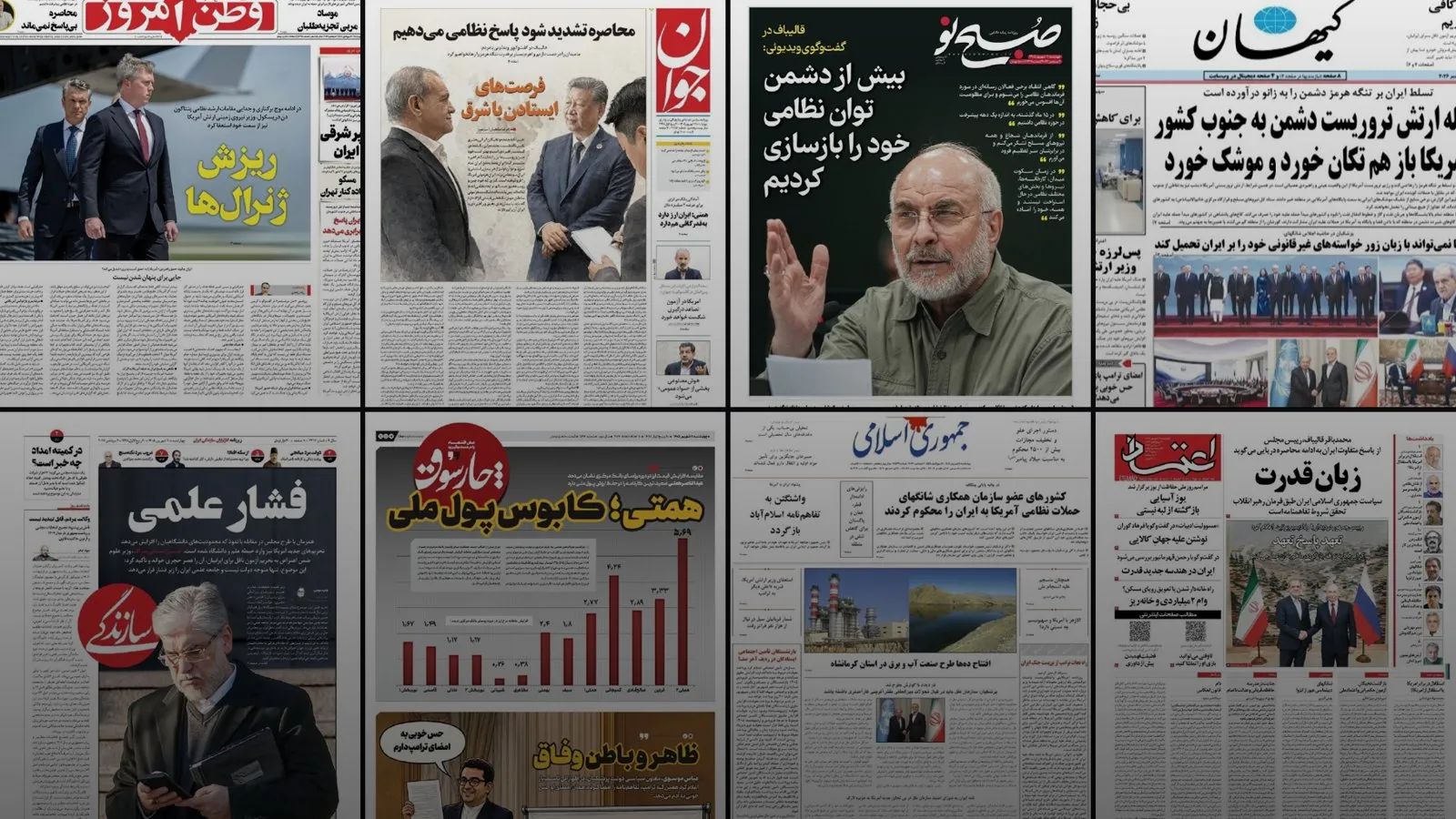
Bottom line: The batch documents Tehran consolidating a two-track posture around a single word, ‘siege,’ and a single instrument, the ceasefire memorandum: the hardline titles run Hormuz maximalism, fresh strike-and-retaliation claims and a Speaker’s rearmament boast, while the reformist and English titles present that same ‘language of power’ as leverage in service of a Leader-sanctioned, memorandum-conditional diplomacy, and the economic press refuses to let the collapsing currency drop off the page.
Executive Summary
The lead judgment of the cycle is that the two-track posture the previous edition flagged (trumpet-and-hedge) has hardened into a coherent doctrine with a name the papers supply themselves: ‘the language of power’ (Etemad’s zaban-e qodrat). The organizing text is a video interview by Speaker Mohammad Bagher Ghalibaf that three titles work in different directions. Javan banners his conditional threat, ‘محاصره تشدید شود پاسخ نظامی میدهیم’ (if the siege intensifies, we will give a military response); Sobh-e No amplifies his claim that Iran has rebuilt its military capacity ‘beyond the enemy’ and that criticizing commanders is ‘haram’; and Etemad reframes the whole interview as leverage in service of diplomacy, with the decisive subhead that Iranian policy, ‘per the order of the Leader of the Revolution,’ is the fulfillment of the memorandum’s conditions. The same interview is thus rendered as a war tripwire, a rearmament boast, and a diplomatic instrument, depending on the lane.
The single most consequential item of the batch is that leadership line. Etemad places the sitting Leader (per standing context, Mojtaba Khamenei) behind a memorandum-conditional policy: even a ‘different response’ to the ‘siege’ is presented as action within the ceasefire framework, not outside it. This is a shift in register from the previous cycle, where the Leader appeared first with a unity decree and then in an administrative clemency role; he now appears as the guarantor of the diplomatic track. Jomhouri Eslami supplies the matching off-ramp, printing ‘Washington should return to the Islamabad memorandum’ as an explicit ‘Iran’s proposal to America,’ and Iran Daily tells its English readers that Pezeshkian ‘voices Iran’s readiness to return to the peace memo with US.’ The memorandum, not fresh escalation, is the batch’s proposed exit.
That diplomatic track is contested from the hardline flank. Kayhan sustains the Hormuz-sovereignty maximalism of the prior cycle (‘Iran’s control of the Strait of Hormuz has brought the enemy to its knees’) and its managing editor Hossein Shariatmadari’s on-record doctrine that the Strait is leverage ‘more powerful than Iran’s missiles,’ non-negotiable, and a lever for extracting compensation. Chahar Sough runs the sharpest anti-memorandum satire of the batch: a cartoon of an official (captioned as Abbas Mousavi) declaring ‘I have a good feeling about Trump’s signature,’ beside a placard listing ‘the crimes bearing Trump’s signature,’ headed by the assassination of the late Supreme Leader. The front pages therefore stage an intra-system argument over whether a US signature is worth anything at all.
A new thread enters the frame this cycle: turbulence in the US defense establishment. Vatan-e Emrooz gives its entire front page to ‘the collapse of the generals,’ built on the resignation of US Army Secretary Dan Driscoll; Kayhan reads the same event as ‘the war’s aftershock reaching the Pentagon’; Jomhouri Eslami calls it ‘a fresh blow to Trump.’ The underlying event is real and independently confirmed (Driscoll tendered his resignation on 31 August amid reported friction with Defense Secretary Hegseth), but the Iranian framing of it as a consequence of Iranian pressure is inference, not fact, and marks a shift in the hardline message from battle-damage triumphalism toward psychological-attrition narrative.
The eastern-alignment thread, prominent since the late-August China editions, is carried this cycle by the Shanghai Cooperation Organization heads-of-state summit and its bilaterals. Javan fronts a Pezeshkian-Xi meeting under ‘the opportunities of standing with the East’; Etemad and Iran Daily foreground a Pezeshkian-Putin handshake with ‘Putin reaffirms support for Tehran after new sanctions’; Jomhouri Eslami reports SCO members condemning the US attacks; Ta’adol reads the summit as ‘creating a just multipolar order.’ Where the previous edition logged a reformist skeptic’s question of whether the East would ‘pay a cost to defend Iran,’ this cycle’s ‘Putin reaffirms support’ line is the nearest the bloc comes to an answer, though it remains a verbal reassurance rather than a commitment.
Two pressure threads hold their front-page space against the diplomacy-and-war narrative. The economic lane splits: Chahar Sough indicts central-bank chief Abdolnaser Hemmati as ‘the nightmare of the national currency’ with a chart placing him worst among recent governors, while Ta’adol chooses a calmer ‘banking network in a resilience test’ frame around the economy minister’s and central-bank governor’s parliamentary testimony on ‘the hard days of the economy’; Kayhan and Iran Daily both carry Hemmati’s reserve-adequacy reassurance, which the economic dailies exist to contest. And a new grievance thread, sanctions on science, appears on Sazandegi (‘academic pressure’) and Iran Daily: the suspension of TOEFL and GRE testing for Iranians, which Science Minister Hossein Simaei-Sarraf calls ‘stone age’ behavior, a confirmed consequence of the 24 August US sanctions package.
Net assessment: this is a doctrine-consolidation edition rather than an escalation edition. The overt material is mixed, Hormuz maximalism and fresh strike claims on one side, a Leader-anchored memorandum off-ramp on the other, but the through-line is that both are now being spoken as one posture, ‘the language of power,’ in which leverage exists to be converted into terms. The consequential findings are that the sitting Leader has been placed behind the memorandum track, giving the diplomatic lane top cover it lacked; that the hardline flank is openly resisting that track with anti-signature polemic; that US-Pentagon turbulence is being harvested as a morale narrative on a factual but misattributed basis; and that the economic and science-sanctions lanes continue to price the war’s domestic cost the hardline optimism cannot close. The threads to watch are whether the Leader’s memorandum directive produces any movement or remains rhetorical; whether the anti-signature hardliners force the diplomatic track back off the page; whether Israel and Lebanon, still near-absent from the front pages but resurfacing on the wires via a claimed Hezbollah drone strike, return to the lead; and whether the East’s ‘reaffirmed support’ ever acquires substance.
Key Points
- KJ-1 [HIGH] The two-track posture has hardened from parallel messaging into a single named doctrine, ‘the language of power,’ organized around one Ghalibaf interview. Evidence: Javan banners his ‘if the siege intensifies, we respond militarily’; Sobh-e No amplifies ‘we rebuilt our military capacity beyond the enemy’; Etemad reframes the same interview as leverage in service of diplomacy under the headline zaban-e qodrat. Significance: the deterrent claim and the de-escalation signal are now delivered as two registers of one posture rather than as competing tracks, indicating centrally-coordinated message discipline in which leverage is explicitly framed as existing to be converted into terms; whether the two registers stay fused is the primary thing to watch.
- KJ-2 [HIGH] The sitting Leader has been placed behind a memorandum-conditional policy line, the most consequential single item of the batch. Evidence: Etemad’s subhead states that Iranian policy, ‘per the order of the Leader of the Revolution,’ is the fulfillment of the memorandum’s conditions, and frames Ghalibaf’s ‘different response’ as action within that framework; Jomhouri Eslami prints ‘Washington should return to the Islamabad memorandum’ as Iran’s proposal, and Iran Daily reports Pezeshkian’s ‘readiness to return to the peace memo.’ Significance: attaching the Leader’s authority to the ceasefire memorandum gives the diplomatic track top cover and signals that Tehran’s preferred exit is the existing framework, not open-ended escalation; the attribution rests principally on the Etemad rendering and is logged as a single-sourced but high-salience leadership signal.
- KJ-3 [MODERATE-HIGH] The Iranian press is converting genuine US defense-establishment turnover into a psychological-attrition narrative on a factual but misattributed basis. Evidence: Vatan-e Emrooz’s whole-page ‘collapse of the generals,’ Kayhan’s ‘war’s aftershock reached the Pentagon,’ and Jomhouri Eslami’s ‘fresh blow to Trump’ all build on the confirmed 31 August resignation of US Army Secretary Dan Driscoll amid reported friction with Defense Secretary Hegseth. Significance: the event is real, so the framing is harder to refute than last cycle’s inconsistent battle-damage claims, but the causal attribution to Iranian pressure is the outlets’ inference and is not adopted here; the shift toward mining verifiable US internal turbulence marks a more durable morale line than fabricated strike tallies.
- KJ-4 [MODERATE-HIGH] The eastern-alignment thread advances at the SCO summit but yields verbal reassurance rather than a defense commitment. Evidence: Pezeshkian’s bilaterals with Xi (Javan) and Putin (Etemad, Iran Daily), ‘Putin reaffirms support for Tehran after new sanctions,’ SCO condemnation of the US strikes (Jomhouri Eslami), and Ta’adol’s ‘just multipolar order.’ Significance: set against the previous edition’s reformist question of whether the East would ‘pay a cost to defend Iran,’ the ‘reaffirmed support’ line is the closest the bloc comes to answering, but it remains a statement of political backing, not a security guarantee, and should be tracked for any concrete deliverable rather than photo-and-communique diplomacy.
- KJ-5 [MODERATE] The hardline flank is openly contesting the memorandum track with anti-signature polemic, keeping the diplomatic line intra-system contested. Evidence: Kayhan’s non-negotiable Hormuz maximalism and Shariatmadari’s ‘leverage more powerful than missiles’ doctrine, and Chahar Sough’s cartoon of an official trusting ‘Trump’s signature’ beside a placard of ‘crimes bearing Trump’s signature’ headed by the assassination of the late Supreme Leader. Significance: the same batch that places the Leader behind the memorandum carries a front-page argument that a US signature is worthless, indicating the diplomatic track is not a settled consensus but a contested position the hardliners are working to push back off the page.
- KJ-6 [MODERATE] The domestic-cost lanes are holding front-page space, with the economic press split and a new science-sanctions grievance added. Evidence: Chahar Sough indicts central-bank chief Hemmati as ‘the nightmare of the national currency’ while Ta’adol chooses a ‘resilience test’ frame for parliamentary testimony on ‘the hard days of the economy,’ with Hemmati’s reserve-adequacy reassurance carried on Kayhan and Iran Daily; Sazandegi and Iran Daily front the TOEFL and GRE suspension, which Science Minister Simaei-Sarraf calls ‘stone age’ behavior. Significance: the war-and-diplomacy narrative has not displaced cost-of-living from the page, and the education-sanctions thread adds a concrete brain-drain grievance that implicates both Washington’s sanction and the domestic response; the split between currency alarm and resilience framing marks the economic press’s own factional divide.
- KJ-7 [LOW-MODERATE] Negative-evidence finding: Israel and Lebanon remain near-absent from the front pages but re-enter on the wires, so the flashpoint’s front-page silence is now a presentation choice rather than a genuine lull. Evidence: the front pages carry only a Mossad reference in a Vatan-e Emrooz sidebar and an Al-Azhar-and-Zionism polemic in Jomhouri Eslami, while the Kayhan channel circulates a claimed Hezbollah suicide-drone strike on northern occupied-Palestine settlements (attributed to Hebrew media) and the wires run the broader strike-and-retaliation cycle. Significance: where the previous edition recorded Israel and Lebanon as simply near-absent, this cycle shows the material exists on the wires but is being kept off the front pages, so any return of the Israel-Lebanon front to the lead in a subsequent batch should register as a deliberate editorial elevation, not the arrival of new events.
Macro Trends
- The two-track posture hardens into a named doctrine, ‘the language of power’. The trumpet-and-hedge posture flagged the previous cycle now has a self-supplied name (Etemad’s zaban-e qodrat) and a single organizing text: a Ghalibaf video interview rendered three ways. Javan banners the conditional ‘if the siege intensifies, we respond militarily’; Sobh-e No amplifies ‘we rebuilt our military capacity beyond the enemy’; Etemad reframes the same interview as leverage for a Leader-sanctioned, memorandum-conditional diplomacy. The deterrent claim and the diplomatic signal are no longer separate tracks but two registers of one posture.
- The sitting Leader is placed behind the memorandum track. Etemad’s subhead attributes to the Leader of the Revolution (per standing context, Mojtaba Khamenei) the directive that Iranian policy is the fulfillment of the memorandum’s conditions. This shifts the Leader from the prior cycle’s unity-decree and clemency registers into the role of guarantor of the diplomatic line, giving the reformist and establishment off-ramp, Jomhouri Eslami’s ‘Washington should return to the Islamabad memorandum’ and Iran Daily’s ‘readiness to return to the peace memo,’ top cover it previously lacked.
- US-Pentagon turbulence is harvested as a psychological-attrition narrative. Vatan-e Emrooz devotes its whole page to ‘the collapse of the generals,’ Kayhan calls the Driscoll resignation ‘the war’s aftershock reaching the Pentagon,’ and Jomhouri Eslami calls it ‘a fresh blow to Trump.’ The event is real and confirmed, but its attribution to Iranian pressure is inference. The hardline message is migrating from last cycle’s battle-damage triumphalism, whose claims were internally inconsistent, toward exploitation of genuine US command turnover, a harder-to-refute morale line.
- The eastern pivot receives a verbal, not material, answer at the SCO summit. The Shanghai Cooperation Organization summit and its bilaterals carry the alignment thread: Pezeshkian-Xi (Javan), Pezeshkian-Putin with ‘Putin reaffirms support for Tehran after new sanctions’ (Etemad, Iran Daily), SCO condemnation of the US strikes (Jomhouri Eslami), and a ‘just multipolar order’ economic reading (Ta’adol). Set against the previous edition’s reformist question of whether the East would ‘pay a cost to defend Iran,’ the ‘reaffirmed support’ line is the nearest the bloc comes to answering, but it stays a reassurance rather than a defense commitment.
- The anti-memorandum hardliners contest the diplomatic track head-on. Kayhan’s Hormuz-non-negotiable maximalism and Chahar Sough’s satire of trusting ‘Trump’s signature,’ beside a placard of ‘the crimes bearing Trump’s signature’ headed by the assassination of the late Supreme Leader, are the front-page face of the camp that rejects any US-signed instrument. The batch therefore stages an open intra-system argument over the memorandum’s worth, with the Leader-anchored diplomacy line on one side and the anti-signature hardliners on the other.
- The domestic-cost lanes, currency and now science, hold their space. The economic lane splits between Chahar Sough’s currency-collapse indictment of central-bank chief Hemmati and Ta’adol’s calmer ‘resilience test’ framing of parliamentary testimony on ‘the hard days of the economy,’ with Hemmati’s reserve-adequacy reassurance carried, and contested, across the hardline and English titles. A new grievance thread, sanctions on science, enters via Sazandegi and Iran Daily: the suspension of TOEFL and GRE testing for Iranians, which the science minister calls ‘stone age’ behavior. Both lanes keep the war’s domestic cost on the page.
Front-Page Snapshot
- Kayhan - “America was shaken again and took missiles; Iran’s control of the Strait of Hormuz has brought the enemy to its knees” (Ultra-hardline flagship) - Hormuz-sovereignty maximalism plus fresh strike-and-retaliation claims and the Pentagon ‘aftershock’ [SEVERE]
- Vatan-e Emrooz - “The Collapse of the Generals” (Hardline / principlist) - US Army Secretary’s resignation reframed as war attrition; ‘the siege will not go unanswered’ [HIGH]
- Sobh-e No - “We Have Rebuilt Our Military Capacity More Than the Enemy” (Principlist) - Ghalibaf video interview: military reconstitution and immunization of the command from criticism [HIGH]
- Javan - “The Opportunities of Standing With the East” (Hardline, IRGC-affiliated) - Eastern pivot (Pezeshkian-Xi) paired with Ghalibaf’s conditional ‘siege’ military-response threat [MODERATE-HIGH]
- Etemad - “The Language of Power” (Reformist) - The Speaker’s leverage reframed as Leader-sanctioned, memorandum-conditional diplomacy; Pezeshkian-Putin handshake [MODERATE]
- Jomhouri Eslami - “SCO member states condemned America’s military attacks on Iran” (Traditional / establishment) - Multilateral legitimation plus an explicit off-ramp: ‘Washington should return to the Islamabad memorandum’ [MODERATE]
- Iran Daily - “CBI chief downplays US economic collapse remarks as psy-war” (Official English-language daily) - English-facing economic reassurance plus Pezeshkian’s ‘readiness to return to the peace memo’ and Putin’s backing [MODERATE]
- Ta’adol - “The Banking Network in a Resilience Test” (Economic / business) - Parliamentary testimony on ‘the hard days of the economy’; a ‘just multipolar order’ summit reading [LOW-MODERATE]
- Sazandegi - “Academic Pressure” (Reformist / Kargozaran) - Sanctions on science (TOEFL and GRE suspension) plus a critique of a domestic ‘infiltration’ bill [LOW-MODERATE]
- Chahar Sough - “Hemmati: The Nightmare of the National Currency” (Economic) - Currency-collapse indictment of the central-bank chief; anti-memorandum ‘Trump’s signature’ satire [LOW-MODERATE]
Full report
The complete edition - per-paper front-page analysis and full translation appendices - is available as a PDF: Download the full report.
Compiled from Iranian front pages and outlet channels via open-source monitoring. Translations are editorial; named-figure attributions are verified against the source pages where possible.