Iranian Press Monitor - Tuesday, 1 September 2026 (Day 182)
Tuesday, 1 September 2026 · 10 Shahrivar 1405 · 19 Rabi al-Awwal 1448 - Front pages published the morning of 1 September, reflecting events through late 31 August, dominated by Iran’s claimed retaliation for the US strike on Larak Island and by President Pezeshkian’s Shanghai Cooperation Organization summit diplomacy, with the currency and the household economy competing for front-page space
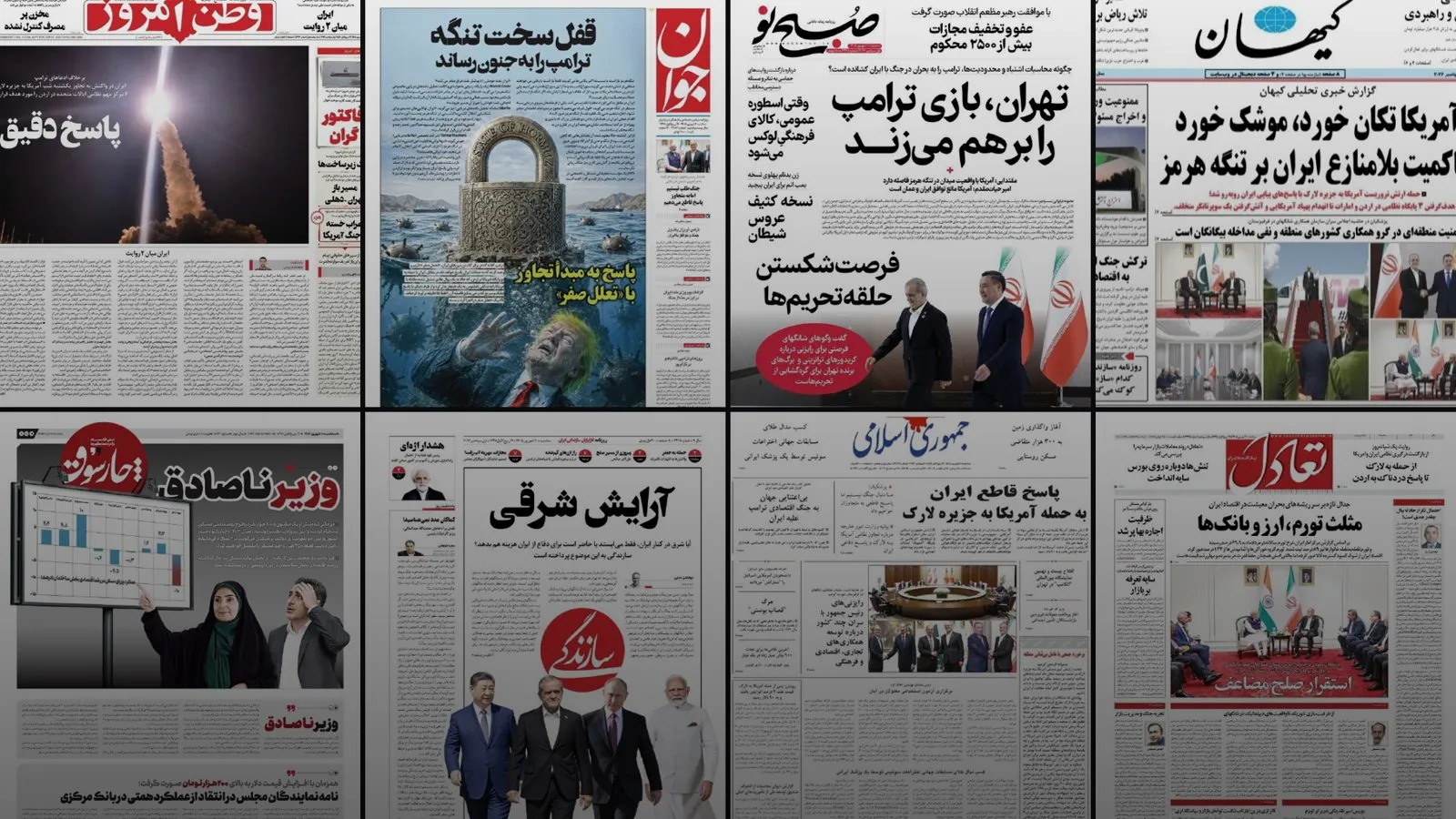
Bottom line: The kinetic US-Iran exchange that the 31 August front pages kept off the page has now become the batch lead: nearly every hardline and official title splashes Iran’s claimed retaliation for the US strike on Larak Island, but the titles cannot agree on what was hit (three bases across Jordan and the UAE versus six US centers in Jordan), the same official who claims the strikes says continuing the war is not in Iran’s interest, and the reformist and economic lanes decline the triumphalism to lead on US authoritarianism and the falling rial, so the edition documents an escalation being simultaneously trumpeted, hedged, and contested.
Executive Summary
The defining development of the cycle is a continuity payoff: the kinetic Strait-of-Hormuz exchange that the 31 August edition tracked only on the wires, and flagged as a negative-evidence finding because the print front pages led instead with the Leader’s unity decree, has now forced its way onto the front pages exactly as that edition said to watch for. Kayhan leads with ‘America was shaken, took the missile’ and a claim of Iran’s ‘undisputed sovereignty over the Strait of Hormuz’; Vatan-e Emrooz devotes its whole page to a missile launch under the single word ‘Precise Response’; Javan renders the strait as a padlock stamped ‘STATE OF HORMUZ’ with a drowning Trump beneath it; Jomhouri Eslami records ‘Iran’s decisive response to America’s attack on Larak Island’; and the English-language Iran Daily tells foreign readers ‘Iran batters US bases in Jordan, UAE in retaliation for strike on isle.’ The exchange has completed its migration from the background to the lead.
The single most analytically useful feature of the retaliation coverage is that the titles do not agree on what happened. Vatan-e Emrooz claims Iran struck ‘six important US military centers in Jordan’; Kayhan and Iran Daily claim ‘three military bases in Jordan and the UAE,’ plus a downed US drone and a supertanker fire; the Defa Press wire separately circulated satellite imagery it says shows damaged US aircraft hangars at the Al-Azraq base in Jordan. These are attributed Iranian claims, none independently confirmed, and their internal inconsistency on the most basic facts, how many sites and in which countries, indicates uncoordinated claim inflation across the hardline lane rather than a single operational readout distributed from the center. The divergence is treated here as evidence about the information operation, not about the operation.
The escalation is being trumpeted and hedged at the same time. On the same front page that carries the retaliation banner, Iran Daily runs President Masoud Pezeshkian’s line that ‘continuation of war is not in the interest of Iran or the region,’ beside a photograph of him shaking hands with Indian Prime Minister Narendra Modi at the Shanghai Cooperation Organization summit. Sobh-e No frames the exchange as Trump being dragged ‘into crisis,’ Tehran ‘disrupting his game,’ rather than as a call for wider war. The message is two-track: the kinetic claim demonstrates deterrent capability while the diplomatic register signals that Tehran wants the exchange contained, not expanded.
The great-power-alignment thread that has run through the series since the China-centered late-August editions is unusually prominent this cycle, carried by the SCO summit. Sazandegi leads with ‘Eastern Formation’ over a photograph of Xi Jinping, Pezeshkian, Vladimir Putin and Narendra Modi walking abreast; Kayhan reports Iran proposing an SCO bank, an export-insurance union and an energy consortium; Jomhouri Eslami and Ta’adol foreground the president’s summit consultations; Etemad calls it his ‘diplomatic maneuver.’ But the alignment is not uncontested even within the reformist lane: Sazandegi alone poses it as a question, ‘will the East merely stand beside Iran, or is it prepared to pay a cost to defend Iran?’, the sharpest skeptical note of the batch.
Two domestic threads refuse to be subordinated to the war narrative. The sitting Leader, Mojtaba Khamenei, remains in the frame that he re-entered on 31 August, but in an administrative register: Sobh-e No reports pardons and commutations for more than 2,500 convicts granted on his approval. And the economic-realist lane holds the line on cost of living: Chahar Sough leads with ‘the untruthful minister’ over a housing-shortfall story and reports the dollar above 120,000 tomans alongside a parliamentary letter against central-bank chief Abdolnaser Hemmati, while Ta’adol leads on ‘the triangle of inflation, currency and the banks’ and reads the day’s market volatility (‘tensions again shadow the bourse’) as the war’s real domestic cost. That an economic daily leads on a falling rial on a morning of claimed missile strikes is itself a signal about competing front-page priorities.
Net assessment: this is an escalation edition in which the escalation is being managed as much as celebrated. The overt story is triumphalist, the retaliation the 31 August press held back is now the front-page lead across the hardline and official titles, complete with a Trump-drowning caricature and a Hormuz-sovereignty claim. The consequential story underneath is that the triumphalism is internally incoherent (the titles cannot agree on the targets), deliberately paired with de-escalation signaling from the president, and openly declined by the reformist and economic lanes, which lead instead on ‘the specter of McCarthyism’ in America and on the collapsing purchasing power of the rial. The threads to watch are whether the battle-damage claims are ever reconciled or independently confirmed; whether the two-track trumpet-and-hedge posture holds or one track wins; whether the SCO alignment produces any concrete deliverable or remains photographic; and whether Israel and Lebanon, conspicuously near-absent from this cycle’s front pages, return to the frame.
Key Points
- KJ-1 [HIGH] The kinetic US-Iran exchange has migrated from the wires to the front pages, resolving the previous edition’s watched thread. The 31 August edition recorded as negative evidence that a live US strike on Larak Island and Iran’s retaliatory claims ran only on the Fars and Defa Press wires while the front pages led with the Leader’s unity decree; this cycle Kayhan, Vatan-e Emrooz, Javan, Jomhouri Eslami and Iran Daily all lead with the retaliation. Significance: the print press has now elevated the exchange to the top of the page, and the shift from suppression to front-page triumphalism within one cycle indicates the war narrative has regained editorial primacy, resolving the exact question the prior edition flagged.
- KJ-2 [HIGH] The Iranian battle-damage claims are internally inconsistent across the hardline titles and are best read as an information operation, not a confirmed operational account. Vatan-e Emrooz claims six US centers in Jordan; Kayhan and Iran Daily claim three bases across Jordan and the UAE plus a downed drone and a supertanker fire; Defa Press circulates separate Al-Azraq imagery. Significance: divergence on the number and location of targets on the same morning indicates claim inflation produced without a shared readout; all figures are attributed, unconfirmed claims and should not be reproduced as fact, and the inconsistency is itself the reportable finding.
- KJ-3 [MODERATE-HIGH] Tehran is running a two-track message that trumpets the retaliation while signaling a preference to contain rather than widen the war. Iran Daily pairs its retaliation banner with President Pezeshkian’s ‘continuation of war is not in the interest of Iran or the region’ and a Modi handshake; Sobh-e No frames the exchange as Trump in crisis rather than as a call to escalate. Significance: the deterrent demonstration and the de-escalation signal are being delivered simultaneously and by the same official apparatus, indicating a calibrated posture aimed at re-establishing deterrence without committing to a wider campaign; whether the two tracks hold is the primary thing to watch.
- KJ-4 [MODERATE-HIGH] The great-power-alignment thread is at its most prominent in weeks, carried by the SCO summit, but is questioned from within the reformist lane. Sazandegi’s ‘Eastern Formation’ photo of Xi, Pezeshkian, Putin and Modi, Kayhan’s report of Iran’s proposed SCO bank and energy consortium, and summit coverage across Jomhouri Eslami, Ta’adol and Etemad extend the eastern pivot; Sazandegi alone asks whether the East will ‘pay a cost to defend Iran.’ Significance: Tehran continues to answer Western pressure by demonstrating eastern alignment, but the reformist question about whether that alignment carries any defense commitment marks the first sustained internal skepticism of the pivot and should be tracked for concrete deliverables versus photo diplomacy.
- KJ-5 [MODERATE] The sitting Leader remains in the editorial frame he re-entered on 31 August, but in an administrative rather than a commanding register. Sobh-e No reports pardons and commutations for more than 2,500 convicts granted on the approval of Mojtaba Khamenei. Significance: the leadership-visibility thread continues, but the shift from a unity decree that both camps weaponized to a routine clemency act suggests the office is maintaining presence without issuing a fresh directive, and the number and attribution remain single-sourced to one front-page banner.
- KJ-6 [MODERATE] The economic-realist lane is holding front-page space against the war narrative, keeping cost of living a competing priority. Chahar Sough leads on housing-target failure and the dollar above 120,000 tomans with a parliamentary letter against central-bank chief Hemmati; Ta’adol leads on inflation, currency and the banks and reads market volatility as the exchange’s real domestic cost. Significance: on a morning of claimed missile strikes, two economic dailies decline to subordinate the rial to the retaliation, indicating that household economic pressure is being treated by part of the press as at least co-equal with the war, a fault line the hardline optimism line cannot fully close.
- KJ-7 [MODERATE] The reformist lane declines the war-triumphalism frame, continuing the factional split over how to read the conflict. Etemad leads not on the retaliation but on ‘the specter of McCarthyism’ in Trump’s America and on Pezeshkian’s ‘diplomatic maneuver,’ running no missile photograph or battle-damage claim on its front page. Significance: the reformist choice to frame the day around US authoritarianism and Iranian diplomacy rather than around Iranian strikes continues the diplomacy-over-confrontation lane tracked since late August and confirms that the front-page consensus on the retaliation is a hardline-and-official, not a system-wide, consensus.
- KJ-8 [LOW-MODERATE] Negative-evidence finding: Israel and Lebanon are near-absent from this cycle’s front pages, which are organized around the US-Iran-Hormuz axis. Where late-August editions carried Lebanon and Israel as live flashpoints, this batch confines them to a passing, unattributed obituary-polemic line in Jomhouri Eslami and otherwise omits them. Significance: the flashpoint of record this cycle is the strait and the US, not the Israel-Lebanon front; the absence is recorded so that any return of Israel or Lebanon to the front pages in the next batch registers as a shift rather than as noise.
Macro Trends
- The retaliation completes its migration from the wires to the front pages. The 31 August edition tracked the US strike on Larak Island and Iran’s retaliatory claims only on the Fars and Defa Press wires, and recorded as negative evidence that the print front pages, going to press on the Leader’s unity decree, did not splash the exchange. This cycle the exchange is the lead: Kayhan (‘America was shaken, took the missile’), Vatan-e Emrooz (‘Precise Response’), Javan (the Hormuz padlock and drowning Trump), Jomhouri Eslami (‘Iran’s decisive response to America’s attack on Larak Island’) and Iran Daily (‘Iran batters US bases in Jordan, UAE’) all front it. The watched thread from the previous edition has resolved toward front-page war triumphalism.
- The battle-damage claims are internally inconsistent, marking an information operation rather than a shared readout. The hardline titles cannot agree on what Iran hit. Vatan-e Emrooz claims six US military centers in Jordan; Kayhan and Iran Daily claim three bases across Jordan and the UAE, plus a downed drone and a supertanker fire; Defa Press circulates separate imagery it attributes to the Al-Azraq base. The divergence on the most basic facts, the number of targets and which countries, indicates claim inflation produced without a common operational account, and every figure is logged as an attributed, unconfirmed claim documented for defensive assessment only.
- Escalation is trumpeted and hedged on the same page. The kinetic claim is deliberately paired with de-escalation signaling. Iran Daily runs Pezeshkian’s ‘continuation of war is not in the interest of Iran or the region’ beside its retaliation banner; Sobh-e No frames the exchange as Trump dragged into crisis and Tehran disrupting his game rather than as a call to widen the war. The two-track message, demonstrate deterrent capability while signaling a preference for containment, is the edition’s defining posture.
- The eastern alignment is prominent but, within the reformist lane, questioned. The SCO summit anchors the great-power-alignment thread: Sazandegi’s four-leader ‘Eastern Formation’ photo (Xi, Pezeshkian, Putin, Modi), Kayhan’s report of Iran proposing an SCO bank, export-insurance union and energy consortium, and summit coverage in Jomhouri Eslami, Ta’adol and Etemad. Yet Sazandegi alone reframes the pivot skeptically, asking whether the East will ‘pay a cost to defend Iran’ or merely stand beside it, the batch’s sharpest internal challenge to the alignment narrative.
- The domestic economy holds front-page space against the war narrative. On a morning of claimed missile strikes, two economic dailies lead on cost of living. Chahar Sough runs ‘the untruthful minister’ over a National Housing Movement shortfall, reports the dollar above 120,000 tomans, and fronts a parliamentary letter against central-bank chief Abdolnaser Hemmati; Ta’adol leads on ‘the triangle of inflation, currency and the banks’ and reads market volatility as the war’s real domestic cost. The refusal to subordinate the rial to the retaliation is a competing-priorities signal.
- The Leader stays in frame, now in an administrative register. After re-entering the editorial frame with the 31 August unity decree, the sitting Leader, Mojtaba Khamenei, remains present but shifts register: Sobh-e No reports clemency for more than 2,500 convicts granted on his approval. The move continues the leadership-visibility thread while dropping the unity-command urgency of the previous cycle.
Front-Page Snapshot
- Kayhan - “America was shaken, took the missile: Iran’s undisputed sovereignty over the Strait of Hormuz” (Ultra-hardline flagship) - Front-page war triumphalism claiming strikes on three bases in Jordan and the UAE and Hormuz sovereignty [SEVERE]
- Vatan-e Emrooz - “Precise Response” (Hardline / principlist) - Full-page missile image claiming six US military centers struck in Jordan [SEVERE]
- Javan - “The Strait’s hard lock drove Trump to madness” (Hardline, IRGC-affiliated) - Hormuz-as-padlock coercion imagery and a ‘zero-delay’ retaliation doctrine, with a drowning-Trump caricature [HIGH]
- Iran Daily - “Iran batters US bases in Jordan, UAE in retaliation for strike on isle” (Official English-language state daily) - English-language retaliation claim paired with Pezeshkian’s ‘war not in Iran’s interest’ de-escalation line [HIGH]
- Jomhouri Eslami - “Iran’s decisive response to America’s attack on Larak Island” (Traditional / establishment) - Measured ‘decisive response’ record paired with SCO summit diplomacy and resilience against the economic war [HIGH]
- Sobh-e No - “Tehran disrupts Trump’s game” (Principlist) - Strategic-vindication framing plus the Leader’s clemency for 2,500-plus convicts and sanctions-breaking corridors [MODERATE-HIGH]
- Sazandegi - “Eastern Formation” (Reformist / Kargozaran) - SCO four-leader photo, but asks skeptically whether the East will pay to defend Iran; carries Ejei’s unrest warning [MODERATE]
- Ta’adol - “The triangle of inflation, currency and the banks” (Economic / business) - Livelihood-crisis lead; the war exchange framed as market risk; Pezeshkian-Modi ‘double peace’ meeting [MODERATE]
- Etemad - “The specter of McCarthyism” (Reformist) - Declines the kinetic splash to frame Trump’s America as authoritarian and foreground Pezeshkian’s diplomacy [LOW-MODERATE]
- Chahar Sough - “The untruthful minister” (Economic) - Housing-target failure, the dollar above 120,000 tomans, and a parliamentary letter against the central-bank chief [LOW-MODERATE]
Full report
The complete edition - per-paper front-page analysis and full translation appendices - is available as a PDF: Download the full report.
Compiled from Iranian front pages and outlet channels via open-source monitoring. Translations are editorial; named-figure attributions are verified against the source pages where possible.