Iranian Press Monitor - Monday, 31 August 2026 (Day 181)
Monday, 31 August 2026 · 9 Shahrivar 1405 · 18 Rabi al-Awwal 1448 - Front pages published the morning of 31 August, reflecting events through late 30 August, dominated by the Leader’s Unity Week message forbidding internal division, the backlash over President Pezeshkian’s television interview, and the launch of the Mahd-e Iran party, while a fresh Strait-of-Hormuz kinetic exchange ran on the wires
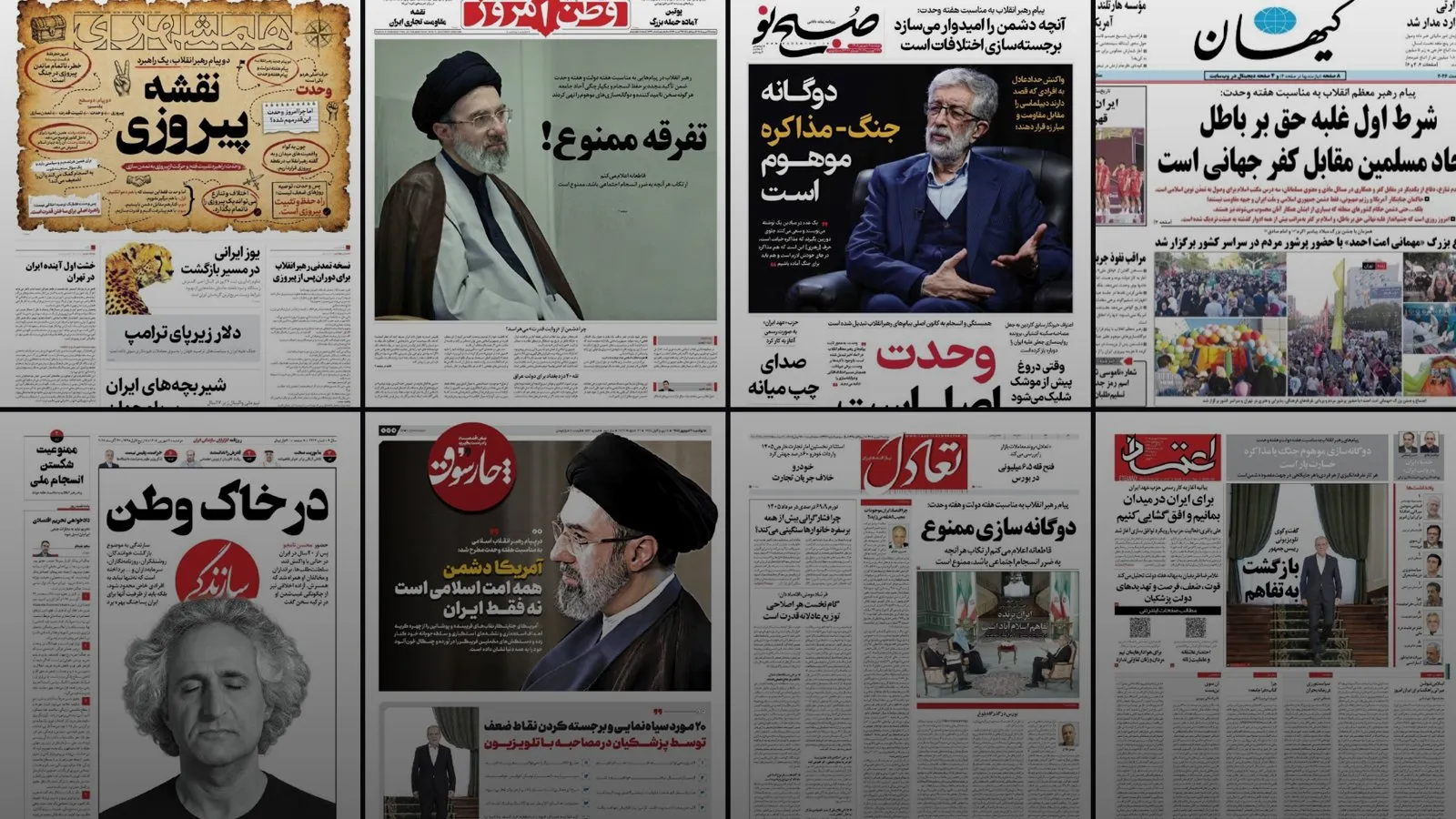
Bottom line: The 31 August batch is a single coordinated event: the Leader breaks his months-long editorial silence to forbid internal division, and nearly every front page carries the decree, but the hardline and reformist lanes immediately turn the identical words to opposite ends (a loyalty test on Pezeshkian versus a license for his diplomacy), so the message meant to close the system’s rupture instead documents it, even as a fresh US-Iran exchange over the Strait of Hormuz plays out off the front pages.
Executive Summary
The defining development of the cycle is a reversal of the series’ longest-running negative-evidence thread: the sitting Leader of the Revolution, Mojtaba Khamenei, silent above the fray through the late-August editions, now features by direct message on nearly every front page. A coordinated text marking Government Week, Unity Week and the 40th International Islamic Unity Conference is splashed by Vatan-e Emrooz (‘Division forbidden!’), Kayhan (‘the unity of Muslims against global unbelief’), Chaharsoo (‘America is the enemy of the entire Islamic ummah’), Jomhouri Eslami (‘recognize the real enemy’), Ta’adol and Etemad (‘dichotomization forbidden’), and Hamshahri (‘blueprint of victory’). The convergence of separately owned hardline, reformist, establishment and business titles on the same message and often the same pulled quote, ‘committing anything to the detriment of social cohesion is forbidden,’ indicates a centrally supplied text rather than organic editorial agreement.
The message’s own content names the reason it was needed, and it is the edition’s single highest-significance finding: the decree forbids ‘illusory dichotomization,’ explicitly the war-versus-negotiation split, the exact fault line that fractured the Iranian press through late August. The clearest proof that the decree suppresses rather than settles that split is that both camps immediately claim it. Kayhan’s front-page note turns it inward, warning President Pezeshkian to ‘beware the unity-breaking current in the body of the government’; Chaharsoo converts it into a numbered indictment of ‘twenty instances of negativism’ in the president’s television interview. Etemad reads the very same sentence as vindication, headlining Pezeshkian’s interview a ‘return to consensus’ and licensing his diplomacy; Sobh-e No enlists Haddad-Adel to brand the war-or-talks binary an enemy illusion. One message, two mutually exclusive readings, each invoking the Leader’s authority.
Beneath the unity decree the internal political contest is intensifying, not resolving. The launch of the new ‘Mahd-e Iran’ party, fronted by Etemad and Sobh-e No through Ali Baqeri’s statement rejecting a ‘confrontation-building’ approach, and glossed by Gholamreza Zarifian’s audit of the Pezeshkian government’s ‘strengths, weaknesses, opportunities and threats,’ opens a fresh institutional vehicle for the diplomacy-and-cohesion lane at the moment the hardline press is trying to close that space. The Pezeshkian television interview functions as the cycle’s real battleground: the reformist lane treats it as candor and consensus-seeking, the hardline and economic lanes as defeatist ‘negativism’ that serves the enemy.
The Strait of Hormuz, the series’ central physical lever, migrated again, and this time off the front pages. Where the 26 August edition tracked an Iran-Oman de-escalation corridor against hardline chokepoint rhetoric, this cycle carries a genuine kinetic exchange that the print front pages, going to press on the unity message, did not splash: a US strike on rocket launchers on Iran’s Larak Island, reported by US Central Command as an imminent mine-laying threat, and Iranian retaliatory claims of ballistic-missile strikes on US bases in Jordan, drone strikes on the Al-Minhad base in the UAE, and the downing of a US MQ-9 over the strait. Iranian wire channels (Fars, Defa Press) carried the operations as the war’s continuation; international reporting corroborated the exchange, with Jordan stating it intercepted eight incoming missiles. That an actual US-Iran exchange ran on the wires while the front pages led with an internal-cohesion decree is itself a finding about editorial priority and message control.
The economic and diplomatic registers round out the cycle without dislodging the unity frame. Ta’adol reports the Tehran bourse topping a 5.5-million peak and car imports up 56 percent, and foregrounds both the Iran-Pakistan ‘Islamabad understanding’ and the Shanghai Cooperation Organization summit; President Pezeshkian departed for the SCO summit in Bishkek, continuing the great-power-alignment thread that ran through the China-centered 26 August edition. Sazandegi supplies the sharpest counter-current, leading not with the decree but with the exiled musician Mohsen Namjoo’s return to Iran and an economist’s candor about sanctions pain, staking out reformist cultural and economic ground against the enforced-optimism line.
Net assessment: this is a top-down message-discipline edition in which the instrument of unity becomes the evidence of disunity. The overt story is that the Leader has re-entered the frame after a prolonged absence to command national cohesion and forbid the war-versus-talks split, and the entire press has amplified him in near-lockstep. The consequential story underneath is that the command failed at the moment of transmission: the hardline flagship reads ‘unity’ as a mandate to purge and discipline the government, the reformist lane reads it as endorsement of the president’s diplomacy, and the new Mahd-e Iran party institutionalizes the diplomacy lane even as Kayhan tries to delegitimize it. The threads to watch are whether the decree is followed by concrete moves against named officials or by an accommodation; whether the Mahd-e Iran launch hardens into an organized pro-diplomacy bloc; and whether the off-front-page Hormuz exchange forces its way onto the next batch’s front pages or is deliberately kept subordinate to the unity narrative.
Key Points
- KJ-1 [HIGH] The sitting Leader has re-entered the editorial frame with a coordinated unity decree, reversing the series’ standing leadership-by-absence thread. A message attributed to Mojtaba Khamenei marking Government Week, Unity Week and the 40th Islamic Unity Conference dominates Vatan-e Emrooz, Kayhan, Chaharsoo, Jomhouri Eslami, Ta’adol, Etemad and Hamshahri, with the same pulled quote recurring across separately owned titles. Significance: after editions defined by the current Leader’s silence, this is a deliberate re-assertion of the leadership register, and the lockstep amplification indicates a supplied text and central message control rather than organic convergence.
- KJ-2 [HIGH] The unity decree has failed to close the intra-system split and instead documents it, because both lanes claim the same words for opposite ends. Kayhan warns Pezeshkian against a ‘unity-breaking current in the government’ and Chaharsoo audits ‘twenty instances of negativism’ in his television interview, while Etemad reads the identical message as a ‘return to consensus’ endorsing his diplomacy and Sobh-e No brands the war-or-talks binary an enemy illusion. Significance: a command to end the war-versus-negotiation split that is immediately turned into ammunition by both camps is evidence the rupture is now structural, not rhetorical, and that top-down messaging cannot presently suppress it.
- KJ-3 [MODERATE-HIGH] The diplomacy-and-cohesion lane is institutionalizing through the new Mahd-e Iran party even as the hardline press moves to delegitimize it. Etemad and Sobh-e No front the launch via Ali Baqeri’s rejection of ‘confrontation-building’ and Gholamreza Zarifian’s government audit, giving the pro-diplomacy camp an organized vehicle. Significance: the contest documented since late August is acquiring formal political structure, which raises the stakes of the hardline flagship’s loyalty-test framing and should be tracked for whether the party coheres into a durable bloc or is neutralized.
- KJ-4 [MODERATE-HIGH] A kinetic US-Iran exchange over the Strait of Hormuz occurred this cycle but was kept off the scanned front pages. A US strike on Larak Island rocket launchers (framed by US Central Command as an imminent mine-laying threat) drew Iranian retaliatory claims of ballistic-missile strikes on US bases in Jordan, drone strikes on Al-Minhad in the UAE, and an MQ-9 downing over the strait, carried by Fars and Defa Press and corroborated internationally, with Jordan reporting eight missiles intercepted. Significance: the print press subordinating a live exchange to an internal-unity decree indicates message priority is being set at the leadership rather than the event level; the Iranian battle-damage figures are attributed claims pending independent confirmation.
- KJ-5 [MODERATE] The great-power-alignment thread continues through the SCO summit and the Iran-Pakistan channel, extending the China-centered 26 August edition. Ta’adol foregrounds the Shanghai Cooperation Organization summit and the ‘Islamabad understanding,’ and President Pezeshkian departed for the SCO gathering in Bishkek, where bilateral meetings with Russian, Chinese, Pakistani and Indian leaders were signaled. Significance: Tehran continues to answer Western pressure by demonstrating eastern and regional alignment, though the front pages present the summit as backdrop to the unity narrative rather than as the day’s lead, so its concrete deliverables remain to be tracked.
- KJ-6 [MODERATE] The economic-realist and reformist-cultural lanes continue to resist the enforced-optimism line the decree demands. Sazandegi leads with Mohsen Namjoo’s return and sanctions candor rather than the unity message; Ta’adol’s Farshad Momeni argues fair power distribution is the precondition for reform; Saeed Leylaz writes on sanctions strain. Significance: even under a top-down cohesion command, part of the press keeps acknowledging hardship and dissent as legitimate rather than defeatist, holding open the fault line the hardline lane frames as an enemy asset.
- KJ-7 [MODERATE] Negative-evidence finding: the front pages carry the Leader’s message but not the day’s kinetic escalation, and no triumphalist war splash appears on any title. Hardline flagships that would ordinarily headline strikes on US bases instead led with internal cohesion, and the operational claims surfaced only on the wires. Significance: the absence of front-page war triumphalism on a day of actual exchange is a signal in itself, consistent with a deliberate decision to keep the unity-and-discipline narrative on top and the kinetic register in the background, and is recorded as negative evidence to be revisited on the next batch.
Macro Trends
- The Leader returns from absence with a coordinated unity decree. After a run of editions in which the sitting Supreme Leader appeared only by absence, Mojtaba Khamenei features by direct message on nearly every front page, marking Government Week, Unity Week and the 40th Islamic Unity Conference. Vatan-e Emrooz distills it to ‘Division forbidden!’, Kayhan to ‘the unity of Muslims against global unbelief,’ Ta’adol and Etemad to ‘dichotomization forbidden,’ Jomhouri Eslami to ‘recognize the real enemy,’ and Chaharsoo to ‘America is the enemy of the whole ummah.’ The recurrence of the same pulled quote across separately owned titles indicates a supplied text and centrally managed message discipline, and reverses the standing leadership-by-absence thread recorded through 26 August.
- One decree, two readings: the unity message documents the split it forbids. The message explicitly forbids the war-versus-negotiation dichotomy, and both camps immediately weaponize it. Kayhan’s front-page note turns it into a warning to Pezeshkian against a ‘unity-breaking current in the government,’ and Chaharsoo into a numbered audit of the president’s ‘negativism’ in his television interview; Etemad reads the identical text as a ‘return to consensus’ that licenses his diplomacy, and Sobh-e No, via Haddad-Adel, brands the war-or-talks binary an enemy illusion. The same sentence wielded for opposite ends is the sharpest available evidence that the decree suppresses rather than resolves the intra-system rupture.
- The internal contest institutionalizes: the Mahd-e Iran party launches. Etemad and Sobh-e No front the official launch of a new ‘Mahd-e Iran’ party, with Ali Baqeri disavowing a ‘confrontation-building’ approach and Gholamreza Zarifian auditing the Pezeshkian government’s strengths and threats. The launch opens an organized vehicle for the diplomacy-and-cohesion lane precisely as the hardline flagship tries to close that space, so the unity decree lands atop an intensifying, not subsiding, political competition.
- Hormuz turns kinetic again, but off the front pages. The 26 August Iran-Oman de-escalation corridor is overtaken by an actual exchange: a US strike on rocket launchers on Larak Island (framed by US Central Command as an imminent Hormuz mine-laying threat) and Iranian retaliatory claims of ballistic-missile strikes on US bases in Jordan, drone strikes on Al-Minhad in the UAE, and an MQ-9 downed over the strait, carried by Fars and Defa Press and corroborated internationally (Jordan reporting eight missiles intercepted). That the print front pages, going to press on the unity message, did not splash a live US-Iran exchange is a finding about editorial priority; the operations and their damage claims are logged as attributed.
- Markets and great-power alignment carry the day’s optimism. Ta’adol reports the Tehran bourse topping a 5.5-million peak, car imports up 56 percent, the Iran-Pakistan ‘Islamabad understanding,’ and the SCO summit; President Pezeshkian departed for the SCO gathering in Bishkek, continuing the great-power-alignment thread from the China-centered 26 August edition. The economic-realist lane keeps its structural argument alive through Farshad Momeni (‘the first reformist step is the just distribution of power’) and Saeed Leylaz on sanctions strain, holding the fault line with the hardline demand for unbroken optimism.
- A reformist cultural counter-current under the enforced-unity line. Sazandegi declines to lead with the decree, fronting instead the exiled musician Mohsen Namjoo’s return to Iran and the hostile reaction of monarchist and ‘overthrowist’ opponents abroad, alongside candor about sanctions pain. The choice stakes out reformist cultural ground at the exact moment the establishment presses for closed ranks, a quiet but pointed refusal of the message discipline the hardline titles enforce.
Front-Page Snapshot
- Vatan-e Emrooz - “Division forbidden!” (Hardline / principlist) - The Leader’s anti-division decree distilled to a single prohibition over his portrait [MODERATE]
- Kayhan - “The first condition for right’s triumph over falsehood is Muslim unity against global unbelief” (Ultra-hardline flagship) - Unity message turned inward via a note warning Pezeshkian against a ‘unity-breaking current’ [MODERATE-HIGH]
- Chaharsoo - “America is the enemy of the entire Islamic ummah, not only of Iran” (Economic / principlist) - Anti-American message fused with a numbered indictment of Pezeshkian’s TV interview [MODERATE]
- Jomhouri Eslami - “Rulers of Islamic countries must recognize their real enemy and confront its designs” (Traditional / establishment) - Unity message set at the Islamic Unity Conference plus a Government Week delivery tally [MODERATE]
- Sobh-e No - “The war-versus-negotiation dichotomy is illusory” (Principlist) - Haddad-Adel recasts the diplomacy-versus-resistance split as an enemy illusion; ‘unity is the principle’ [MODERATE]
- Etemad - “The illusory war-versus-negotiation dichotomy is costly” (Reformist) - Same decree read as licensing Pezeshkian’s ‘return to consensus’; Mahd-e Iran party launch [LOW-MODERATE]
- Hamshahri - “Blueprint of victory” (Centrist, Tehran municipality) - Unity as strategy (‘two messages, one strategy’), with a lighter civic and cultural mix [LOW-MODERATE]
- Ta’adol - “Dichotomization forbidden” (Economic / business) - Decree read as market and diplomatic upside: 5.5-million bourse peak, Islamabad understanding, SCO summit [LOW-MODERATE]
- Sazandegi - “On the soil of the homeland” (Reformist / Kargozaran) - Declines the decree to lead on Mohsen Namjoo’s return and sanctions candor [LOW]
- Iran Daily - “Tehran urges countries not to become complicit in US ‘economic terrorism’” (Official English-language state daily) - Outward legal-diplomatic framing of sanctions plus the Qatari-FM meeting (scan one day behind) [MODERATE]
Full report
The complete edition - per-paper front-page analysis and full translation appendices - is available as a PDF: Download the full report.
Compiled from Iranian front pages and outlet channels via open-source monitoring. Translations are editorial; named-figure attributions are verified against the source pages where possible.