Iranian Press Monitor - Wednesday, 26 August 2026 (Day 176)
Wednesday, 26 August 2026 · 4 Shahrivar 1405 · 13 Rabi al-Awwal 1448 - Front pages published the morning of 26 August, reflecting events through late 25 August local, principally China’s formal protest of the new US sanctions, an openly contested Pakistani mediation track, and an Iran-Oman understanding on the Strait of Hormuz
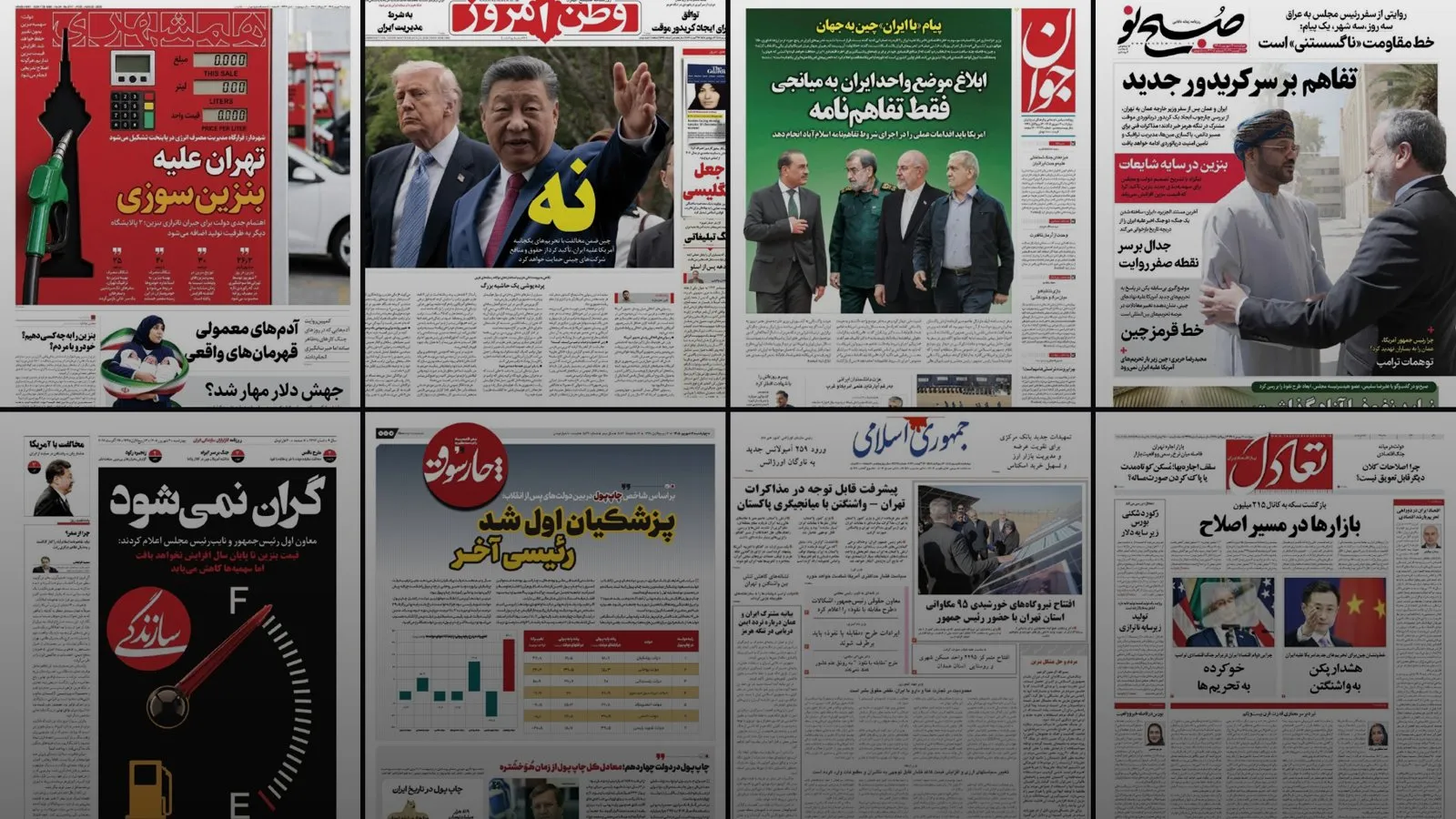
Bottom line: The 26 August batch converts the sanctions story into a great-power confrontation, elevating China’s formal protest into a strategic shield, while the Iranian system fractures in public over the Pakistani mediation meant to end the war: the government-establishment lane touts progress and the hardline flagship brands the mediator an American agent and the whole channel a deception.
Executive Summary
The defining development of the cycle is the entry of China as an active party. Where the 24-25 August batches answered the US ‘economic D-Day’ sanctions with a self-generated ‘boomerang’ narrative, this morning that narrative acquires a great-power mechanism: China formally protested the new US measures, its foreign-ministry spokesman calling them unilateral, and signaled that Chinese firms will continue to work with Iran. Vatan-e Emrooz runs the story as a single giant ‘No’ over a photograph of Trump and Xi; Etemad fronts ‘Beijing’s counterstrike’; Ta’adol headlines ‘Beijing’s warning to Washington’; Sobh-e No calls it ‘China’s red line’ and Sazandegi ‘opposition to America.’ The convergence across hardline, reformist and business titles, corroborated by the wire agencies (Defa Press citing Bloomberg that Iran ties ‘should not be disrupted,’ Nour News citing the Independent on the limits of US leverage over China), marks the moment Tehran’s press stopped arguing that the sanctions would fail on their own and started arguing that a great power will make them fail.
Running against that unified anti-sanctions front is the sharpest intra-system split of the war so far, and it is the edition’s single highest-significance finding. The Pakistani mediation track that the government-reformist lane welcomed on 25 August has now openly fractured the system. Jomhouri Eslami fronts ‘significant progress in Tehran-Washington talks under Pakistani mediation’ and the English Iran Daily reports ‘significant progress’ on the ‘Islamabad MoU’; Javan accepts the channel but hardens the terms to ‘the memorandum only, and Washington must act first.’ Kayhan’s flagship ‘Yadasht-e Rooz’ editorial does the opposite: it brands the mediator Asim Munir ‘an American operative’ and the entire mediation a ‘deception operation’ designed to extract what the battlefield did not. The hardline flagship is no longer merely subordinating the diplomacy to the boomerang narrative, as on 25 August; it is actively working to discredit and derail it.
The Strait of Hormuz, which migrated on 25 August from a deterrence threat to a bargaining object, this morning becomes an operational de-escalation mechanism, and simultaneously a rhetorical escalation. Sobh-e No fronts an Iran-Oman ‘understanding on a new corridor,’ reporting that after the Omani foreign minister’s Tehran visit the two states agreed to review a temporary maritime corridor with mine-clearing, traffic-management and security provisions; Jomhouri Eslami carries the matching ‘joint Iran-Oman statement,’ and Defa Press details the phased framework. Yet Kayhan’s editorial, the same morning, insists Iran holds the Hormuz and Bab al-Mandeb chokepoints and should escalate its demands, and Nour News reports the strait’s traffic has collapsed to five transits on Tuesday against a recent average of fifteen. The chokepoint is being negotiated open and rhetorically kept closed in the same cycle, and the two lanes now diverge visibly on it.
Beneath the great-power drama, domestic economic strain surfaces on the front pages in a way the boomerang triumphalism cannot absorb. Hamshahri leads with ‘Tehran against fuel-burning,’ a municipal warning to the government over the gasoline-shortage crisis; Sazandegi promises ‘it won’t get more expensive’ while conceding ration cuts; Sobh-e No fights a fuel-price rumor. Etemad carries economy minister Hemmati’s insistence that the dollar’s move past 300,000 is ‘temporary’; Nour News reports jet fuel up roughly 50 percent since late February; Charsou defends the administration’s monetary record with a comparative league table. The cost side of the sanctions ledger, muted in the defiance narrative, is legible at the pump and the exchange counter.
Two secondary threads round out the cycle. An information-operations front widens: Vatan-e Emrooz runs ‘British forgery’ and ‘propaganda war,’ and Sobh-e No fronts a ‘battle over the zero-point narrative,’ contesting an Al Jazeera documentary’s account of the war’s origins, so that control of the war’s story becomes its own theater. And on the ceasefire’s edge, Fars relays Al-Mayadeen reporting of intense Israeli strikes on southern Lebanon, a reminder that the fragile 17 June understanding has not stilled the Lebanon front, though the claim is single-sourced and carried as such.
Net assessment: this is a great-power edition wrapped around an internal rupture. The overt story is that China has stepped from the wings to become Iran’s declared shield against the largest sanctions package since 2018, and the press has moved from asserting the sanctions will boomerang to naming the actor who will make them do so. The consequential story underneath is that the Iranian system is now fighting itself in public over how to end the war: the establishment and reformist-government lane sells a Pakistani-mediated, Oman-assisted diplomatic off-ramp, and the hardline flagship works openly to blow it up, calling the mediator an enemy agent and the strait a weapon to be pressed harder. The threads to watch are whether China’s ‘support’ materializes as named, verifiable commercial or diplomatic commitments; whether the Kayhan-versus-government fight over Asim Munir hardens into a decision to abandon or pursue the channel; and whether the Iran-Oman corridor produces an actual change in Hormuz transit or remains, like the mediation, a claim contested from within.
Key Points
- KJ-1 [HIGH] China has moved from silent beneficiary to Iran’s declared great-power shield against the US sanctions. Beijing formally protested the new measures as unilateral and signaled its Iran ties should not be disrupted; the story leads Vatan-e Emrooz (‘No,’ over Trump and Xi), Etemad (‘Beijing’s counterstrike’), Ta’adol (‘Beijing’s warning to Washington’), Sobh-e No (‘China’s red line’) and Sazandegi, and is corroborated by Defa Press (via Bloomberg) and Nour News (via the Independent). Significance: this converts the standing ‘boomerang’ thread from self-assertion into a claimed external mechanism, giving the anti-sanctions narrative a named patron; but the concrete content, ‘Chinese companies will support Iran,’ is uncosted and unnamed, so the shift is real in framing and unproven in substance.
- KJ-2 [HIGH] The Pakistani mediation track has openly fractured the Iranian system, the sharpest intra-system split of the war to date. Jomhouri Eslami and Iran Daily front the channel as producing ‘significant progress,’ Javan accepts it only on hardened terms (‘the memorandum only’), while Kayhan’s flagship editorial brands the mediator Asim Munir ‘an American operative’ and the mediation a ‘deception operation.’ Significance: the hardline flagship has shifted from subordinating the diplomacy (its 25 August posture) to actively working to discredit and derail it, exposing a real fight over whether to pursue an off-ramp at all and identifying the specific channel, and person, the rejectionist lane will target.
- KJ-3 [MODERATE-HIGH] The Strait of Hormuz has become an operational de-escalation mechanism and a rhetorical escalation in the same cycle. Sobh-e No and Jomhouri Eslami front an Iran-Oman understanding on a temporary maritime corridor with mine-clearing, and Defa Press details the phased framework; simultaneously Kayhan’s editorial urges pressing the Hormuz and Bab al-Mandeb chokepoints harder, and Nour News reports transit collapsing to five vessels on Tuesday against a fifteen-vessel average. Significance: the chokepoint is being negotiated open by the government-establishment lane and rhetorically kept closed by the hardline lane, a visible divergence that maps the diplomacy-versus-deterrence split onto the war’s most consequential physical lever.
- KJ-4 [MODERATE] The mediation’s substance is contested even in how it is framed, and the broadest claim outruns its corroboration. Jomhouri Eslami reports ‘significant progress in Tehran-Washington talks under Pakistani mediation,’ while the outward-facing Iran Daily renders the same development more narrowly as ‘Iran-Pakistan talks on the Islamabad MoU.’ Significance: the gap between an asserted US-Iran contact and a bilateral Iran-Pakistan process signals that the strongest version of the progress claim is not independently confirmed; it is logged as attributed, and the two-audience architecture (harder inward, softer outward) is again visible in the split.
- KJ-5 [MODERATE-HIGH] Domestic economic strain has broken onto the front pages across lanes, puncturing the boomerang triumphalism. Hamshahri leads on the gasoline-shortage crisis and stalled war-damage reconstruction; Sazandegi concedes ration cuts; Etemad carries Hemmati’s ‘the dollar past 300,000 is temporary’; Nour News reports jet fuel up about 50 percent since late February. Significance: the pressure the defiance narrative frames as self-defeating for Washington is simultaneously being felt at the Iranian pump and exchange counter, and the economic-realist lane’s continued insistence that candor about hardship is legitimate keeps an open rhetorical fault line with the hardline demand for unbroken optimism.
- KJ-6 [MODERATE] An information-operations front is widening alongside the economic and diplomatic ones. Vatan-e Emrooz runs ‘British forgery’ and ‘propaganda war’ against a claimed Western operation, and Sobh-e No fronts a ‘battle over the zero-point narrative,’ contesting an Al Jazeera documentary’s account of the war’s origins. Significance: the Iranian press is treating control of the war’s story, both its origins and the meaning of the sanctions, as a distinct theater, which indicates centrally-managed narrative discipline rather than incidental commentary and should be tracked for the specific claims it seeks to pre-empt.
- KJ-7 [MODERATE] Negative-evidence finding: the sitting Supreme Leader again issued no message and appears only by absence. No statement from Mojtaba Khamenei features on any front page or channel; the leadership register is carried by President Pezeshkian’s governance events and by economic and security voices. Significance: on a cycle defined by China’s entry, a fracturing mediation and a Hormuz understanding, the current Leader’s continued silence above the fray is a standing marker in the succession picture and is recorded as negative evidence, consistent with the pattern since the 28 February assassination of Ali Khamenei.
Macro Trends
- China moves from bystander to declared backstop. The cycle’s defining shift is the elevation of China from a background beneficiary of Iranian oil to the named actor who will defeat the sanctions. China formally protested the new US measures as unilateral and signaled its Iran ties ‘should not be disrupted’; Vatan-e Emrooz stamps a giant ‘No’ over Trump and Xi, Etemad runs ‘Beijing’s counterstrike,’ Ta’adol ‘Beijing’s warning to Washington,’ Sobh-e No ‘China’s red line’ and Sazandegi ‘opposition to America.’ Corroborated by Defa Press (via Bloomberg) and Nour News (via the Independent), the convergence across separately owned titles indicates a supplied great-power frame and continues the standing adversary-decay thread, now with a patron attached (attributed argumentation; ‘Chinese companies will support Iran’ remains uncosted and unnamed).
- The Pakistani mediation fractures the system in public. The Munir channel that the government-reformist lane welcomed on 25 August now divides the press openly. Jomhouri Eslami fronts ‘significant progress in Tehran-Washington talks’ and Iran Daily reports progress on the ‘Islamabad MoU’; Javan accepts the channel but hardens it to ‘the memorandum only’; Kayhan’s flagship editorial brands Asim Munir ‘an American operative’ and the mediation a ‘deception operation.’ This is a break from the 25 August shared-boomerang consensus: the hardline flagship has shifted from subordinating the diplomacy to actively trying to discredit it, converting the diplomacy-versus-deterrence tension into a fight over whether the war should be ended at all.
- Hormuz negotiated open, rhetorically kept closed. The chokepoint splits along the same fault line. Sobh-e No fronts an Iran-Oman ‘understanding on a new corridor’ (a temporary maritime passage with mine-clearing and traffic management), Jomhouri Eslami carries the matching joint statement, and Defa Press details the phased framework, an operational de-escalation track. Against it, Kayhan’s editorial insists Iran should press the Hormuz and Bab al-Mandeb chokepoints harder, and Nour News reports transit collapsing to five vessels on Tuesday against a fifteen-vessel average. The strait is simultaneously a diplomatic corridor Iran is helping to open and a weapon the hardline lane wants kept cocked, a single-cycle divergence that did not exist a week ago.
- Domestic economic strain surfaces under the triumphalism. The cost side of the sanctions ledger reaches the front pages. Hamshahri leads with a municipal warning over the gasoline-shortage crisis and stalled war-damage reconstruction; Sazandegi promises price stability but concedes ration cuts; Sobh-e No fights a fuel-price rumor; Etemad carries Hemmati’s ‘the dollar past 300,000 is temporary’; Nour News reports jet fuel up about 50 percent since late February; Charsou defends the administration’s monetary record. The economic-realist lane keeps acknowledging the squeeze as legitimate rather than defeatist, holding the fault line with the hardline loyalty-test framing that ran through the prior cycle.
- The information war over the sanctions and the war’s origins. A distinct narrative-control front widens. Vatan-e Emrooz runs ‘British forgery’ and ‘propaganda war’ against a claimed Western information operation, while Sobh-e No fronts a ‘battle over the zero-point narrative,’ contesting an Al Jazeera documentary’s account of how the war began. Control of the story, of who started the war and of what the sanctions mean, is treated as its own contested theater alongside the economic and diplomatic ones.
- Leadership by absence persists on a high-stakes cycle. No message from the sitting Supreme Leader, Mojtaba Khamenei, appears on any front page or channel; the leadership register is carried by President Pezeshkian’s governance-and-delivery events (solar plants, housing handovers) and by economic and security voices. On a cycle defined by China’s entry, a fracturing mediation and a Hormuz understanding, the current Leader’s continued editorial silence above the fray is recorded as negative evidence in the succession picture, consistent with the pattern since the 28 February assassination.
Front-Page Snapshot
- Vatan-e Emrooz - “No” (Hardline / principlist) - China rejects the US sanctions as unilateral; a great-power ‘No’ over Trump and Xi [MODERATE-HIGH]
- Etemad - “Beijing’s counterstrike” (Reformist) - China’s formal protest as the day’s diplomatic lever, paired with a call for internal reform [MODERATE]
- Ta’adol - “Markets on the path of correction” (Economic / business) - Market easing tied to ‘Beijing’s warning to Washington’ as the swing variable [LOW-MODERATE]
- Jomhouri Eslami - “Significant progress in Tehran-Washington talks under Pakistani mediation” (Traditional / establishment) - The most forward pro-diplomacy claim, plus the Iran-Oman Hormuz statement [MODERATE]
- Iran Daily - “‘Significant progress’ made during Iran-Pakistan talks on Islamabad MoU” (Official English-language state daily) - Softer outward framing of the mediation; op-ed casts China as Iran’s ‘historic opportunity’ [MODERATE]
- Javan - “Iran’s unified position conveyed to the mediator: the memorandum only” (Hardline, IRGC-affiliated) - Accepts the channel but hardens terms; Washington must act first [MODERATE]
- Kayhan - “Sending a mediator is a deception operation” (Ultra-hardline flagship (channel)) - Brands Asim Munir ‘an American operative’; urges pressing the chokepoints harder [HIGH]
- Sobh-e No - “An understanding on a new corridor” (Principlist) - Iran-Oman temporary Hormuz corridor with mine-clearing; fights fuel and narrative rumors [MODERATE-HIGH]
- Sazandegi - “It won’t get more expensive” (Reformist / Kargozaran) - Fuel-price reassurance with ration cuts; China’s ‘opposition to America’ as backing [LOW-MODERATE]
- Hamshahri - “Tehran against fuel-burning” (Centrist, Tehran municipality) - Municipal warning over the gasoline-shortage crisis and stalled war-damage reconstruction [LOW-MODERATE]
- Charsou - “Pezeshkian first, Raisi last” (Economic / political) - Comparative defense of the administration’s monetary record; anti-US ‘oil death’ frame [LOW]
Full report
The complete edition - per-paper front-page analysis and full translation appendices - is available as a PDF: Download the full report.
Compiled from Iranian front pages and outlet channels via open-source monitoring. Translations are editorial; named-figure attributions are verified against the source pages where possible.