Iranian Press Monitor - Tuesday, 25 August 2026 (Day 175)
Tuesday, 25 August 2026 · 3 Shahrivar 1405 · 12 Rabi al-Awwal 1448 - Front pages published the morning of 25 August, reflecting events through late 24 August local, principally the 24 August US sanctions package and the Pakistani mediation visit to Tehran
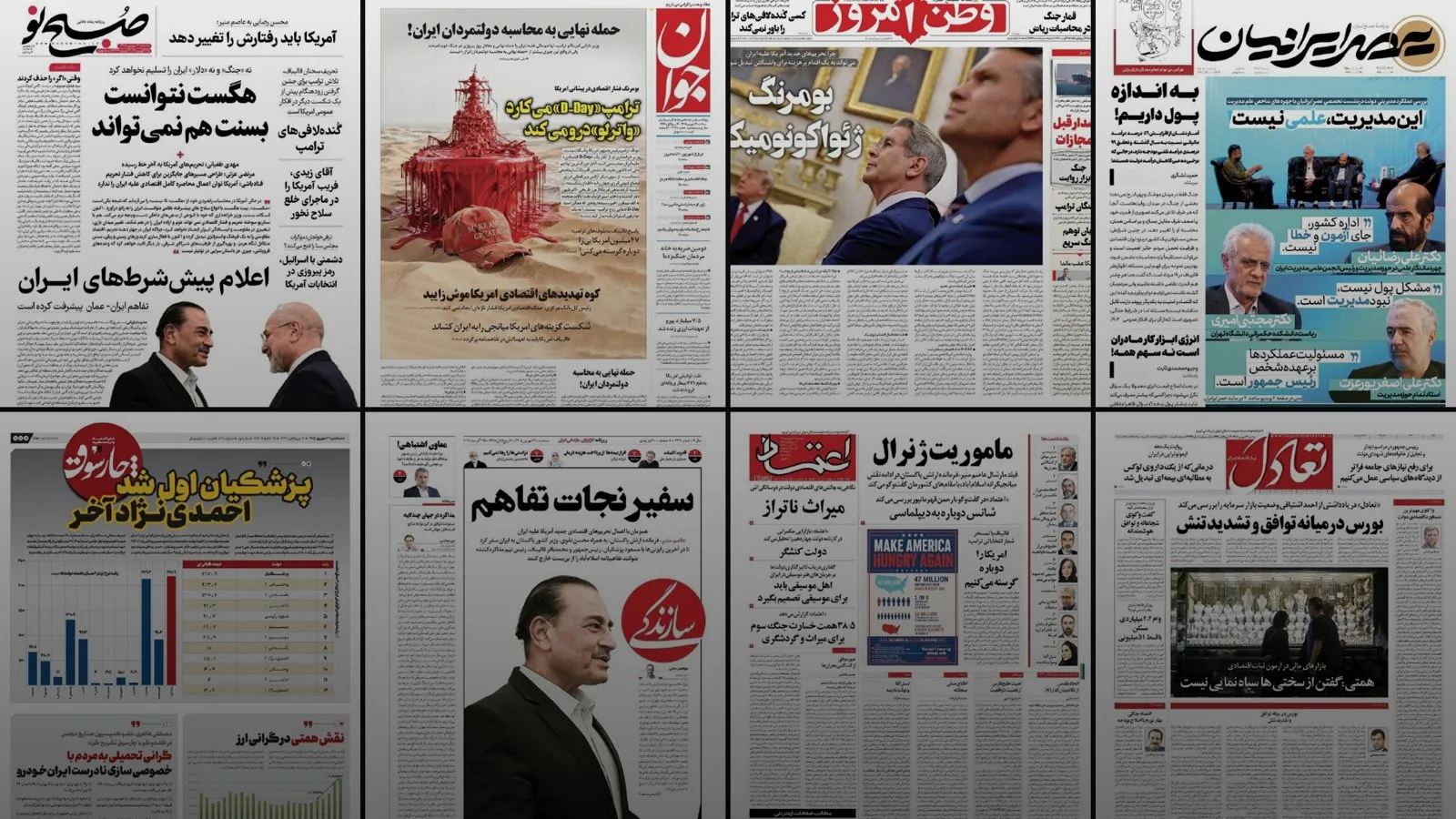
Bottom line: The 25 August batch answers the 24 August ‘economic D-Day’ sanctions with a spectrum-wide ‘boomerang’ defiance narrative, while quietly opening a Pakistani-mediated diplomatic track in which reopening the Strait of Hormuz has become a stated bargaining objective rather than only a deterrence threat.
Executive Summary
The cycle is organized by a single external trigger: the US Treasury and State Department sanctions package of 24 August, branded by Treasury Secretary Scott Bessent as an ‘economic D-Day’ and described in Western reporting as the largest against Iran since 2018, targeting Iranian oil-shipping networks. The Iranian press does not contest the scale; it reframes the intent. Javan turns Bessent’s own label against him (‘Trump plants a D-Day, harvests a Waterloo’), Vatan-e Emrooz supplies the analytic version (‘geoeconomic boomerang’, arguing the sanctions are a net cost to Washington), and Sobh-e No pairs the defense secretary and the Treasury secretary to argue that ‘neither war nor the dollar’ will force capitulation. The shared move is inversion: the adversary’s escalation is presented as evidence of the adversary’s weakness.
Running alongside the defiance is a genuine diplomatic development that the reformist-government bloc foregrounds and the hardline lane largely ignores: the 24 August Tehran visit of Pakistan’s Field Marshal Asim Munir and Interior Minister Mohsin Naqvi, received by Iran’s Interior Minister Eskandar Momeni and meeting President Pezeshkian. Sazandegi casts Munir as an ‘ambassador of rescue’ bringing the ‘Islamabad understanding’ out of deadlock; Etemad reads it as ‘another chance for diplomacy’; the English Iran Daily presents it outward as promoting ‘regional stability.’ This is the third Munir visit to Iran in 2026, and the papers tie it explicitly to breaking the US-Iran negotiation deadlock and to reopening the Strait of Hormuz.
The single highest-significance finding is the reframing of the Strait of Hormuz. In the prior cycle (24 August) the chokepoint was packaged as a militarized deterrence doctrine, ‘not a single drop of oil.’ This morning Jomhouri Eslami fronts ‘reopening the Strait of Hormuz’ as an explicit objective of the Pakistani mediation, and Iran Daily runs an op-ed ‘redefining Persian Gulf security architecture after the Hormuz crisis.’ The chokepoint has migrated in a single cycle from a threat Iran issues to a closure Iran seeks to trade, an implicit concession that the coercion carries a cost Tehran now wishes to monetize diplomatically.
A distinct information-operations thread runs through the day around Speaker Ghalibaf. Trump, via a Newsmax rendering, presented Ghalibaf as having said Iranians ‘are hungry and cannot survive’; Ghalibaf answered on 24 August with a ‘Make America Hungry Again’ post citing US hunger statistics and the line ‘you cannot cover up defeats with false claims.’ Iranian fronts amplify the riposte (Etemad and Javan reproduce the figure; Vatan-e Emrooz runs ‘Trump’s hungry’), while Sobh-e No fronts ‘distortion of Ghalibaf’s remarks’ and Kayhan’s Shariatmadari editorial defends the Speaker against selective quotation. The convergence of the Ghalibaf-defense across separately owned hardline titles indicates a coordinated response to the selective quote rather than organic agreement.
The economic titles price the moment rather than sloganeer it. Ta’adol reads the capital market as suspended ‘between agreement and rising tension’, with the sanctions as the swing variable, and carries economy minister Hemmati’s notable line that ‘speaking of the hardships is not blackwashing’, an official pushback against the hardline demand that acknowledging pressure equals disloyalty. Charsou defends the administration’s macro record with a comparative league table and asserts ‘Trump’s siege has been neutralized.’ The lone outlier is Asr-e Iranian, which turns entirely inward to a management-science critique (‘this management is not scientific’), pinning economic strain on governance failure rather than sanctions.
Leadership again appears only by absence. No first-person message from the sitting Supreme Leader, Mojtaba Khamenei, features on any front page or channel; the executive register is carried by Pezeshkian’s governance messaging and by Hemmati’s and Ghalibaf’s defiance. The current Leader’s continued editorial silence, on a cycle defined by a major sanctions escalation and an active mediation, is logged as negative evidence in the succession picture, not as missing content.
Net assessment: this is a two-track edition. The overt track is spectrum-wide ‘boomerang’ defiance that reframes the largest sanctions package since 2018 as American self-harm; the quieter and more consequential track is a reformist-government opening, via Pakistani mediation, in which reopening the Strait of Hormuz has become a stated negotiating objective. The hardline lane owns the rhetoric; the government-reformist bloc owns the diplomacy; and the chokepoint, yesterday a doctrine, is this morning a chip. The threads to watch are whether the Munir channel produces any announced US-Iran contact, whether ‘reopening Hormuz’ hardens into an official negotiating position or stays a newspaper frame, and whether the coordinated Ghalibaf-defense signals a broader hardline move to police the ceasefire debate.
Key Points
- KJ-1 [HIGH] KJ-1 [HIGH] Iran’s press has answered the 24 August US sanctions package with a coordinated ‘boomerang’ narrative that reframes escalation as adversary self-harm. Javan (‘D-Day into Waterloo’), Vatan-e Emrooz (‘geoeconomic boomerang’), Sobh-e No (‘neither war nor the dollar’) and Kayhan (‘empty hands’) carry the same inversion across separately owned titles in one cycle. Significance: the convergence indicates a supplied interpretive frame rather than organic agreement, and it sets the edition’s dominant register, defiance-by-inversion, though the argument that the largest sanctions package since 2018 is a net US loss rests on assertion, not on demonstrated economic effect.
- KJ-2 [HIGH] KJ-2 [HIGH] A Pakistani mediation channel is now an active, corroborated diplomatic track, foregrounded by the government-reformist bloc. Field Marshal Asim Munir and Interior Minister Mohsin Naqvi visited Tehran on 24 August (Munir’s third Iran visit of 2026), met Interior Minister Momeni and President Pezeshkian, and the visit is externally confirmed as aimed at breaking the US-Iran deadlock and reopening the Strait of Hormuz. Sazandegi, Etemad, Iran, Jam-e Jam and Iran Daily carry it as an opening; the hardline lane largely omits it. Significance: the diplomacy is real and third-party-brokered, and the lane that owns it (reformist-government) is distinct from the lane that owns the boomerang rhetoric (hardline), sharpening the intra-system fight over ending the war.
- KJ-3 [HIGH] KJ-3 [HIGH] The Strait of Hormuz has shifted from a deterrence threat to a stated bargaining object in a single cycle. Jomhouri Eslami fronts ‘reopening the Strait of Hormuz’ as an explicit objective of the Pakistani mediation, and Iran Daily treats the ‘Hormuz crisis’ as a structural rebalancing; this reverses the prior cycle’s ‘not a single drop of oil’ deterrence packaging. Significance: naming reopening as a goal concedes the chokepoint is effectively closed and that the closure imposes a cost Iran now seeks to trade, the clearest evidence yet that the coercion campaign has reached a point where Tehran is signaling a willingness to de-escalate the strait for diplomatic return.
- KJ-4 [MODERATE-HIGH] KJ-4 [MODERATE-HIGH] A coordinated hardline defense of Speaker Ghalibaf indicates message discipline policing the ceasefire debate. Sobh-e No (‘distortion of Ghalibaf’s remarks’) and Kayhan’s Shariatmadari editorial defend the Speaker against a selective-quote operation, after Trump’s Newsmax-sourced rendering and Ghalibaf’s ‘Make America Hungry Again’ reply (both externally corroborated). Significance: closing ranks around Ghalibaf across separately owned hardline titles is both anti-US counter-messaging and an internal factional move, attributing the distortion to reformist-adjacent circles, and it shows the hardline lane managing the domestic narrative as tightly as the foreign one.
- KJ-5 [MODERATE-HIGH] KJ-5 [MODERATE-HIGH] The government and economic-realist camp is publicly resisting the hardline loyalty-test framing of economic hardship. Ta’adol carries economy minister Hemmati’s ‘speaking of the hardships is not blackwashing’, and Jam-e Jam his ‘you will fail this time too’; Charsou defends the administration’s record with data. Significance: an official minister’s insistence that candor about pressure is legitimate, not defeatist, marks an open rhetorical fault line between the executive’s economic realism and the hardline demand for unbroken optimism, and it aligns the economic titles with the settlement bloc.
- KJ-6 [MODERATE] KJ-6 [MODERATE] The two-audience message architecture holds: coercive-defiant inward, stabilizing outward. The Persian fronts run ‘boomerang’ defiance and Hormuz-reopening bargaining, while the English Iran Daily frames the Munir visit as ‘promoting regional stability’ and downgrades the sanctions to a manageable $4 oil premium. Significance: the deliberate split lets Tehran project resolve and grievance to the home front while presenting itself to foreign readers as the stabilizing, reasonable party, limiting escalation costs abroad, though the domestic-outward gap is itself a signal of which audience each message is calibrated for.
- KJ-7 [MODERATE] KJ-7 [MODERATE] The Saudi-Riyadh dimension is being folded into the adversary-overreach frame, a widening of the target set. Vatan-e Emrooz fronts ‘the gamble of war in Riyadh’s calculations’, and Kayhan carries insurer reclassification of Saudi vessels as ‘high-risk.’ Significance: extending the boomerang argument to Riyadh signals Iran’s readiness to raise the regional cost of the pressure campaign for US partners, but the material is thin and partly second-hand (insurer-risk claims), and whether it hardens into a sustained anti-Saudi line or fades is a thread to watch.
- KJ-8 [MODERATE] KJ-8 [MODERATE] Negative-evidence finding: the sitting Supreme Leader again issued no message and appears only by absence. No statement from Mojtaba Khamenei features on any front page or channel; the executive (Pezeshkian) and parliamentary/security voices (Ghalibaf, Hemmati) carry the leadership register. Significance: on a cycle defined by a major sanctions escalation and an active mediation, the current Leader’s continued editorial silence above the fray is a standing marker in the succession picture and is recorded as negative evidence, consistent with external reporting that he has not appeared publicly since assuming the leadership.
Macro Trends
- The sanctions are inverted into an adversary-self-harm ‘boomerang’. The defining move of the cycle is inversion rather than denial. Javan weaponizes Bessent’s own ‘economic D-Day’ label into a promise of ‘Waterloo’; Vatan-e Emrooz dresses it as a ‘geoeconomic boomerang’ with a costed argument that the oil-shipping sanctions raise global prices and strike US interests; Sobh-e No pairs the two US secretaries to argue neither instrument can compel surrender; Kayhan cites US Senator Chris Murphy’s own criticism to call the package ‘empty hands.’ The convergence across separately owned hardline and principlist titles indicates a supplied interpretive frame, and it continues the standing adversary-decay-and-overreach thread, now fixed to the specific 24 August Treasury action (all attributed argumentation).
- Pakistani mediation opens a diplomatic off-ramp the reformist-government bloc foregrounds. The Munir-Naqvi visit is read by the government-reformist lane as the cycle’s real opportunity. Sazandegi frames Munir as an ‘ambassador of rescue’ for the ‘Islamabad understanding’; Etemad calls it ‘another chance for diplomacy’; Iran and Jam-e Jam carry Islamabad’s ‘highly constructive’ read-out and Pezeshkian’s above-politics messaging; Iran Daily presents it outward as ‘promoting regional stability.’ The hardline titles, by contrast, either ignore the visit or subordinate it to the boomerang narrative (‘the failure of America’s mediator options dragged it to Iran’). The split marks the intra-system fight over ending the war, diplomacy versus deterrence, mapped onto a concrete third-party channel.
- The Strait of Hormuz migrates from deterrence threat to bargaining object. The sharpest cross-cycle shift: where the 24 August batch packaged the chokepoint as a militarized doctrine (‘not a single drop of oil’), Jomhouri Eslami now fronts ‘reopening the Strait of Hormuz’ as an explicit goal of the Pakistani mediation, and Iran Daily’s op-ed treats the ‘Hormuz crisis’ as a structural rebalancing of Gulf security. Naming reopening as an objective concedes the strait is effectively closed and that the closure carries a cost Iran now seeks to trade. The coercion has acquired a price tag and a negotiating table in a single cycle.
- A coordinated defense of Ghalibaf against a selective-quote information operation. Trump’s Newsmax-sourced rendering of Ghalibaf (‘we are hungry, we cannot survive’) and the Speaker’s ‘Make America Hungry Again’ riposte drive a distinct thread. Sobh-e No fronts ‘distortion of Ghalibaf’s remarks’; Kayhan’s Shariatmadari editorial (‘the carpet-weaver we know’) defends the Speaker against selective quotation attributed to Western-oriented circles; Etemad and Javan reproduce the hunger-statistics counter. The appearance of the same defense across separately owned hardline titles indicates centrally-guided message discipline closing ranks around the Speaker, doubling as a factional shot inside the ceasefire debate.
- The economic titles price the sanctions rather than sloganeer them. Against both the boomerang triumphalism and the reconciliation optimism, the business papers read the moment as a live balance. Ta’adol frames the bourse as ‘between agreement and rising tension’ and carries Hemmati’s ‘candor is not blackwashing’ pushback against the loyalty-test framing; Charsou defends the administration’s macro record with a comparative league table while asserting the ‘siege’ is neutralized. The economic-realist camp aligns rhetorically with the settlement bloc, treating acknowledgment of hardship as legitimate rather than defeatist.
- Leadership by absence persists on a high-stakes cycle. No message from the sitting Supreme Leader, Mojtaba Khamenei, appears on any front page or channel; the leadership register is carried by the executive (Pezeshkian) and by parliamentary and security voices (Ghalibaf, Hemmati). On a cycle defined by the largest sanctions package since 2018 and an active mediation, the current Leader’s continued editorial silence above the fray is a standing marker in the succession picture and is recorded as negative evidence, not absence of content.
Front-Page Snapshot
- Javan - “Trump plants a ‘D-Day’, harvests a ‘Waterloo’” (Hardline, IRGC-affiliated) - Sanctions inverted into adversary-defeat messaging [HIGH]
- Vatan-e Emrooz - “Geoeconomic boomerang” (Hardline / principlist) - Sanctions as a net cost to the US and Riyadh [MODERATE-HIGH]
- Sobh-e No - “Hegseth couldn’t, Bessent can’t either: neither ‘war’ nor ‘the dollar’ will make Iran surrender” (Principlist) - Defiance plus Iran’s preconditions via mediation [MODERATE-HIGH]
- Kayhan - “Economic war with empty hands” (Ultra-hardline flagship (channel)) - Sanctions as a bluff; coordinated defense of Ghalibaf [HIGH]
- Sazandegi - “The ambassador who rescues the understanding” (Reformist / Kargozaran) - Pakistani mediation as a diplomatic rescue [LOW]
- Etemad - “The general’s mission” (Reformist) - Mediation as ‘another chance for diplomacy’ [LOW]
- Jomhouri Eslami - “Pakistan’s efforts to break the deadlock and reopen the Strait of Hormuz” (Traditional / establishment) - Hormuz reopening as a bargaining object [MODERATE]
- Iran - “New US sanctions meet Pakistani mediation as Iran holds its line” (Official government daily (channel)) - Government endurance balancing sanctions and mediation [MODERATE]
- Jam-e Jam - “Pezeshkian: we act beyond political viewpoints to meet society’s needs” (State broadcaster (IRIB) daily (channel)) - Executive unity, constructive mediation, resilience [LOW-MODERATE]
- Iran Daily - “Pakistani army chief in Tehran to ‘promote regional stability’” (Official English-language state daily) - Outward-facing stability framing; sanctions as a $4 oil premium [MODERATE]
- Ta’adol - “The bourse between agreement and rising tension” (Economic / business) - Markets pricing the sanctions-versus-diplomacy balance [LOW-MODERATE]
- Charsou - “Pezeshkian came first, Ahmadinejad last” (Economic / political) - Administration’s record and sanctions resilience [LOW-MODERATE]
- Asr-e Iranian - “This management is not scientific” (Governance-focused daily) - Domestic governance critique of the administration [LOW]
Full report
The complete edition - per-paper front-page analysis and full translation appendices - is available as a PDF: Download the full report.
Compiled from Iranian front pages and outlet channels via open-source monitoring. Translations are editorial; named-figure attributions are verified against the source pages where possible.