Iranian Press Monitor - Monday, 24 August 2026 (Day 174)
Monday, 24 August 2026 · 2 Shahrivar 1405 · 11 Rabi al-Awwal 1448 - Nine Persian print titles read from scan (Vatan-e Emrooz, Javan, Sobh-e No, Hamshahri, Sazandegi, Charsou, Ta’adol, Etemad, Jomhouri Eslami), the English Iran Daily read from scan, and three dailies read from their own channels (Kayhan, Iran, Jam-e Jam); Defa Press, Fars News and Nour News monitored for corroboration; Tehran Times unavailable at the time
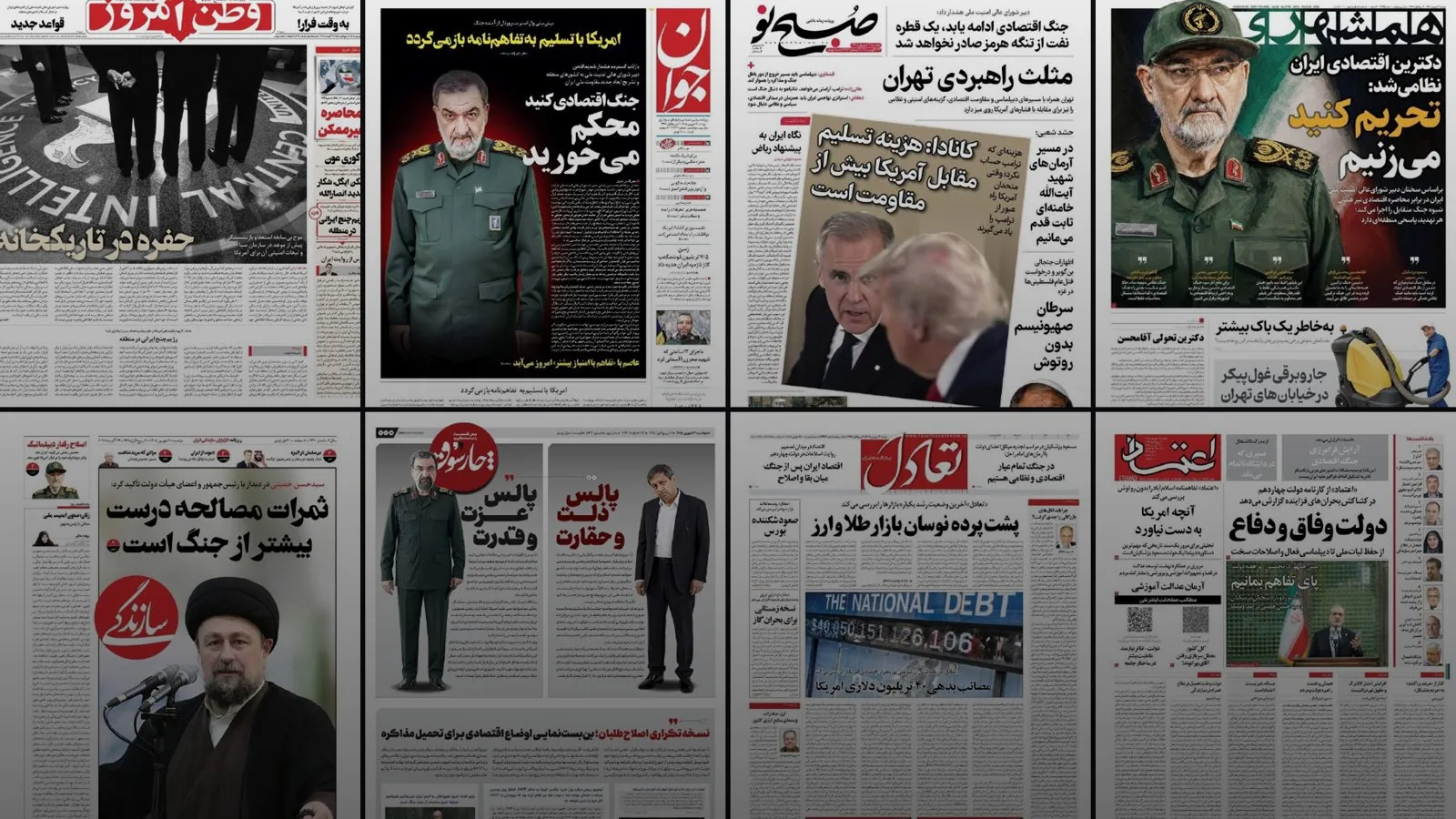
Bottom line: The 24 August batch shows Iran hardening the economic confrontation into a declared military-deterrence doctrine built on the Strait of Hormuz, amplified across centrist and hardline titles with identical supplied imagery and, for the first time this week, backed by an actual shipping-enforcement mechanism, even as a government-reformist bloc presses the opposite line of holding to the ceasefire understanding.
Executive Summary
The dominant development of the cycle is doctrinal: a warning attributed to the Secretary of the Supreme National Security Council, that if the economic war continues not a single drop of oil will be exported through the Strait of Hormuz or anywhere in the Persian Gulf, and that any state’s participation in the economic war will be treated as a military act, is carried across the batch as a settled Iranian position rather than as a one-off remark. Hamshahri, a centrist municipal daily, states it as ‘Iran’s economic doctrine is now militarized: sanction us and we strike’; Sobh-e No supplies the sharpest conditional (‘not a single drop of oil’); Javan renders it as ‘wage economic war and you will be hit hard.’ The threat itself is a continuation of the standing chokepoint-coercion thread, but its packaging this morning is new.
The strongest evidence of central direction is visual: Hamshahri and Javan front the identical supplied portrait of the SNSC Secretary in uniform, and three separately owned titles carry the same core quote within a single cycle. This indicates a supplied image and a centrally-packaged message rather than organic editorial convergence, and it moves the Hormuz/economic-war line from the hardline lane into the centrist mainstream. The same coordination extends to an administrative measure: the Persian Gulf Waterway (Strait) Management Authority notice warning that vessels cooperating with non-compliant ships face fines, detention or confiscation, and directing operators to a published non-compliant-vessels list, is fronted by the government daily Iran, the hardline flagship Kayhan and the wire Defa Press alike. For the first time this week the chokepoint campaign appears not only as rhetoric but as an enforcement machinery, an escalation in form.
Against the deterrence doctrine, a government-and-reformist bloc presses the opposite conclusion in the same cycle. Sazandegi fronts Seyyed Hassan Khomeini, a figure of lineage authority, telling the President and cabinet that ‘the fruits of proper reconciliation exceed those of war,’ and carries Mohsen Rezaei urging Iran to ‘change its diplomatic behavior toward America.’ Etemad defends the fourteenth government as one of ‘concord and defense’ and foregrounds Pezeshkian’s ‘let us stand by the understanding’ line on the first day of Government Week. The result is an unusually explicit contest, staged most nakedly by Charsou’s dueling ‘pulse of dignity and power’ versus ‘pulse of humiliation and disgrace’ front, over whether to consolidate the ceasefire or to answer economic pressure with military deterrence.
A second-order narrative, adversary decay and overreach, runs beneath both poles and is shared across the spectrum. Vatan-e Emrooz leads on an alleged wave of resignations and early retirements at the CIA (‘a breach in the darkroom’), Etemad echoes the same CIA-attrition story, and Ta’adol fronts ‘the woes of America’s 40-trillion-dollar debt’; Sobh-e No and Kayhan redeploy Canadian friction with Washington as proof that even US allies now resist. That this frame appears simultaneously in hardline, reformist and economic titles indicates it is the agreed interpretive backdrop, the claim that the pressure Iran faces is a sign of adversary weakness, and it supplies the confidence for both the deterrence and the settlement arguments.
The executive register aligns rhetorically with the security establishment even where it argues for restraint elsewhere: President Pezeshkian’s ‘we are in an all-out economic and military war’ (Ta’adol) and ‘the people did a great feat’ (Jomhouri Eslami) match the martial framing, while the English state daily Iran Daily downgrades the same confrontation for foreign readers, with FM Abbas Araghchi dismissing Trump’s economic warfare as an ‘old US bullying tactic’ and the paper stressing that Iran is ‘standing firm.’ The two-audience architecture is clean: coercive deterrence and chokepoint threat for the home front, measured defiance and diplomacy for external readers.
Leadership again appears only by absence. No first-person message from the sitting Supreme Leader, Mojtaba Khamenei, features on any front page or channel; the leadership register is carried by the cabinet’s covenant-renewal ceremony at Imam Khomeini’s mausoleum and by commemoration of the martyred predecessor and of Ayatollah Beheshti. On a morning of visibly coordinated messaging, the current Leader’s continued editorial silence is logged as negative evidence in the succession picture, not as missing content.
Net assessment: this is a chokepoint-as-doctrine edition. Iran hardened the economic confrontation into a declared military-deterrence line built on the Strait of Hormuz, coordinated across separately owned titles with identical supplied imagery and, distinctively, backed by an actual vessel-enforcement notice, while an adversary-decay narrative supplied the confidence and a government-reformist bloc pressed the opposite case for holding to the ceasefire understanding. The identity of the official behind the day’s central threat is itself unresolved, printed as ‘Falahi’ by Javan and rendered ‘Rezaei’ by Defa Press against the ‘Zolqadr’ named in early August. The threads to watch are whether the waterway-authority enforcement regime produces any reported maritime action rather than remaining administrative; whether the identical-portrait coordination hardens into a durable centrist-hardline bloc for the deterrence doctrine; whether the Hassan Khomeini-Pezeshkian reconciliation line gains or loses ground against it; and whether the sitting Leader breaks his silence as the ceasefire fight sharpens.
Key Points
- KJ-1 [HIGH] Iran has hardened the economic confrontation into a declared military-deterrence doctrine centered on the Strait of Hormuz. The SNSC-secretary line, carried by Hamshahri (‘sanction us and we strike’), Sobh-e No (‘not a single drop of oil’) and Javan (‘wage economic war and you will be hit hard’), and corroborated by Defa Press, frames economic siege as answerable by reciprocal war and casts participation in the economic war as a military act. Significance: what circulated in prior cycles as a signaling threat is now packaged as settled doctrine across the spectrum, making the chokepoint the edition’s organizing frame; the quoted content is well-corroborated even where the speaker’s name is not.
- KJ-2 [HIGH] The morning shows centrally-guided message discipline, evidenced by identical supplied imagery and a shared quote across separately owned titles. Hamshahri and Javan front the same supplied SNSC-secretary portrait, and three separately owned papers carry the same core threat in one cycle. Significance: the convergence of a common image and a common quote indicates supplied packaging rather than organic agreement, and its reach into a centrist municipal daily (Hamshahri) shows the deterrence line being mainstreamed beyond the hardline lane.
- KJ-3 [MODERATE-HIGH] The Hormuz-pressure track has acquired an administrative enforcement face this cycle. The Persian Gulf Waterway (Strait) Management Authority notice, penalties of fines, detention or confiscation for vessels cooperating with non-compliant ships, and a published non-compliant-vessels list, is fronted by the government daily Iran, the flagship Kayhan and the wire Defa Press. Significance: this is the first appearance this week of an enforcement mechanism rather than rhetoric alone, an escalation in form; the open question is whether it translates into any reported maritime action or remains a regulatory posture (the notice is an attributed official announcement, with no corroborated incident this cycle).
- KJ-4 [MODERATE-HIGH] The intra-system fight over ending the war remains contested, with a government-reformist bloc pressing consolidation against the deterrence doctrine. Sazandegi fronts Hassan Khomeini (‘reconciliation exceeds war’) and Rezaei (‘change diplomatic behavior’); Etemad foregrounds Pezeshkian’s ‘stand by the understanding’; Charsou stages the cleavage as competing ‘pulses.’ Significance: the ceasefire is again the defining domestic cleavage, now with lineage authority (Hassan Khomeini) enlisted on the settlement side against a centrist-hardline deterrence bloc; which pole gains ground is the thread to watch.
- KJ-5 [MODERATE] An adversary-decay-and-overreach narrative is carried across the spectrum as the shared backdrop. Vatan-e Emrooz and Etemad run an alleged CIA resignation-and-retirement wave, Ta’adol fronts America’s 40-trillion-dollar debt, and Sobh-e No and Kayhan redeploy Canadian friction with Washington. Significance: the frame supplies the confidence underwriting both the deterrence and settlement arguments, but it rests on external developments Tehran does not control and on unverified claims, and could fade with the news cycle.
- KJ-6 [MODERATE] The executive presents a two-audience message architecture. Pezeshkian’s ‘all-out economic and military war’ (Ta’adol) matches the martial home-front register, while the English Iran Daily downgrades the same confrontation, FM Araghchi calling Trump’s economic warfare an ‘old US bullying tactic’ and the paper stressing Iran is ‘standing firm.’ Significance: the deliberate split, coercion inward, measured defiance outward, lets Tehran signal resolve domestically while limiting escalation costs with foreign audiences.
- KJ-7 [MODERATE] Negative-evidence finding: the sitting Supreme Leader again issued no message and appears only through commemoration and the cabinet’s covenant-renewal ceremony. No statement from Mojtaba Khamenei features on any front page or channel; the leadership register is carried by the tajdid-e mithaq event and by memorials to the martyred predecessor (Sobh-e No) and Ayatollah Beheshti (Jomhouri Eslami). Significance: on a cycle of visibly coordinated security messaging and an open ceasefire fight, the current Leader’s editorial silence above the fray is a standing marker in the succession picture and is recorded as negative evidence, not absence of content.
- KJ-8 [MODERATE] The identity of the official behind the day’s central threat is unresolved and is treated as a sourcing flag. The Secretary of the Supreme National Security Council is printed as ‘Falahi’ by Javan, rendered ‘Rezaei’ by Defa Press, and was named ‘Zolqadr’ by this monitor in early August. Significance: the office and the quoted content are corroborated, but the inconsistent naming, either a recent change of office-holder or divergent source rendering, is left unresolved pending verification and is itself logged as a monitoring note rather than resolved to a single name.
Macro Trends
- The economic war is reframed as a military-deterrence doctrine. The SNSC-secretary line, that economic siege will be answered by the same reciprocal-war method used on the battlefield and that participation in the economic war is a military act, is carried as settled doctrine rather than a single quote. Hamshahri (‘sanction us and we strike’), Javan (‘wage economic war and you will be hit hard’) and Sobh-e No (‘not a single drop of oil’) render it in escalating registers, and Charsou stages the resulting resistance-versus-negotiation cleavage explicitly. The economic front and the military front are merged into one deterrence argument.
- Coordinated packaging: identical imagery and a shared quote across separately owned titles. Hamshahri and Javan front the same supplied portrait of the SNSC Secretary, and three separately owned titles carry the same core threat in a single cycle. The convergence of a supplied image with a common quote indicates centrally-guided message discipline rather than organic editorial agreement, and it is the clearest single marker of coordination this cycle, notable because it pulls a centrist municipal daily into the hardline security lane.
- The chokepoint campaign acquires an enforcement machinery. Beyond rhetoric, the Persian Gulf Waterway (Strait) Management Authority notice, warning that vessels cooperating with non-compliant ships face fines, detention or confiscation and directing operators to a published non-compliant list, is fronted by the government daily Iran, the flagship Kayhan and the wire Defa Press. This is the first appearance this week of an administrative enforcement face on the Hormuz-pressure track, an escalation in form even without any reported maritime incident.
- A government-reformist bloc presses the opposite case for the ceasefire. Sazandegi fronts Hassan Khomeini (‘reconciliation exceeds war’) and Rezaei (‘change diplomatic behavior toward America’); Etemad defends the government as one of ‘concord and defense’ and foregrounds Pezeshkian’s ‘stand by the understanding.’ Against the deterrence doctrine, a lineage-and-executive bloc argues for consolidating the ceasefire, keeping the intra-system fight over ending the war, flagged in prior editions, contested and open.
- Adversary decay and overreach as the shared interpretive backdrop. Vatan-e Emrooz and Etemad run an alleged CIA resignation-and-retirement wave; Ta’adol fronts America’s 40-trillion-dollar debt; Sobh-e No and Kayhan redeploy Canadian friction with Washington. The appearance of the same weakness-and-overreach frame across hardline, reformist and economic titles makes it the agreed backdrop that underwrites both the deterrence and the settlement arguments (all attributed claims).
- A two-audience message architecture. The domestic front carries coercive deterrence and the oil-export threat; the English Iran Daily downgrades the same confrontation, with FM Araghchi calling Trump’s economic warfare an ‘old US bullying tactic’ and the paper stressing Iran is ‘standing firm.’ The split between a martial home-front register and a measured external one is clean and deliberate.
- Leadership by absence and commemoration continues. No message from the sitting Leader, Mojtaba Khamenei, appears anywhere; the leadership register is the cabinet’s covenant-renewal ceremony and commemoration of the martyred predecessor (Sobh-e No) and Ayatollah Beheshti (Jomhouri Eslami). On a coordinated-messaging morning, the current Leader’s silence is logged as negative evidence in the succession picture.
Front-Page Snapshot
- Hamshahri - “Iran’s economic doctrine is now militarized: sanction us and we strike” (Tehran municipality daily, centrist) - Economic war reframed as military doctrine; same supplied SNSC portrait as Javan [HIGH]
- Javan - “America returns to the understanding through surrender” (Hardline, IRGC-affiliated) - Coercive deterrence (‘wage economic war and you will be hit hard’) plus a WSJ ‘surrender’ forecast [HIGH]
- Sobh-e No - “Tehran’s strategic triangle” (Principlist) - Conditional threat to halt all Hormuz oil exports; three-track doctrine; Ben-Gvir and Carney items [SEVERE]
- Kayhan - “The enemy must be made to regret the economic attack” (Ultra-hardline flagship (channel)) - Editorial fusing economic-front discipline with Hormuz vessel-enforcement [HIGH]
- Vatan-e Emrooz - “A breach in the darkroom” (Hardline / principlist) - Alleged CIA resignation wave; adversary-decay and regional-front claims (ScanEagle, Lebanon) [MODERATE-HIGH]
- Iran - “Government Week: the administration held its stability amid pressures” (Official government daily (channel)) - Endurance messaging plus the official Hormuz vessel-enforcement notice; Oman-FM visit [MODERATE]
- Ta’adol - “Behind the scenes of the gold and currency market swings” (Economic / business) - Pezeshkian’s ‘all-out war’ line; market volatility; America’s 40-trillion-dollar debt [MODERATE]
- Iran Daily - “FM downplays Trump economic warfare as ‘old US bullying tactic’” (Official English-language state daily) - Outward-facing measured defiance; Araghchi confirmed; 7.5 tcf gas find [MODERATE]
- Jam-e Jam - “Nine million barrels a day pass through the Strait of Hormuz” (State broadcaster (IRIB) daily (channel)) - Chokepoint-significance framing; domestic energy strain and fuel smuggling [MODERATE]
- Etemad - “A government of concord and defense” (Reformist) - Defense of the government; Pezeshkian’s ‘stand by the understanding’; CIA-decay echo [LOW]
- Sazandegi - “The fruits of proper reconciliation exceed those of war” (Reformist / Kargozaran) - Hassan Khomeini’s settlement message; Rezaei on changing diplomatic behavior [LOW]
- Charsou - “A pulse of dignity and power vs a pulse of humiliation and disgrace” (Economic / political) - Dueling-columns polemic; charges reformists with weaponizing hardship to force talks [LOW-MODERATE]
- Jomhouri Eslami - “A gas field of 7 trillion cubic feet discovered in southern Fars” (Traditional / establishment) - Resource nationalism and social-welfare measures; Pezeshkian’s ‘great feat’ line [LOW]
Full report
The complete edition - per-paper front-page analysis and full translation appendices - is available as a PDF: Download the full report.
Compiled from Iranian front pages and outlet channels via open-source monitoring. Translations are editorial; named-figure attributions are verified against the source pages where possible.