Iranian Press Monitor - Sunday, 23 August 2026 (Day 173)
Sunday, 23 August 2026 · 1 Shahrivar 1405 · 10 Rabi al-Awwal 1448 - Nine Persian print titles read from scan (Hamshahri, Vatan-e Emrooz, Javan, Sobh-e No, Sazandegi, Charsou, Ta’adol, Etemad, Jomhouri Eslami) plus two dailies read from their own channels (Kayhan, Iran); Defa Press, Fars News and Nour News monitored for corroboration; no fresh English print edition and Tehran Times unavailable at the time
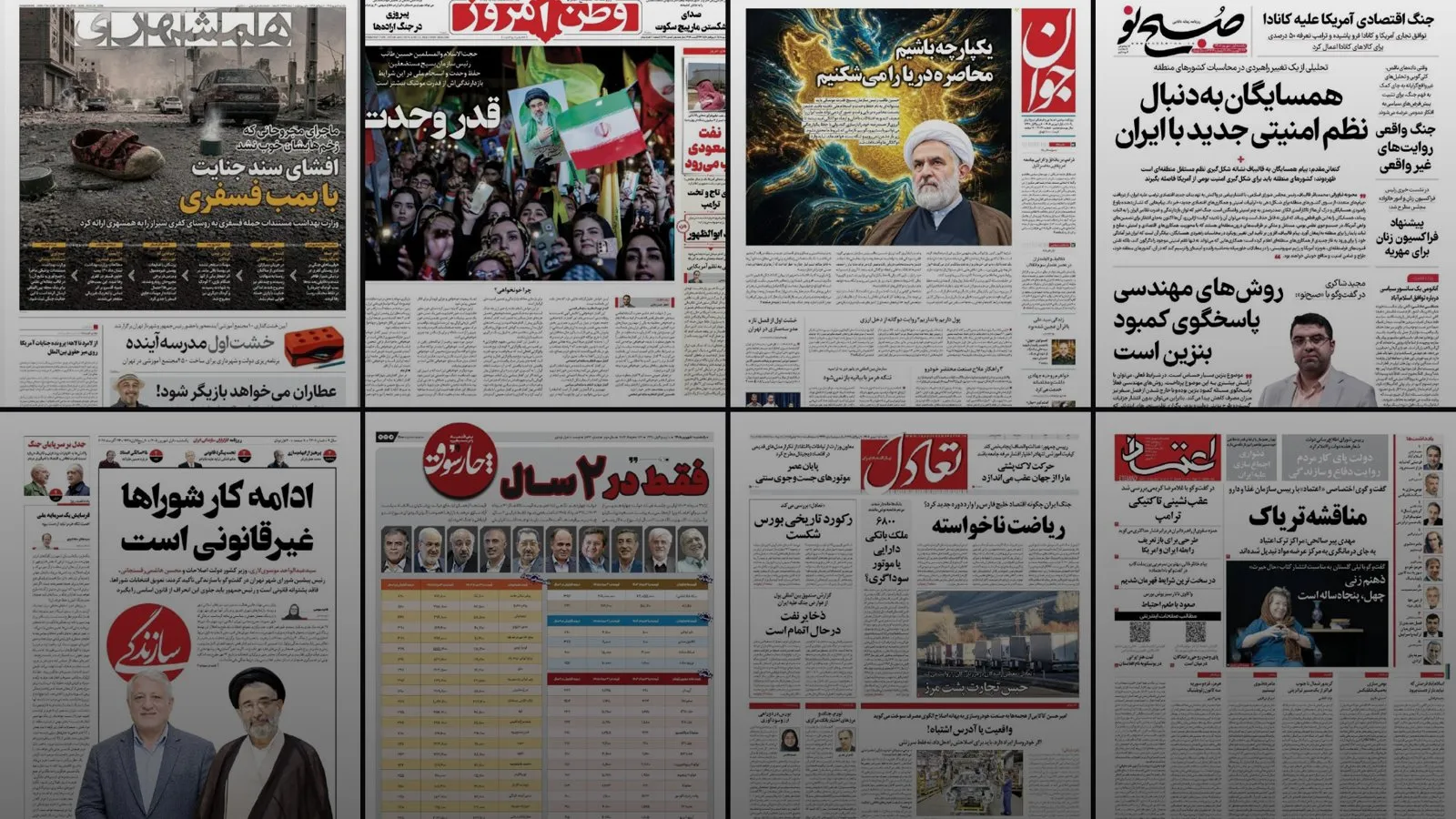
Bottom line: Iran turned the war into a legal and narrative offensive this cycle, documenting an alleged phosphorus attack and demanding reparations from Trump while casting US tariffs on Canada and Israel’s isolation as adversary overreach, even as the hardline flagship openly branded the government’s ‘end the war from strength’ line a betrayal of battlefield victory and the reformist-economic press documented a deepening livelihood collapse.
Executive Summary
The 23 August batch pivots from the prior day’s ‘US economic offensive’ story into a coordinated Iranian counter-offensive fought on legal and narrative ground rather than at the front. The single highest-significance development is internal: Kayhan’s editorial-of-the-day, ‘do not tarnish the great victory on the battlefield,’ openly rebuts the joint government-and-Parliament ‘end the war from a position of strength’ line that the reformist and centrist press pressed 24 hours earlier, recasting any move to consolidate the ceasefire as a display of weakness that serves the enemy. What was a cross-branch consensus on ending the war has become contested ground overnight, and the ceasefire is now the defining domestic cleavage.
The edition’s most novel external thread is a legal-accountability campaign that surfaces simultaneously across separately owned titles. Hamshahri leads with Health Ministry documentation of an alleged phosphorus-munition attack on a village in the Shiraz area, framed as a war-crimes exhibit; Kayhan fronts ‘Iran seeks the war’s costs from Trump’; the government daily Iran carries judiciary official Kazem Gharibabadi’s charge that continued weapons transfers to Israel are ‘deliberate participation in the regime’s crimes’; and Defa Press reports formal case files being prepared over the war. The convergence of a documentation front, a reparations demand, and a prosecution track across the hardline, centrist and government lanes in a single cycle indicates a centrally-guided shift onto the legal register, an escalation in form rather than in kinetic tempo.
Running in parallel is an adversary-overreach-and-isolation narrative. Sobh-e No’s top strip and Fars News report the collapse of the US-Canada trade agreement and Trump’s 50-percent tariffs on Canadian goods, deployed as proof that Washington’s economic weapon now alienates its own partners; Jomhouri Eslami packages Moroccan street protests against a visiting Israeli minister, ‘Zionist media admit Tel Aviv’s growing global isolation,’ and ‘Trump’s worry about defeat in the midterm elections’; and Etemad reads the same trend as ‘Trump’s tactical retreat.’ The composite argues that the pressure Iran faced the prior day is a sign of adversary weakness and isolation, not strength, and it is the narrative bridge from yesterday’s ‘sanctions are a spent weapon’ line to today’s confidence.
The unity-and-deterrence register is carried by the new Basij command. Both Vatan-e Emrooz (‘the worth of unity’) and Javan (‘let us be united, and we break the sea blockade’) front the first message of Hojjatoleslam Hossein Taeb, appointed head of the Basij Organization by Mojtaba Khamenei on 11 August, that national cohesion is a greater deterrent than missile power and the instrument for breaking a naval blockade. Fronting the same remarks across two hardline titles on the same morning indicates coordinated amplification of the new appointee, and it ties the internal-unity theme directly to the Strait-of-Hormuz pressure track, where the Supreme National Security Council’s warnings on closing the strait and targeting US forces continue to circulate via the Kayhan channel.
Against the martial and legal fronts, the reformist and economic tier documents a widening livelihood crisis and keeps the case for ending the war alive. Charsou devotes its entire front to a two-year price series pinning a broad cost-of-living surge on the sitting government; Ta’adol frames the downturn as ‘unwanted austerity,’ reports oil reserves ‘running out’ and exports halted; and Sazandegi shifts the attack onto constitutional ground, calling the postponement of council elections unlawful, while keeping a ‘dispute over ending the war’ box open. Where Kayhan weaponizes the crisis to argue against retreat, this lane uses the identical distress to argue that ending the war is an economic necessity, so the single economic reality again yields two opposite verdicts.
Leadership again appears only by absence. No message from the sitting Supreme Leader, Mojtaba Khamenei, features on any front page or channel; the leadership register is carried by commemoration of the martyred predecessor (Javan, Vatan-e Emrooz) and of Ayatollah Beheshti (Jomhouri Eslami). On a morning of visibly coordinated messaging across the accountability, unity and ceasefire-backlash threads, the current Leader’s continued editorial silence is logged as negative evidence in the succession picture rather than as missing content.
Net assessment: this is an accountability-and-backlash edition. Iran reframes the war as a legal and narrative offensive, documenting alleged war crimes, demanding reparations from Trump, and casting US tariffs on Canada and Israel’s isolation as adversary overreach, while mobilizing unity under a newly installed Basij chief. Beneath that outward confidence, the domestic picture is unusually fractured: the hardline flagship has broken openly with the government’s ‘end the war from strength’ line, the reformist-economic tier documents a deepening collapse and presses to lock in the ceasefire, and the sitting Leader stays silent above the fight. The threads to watch are whether the Kayhan-led backlash hardens into an organized bloc against consolidating the ceasefire; whether the war-crimes-and-reparations track produces any concrete legal filing or remains rhetorical; whether the Canada-tariff and Israel-isolation frames are sustained or fade with the news cycle; and whether the SNSC’s standing Hormuz and troop-targeting warnings translate into any maritime action.
Key Points
- KJ-1 [HIGH] The intra-system consensus on ending the war has fractured, with the hardline flagship now openly resisting consolidation of the ceasefire. Kayhan’s editorial ‘do not tarnish the great victory on the battlefield’ rebuts the prior day’s joint Pezeshkian-Qalibaf ‘end the war from strength’ line as defeatism serving the enemy; the government daily counters by defending the nuclear accord, and Sazandegi keeps the dispute open. Significance: what read 24 hours earlier as a cross-branch move to lock in the ceasefire is now contested ground, making the ceasefire the edition’s defining domestic cleavage; whether the Kayhan-led backlash coheres into an organized bloc is the thread to watch.
- KJ-2 [MODERATE-HIGH] Iran opened a coordinated legal-accountability track this cycle, escalating in form rather than in kinetic tempo. Hamshahri fronts Health Ministry documentation of an alleged phosphorus attack near Shiraz, Kayhan runs ‘Iran seeks the war’s costs from Trump,’ Iran carries Gharibabadi’s ‘participation in crimes’ charge over Israeli arms transfers, and Defa Press reports case files in preparation. Significance: the near-simultaneous documentation, reparations and prosecution fronts across separately owned titles indicate a centrally-guided pivot onto the legal register; the open question is whether it yields any concrete filing or remains a rhetorical campaign (all items treated as attributed claims).
- KJ-3 [MODERATE-HIGH] An adversary-overreach-and-isolation narrative was carried in unison to reframe US and Israeli pressure as weakness. Sobh-e No and Fars front Trump’s 50-percent tariffs on Canada as coercion of an ally; Jomhouri Eslami packages Moroccan anti-Israel protests, admitted Israeli isolation, and Trump’s midterm anxiety; Etemad reads ‘tactical retreat.’ Significance: the frame bridges from the prior day’s ‘sanctions are a spent weapon’ line to today’s confidence and supplies the narrative cover for the accountability offensive, but it rests on external developments Tehran does not control and could fade with the news cycle.
- KJ-4 [MODERATE-HIGH] The new Basij command was used to convert national unity into a deterrence instrument tied to the Hormuz track. Vatan-e Emrooz and Javan both front Hossein Taeb’s first message, that cohesion outweighs missile power and breaks a naval blockade, days after his appointment by Mojtaba Khamenei. Significance: coordinated amplification across two hardline titles signals centrally-timed promotion of the appointee and frames the internal-unity theme as a weapon against the maritime blockade, implicitly casting the reformist peace lobby as the vulnerability to be disciplined.
- KJ-5 [MODERATE] The reformist-economic tier documented a deepening livelihood collapse and marshalled it for the opposite conclusion to the hardliners. Charsou’s two-year price series indicts the sitting government, Ta’adol reports ‘unwanted austerity,’ oil reserves ‘running out’ and exports halted, and Sazandegi attacks postponed council elections as unlawful. Significance: the same near-zero-revenue reality Kayhan uses to argue against retreat is turned by this lane into the case for ending the war, converting the ceasefire fight into a contest over the domestic causes and cost of the crisis (economic figures are outlet claims).
- KJ-6 [MODERATE] The Strait-of-Hormuz coercion thread persists at the signaling level without fresh maritime action. The Supreme National Security Council’s warnings, relayed via the Kayhan channel, to close the strait if the economic war escalates, to target any new US troops at regional bases, and to hit US oil and economic firms, continue alongside Javan’s ‘break the sea blockade’ framing. Significance: the chokepoint remains the standing escalation lever, now knitted to the unity message; the warnings are institutional claims carried second-hand and are not corroborated by any reported incident this cycle, so the signal is rhetorical continuation, not new escalation.
- KJ-7 [MODERATE] Iran continued to build its regional-order counter to US pressure through Iraq. Sobh-e No reads ‘neighbors seeking a new security order with Iran’ and casts messages to Speaker Qalibaf as an independent, America-free architecture, corroborated by Defa Press coverage of his Iraq visit and a Baghdad prayer leader’s endorsement of resistance weapons. Significance: this is the slower-moving structural bet beneath the fast accountability story, consolidating friendly capitals as the durable counterweight to the US economic campaign.
- KJ-8 [MODERATE] Negative-evidence finding: the sitting Supreme Leader again issued no message and was present only by commemoration. No statement from Mojtaba Khamenei appears on any front page or channel; the leadership register is carried by memorials to the martyred predecessor (Javan, Vatan-e Emrooz) and to Ayatollah Beheshti (Jomhouri Eslami), and an undisambiguated ‘silence is lying’ quote graphic attributed to ‘Ayatollah Khamenei’ is logged as unverified. Significance: on a cycle of visibly coordinated messaging and an open intra-system fight over the ceasefire, the current Leader’s editorial silence above the fray remains a standing marker in the succession picture and is recorded as negative evidence, not absence of content.
Macro Trends
- A legal-accountability offensive opens across the press. War-crimes documentation, a reparations demand, and a prosecution track surface together: Hamshahri fronts Health Ministry documentation of an alleged phosphorus attack near Shiraz, Kayhan runs ‘Iran seeks the war’s costs from Trump,’ the government daily Iran carries Gharibabadi’s ‘participation in crimes’ charge over weapons transfers to Israel, and Defa Press reports case files being prepared. The near-simultaneous appearance across hardline, centrist and government titles indicates a centrally-guided pivot onto the legal register, escalating in form rather than in kinetic tempo (all items attributed claims).
- The ceasefire becomes contested ground; the hardline flagship breaks openly. Kayhan’s editorial ‘do not tarnish the great victory on the battlefield’ rebuts the prior day’s joint executive-legislature ‘end the war from strength’ line as a display of weakness, while Sazandegi keeps a ‘dispute over ending the war’ box open and the government daily defends the nuclear accord. A cross-branch consensus of 24 hours earlier has fractured into an open intra-system fight over whether to consolidate the ceasefire.
- Adversary overreach and isolation as the master narrative. Sobh-e No and Fars News front the collapse of the US-Canada trade deal and Trump’s 50-percent tariffs on Canada as evidence Washington now turns its economic weapon on allies; Jomhouri Eslami packages Moroccan protests against an Israeli minister, admitted Israeli global isolation, and Trump’s midterm anxiety; Etemad reads it as ‘Trump’s tactical retreat.’ The frame recasts the pressure Iran faced as a sign of adversary weakness, bridging from ‘sanctions are spent’ to today’s confidence.
- Unity-as-deterrence under the new Basij command. Vatan-e Emrooz (‘the worth of unity’) and Javan (‘let us be united, and we break the sea blockade’) both front Basij chief Hossein Taeb’s first message that cohesion outweighs missile power and breaks a naval blockade. Coordinated amplification of the new appointee across two hardline titles ties internal solidarity to the Hormuz-pressure track, with dissent implicitly cast as the vulnerability.
- The economic tier documents collapse and presses for peace. Charsou’s all-data front pins a two-year price surge on the sitting government; Ta’adol frames ‘unwanted austerity,’ reports oil reserves ‘running out’ and exports halted; Sazandegi attacks postponed council elections as unlawful. The reformist-economic lane uses the same distress Kayhan weaponizes against retreat to argue instead that ending the war is an economic necessity, so one economic reality yields two opposite verdicts.
- The regional-order thread advances through Iraq. Sobh-e No reads ‘neighbors seeking a new security order with Iran’ and casts the messages to Speaker Qalibaf as the formation of an independent, America-free regional architecture, corroborated by Defa Press coverage of Qalibaf’s Iraq visit and a Baghdad prayer leader’s endorsement of resistance weapons. The standing ‘post-American regional order’ thread is the slower-moving structural bet beneath the fast-moving accountability story.
- Leadership by commemoration; the sitting Leader again silent. No message from Mojtaba Khamenei appears on any front page or channel; the leadership register is carried by memorials to the martyred predecessor (Javan, Vatan-e Emrooz) and to Ayatollah Beheshti (Jomhouri Eslami). On a day of visibly coordinated messaging, the current Leader’s continued editorial silence is logged as negative evidence in the succession picture.
Front-Page Snapshot
- Hamshahri - “The crime documented: with a phosphorus bomb” (Tehran municipality daily, centrist) - Health Ministry phosphorus-attack dossier framed as a war-crimes exhibit [MODERATE]
- Kayhan - “The great battlefield victory must not be marred” (Ultra-hardline flagship (channel)) - Editorial pushback on the peace line; reparations demand on Trump [HIGH]
- Vatan-e Emrooz - “The worth of unity” (Hardline / principlist) - New Basij chief Taeb: unity a greater deterrent than missiles [MODERATE-HIGH]
- Javan - “Let us be united, and we break the sea blockade” (Hardline, IRGC-affiliated) - Taeb’s unity message tied to breaking a naval blockade at Hormuz [MODERATE-HIGH]
- Jomhouri Eslami - “Donors’ large contribution to expanding schools” (Traditional / establishment) - Welfare lead plus the batch’s fullest Israel-isolation package [MODERATE]
- Sobh-e No - “Neighbors are seeking a new security order with Iran” (Principlist) - Regional realignment via Iraq; US tariffs on Canada as coercion of an ally [MODERATE]
- Iran - “Iran did not become another Venezuela; the world was astonished by its power” (Official government daily (channel)) - Official resilience messaging; Israel-isolation and accountability signaling [MODERATE]
- Etemad - “The opium dispute” (Reformist) - Domestic addiction lead; ‘Trump’s tactical retreat’ on Iran-US relations [LOW]
- Sazandegi - “Continuing the councils’ work is unlawful” (Reformist / Kargozaran) - Constitutional-legitimacy attack; keeps the end-the-war dispute open [LOW-MODERATE]
- Ta’adol - “Unwanted austerity” (Economic / business) - War-driven contraction; oil reserves ‘running out’; exports halted [LOW-MODERATE]
- Charsou - “In just 2 years” (Economic / business) - Two-year price-surge data indicting the sitting government [LOW]
Full report
The complete edition - per-paper front-page analysis and full translation appendices - is available as a PDF: Download the full report.
Compiled from Iranian front pages and outlet channels via open-source monitoring. Translations are editorial; named-figure attributions are verified against the source pages where possible.