Iranian Press Monitor - Saturday, 22 August 2026 (Day 172)
Saturday, 22 August 2026 · 31 Mordad 1405 · 9 Rabi al-Awwal 1448 - 12 Iranian front pages surveyed: nine Persian print titles read from scan (Hamshahri, Vatan-e Emrooz, Javan, Sobh-e No, Sazandegi, Charsou, Ta’adol, Etemad, Jomhouri Eslami) plus Iran Daily in English from scan, and two dailies read from their own channels (Kayhan, Iran); Defa Press, Fars News and Nour News monitored for corroboration; Tehran Times was unavailable at the time
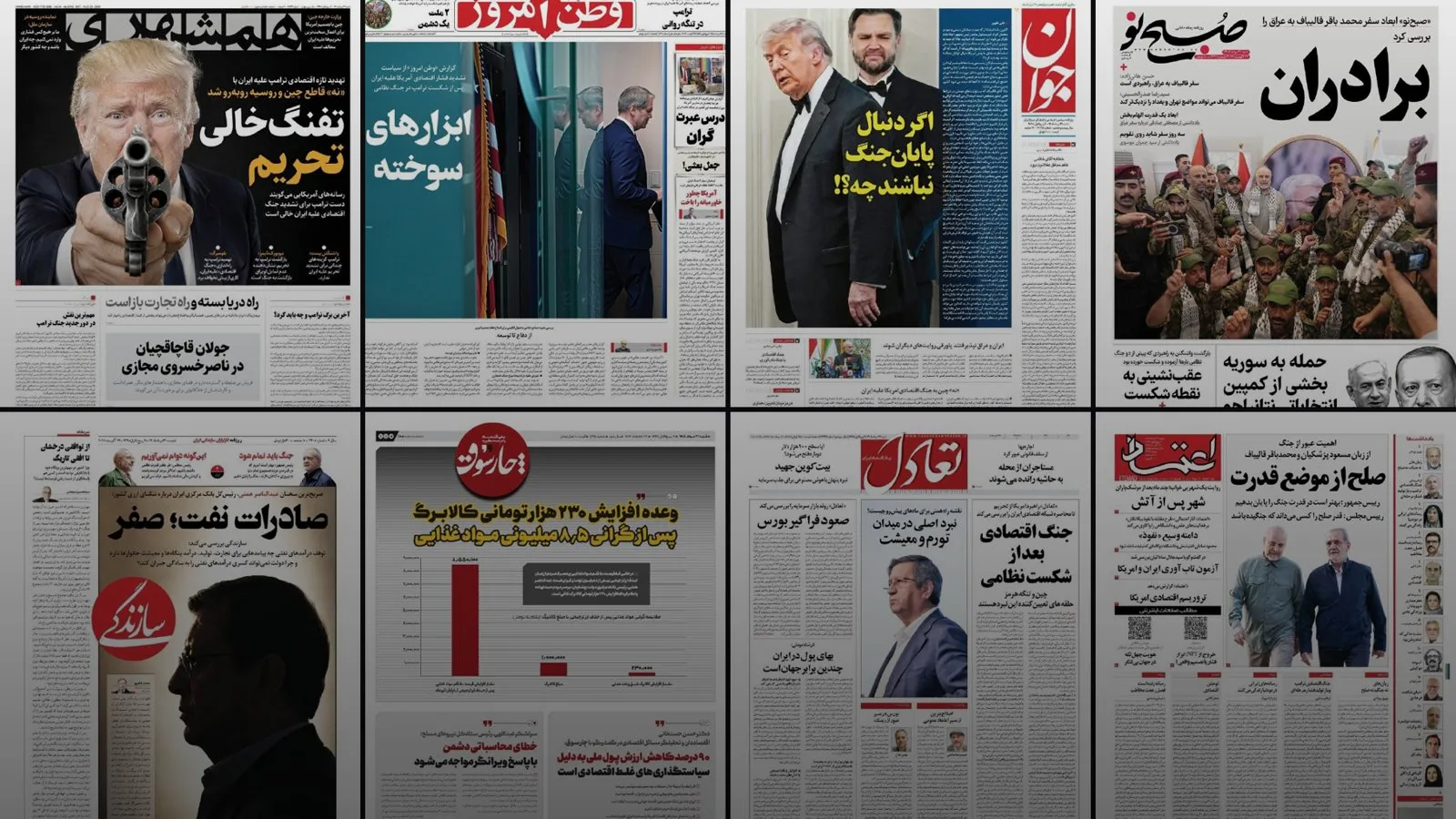
Bottom line: Iran met Trump’s newly declared economic offensive, and his claim on the Strait of Hormuz, with a coordinated ‘the sanctions gun is empty’ dismissal and a China-and-Russia ‘No,’ while the government and Parliament jointly pushed an ‘end the war from a position of strength’ line, and the reformist-economic tier and hardline Kayhan alike turned the same near-zero oil-revenue and currency data to opposite conclusions: to argue for locking in the ceasefire, and to indict the accord that produced it.
Executive Summary
The 22 August batch pivots decisively from the Gulf-coercion cycle of the prior week to a single dominant story: a newly declared US economic offensive against Iran, and its coordinated dismissal as futile. Fars News reports Trump claiming Washington has launched ‘the most crushing economic operations in history,’ and the front pages answer in near-unison that the weapon is spent. Hamshahri renders it as a revolver with an empty cylinder (‘the empty gun: sanctions’), Vatan-e Emrooz as ‘burned tools’ deployed only ‘after Trump’s defeat in the military war,’ Ta’adol as ‘economic war after military defeat,’ and Iran Daily, in English, as ‘economic terrorism.’ The common structural claim, that sanctions are what a defeated adversary reaches for, is carried across separately owned titles closely enough to indicate shared message discipline rather than organic convergence, and it is bolstered by a repeated ‘China and Russia said No’ line (Hamshahri, Javan, Iran Daily).
The escalatory hook beneath the dismissal is territorial. Fars News quotes Trump declaring, ‘I now consider the Strait of Hormuz American territory,’ which Iran’s Foreign Ministry answers as an attempt to impose extraterritorial US sovereignty over independent UN member states. The economic tier turns this into leverage rather than threat: Ta’adol names ‘China and the Strait of Hormuz’ as ‘the determining links of this battle,’ and the government daily Iran, citing The Guardian, argues any real sanctions escalation would force Washington to target Beijing, complicating diplomacy ahead of an expected Xi Jinping visit to the US. The chokepoint contest the monitor has tracked for weeks is thus reframed from a maritime standoff into a test of great-power alignment, with China positioned as the factor that makes the US threat ‘empty.’
Against that external front, the edition surfaces a striking domestic convergence: a joint government-and-Parliament ‘peace from a position of strength’ line. Etemad prints President Masoud Pezeshkian and Speaker Mohammad Baqer Qalibaf together, the President saying ‘it is better that we end the war from a position of strength’ and the Speaker that ‘only one who has fought knows the value of peace’; Jomhouri Eslami runs the President’s fuller formulation, ‘now that we are in power and dignity, it is better to end the war,’ and Iran Daily broadcasts the same to a foreign audience. The message runs in parallel with, not instead of, deterrence signaling: Charsou prints Maj. Gen. Abdollahi, identified as Chief of the General Staff, warning that ‘the enemy’s miscalculation will meet a devastating response,’ while Defa Press claims defense production has doubled and Nour News carries a bounty offer for capturing or killing US soldiers. The composite is a dual-track posture, consolidate the ceasefire while advertising the capacity to resume fighting.
The accord dispute the monitor has followed did not recede; it migrated onto the economy, and the same data now serves two opposite arguments. Kayhan fronts ‘the accord was a mirage,’ quoting Central Bank governor Abdolnaser Hemmati that ‘not even one dollar’ has been released under the memorandum, and builds from there to a charge of governmental miscalculation and a demand to preserve deterrent capability rather than trust diplomacy. The reformist and economic titles read the identical distress in the opposite direction: Sazandegi fronts ‘oil exports: zero’ and the currency crunch as the reason ‘the war must end,’ Charsou documents a promised food-coupon top-up an order of magnitude below actual food inflation and an economist pinning 90 percent of the currency’s collapse on domestic policy, and Ta’adol insists ‘the main battle is in the field of inflation and livelihood.’ Where the hardline flagship weaponizes the economy against the deal, the reformist-economic lane uses it to argue for locking the ceasefire in.
Regionally, Iran continued to build the axis counter to US pressure while the active kinetic front stayed at the margins. Sobh-e No fronts ‘Brothers,’ reading Speaker Qalibaf’s trip to Iraq as deliberate Tehran-Baghdad alignment, and casts a prospective Israeli operation in Syria as ‘part of Netanyahu’s electoral ambush’ rather than strategy. Israel and Lebanon otherwise recede even as the toll mounts: Kayhan and Fars News report Israeli shelling of southern Lebanon, and the government daily Iran carries a Lebanese health-ministry tally of more than 16,000 casualties since early March. The subordination of a live front with rising casualties to the economic-war narrative is itself an editorial choice worth logging.
Leadership again appears by absence. No message from the sitting Supreme Leader, Mojtaba Khamenei, features on any front page, and khamenei.ir was unavailable for independent check; the leadership register is carried by a commemorative Razavi-shrine gathering for a ‘martyr of the revolution’ on Jomhouri Eslami. Consistent with recent cycles, the current Leader’s editorial silence, on a day of visibly coordinated messaging, is recorded as a finding rather than as missing content.
Net assessment: this is an economic-war edition in which Iran reframes a fresh US sanctions escalation, and a provocative US claim on the Strait of Hormuz, as evidence of American weakness rather than strength, insulated by a China-and-Russia refusal and a China-plus-Hormuz leverage argument. Beneath the unified external dismissal, the domestic picture is unusually candid: a joint executive-legislature push to end the war from claimed strength, a hardline flagship using the currency collapse to bury the accord, and an economic tier conceding oil revenue near zero and the binding constraints as domestic. The threads to watch are whether the ‘end from strength’ line hardens into a formal move to consolidate the ceasefire or draws open hardline resistance; whether the Hormuz-as-American-territory claim triggers a maritime incident; whether the China-leverage bet holds as Washington weighs secondary measures; and whether the Leader’s continued silence outlasts this coordinated cycle.
Key Points
- KJ-1 [HIGH] The edition’s lead is a coordinated dismissal of a newly declared US economic offensive as futile after military failure. Fars News reports Trump calling it ‘the most crushing economic operations in history’; the front pages answer with Hamshahri’s ‘empty gun,’ Vatan-e Emrooz’s ‘burned tools’ (deployed ‘after Trump’s defeat in the military war’), Ta’adol’s ‘economic war after military defeat,’ and Iran Daily’s ‘economic terrorism,’ each paired with a ‘China and Russia said No’ line. Significance: the near-identical ‘sanctions equal a beaten adversary’s last resort’ construction across separately owned titles indicates centrally guided message discipline; the open question is whether that confidence survives the domestic economic data the same batch prints.
- KJ-2 [MODERATE-HIGH] Trump’s claim that the Strait of Hormuz is ‘American territory’ escalated the standing chokepoint thread, and Iran answered with a China-plus-Hormuz alignment argument rather than a maritime threat. Fars News carries the Trump quote and the Foreign Ministry’s ‘extraterritorial sovereignty’ rejection; Ta’adol calls China and Hormuz the ‘determining links,’ and the government daily Iran argues (via The Guardian) that escalation must target Beijing before an expected Xi visit. Significance: the contest over the strait is being reframed from a naval standoff into a test of great-power alignment, with China cast as the factor that renders the US threat empty; a maritime incident remains the tail risk.
- KJ-3 [MODERATE-HIGH] A joint government-and-Parliament ‘end the war from a position of strength’ line emerged in unison across the print spectrum. Etemad prints Pezeshkian and Qalibaf together; Jomhouri Eslami runs the President’s ‘now that we are in power and dignity, it is better to end the war’; Sazandegi and Iran Daily carry the same. Significance: the message signals intent to consolidate the fragile ceasefire while claiming the upper hand, and its joint executive-legislature sourcing suggests institutional weight behind it; watch for hardline pushback, of which Kayhan’s accord-as-mirage front and Javan’s skepticism are the opening shots.
- KJ-4 [MODERATE-HIGH] The accord dispute migrated onto the economy, with the currency and oil-revenue collapse marshalled to opposite ends. Kayhan fronts ‘the accord was a mirage,’ quoting Central Bank governor Hemmati that ‘not a dollar’ has been freed, to indict the deal; Sazandegi (‘oil exports: zero’), Charsou (a food-coupon top-up far below food inflation; 90 percent of the currency loss attributed to domestic policy) and Ta’adol (‘the main battle is inflation and livelihood’) read the same distress as the case for ending the war. Significance: the hardline camp weaponizes economic pain against the memorandum while the reformist-economic tier uses it to argue for peace, converting a foreign-policy split into a contest over the domestic causes of the crisis.
- KJ-5 [MODERATE] Deterrence signaling ran on a parallel track to the peace line, producing a deliberate deter-and-negotiate posture. Charsou prints Maj. Gen. Abdollahi, identified as Chief of the General Staff, warning that ‘the enemy’s miscalculation will meet a devastating response’; Defa Press claims defense production has doubled; Nour News carries a bounty offer for capturing or killing US soldiers. Significance: Iran is advertising the capacity to resume fighting even as its officials argue for ending the war, hedging the de-escalation message; the bounty and production claims are single-source agency items and are treated as claims, not verified facts.
- KJ-6 [MODERATE] Iran deepened its regional-axis counter to US pressure through Speaker Qalibaf’s engagement with Iraq. Sobh-e No’s ‘Brothers’ reads the trip as deliberate Tehran-Baghdad alignment, and analysts it cites call the visit ‘strategic’; the framing extends the standing ‘post-American regional order’ thread through Baghdad. Significance: with the Gulf-warning cycle of the prior week now behind it, Iran is consolidating friendly capitals as the durable counterweight to the US economic campaign, a slower-moving thread than the sanctions story but the structural one.
- KJ-7 [LOW-MODERATE] Negative-evidence finding: the active Israel-Lebanon front receded to the margins even as casualties mounted. Kayhan and Fars News report Israeli shelling of southern Lebanon; the government daily Iran carries a Lebanese health-ministry tally of more than 16,000 casualties since early March; only Sobh-e No fronts an Israel angle, and it frames a prospective Syria operation as Netanyahu electioneering rather than a strategic escalation. Significance: the front pages subordinate a live kinetic front with rising casualties to the economic-war narrative, an editorial prioritization that itself signals where the regime wants attention this cycle.
- KJ-8 [MODERATE] Negative-evidence finding: the sitting Supreme Leader again issued no message of his own and was present only by commemoration. No statement from Mojtaba Khamenei appears on any front page, khamenei.ir was unavailable for check, and the leadership register is carried by a Razavi-shrine memorial for a ‘martyr of the revolution’ (Jomhouri Eslami). Significance: on a cycle of visibly coordinated messaging around the sanctions offensive and the ‘end from strength’ line, the current Leader’s continued editorial silence remains a standing marker in the succession picture and is logged as negative evidence, not absence of content.
Macro Trends
- The US economic offensive reframed as a spent weapon. A newly declared US sanctions push, which Fars News reports Trump calling ‘the most crushing economic operations in history,’ is met with coordinated dismissal: Hamshahri’s ‘empty gun,’ Vatan-e Emrooz’s ‘burned tools’ deployed ‘after Trump’s defeat in the military war,’ Ta’adol’s ‘economic war after military defeat,’ and Iran Daily’s ‘economic terrorism.’ The near-identical ‘sanctions are what a beaten adversary reaches for’ construction across separately owned titles indicates centrally guided messaging, reinforced by a repeated ‘China and Russia said No.’
- Hormuz escalates from a chokepoint to a great-power alignment test. Fars News quotes Trump declaring the Strait of Hormuz ‘American territory’; Iran’s Foreign Ministry calls it an attempt at extraterritorial sovereignty. Ta’adol names ‘China and the Strait of Hormuz’ as the ‘determining links’ of the fight, and the government daily Iran (citing The Guardian) argues any real escalation must target China, complicating US diplomacy before an expected Xi visit. The maritime standoff is recast as a contest over great-power alignment.
- A joint ‘peace from a position of strength’ line from the executive and Parliament. Etemad prints President Pezeshkian and Speaker Qalibaf together on ending the war ‘from a position of strength’; Jomhouri Eslami runs the President’s ‘now that we are in power and dignity, it is better to end the war’; Iran Daily carries it in English. The line signals intent to consolidate the ceasefire while claiming the upper hand, and is carried jointly across the two branches rather than by one camp.
- Deterrence runs on a parallel track to the peace line. Charsou prints Maj. Gen. Abdollahi, identified as Chief of the General Staff, warning of a ‘devastating response’ to enemy miscalculation; Defa Press claims defense production has doubled; Nour News carries a bounty offer for capturing or killing US soldiers in the event of a ground invasion. The martial register persists alongside the de-escalation message, producing a deter-and-negotiate posture (single-source agency items flagged as claims).
- The accord fight migrates onto the economy; one data set, two verdicts. Kayhan fronts ‘the accord was a mirage,’ quoting Hemmati that ‘not a dollar’ has been freed, to indict the memorandum and its signatories. The reformist-economic tier reads the same distress the other way: Sazandegi’s ‘oil exports: zero,’ Charsou’s food-coupon-versus-inflation gap and ‘90 percent of the currency collapse is domestic policy,’ and Ta’adol’s ‘the main battle is inflation and livelihood.’ The economy is now the terrain of the accord dispute.
- Axis-building via Iraq; Israel and Lebanon at the margins. Sobh-e No’s ‘Brothers’ reads Qalibaf’s Iraq trip as deliberate Tehran-Baghdad alignment and frames a possible Israeli Syria operation as Netanyahu electioneering. The active front recedes even as casualties mount: Kayhan and Fars report Israeli shelling of southern Lebanon, and Iran carries a Lebanese health-ministry tally exceeding 16,000 casualties since early March, subordinated beneath the economic-war lead.
- Leadership by commemoration; the sitting Leader again silent. No message from Mojtaba Khamenei appears on any front page; the leadership register is carried by a Razavi-shrine commemoration for a ‘martyr of the revolution’ (Jomhouri Eslami). On a day of visibly coordinated messaging, the current Leader’s continued editorial silence is logged as negative evidence in the succession picture.
Front-Page Snapshot
- Hamshahri - “The empty gun of sanctions” (Tehran municipality daily, centrist) - US economic threat framed as hollow; China and Russia’s ‘No’ [MODERATE]
- Vatan-e Emrooz - “Burned tools” (Hardline / principlist) - Sanctions as proof of US military defeat; ‘two nations, one enemy’ [MODERATE-HIGH]
- Iran Daily - “New US sanctions amount to ‘economic terrorism’” (Official English-language state daily) - Sanctions branded terrorism for external audiences; end war from strength [MODERATE]
- Kayhan - “The accord was a mirage; Hemmati: not a dollar released” (Ultra-hardline flagship (channel)) - Currency crunch weaponized against the ceasefire memorandum [MODERATE-HIGH]
- Ta’adol - “Economic war after military defeat” (Economic / business) - China and Hormuz as the ‘determining links’; inflation the real front [LOW-MODERATE]
- Iran - “Clear, sunny skies on the final day of Mordad” (Official government daily (channel)) - Sanctions futility via Western press; China leverage; Lebanon toll [LOW-MODERATE]
- Etemad - “Peace from a position of strength” (Reformist) - Pezeshkian and Qalibaf jointly on ending the war; ‘economic terrorism’ [LOW-MODERATE]
- Jomhouri Eslami - “Now that we are in power and dignity, it is better to end the war” (Traditional / establishment) - President’s fullest ‘end from strength’ line; commemoration [LOW]
- Sazandegi - “Oil exports: zero” (Reformist / Kargozaran) - Oil-revenue halt and currency crunch as the binding constraint [LOW-MODERATE]
- Javan - “And what if they are not seeking to end the war?!” (Hardline / IRGC-affiliated) - Distrust of a US off-ramp; deterrence-first; ‘China’s No’ [MODERATE-HIGH]
- Sobh-e No - “Brothers” (Principlist) - Qalibaf’s Iraq trip as axis-building; Israel as Netanyahu electioneering [MODERATE]
- Charsou - “A food-coupon rise dwarfed by 8.5-million food inflation” (Economic / business) - Cost-of-living gap; a general’s ‘devastating response’ warning [MODERATE]
Full report
The complete edition - per-paper front-page analysis and full translation appendices - is available as a PDF: Download the full report.
Compiled from Iranian front pages and outlet channels via open-source monitoring. Translations are editorial; named-figure attributions are verified against the source pages where possible.