How Erdoğan’s Türkiye Uses the West to Build the World After It
NATO’s second-largest army belongs to a government that publicly calls America the obstacle to a just world. A decade of statements, budgets, court columns and European intelligence files tells a single, coherent story.
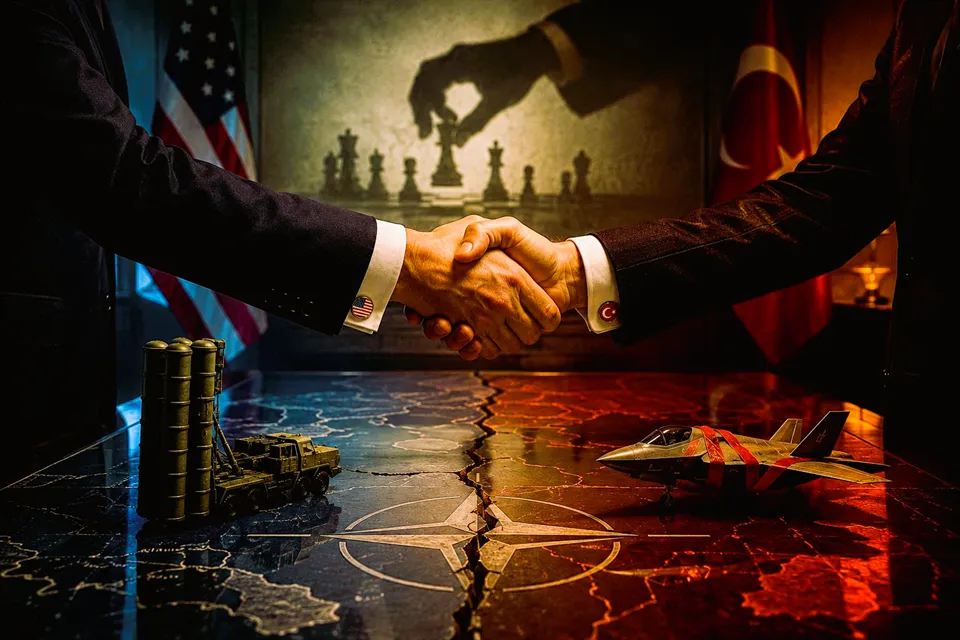
In July 2026, for the first time in more than two decades, NATO leaders gathered in Ankara. The host greeted them at the Presidential Complex as a model ally: mediator, ceasefire broker, indispensable bridge. That same week, his government was deepening a formalized axis with Qatar and Pakistan, courting Saudi Arabia and Egypt into a regional order with no American umbrella, hosting Hamas officials in Istanbul, and pressing Washington for F-35s while Russian S-400 batteries sat integrated in its air defenses.
None of this was hidden. That is the most striking feature of Türkiye’s trajectory under Recep Tayyip Erdoğan: the double game is conducted in the open, in speeches published on official state platforms, in newspaper columns written by men with personal access to the President, and in defense budgets anyone can read. What follows is that record, in Ankara’s own words and numbers.
“But not with America”
Begin with the sentence that contains the whole doctrine. On December 9, 2023, one day after an American veto of a UN Security Council ceasefire resolution on Gaza, Erdoğan told an audience in Istanbul:
“A just world is possible. But not with America. Because America stands beside Israel with its money, with all its weapons and ammunition. O America! How will you account for this?”
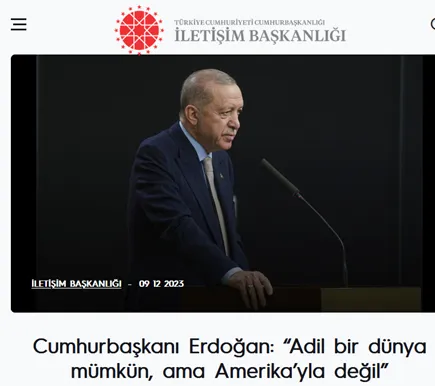
President Erdoğan, Istanbul, December 9, 2023. Published, in Turkish and English, on the Presidency’s official communications site: T.C. İletişim Başkanlığı
The line inverts Erdoğan’s own slogan. “A more just world is possible” is the title of his 2021 book and of his standing UN reform platform. By appending “but not with America,” he recast Washington not as a flawed partner in building a just order but as the structural obstacle to it. And the Presidency chose to publish the statement on its official platform: not rally rhetoric that escaped its author, but state messaging.
The territorial version of the same idea is older. On November 10, 2016, at the annual Atatürk commemoration, of all venues, Erdoğan declared:
“The world is bigger than five. Türkiye is bigger than Türkiye. We cannot fit into 780,000 square kilometers. Our physical borders are one thing; the borders of our heart are quite another.”
President Erdoğan, Atatürk Commemoration, Beştepe, November 10, 2016. Turkish coverage: Bianet
Delivered at the memorial of the man who fixed the republic within those 780,000 square kilometers, the four sentences fuse everything that followed: the challenge to the Western-led order, the rejection of the republican territorial settlement, and a claimed sphere reaching from Mosul to Skopje. The “Century of Türkiye,” the “Türkiye Axis,” the Blue Homeland maritime doctrine: each is an operationalization of that declaration.
Three presidents, one trajectory
It is tempting to read Turkish-American friction as a series of episodes. The record reads instead as a single curve. In December 2017, after the Jerusalem recognition, Erdoğan taunted an American president by name on live television: “Hey Trump! What are you trying to do?”, and days later, before the UN vote, “Mr. Trump, you cannot buy Turkey’s democratic will with your dollars.” In August 2018, at the height of the Brunson sanctions crisis, he reframed American economic pressure as holy war: “If they have their dollars, we have our people, our righteousness, and our God.” In November 2019 he theatrically handed Trump’s “Don’t be a fool” letter back to him in the Oval Office itself. Through it all, Ankara took delivery of Russian S-400 systems, absorbed its expulsion from the F-35 program, and paid no price it was unwilling to pay.
The Biden years institutionalized the register. When ten Western ambassadors, the American among them, jointly raised a judicial case in October 2021, Erdoğan’s answer was not a démarche but a worldview: “Turkey is not a tribal state… You cannot just come to our Ministry of Foreign Affairs and dictate orders.” Sweden’s NATO accession was held hostage for F-16s. The first application by a NATO member for full BRICS membership followed.
Trump’s second term brought warmth at the top, and the same divergence underneath. In June 2026 the White House notified Congress of a $700 million sale of F-110 engines for Türkiye’s indigenous KAAN fighter, while the S-400s remained in place, Hamas leaders remained in Istanbul, and Ankara’s regional architecture advanced. Personal chemistry, the record suggests, is not alignment.
The war that proved it
The 2026 U.S.-Iran war was the controlled experiment. A NATO ally bordering the battlespace, with the alliance’s second-largest army, chose its position in real time, and chose neither side’s war aims. Turkey did not join the American campaign, did not open its territory to offensive operations, and did not endorse the strategy. When an Iranian missile violated Turkish airspace in March, Foreign Minister Hakan Fidan offered Tehran an accident theory with a warning attached: “If this was a missile that lost its course, that is one thing. But such incidents should happen only once.” No cost followed. Days later he declared Türkiye “completely opposed to any plan that aims to provoke civil war in Iran,” a categorical public rejection of regime change at the height of the campaign, and echoed Tehran’s internal-security narrative outright: “The Mossad is not hiding this. They are calling on the Iranian people to rise up against the regime.”
Fidan statements: Anadolu Agency, March 8 and March 12, 2026: AA (March 8) · AA (March 12)
The President went further. In late February, with American operations underway, Erdoğan publicly deplored “joint US-Israeli attacks, which clearly violate Iran’s sovereignty and threaten the peace of the friendly and brotherly Iranian people,” warning that the region risked “being dragged into a ring of fire.” A NATO leader, describing the campaign of his own alliance’s leading power as an assault on a brotherly nation: the double game compressed into a single sentence. Meanwhile NATO air defenses anchored by the Kürecik radar intercepted Iranian missiles over Turkish territory. Ankara sheltered under a Western ballistic shield against the very regime it refused to condemn.
At the July summit, Trump credited his personal relationship with Erdoğan for keeping Turkey out of the war on Iran’s side, “a military power, millions of soldiers,” in his words. The compliment was accurate, and it was also the point: the achievement of a decade of American engagement was Turkish non-belligerence, not Turkish alignment.
The men who say the quiet part loud
To know where official policy is heading, read the columnists the Palace tolerates. İbrahim Karagül, former editor-in-chief of the AKP flagship Yeni Şafak and with documented personal access to the President, has spent the past year escalating in print. In June 2025: “Israel is an existential threat to Turkey,” then “We are forced to strangle Israel in this region,” then “The time has come to annihilate Israel.” On October 7, 2025: “The one who reopened Hagia Sophia will save Jerusalem!” And on February 23, 2026, a column whose title alone repays attention: “If you want to prevent a nuclear disaster, get the Jewish tribe under control. A preemptive strike on Israel should be considered.” Its body demanded that “Turkey must urgently be converted into a nuclear power” and that an “encirclement map must be formed around Israel.”
Sources: MEMRI Daily Brief No. 856 (June 2025 series): memri.org · Yeni Şafak, February 23, 2026 (Turkish original): yenisafak.com · MEMRI Special Dispatch No. 12380: memri.org
No Turkish official has disavowed any of it. The pattern documented across years is consistent: Karagül’s themes migrate, softened and institutionalized, into official language. He is not a fringe voice but a leading indicator, a deniable extension of state messaging published in the governing party’s house organ.
The order being built instead
What replaces the American architecture? Ankara has answered in one sentence. Fidan, in February 2026: “If regional countries commit to each other’s security, 80% of problems can be resolved.” The unstated corollaries define the project: if regional states guarantee each other’s security, there is no American umbrella, and in the “broader and more inclusive regional platform” Erdoğan envisions, there is no Israeli membership. The same month, Erdoğan named the core of the structure after his Riyadh and Cairo shuttle: “As Turkey, Saudi Arabia and Egypt, we aim to be involved in all processes.” The United States does not appear in the sentence.
Fidan remarks: Anadolu Agency, February 2026: aa.com.tr
The load-bearing wall of this construction is Qatar: more than 1,370 Turkish companies operating in the emirate, billions in Qatari investment flowing the other way, coordinated diplomacy that pairs Palestinian statehood with Israeli security while never mentioning Hamas disarmament, and Al Jazeera’s platforms amplifying Ankara’s framing to a global audience. Pakistan supplies the third leg, its defense relationship with Ankara deep enough that India blocked Türkiye’s BRICS bid over Turkish support for Islamabad’s May 2025 operation. A NATO member applied to join BRICS, and even BRICS said no.
The European front
The double game does not stop at the region’s edge. For three consecutive years, Germany’s domestic security service, the BfV, has devoted a section of its annual federal threat report to the intelligence services of the Republic of Türkiye. The 2023 report describes services that “spy on associations and individuals in Germany that actually or supposedly stand in opposition to the Turkish government.” The 2024 report formally classifies the effort as “Transnational Repression,” the category German counterintelligence otherwise reserves for states like Iran, and notes that Turkish diplomatic missions “are integrated into the collection, evaluation and forwarding of information, including to prosecution authorities in Turkey.” The 2025 report finds the activity continuing “at a high level.” German federal reporting has listed Türkiye alongside Russia, China, Iran and North Korea among the principal espionage actors operating against Germany. It is the only NATO ally in that category.
Investigative reporting fills in the mechanics: a classified January 2024 document from Turkey’s police intelligence branch listing 82 individuals profiled abroad for one province alone, collection theaters spanning eleven Western countries, and a foreign ministry reorganized under Fidan, MIT’s chief for a decade, with intelligence officers installed in key posts. Beneath the covert layer sits an influence system: the Cologne-based UID, which the BfV calls the largest state-affiliated influence organization among the diaspora, and a Grey Wolves ecosystem of roughly 12,500 adherents in Germany whose ideology, in the BfV’s words, holds antisemitism as a “core element.”
Nordic Monitor, March 7, 2024: “Turkey escalates covert intelligence activities in Europe and North America” · Verfassungsschutzberichte 2023 (pp. 329-330), 2024 (pp. 327-328), 2025 (pp. 345-346)
Built to outlast
Doctrine and rhetoric rest on a material base, and the base has been rebuilt for exactly this role. Turkish military spending reached $30 billion in 2025, up 94 percent in real terms over a decade, with more than a fifth of it channeled into indigenous defense development. The result, per the 2026 Global Firepower Index: ninth in the world, first in the Middle East, the second-largest standing army in NATO after the United States, a 192-vessel navy led by the world’s first dedicated drone carrier, acknowledged drone superpower status, and, decisively, more than 80 percent of military inventory sourced domestically. The embargo lever that disciplined Turkish behavior in earlier decades has been engineered away. This is a military built to act alone, supplied at home, and designed to outlast pressure.
Not a homecoming
Read together, the record admits one coherent interpretation. Türkiye has not left the West, and it has not joined an anti-Western bloc. It has built something more durable than either: a doctrine of strategic autonomy that extracts protection, technology, and legitimacy from the alliance while, in parallel and in the open, constructing the regional order intended to succeed American primacy. The rhetoric is published on state platforms. The espionage is documented by allied governments. The budget is in SIPRI’s tables. The columns run in the party’s own newspaper.
Which is why the Ankara summit deserved a different headline than the one it received. The story was never whether Turkey is coming back to the West. The story is about a consequential middle power using the alliance’s own stage and shield to build the world after it.
The double game is not a deviation from Turkish strategy.
It is the strategy.