Former President Criticizes Apocalyptic Factions Advocating War
**Summary **
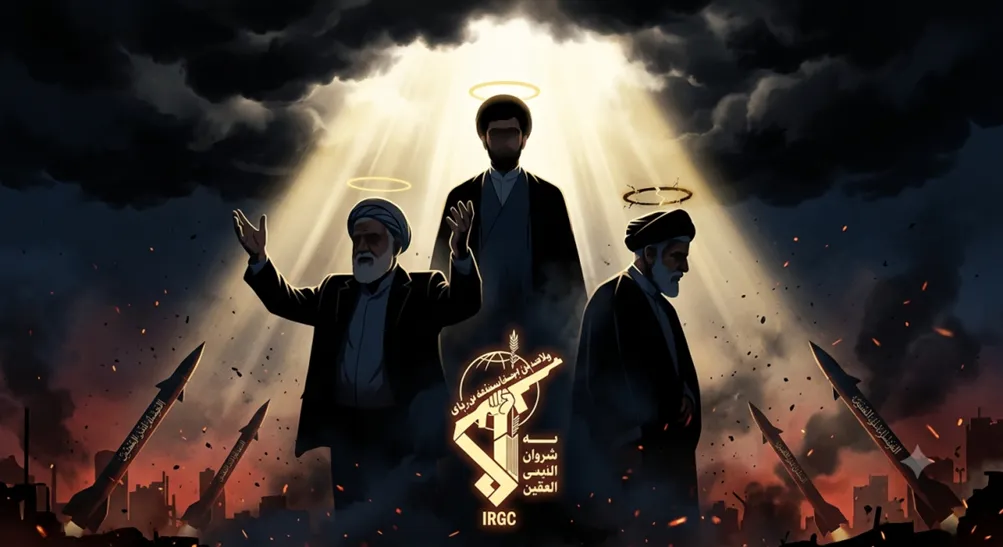
• On or around 5 August 2026, former President Hassan Rouhani explicitly acknowledged and publicly criticized a minority faction within the Iranian establishment that views escalation of the current conflict as a means to accelerate the reappearance of the Hidden Imam (Imam Mahdi).
• Rouhani framed these views as “strange and bizarre,” attributing them to ignorance or opportunism, and contrasted them with what he described as the late Supreme Leader’s consistent opposition to unnecessary war.
• The remarks constitute one of the clearest high-level public admissions in recent years that apocalyptic Mahdist ideology continues to influence strategic thinking among certain hardline elements.
• Rouhani also recounted a 2004 incident involving a proposal to construct a large public platform in Tehran specifically for the Mahdi’s expected speech, illustrating the depth of such beliefs even at senior levels two decades ago.
• The eschatological reading Rouhani ascribes to a fringe is the same reading Kayhan, the Supreme Leader’s flagship daily, advanced in print throughout the war. Hossein Shariatmadari’s April 2026 “An Event Is On Its Way” editorials cast Iran’s wartime sacrifice as a divinely managed process the Hidden Imam is personally awaiting. (High confidence.)
• The same editorial line underwrites the Mojtaba Khamenei succession, holding that the new Supreme Leader was chosen by the Hidden Imam directly. Kayhan is no dissident outlet: its managing director is a personal appointee of the Leader, which places the doctrine Rouhani calls marginal at the ideological center of the post-Khamenei order. (High confidence.)
• This assessment departs from Rouhani on the central point. The apocalyptic current reads here as the operative worldview of the Islamic Republic in its present form, carried into practice by the IRGC, rather than a small minority inside the regime. Rouhani’s “minority” label is best understood as a factional move by a sidelined pragmatist rather than a neutral count. (Moderate-to-high confidence.)Context and Setting
Rouhani delivered the remarks during a closed meeting with former ministers and vice presidents from his two administrations (2013–2021). The content was subsequently released through his official office “X” account and widely reported by Iranian outlets including Entekhab, Tabnak, Vista, and others. The timing coincides with ongoing regional hostilities and internal debates over whether to pursue de-escalation or continued confrontation.
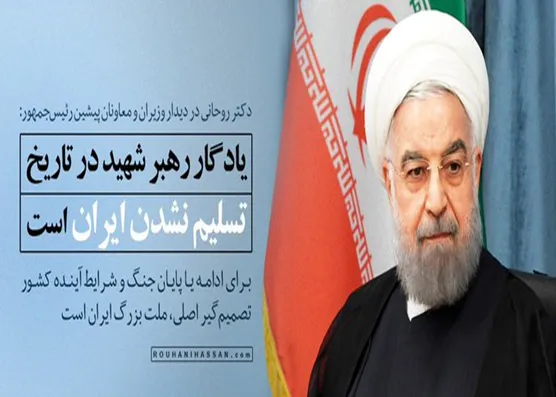
This is a graphic from Rouhani’s media outlet (watermark: ROUHANIHASSAN.com) featuring former President Hassan Rouhani. Full translation:
Kicker (top, small type):“Dr. Rouhani, in a meeting with former ministers and deputies of the President:”
Headline (large, highlighted):“The martyred Leader’s legacy in history is that Iran does not surrender.”
Subhead / pull quote (bottom, small type):“On continuing or ending the war and on the country’s future circumstances, the principal decision-maker is the great nation of Iran.”
Core Statements by Rouhani
Rouhani stated:
“In our society there is sometimes a minority that says strange and bizarre things. There is a minority that says: if this war is intensified and expanded, the Imam of the Time will appear sooner, and therefore to bring about the Imam’s appearance we must intensify the war.”
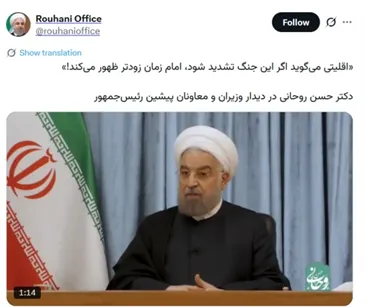
**He continued: **
“A minority says that if this war is intensified, the Imam of the Time will appear sooner!”
On the 2004 platform proposal:
“In 1383 [2004], an individual (probably referring to Ahmadinejad, analyst) ) wanted to build a large platform in one of Tehran’s main squares for the Imam of the Time to deliver a speech, and to install a sophisticated sound system so that all the people of Tehran could hear him.”
Rouhani added that other groups have different motives:
“There are also people who are after business — the same sanctions merchants, in fact. They may be happy for the war and chaos to continue. There are also individuals who may hold the idea that we should go and conquer the world and guide everyone, so to speak.”
Regarding the late Supreme Leader’s approach:
“What we received from the thinking of our martyred Leader is that the leadership never sought war at any stage. Wherever the enemy wanted_, or a foolish friend wanted__, or others _wanted to ignite the fire of war, he stood firm with resolve.”
Internal Iranian Discourse
Rouhani’s comments confirm the **existence of a recognizable, if minority, current within regime circles **— particularly among certain IRGC-linked and hardline clerical networks — that interprets prolonged conflict and regional chaos through an eschatological lens. In this worldview, large-scale war is not merely a strategic necessity but a religious prerequisite that can hasten the Mahdi’s return.
This strand of thought has historical precedent. Similar ideas were promoted more openly during the Ahmadinejad era and have periodically resurfaced in statements by figures such as Ayatollah Mohammad Mehdi Mirbagheri. Recent reporting has also noted circulating rumors inside parts of the security apparatus that the present confrontation itself may serve as the trigger for the Imam’s appearance.
Rouhani’s intervention represents a deliberate attempt by a relatively pragmatic former senior official to stigmatize these views as fringe, dangerous, and contrary to the late Leader’s recorded stance. Iranian media coverage of the speech has been **largely neutral to **sympathetic toward Rouhani’s framing, treating the “minority” as an internal problem rather than denying its existence.
Opposition voices outside the system have reacted with skepticism toward Rouhani himself, viewing him as an integral part of the broader Islamic Republic structure. Hardline circles have so far offered limited public response, consistent with a pattern of avoiding direct confrontation over sensitive doctrinal issues.
Corroboration from the Kayhan Editorial Record (Shariatmadari)
Rouhani presents the war-hastens-the-Mahdi idea as something “a minority says.” The regime’s most authoritative hardline platform has been saying it in print, under the Leader’s imprimatur, for the length of the war. Kayhan’s managing director, Hossein Shariatmadari, is appointed directly by the Supreme Leader’s office, and his daily Yaddasht-e Rooz column reads across the Iranian system as a semi-official statement of leadership redlines. Two strands of that column speak directly to what Rouhani described.
War as an Eschatological Process
On 1 April 2026 (12 Farvardin 1405) Shariatmadari ran a two-part editorial, “An Event Is On Its Way…!”, that recast the war in openly messianic terms. Part 1 treats Iran’s wartime steadfastness as the approach of a “great and fate-determining event” (واقعه عظیم)), tying the Iranian people to Quranic prophecy (Surah al-Jumu’a 2–3, read through the hadith that identifies the “other people” of the verse as Persians via Salman al-Farsi) and to Khomeini’s claim that today’s Iranians surpass the Prophet’s own companions in faith. Part 2 lands the argument: the Hidden Imam is watching the sacrifices of Iranians under fire, and those sacrifices, in Shariatmadari’s words, will not be left unanswered, with a divinely ordained “great and fateful victory” close at hand.
“An event is on its way…” The millions in the streets, fasting through the winter cold and under missile fire, are being watched by the Master of the Age himself, and their devotion “will not be left unanswered.” (Kayhan, Yaddasht-e Rooz, Part 2,)
**Source: **Kayhan / @Rajanews_com · “An Event Is On Its Way (Part 1),” 1 April 2026
**Source: **Kayhan / @Rajanews_com · “An Event Is On Its Way (Part 2),” 1 April 2026
This is the exact proposition Rouhani files under a bewildered minority that intensifying the war is bound up with the Imam’s appearance, stated as the lead argument of the Leader’s own newspaper by its editor. Its practical weight is that it renders a settlement illegible: one does not negotiate a ceasefire in the middle of a divine fulfillment.
Succession as Direct Mahdi-Designation
The same column supplies the theological scaffolding for the succession, built on identical logic. In mid-March 2026, days after Mojtaba Khamenei’s appointment, Shariatmadari argued that the new Leader was not selected by the Assembly of Experts through scholarly deliberation but chosen by the Hidden Imam directly, the Assembly merely “discovering” a decision already taken.
“One can say with confidence that His Eminence Ayatollah Seyyed Mojtaba Hosseyni Khamenei — may God preserve him — is also the chosen and selected one of His Holiness Saheb al-Zaman [the Hidden Imam, the Mahdi], who has been placed in the arena of discovery by the dear Assembly of Experts and introduced. Therefore, obedience to him is the same as obedience to His Holiness Saheb al-Zaman.”
“… it is not the Assembly of Experts that chooses the representative of Imam Mahdi; rather, it is Imam Mahdi who chooses his representative, and then places the chosen person in the arena for the Assembly of Experts to ‘discover’ through hidden guidance.” (Hossein Shariatmadari, Kayhan managing director, 15 March 2026.)
**Source: **Iran International (Arabic) · Kayhan director: Mojtaba chosen by Imam Mahdi (15 March 2026)
**Source: **Khabar Online (Persian) · Kayhan text cited directly
**The construction converts obedience to Mojtaba into obedience to the Mahdi, and any objection into apostasy. **Mahdism here is doing load-bearing work: it legitimizes the man now at the top of the system. The doctrine Rouhani treats as a fringe curiosity is the one propping up the leadership itself.
A Ruling Temper, Not a Fringe
Rouhani’s framing should be read as a factional act before it is read as a description. He is a sidelined pragmatist characterizing his rivals, and taking his “minority” as a headcount rather than a rhetorical placement mistakes the map for the ground. That a former president felt obliged to denounce the idea in a closed room, and that the denunciation was then pushed out publicly, points to a current strong enough to need containing.
**The doctrine sits at the center of the system, not its edge. **Its carrier is the Leader’s own daily, run by his personal appointee. The ideology that formed the sitting Supreme Leader is Mesbah Yazdi’s activist Mahdism, whose living standard-bearer, Ayatollah Mohammad-Mehdi Mirbagheri, teaches that “extensive confrontation with the infidel West” is a precondition for the Mahdi’s return and that holding state power is “an operational stage in advancing the coming of the Mahdi.” MEMRI’s read of the succession was blunt: Mojtaba’s rise marks the triumph of the radical messianic-apocalyptic stream in the establishment.
**Source: **MEMRI · The Iranian Regime Under Mojtaba Khamenei: Religious-Apocalyptic Radicalization (13 March 2026)
Crucially, the IRGC is the executor. The belief does not stay in sermons and editorials; the Guard writes it onto its ordnance. During the succession it ran Wave 30 of Operation True Promise 4 under the code-phrase “Ali Waliy Allah” (“Ali is the Guardian of God”), with missiles inscribed “Labbayk, Seyyed Mojtaba” (“At your service, Sayyid Mojtaba”), mapping the transfer of power onto the founding Shia succession at Ghadeer Khumm. The network that engineered Mojtaba’s appointment traces to his Habib Battalion (Hossein Taeb and Hossein Nejat), the security core of the Guard rather than any clerical periphery. The eschatological reading and the men who run Iran’s missile war are the same institution.
What Rouhani calls a strange minority is, on the evidence of the regime’s flagship paper, its reigning theology, and its missile corps, the governing temper of the Islamic Republic as the IRGC now runs it. His testimony is valuable precisely because it confirms the belief operates at elite level; his editorializing about its size should be discounted. He sees a fringe to be managed. The Leader’s own newspaper, the theology that formed him, and the Guard’s ordnance all point the other way, toward a doctrine that has moved to the center of gravity.
This does not mean every operational choice is driven by end-times calculation. Pragmatic and factional considerations still shape day-to-day policy, and Shariatmadari’s succession theology also functions as a defensive patch over Mojtaba’s thin clerical credentials.
But the reservoir of belief is deep, institutionally housed, and available to be drawn on in any escalation. That is what makes it a strategic problem for Israel and the West, and not the theological curiosity Rouhani would prefer his audience to see.
Assessment
Rouhani’s remarks provide rare, high-level validation that apocalyptic Mahdism remains a live, if contested, factor in Iranian strategic culture. While he presents the faction as small and misguided, the fact that a former president felt compelled to address it publicly indicates the idea retains enough traction to influence debates over escalation. The 2004 anecdote further demonstrates that such thinking has long penetrated elite circles.
These statements should be weighed alongside ongoing military and political developments. They do not prove that Mahdist ideology currently drives official policy at the highest levels, but they do confirm that it continues to shape the worldview of significant secondary actors whose influence can grow during periods of intense conflict.
Primary Sources
• Official Rouhani Office video release: x.com/rouhanioffice/status/2085258524028788736
• Entekhab (Iranian news site): entekhab.ir/fa/news/933717
• Tabnak: tabnak.ir/fa/news/1388504
• Iran Global: iranglobal.info/fa/node/202473
• Shafaq News (Arabic reporting of the same statements): shafaq.com/ar (Rouhani article of 5 August 2026)
• Additional Iranian coverage via Vista and Rouydad24 confirming the same quotes and context.
• Corroboration · Kayhan / Shariatmadari, “An Event Is On Its Way… (Part 1),” 1 April 2026: t.me/rajanews_com/285333
• Corroboration · Kayhan / Shariatmadari, “An Event Is On Its Way… (Part 2),” 1 April 2026: t.me/rajanews_com/285341
• Corroboration · Shariatmadari on Mojtaba’s Mahdi-designation, 15 March 2026 (Iran International, Arabic): iranintl.com/ar/202603151076
• Corroboration · Kayhan text cited directly (Khabar Online, Persian): khabaronline.ir/news/2192126
• Assessment · MEMRI, “The Iranian Regime Under Mojtaba Khamenei” (13 March 2026): memri.org · Iranian Regime Under Mojtaba Khamenei
•