The Internal Dispute over Ending the War: The IRGC, the Government, and the Fuel File
Executive Summary
The defining development of the past week in the Iranian information space is the movement of the argument over ending the war from coded signaling into open institutional conflict. The dispute now runs **between the security establishment, with the IRGC at its core and Kayhan as its enforcement organ, and the government camp around President Pezeshkian, joined by the reformist press and parts of the clerical establishment. **The question in contention is no longer the tone of wartime messaging. It is who holds the pen on the terms of any exit from the war: whether the executive that negotiates or the security establishment that fights writes the conditions under which the confrontation ends.
Three findings anchor the assessment. First, the disciplining of the war-termination camp has become public, personal, and now reciprocal.** State broadcasting edited the words “understanding” and “peace” from remarks by Pezeshkian and Seyyed Hassan Khomeini, as **
reported independently by Shargh and Etemad. Hossein Shariatmadari used his Kayhan Nokteh column of 25 August to warn Speaker Ghalibaf, the former IRGC commander who heads the negotiating team, that “Westernizing currents” are working to detach him from the revolutionary base. In an unusual step, Ghalibaf answered with an open letter on his official Telegram channel: negotiation “possesses neither intrinsic value nor taboo,” and when it serves national interests it is “that very field of struggle and resistance, neither its substitute nor a sign of retreat,” while shirking the negotiating burden and “sitting in ambush” to name every achievement of the team a betrayal is “the very essence of comfort-seeking.” A sitting Speaker publicly rebutting the Supreme Leader’s own editor, with both men formed inside the IRGC, measures how deeply the argument over ending the war now runs within the revolutionary camp itself (Appendices A and B).
Second, fuel is where the external economic war meets the internal legitimacy question, and the week showed the state unable to decide. The aborted Kerman pilot, which would have priced above-quota gasoline at roughly seventeen times the standard rate before being canceled hours ahead of launch, exposed either a lost chain of command or a failed trial balloon; both readings circulated on Iranian front pages. The government’s freeze formula, prices held flat while quotas are cut and imports have stopped, is defended daily across the establishment press with a defensiveness that signals a politically dangerous decision deferred, not resolved. Fuel lines in Tehran and reporting that strategic reserves are weeks from exhaustion shorten the deferral window.
Third, the price of continuation is now printed on Iran’s own front pages. The rial reached two million to the dollar, the deepest wartime low, as Washington announced a new sanctions package built on a third-country ultimatum. Conservative papers acknowledge the deterioration but frame it as a management failure by the government, turning the war’s economic cost into factional ammunition rather than grounds for accommodation. Hormuz transit remains roughly ninety percent below pre-war volumes, cutting into the export revenue that funds the subsidy state.
Net assessment: the internal dispute over war termination will intensify on a slope tracking the sanctions campaign. Each new enforcement round raises the cost of the maximalist line and widens the constituency for settlement, which in turn hardens the security establishment’s public discipline of that constituency. The fuel decision is the likeliest catalyst for the next escalation of the internal fight, with the November anniversary of the 2019 fuel protests and the January 2026 protest memory setting its political horizon. The direction of travel is toward a sharper, more personalized, and less containable elite conflict as sanctions advance.
1. The Fault Line: Who Writes the Terms of Exit
The week opened with the negotiating floor formally hardened. Parliament Speaker Ghalibaf, who heads the negotiating team, declared that the Strait of Hormuz remains closed until Washington implements its commitments under the Islamabad memorandum, tying the reopening to sanctions relief, the release of frozen assets, the naval blockade, and broader military restraint. IRNA supplied the legal scaffolding, arguing that the memorandum’s sixty-day clock “never began” because talks were never convened, leaving a framework in a coma that Washington can still revive. Beneath this unified public position, the week’s front pages recorded a live contest over whether it remains the ceiling or becomes the exit ramp.
The government camp and its allies
The settlement constituency spoke through three channels. Sazandegi gave its lead to Seyyed Hassan Khomeini’s argument that the fruits of a sound settlement exceed those of war, the most senior clerical endorsement of termination printed during the window. The reformist press ran structural-reform essays, Kalantari’s call for “courageous reforms,” and Baghi’s letter against collective punishment. The pragmatist economic press defended the Islamabad memorandum as the acquis that must not be traded away, with Sazandegi asking “Why from zero?” in response to proposals for a new framework.
The security establishment’s response: discipline in public
The counter-campaign was conducted through named individuals rather than abstractions. State broadcasting censored the words “understanding” and “peace” from remarks by both Pezeshkian and Seyyed Hassan Khomeini, reported independently by Shargh and Etemad; the security establishment now controls the authorized vocabulary of the war’s end. Nobonyad carried reformists Ashna and Sadeghi attacking Mohsen Rezaei over his mandate, and then answered with its standing line that projecting weakness is the prelude to war and the Islamabad understanding a mistake requiring correction. Charsoogh set facing portraits of Rezaei and Hemmati under “dignity and power” against “abasement and humiliation,” Farhikhtegan attacked Hemmati directly, and Kayhan called the Omani mediation channel a deception operation.
The Shariatmadari-Qalibaf polemic
The apex of the campaign, and the most consequential exchange of the week, was the public polemic between Shariatmadari and the Speaker. The Nokteh column of 25 August, “The Qalibaf We Know,” written in the register of personal affection, functions as a disciplinary instrument aimed at the head of the negotiating team: it recites Ghalibaf’s IRGC record, warns that Westernising currents seek to transfer his social base to the reform camp, demands that he restate his revolutionary positions “with greater emphasis and clarity,” and explains that publication was chosen over a private message because the same stratagem “is being employed in other cases as well,” identifying the column as the opening of a wider campaign (Appendix A).
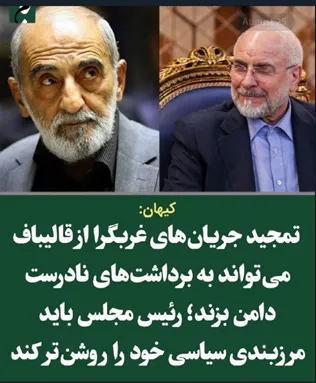
Ghalibaf took an unusual step by publishing an open letter on his official Telegram channel, deferential in form and unyielding in substance. He accepts the reminder as brotherly, then defends the mandate on its merits: negotiation “possesses neither intrinsic value nor taboo; it is neither absolutely good nor absolutely evil,” and when it advances national interests and consolidates the achievements of the resistance, it is “that very field of struggle and resistance, neither its substitute nor a sign of retreat.” **He calls the mandate “a heavy examination and a perilous trust,” not a privilege, and turns the loyalty test back on his critics: shirking the burden of negotiating with the enemy while “sitting in ambush so as to name every achievement of the negotiating team a betrayal” is “the very essence of comfort-seeking.” **He rejects “selective velayat-acceptance” alongside West-leaning, reaffirms complete obedience to the Guardian Jurist, and closes on the Quranic warning against internal dispute that makes the community’s strength depart (Appendix B). The fault line over ending the war runs through the revolutionary camp itself, and the negotiating camp has decided to defend its legitimacy in public rather than absorb discipline in silence.
Sources: Kayhan, Nokteh, 3 Shahrivar 1405 (25 August 2026), p. 2, kayhan.ir/001PZQ | Qalibaf, official Telegram channel, t.me/ghalibaf/25349. Full translations in the appendices.
The contest also runs inside the hardline establishment. The “seven directives centered on cohesion” circulated during the week a_ddress a real dispute rather than describe a resolved one, and reporting on the power struggle behind the Leader’s new military appointments shows that the succession-era competition among security factions continues_ in parallel with the fight against the settlement camp.
_See also: Amwaj Media, “Inside story: The power struggle behind Khamenei’s new appointments,” _amwaj.media
2. The Fuel File: Where the External War Meets Internal Legitimacy
Gasoline was the most persistent domestic item on Iranian front pages through August, and the week confirmed it as the single sharpest node of the internal dispute. The trigger was the Kerman episode: provincial authorities announced that gasoline consumed beyond the monthly quota would sell at 872,000 rials per liter, roughly seventeen times the non-quota price, then canceled the scheme hours before launch after contact with national officials, who said they had not been consulted. Vatan-e Emrooz framed the episode as the work of rogue actors; other readings treated it as a failed trial balloon. Both interpretations are damaging: one implies a lost chain of command in wartime, the other a state testing the public’s pain threshold and then retreating.
Sources: Iran International, “Iran weighs gasoline rationing as fuel deficit widens,” iranintl.com | Al Jazeera, “Iran’s government signals fuel price hike on eve of new US sanctions,” 23 August 2026, aljazeera.com | Daily monitors, 15 to 26 August 2026.
The arithmetic behind the episode is not contested inside Iran. Pezeshkian has put the gasoline import bill for the last Iranian year at about six billion dollars; imports have since stopped under the war and the blockade; refinery output is being stretched with petrochemical blending and reduced fuel quality; and the second monthly quota was cut from seventy to fifty liters in July. The government’s declared options, per its energy optimization chief, run from continued rationing through tiered pricing to full liberalization at the 872,000-rial level, each carrying its own inflationary or political charge. By the final days of the window_,_ the deferral itself had become visible on the street: fuel lines formed across Tehran, and sourced reporting indicated the strategic reserve buffer may be weeks from exhaustion.
_Sources: AP via The Washington Post, “Iran’s gas lines are growing,” 25 August 2026, washingtonpost.com | Iran International, “Iran fuel reserves may run dry within weeks,” 26 August 2026, _iranintl.com
On the front pages, the fuel question has become a proxy war over economic doctrine and, through it, over the war itself. Charsoogh ran a full-front_al prosecution of the Nili school of price liberalization, enlisting Momeni and Shakeri to argue that three decades of shock therapy “plundered the people’s existence,” while Taadol carried the counter-case through Ardakani, arguing_ that below-cost fuel robs future generations and must move to real pricing. Kayhan attacked the “petrol pricing faction inside government,” and Charsough’s ranking of post-revolution governments by money printing placed the incumbent first, converting monetary polemics into factional ammunition. The state’s freeze formula, prices flat, quotas cut, a consumption war in the capital, is repeated defensively across the establishment press. The density and defensiveness of that repetition is the tell: a politically dangerous pricing decision is pending, and every faction is positioning to assign its cost to a rival. The precedents that discipline all sides are November 2019 and January 2026, when fuel decisions preceded nationwide unrest and lethal crackdowns.
3. The Price of Continuation
The week priced the war in public. The rial fell to two million to the dollar, a record wartime low that Iranian front pages carried in toman terms, and fell again as the US Treasury announced its new sanctions package on 24 August, presented by Secretary Bessent with an explicit third-country ultimatum: keep doing business with Tehran and lose access to the United States. Trump’s framing of the campaign as the most crushing economic operation ever undertaken against any country set the declaratory ceiling. Hormuz transit remained roughly 90% below pre-war volumes throughout the window, with fewer than 20 commodity vessels crossing over the weekend, throttling the export revenue that funds the subsidy state even as Tehran builds its own counter-enforcement architecture of vessel lists, fines, and permits over the strait.
Sources: AP via The Washington Post, “Iran’s rial currency hits new record low as US prepares to announce more sanctions,” 24 August 2026, washingtonpost.com | Daily monitors, 24 to 26 August 2026.
What matters analytically is how this cost is processed inside the system. Conservative papers now acknowledge the deterioration openly, Shargh’s dollar quotation, Kayhan’s lead on price acceleration, the inflation and liquidity columns across the economic dailies, but frame it as a management failure of the Pezeshkian government rather than as grounds for accommodation. This framing does double work for the maximalist line: it shields the decision to continue the war from the economic evidence against it, and it spends the government’s remaining legitimacy on the war’s behalf. The government camp reads the same numbers in the opposite direction, as the case for settlement, which is precisely the argument state broadcasting is editing out of the record. The economic data is therefore no longer a neutral backdrop to the internal dispute; it is the dispute’s primary ammunition, and every new round of sanctions enlarges both sides’ arsenals while narrowing the state’s room to defer the fuel decision that sits between them.
Outlook and indicators
The internal dispute will intensify with each stage of the sanctions campaign, because sanctions raise the price of the maximalist line faster than the security establishment can suppress the constituency that says so. Indicators to watch over the coming weeks:
• The fuel decision. Any move off the freeze, whether liberalization, deeper rationing, or a second regional pilot, is the likeliest trigger for the next escalation of the internal fight and carries direct street risk on the 2019 and January 2026 precedents.
• Migration of the currency and pricing debate from the economic dailies onto the front pages of ideological outlets, which would signal that economic stress has fully become a factional weapon.
• Whether the Shariatmadari campaign that opened with the Qalibaf column extends to additional named figures, as its author signaled it would, and whether other members of the negotiating and government camps follow Ghalibaf in answering publicly rather than absorbing discipline in silence.
• Any softening in IRGC-aligned statements on negotiation, which would indicate internal authorization for a settlement track is progressing despite the public discipline.
• An enforcement incident at sea where the American and Iranian rule systems converge on the same hulls, which remains the likeliest route back to kinetic exchange and would reset the internal argument in the maximalists’ favor.
Appendix A. Hossein Shariatmadari, “The Qalibaf We Know”
Nokteh column, Kayhan, 3 Shahrivar 1405 (25 August 2026), page 2. Author: Hossein Shariatmadari, managing editor of Kayhan and the representative of the Supreme Leader at the newspaper. Source: kayhan.ir/001PZQ. Translated in full from the Persian, preserving the original numbered structure.
-
My dear brother Dr Qalibaf is aware of this writer’s long-standing devotion to him, and he certainly knows that what appears in the text before him is a compound of two lessons, an experience from the not-so-distant past and an anxiety about its repetition. It is also necessary to note that, at times, a reality remains hidden from the view of intelligent people, and drawing attention to it does not mean that the one giving the reminder is more intelligent; rather, in some cases, that reminder arises from the informational position of the one who gives it. Some years ago, when the matter at hand was the conveying of information to one of the eminent figures, I began my text with this introduction: “In the word of God it is said that when Solomon, peace be upon him, did not see the hoopoe among the birds that were with him, he became agitated and said: ‘Why do I not see the hoopoe? Or is he among the absent?’ But his wait was not long before the hoopoe arrived and said: ‘I have encompassed that which you have not encompassed, and I have brought you from Sheba a sure report.’ The hoopoe was only a bird. Yet it had brought Solomon a report from Sheba to which Solomon, for all his majesty, had no access.”
-
The Qalibaf we know: the devoted divisional commander of the Sacred Defence years, the fearless military and commercial pilot, the authoritative commander of the Law Enforcement Force, the successful mayor of Greater Tehran, the Speaker of the Islamic Consultative Assembly, and now the official responsible for the negotiating team in the recent war. Each one of the qualities and offices mentioned can by itself attract the appetite of external enemies and their domestic appendages for hostile confrontation with him. But how? Qalibaf has shown many times that he is no willow that trembles at the blowing of adverse winds from the enemies. He is an outstanding official who has passed with courage through difficult ground, and so on.
-
Some of the available evidence suggests that a Westernizing current and a number of claimants to reform have targeted a change in Mr Qalibaf’s “social base,” and are pursuing the transfer of his social base from among the vast and self-sacrificing masses of the people into the arena of political activity of the claimants of reform and the Westernisers. Perhaps this reading has no external reality and amounts to no more than a possibility. Yet the alignment, apparent and not real, of some of Mr Qalibaf’s recent positions with the Westernizing crowd feeds this reading, or at the least this possibility. The Westernizing currents, by distorting or truncating some of Mr Qalibaf’s positions and then praising and lauding the position in question, insist on presenting his social base as having changed on the one hand, and on tarnishing the perpetual devotion of the revolutionary forces and of Hezbollah toward him on the other. Our dear brother Mr Qalibaf is certainly not unaware of the political fate of those who have fallen victim to this very stratagem. Although, given the character we know of Mr Qalibaf, this stratagem amounts to pounding water in a mortar, the expectation is that he should place greater emphasis and clarity on his revolutionary positions to avoid misreadings, so that the way remains closed to abuse and tendentious interpretations.
Finally, it should be said that this brief note could have remained confidential and been sent privately, but for two reasons its publication appeared necessary. First, that this stratagem is being employed in other cases as well, and its becoming public can serve as a warning tap. Second, the necessity of emphasizing the outstanding and revolutionary character of Mr Qalibaf, which has perhaps remained untold for today’s young generation.
Hossein Shariatmadari
Appendix B. Mohammad Baqer Qalibaf, Open Reply to Shariatmadari
Open letter published on the official Telegram channel and information base of the Speaker of the Islamic Consultative Assembly (t.me/ghalibaf/25349, imprint ghalibaf.ir), in direct reply to the Nokteh column of 25 August 2026. Signed “Soldier of the Revolution | Mohammad Baqer Qalibaf.” Translated in full from the Persian; Quranic citations are rendered in standard English equivalents. A facsimile of the original two-page letter follows the translation.
In the name of God, the Compassionate, the Merciful.
To the esteemed brother of the arena of pen and media, Haj Hossein Shariatmadari. Peace be upon you.
First, I must express my thanks for Your Excellency’s benevolence, concern, and brotherly reminder. For many years I have known you as a soldier in the soft war and in the front ranks of the pioneers of the defense of the Islamic Revolution. In the school of the Quran, a believer’s reminder is no cause for resentment but a sign of brotherhood, for God Almighty has said: “And remind, for the reminder benefits the believers.” I therefore receive your reminder not as confrontation but as an act of religious and revolutionary brotherhood, offered by a brother tested in the arena of the pen to his smaller brother.
I count myself a small soldier of the self-sacrificing ranks of the mujahidin of the revolution; one whose principal capital lies not in posts and titles but in the covenant he made with the departed Imam of great rank, with the martyred Imam and great Leader of the revolution, with the believing people of Iran, and with the pure blood of the martyrs.
Today likewise, the difficult responsibility of negotiating with enemies whose hands are stained with the blood of this nation’s martyred Imam, of my friends and comrades, and of the women and children of this land, is for me not a privilege but a heavy examination and a perilous trust. From you, dear brother, and from all the noble people of Iran, I ask prayers for a good ending for this small brother.
As for negotiation: in my view it possesses neither intrinsic value nor taboo; it is neither absolutely good nor absolutely evil. Negotiation acquires meaning when it becomes an instrument for advancing national interests, securing the nation’s rights, removing injustice, and consolidating the achievements of the resistance. For years in the Guards, the noble verse “And prepare against them whatever you are able of power” has been engraved upon my heart, and by the same logic, dialogue too, wherever necessary, is that very field of struggle and resistance; neither its substitute nor a sign of retreat from it.
Our great Imam, with all his candour and steadfastness before arrogance, saw the administration of the country and the preservation of the interests of Islam and the Muslims within the framework of rationality, prudence, and the discernment of committed officials, and taught us that the criterion is the preservation of Islam, the independence of the country, the dignity of the people, and the negation of foreign domination. Our martyred Imam also emphasized this truth many times: that engagement with the world differs fundamentally from dependence and surrender, and that negotiation, wherever necessary, must proceed from a position of power, with dignity preserved, wisdom, and expediency. Just as Your Excellency showed kindness toward this humble servant, those who know this brother of yours know that from the first days of the revolution I have kept my boundary with West-leaning, with sedition-mongering, with deviation, with distortion of the Imam’s line, and with every current that sees the solution of the country’s problems in courting the satisfaction of foreigners, clear and practical. With those who, instead of relying on the power of the people, keep their eye on the enemy’s hand, we have no merely tactical difference; our difference is one of foundations.
At the same time, in drawing the boundary with West-leaning, it must be said that not every rational act taken from a revolutionary position, nor the dialogue of the mighty and the dignified, nor the effort to take the nation’s right from the enemy, should be wrongly defined under compromise and passivity. The enemy forever strives to sow misunderstanding and discord among the forces of the revolution and to wear down the capital of their fellow feeling. Mindful of the noble verse “And do not dispute with one another, lest you falter and your strength depart,” I believe that benevolent criticism and revolutionary vigilance are necessary; but hasty interpretations and politically charged atmospherics must not be allowed to weaken the border guards of this frontier, that is, the mujahid-like negotiation, and to cast doubt on unity, trust, and confidence in forces loyal to the Imams of the revolution and to the Leadership. At this juncture too, I have considered emptying one’s shoulder from under the burden of the responsibility of negotiating with the enemy, and sitting in ambush so as to name every achievement of the negotiating team a betrayal, the very essence of comfort-seeking. One must put one’s shoulder under the burden of responsibility, and guard and protect the instruments of power, so that we can consolidate the achievements of the war and carry the country safely through the grave calamities that the enemies have charted for it.
Just as I have kept a clear boundary with West-leaning, deviation, and sedition-mongering, so I keep a boundary with extremism, with indiscipline in speech and act, with disregard of political piety, with the politics of purification that cuts itself off from the people, and with selective velayat-acceptance; and I am convinced that revolutionary rationality is the lost point of revolutionary conduct, which holds that justice, spirituality, and rationality belong together.
I believe that belief in the people, belief in God, and belief in ourselves are the pillars of our success. On that basis we must count the hard core of the revolution as ninety million, act with faith in the divine traditions, light the way with a rationality joined to revelation, and pursue our ideals with realism. And I believe that the principal guarantee of our felicity is complete obedience to the Guardian Jurist. Velayat-acceptance is not the selection of preferred sentences from the words of the Guardian Jurist; it is practical commitment to the whole system of his guidance, from resistance against the enemy to the preservation of national cohesion, from the strengthening of internal capacity to the avoidance of harmful polarisations.
The country today faces great and complex problems and an open, many-layered enmity. Our duty is to spend our strength and time solving the people’s problems, increasing Iran’s power, guarding the achievements of the resistance, and leaving the enemy unsuccessful; not to overspend the limited capital of responsibility on addressing every imprecise perception and judgment. In closing, I value Your Excellency’s honest and compassionate reminder, and I ask God in His grace to keep my steps firm, so that I may continue to do my duty in the path of the exaltation of Islam, of the revolution, and of dear Iran. “Our Lord, let not our hearts deviate after You have guided us, and grant us mercy from Yourself.”
Soldier of the Revolution | Mohammad Baqer Qalibaf
Facsimile of the original letter as published on the official channel: