Majid Shakeri and the Doctrine of Strategic Patience
Executive Summary
Bottom line. Majid Shakeri is packaging a single elite message: Iran should not seek a deal now, should hold a controlled state of neither war nor peace, keep pressure on the market, and outlast Trump. He frames this not as retreat but as principled endurance. His written thread opens by addressing the assassinated Supreme Leader and pledging that the path continues, which fuses a secular argument about American attention spans with a Shia theology of sacrifice and eventual, divinely assured victory. Shakeri is not a first-tier decision maker. He is a weathervane, and the direction he shows matches the day’s security appointments. The strategic question this raises sits above Shakeri: Iran is signaling readiness for a long campaign at any price, and the open issue is whether the West can match its patience.
Key Points
• **The message is coherent across formats, confidence high. **The written post and the circulating interview say the same thing in two registers: no durable deal with Trump, and patience until the current period ends.
• **The frame is theological as much as strategic, confidence high. **Waiting out Trump is presented through endurance, sacrifice and the continuity of the martyred Leader’s path, the same idiom we tracked in Shia messaging after Mojtaba Khamenei’s consolidation.
• **The interview does not mention Hormuz, confidence high. **The on-screen subtitles support prolonged confrontation and no deal with Trump. They do not reference the strait and do not literally say Iran will accompany Trump to the end of his term. The closest phrase is until this period is over.
• **One amplifier connects the threads, confidence high. **The clip is an Espresso Talk interview reposted by the Handala Farsi channel, the same channel that produced the Hormuz-until-2029 package. The endurance narrative and the harder Hormuz claim share a single distributor working from Shakeri material.
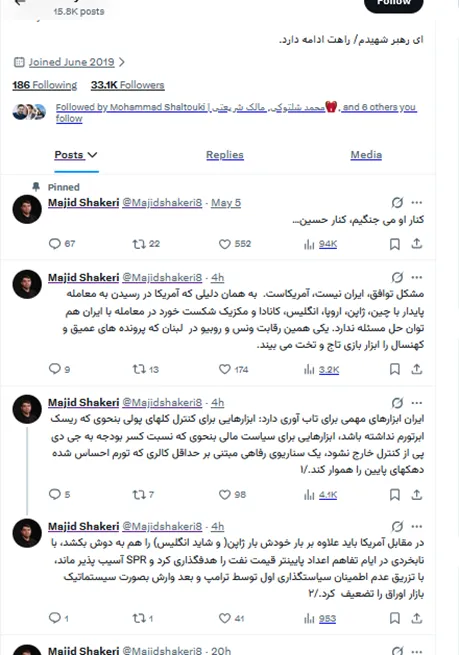
• **His own feed now confirms the frame, confidence high. **Shakeri’s timeline carries the pinned devotional line about fighting at Hussein’s side, the martyred-Leader bio, a written argument that the obstacle to a deal is America and not Iran, and an economist’s case that Iran can afford to wait. The message is his, in his own words.
Iran is preparing for a prolonged campaign and signals readiness to pay any price to sustain it. That price is already visible on three fronts, and a fourth is held in reserve. It has absorbed the loss of senior figures in combat, including the killing of its Leader and of Larijani, without breaking stride. It has shown a willingness to suppress domestic protest by force, as we have already seen. And it continues to treat the Strait of Hormuz as a strategic weapon, to be tightened or loosened as leverage rather than closed outright.
The through-line in Shakeri’s messaging, and in the day’s security appointments, is strategic patience: hold the ambiguous middle of neither war nor peace, keep pressure on the market, and outlast Trump. Iran has now demonstrated that it possesses this quality. The open question is whether the West possesses a patience of comparable depth. On present evidence, the burden of endurance is one Tehran is prepared to carry longer than Washington may be.
The implication for planning is continuity, not resolution. We should prepare for the confrontation to persist in its current form, with peaks and troughs rather than a clean break, and without assuming an early settlement.
Two variables sit above that baseline and can move it sharply in either direction:
· The first is the Trump wild card, an unpredictable actor capable of abrupt escalation or abrupt disengagement.
· The second is Iran’s demonstrated readiness to respond forcefully to any strong move against it, which raises the cost of pressure and narrows the space for a decisive Western blow. Plan for a long contest managed for endurance, in which the decisive risks are miscalculation and sudden escalation, not a negotiated end.
1. The Core Message: Patience to the Point of Victory
The anchor text is Shakeri’s own post (@Majidshakeri8), which opens with a martyrdom invocation and then states the strategy in full.
«ای رهبر شهیدم، راهت ادامه دارد. راه پيروزى در اين جنگ، فقط جنگيدن يا فقط تفاهم كردن نيست. راه پيروزى «مديريت فرايند نه جنگ نه صلح، تا نقطه پيروزى» است.»
“O my martyred Leader, your path continues. The path to victory in this war is not only to fight, nor only to reach an understanding. The path to victory is ‘managing the process of neither war nor peace, up to the point of victory.’”
**Reading. **Two moves are bound together. The strategic move is to refuse a binary of war or deal and to hold the ambiguous middle while keeping economic pressure on. The devotional move is to place that patience inside the continuity of a martyred leadership, so that waiting becomes fidelity rather than weakness. This is the seam the rest of the messaging runs along.
He locates the obstacle to a settlement not in Tehran but in Washington, in a written post from the same feed:
«مشکل توافق، ایران نیست، آمریکاست.»
“The problem of a deal is not Iran, it is America.”
His argument is structural rather than tactical**. America, he writes, failed to reach durable deals with China, Japan, Europe, Britain, Canada and Mexico, so it lacks the capacity to close one with Iran either.** This is the written twin of the interview line that Trump has concluded no agreement with any country. It also lets Shakeri claim the moral and analytic high ground: the refusal to negotiate is recast as realism about an adversary that cannot deliver.
2. The Resilience Claim: Why Waiting Is Affordable
Patience is only credible if it is bearable, and Shakeri devotes a thread to arguing that it is. Iran, he contends, holds real tools of resilience: monetary levers to keep the money supply from tipping into hyperinflation, fiscal levers to stop the budget deficit**-to-**output ratio from running away, and a welfare scenario built around a minimum-calorie basket meant to cushion the poorest against the inflation people have actually felt for decades. The claim is not that life is comfortable. It is that the floor will hold.
He then turns the ledger on Washington. America, in his telling, must carry its allies as well as itself; it mis-targeted low oil prices during the period of understanding and left its Strategic Petroleum Reserve exposed; and it weakened its own bond market by injecting political uncertainty, first through Trump and then systematically. Time, on this reading, runs against the United States, not Iran. This is the economic leg of the endurance posture: outlasting Trump is presented as affordable at home and costly for the adversary.
Sources: Shakeri resilience thread (@Majidshakeri8), parts 1 and 2.
3. The Interview: Shakeri on Camera
The circulating clip is a ninety-six**-**second excerpt of an Espresso Talk interview, reposted with subtitles by the Handala Farsi channel. The host voices ordinary Iranian exhaustion and needles the guest on bravado, Turkey and Pakistan, and whether Pakistan’s bomb means anything in practice. Shakeri answers in the register of endurance and long-horizon patience. The verified on-screen subtitles below carry the analytical core.
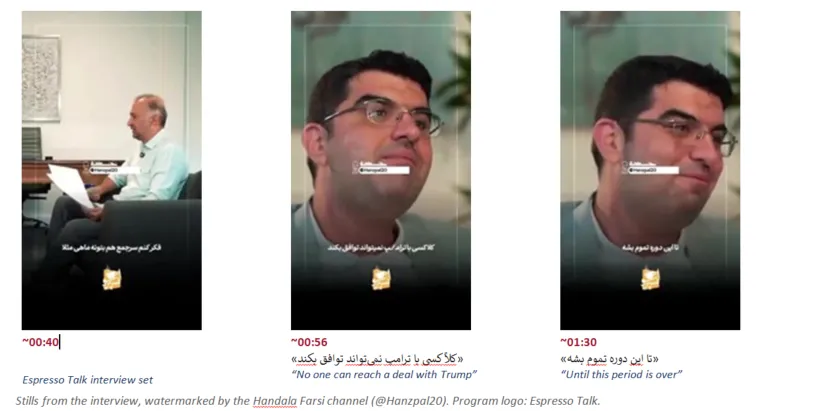
Stills from the interview, watermarked by the Handala Farsi channel (@Hanzpal20). Program logo: Espresso Talk.
The Trump section, from roughly 00:55 to 01:08, is categorical. Shakeri argues «کلاً کسی با ترامپ نمیتواند توافق بکند », no one at all can reach an agreement with Trump, and stresses he means Trump specifically, not the United States in general. He adds that the current team has reached no agreement with anyone, and that across his whole term Trump has concluded no agreement with any country. The clip closes near 01:30 on«تا این دوره تموم بشه», until this period is over.
**The earlier section adds texture. **Before the Trump argument, the exchange runs through the exhausted ordinary Iranian who works several jobs and keeps nothing, a skeptical aside on the Mecca Pact partners Turkey and Pakistan and whether Pakistan’s bomb is usable in any real contingency, and a striking admission that part of the fault is our own. The rhetorical arc moves from hardship, through self-criticism, to patience. That arc is the message.
Sources: Espresso Talk (@spressotalk) interview, clipped and subtitled by the Handala Farsi channel (@handala_farsi); user-provided video and verified on-screen subtitles.
4. The Theological Register: Sacrifice, Endurance, Divine Victory
The strategic argument would stand on its own, but Shakeri does not leave it there. His timeline makes the register explicit and standing, not incidental. His bio is a pledge of continuity to a killed leader, and his pinned post places the whole confrontation inside the paradigm of Karbala:
«ای رهبر شهیدم، راهت ادامه دارد.» — «کنار او میجنگیم، کنار حسین…»
“O my martyred Leader, your path continues.” — “We fight at his side, at Hussein’s side…”
This is the Shia idiom was tracked after Mojtaba Khamenei’s consolidation: a politics that reads hardship as trial, sacrifice as merit, and patience as the precondition of a deliverance that is ultimately granted, not merely engineered. To fight at Hussein’s side is to accept a stand against long odds as itself righteous, independent of the outcome. In that frame, outlasting Trump is not a wager on American politics. It is confidence that a community which has absorbed war, sanctions and the killing of its leaders will absorb one more presidency, and that endurance itself is a form of victory.
**Why it matters analytically. **This register does specific work. It converts a costly stalemate into a story of principled steadfastness, which lowers the domestic political price of not negotiating and raises the price of any leader who breaks ranks to seek a deal. It also gives the elite a language that does not depend on battlefield results. Shakeri’s economics and his theology point the same way: deny the adversary a settlement, hold the line, and let time and faith do the work. Treat this as the outward posture, the mantle the system wants worn in public, not necessarily a full account of private calculation.
5. What the Clip Does and Does Not Say
Precision protects the product. In the verified subtitles of this excerpt, the strait of Hormuz is not mentioned, and there is no literal statement that Iran will accompany Trump until the end of his term. The defensible takeaways are that no durable deal with Trump is expected, that the argument is aimed at Trump personally, and that the present situation is expected to hold until the current period ends. The harder formulations that traveled with this clip, a dated Hormuz closure and a six-point list of demands, come from the packaging around it, not from Shakeri’s words here.
**What is now firmer. **The thesis that no durable deal with Trump is coming is no longer interview-only. Shakeri states it in writing on his own feed that the obstacle is America and not Iran. The one formulation still short of verbatim support is the viral line that Iran will accompany Trump until the end of his term. Its nearest verified anchor remains the interview close, until this period is over, and the written posture of waiting the adversary out. Treat the deal thesis as his own words, and the accompany-until-term-end phrasing as a faithful paraphrase rather than a quotation.
**Provenance note. **The clip reached circulation through the Handala Farsi channel, the same amplifier behind the Hormuz-until-2029 package assessed separately. This does not discredit the interview, which is authentic, but it does explain how an analyst’s endurance thesis and a maximalist Hormuz claim came to travel together. One distributor is building a single narrative out of Shakeri material.
6. Convergence: The Analyst’s Voice and the Day’s Appointments
Shakeri is not a first-tier influencer, and his reach should not be overstated. His value is as an indicator. On the same day his interview circulated, the security leadership changed hands: Mohsen Rezaei, a veteran commander, took the secretaryship of the Supreme National Security Council as the Supreme Leader’s representative, alongside other military appointments. The civilian analyst and the institutional moves point the same way, toward a long-horizon confrontation posture managed for endurance rather than resolution. When a weathervane and a chain of command align, the direction is worth marking even if the weathervane is small.
_ _
Mohsen Rezaei, now Secretary of the Supreme National Security Council, restated the Hormuz doctrine in his own words, in English, to a large international audience:
“IRAN’s message is clear: the Strait of Hormuz will not reopen until the U.S. ends the war and blockade, releases Iran’s frozen assets, and agrees to a region-wide ceasefire, including in Lebanon and Gaza. Until all conditions are met, the Strait will remain closed.”
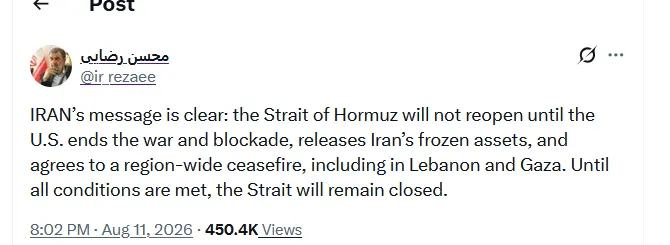
**Significance. **This hardens the Zolghadr-era terms and moves them up the chain, from an analyst’s framing to the Secretary’s own signature. He chose English and a public platform, which marks this as deterrent signaling aimed at Washington rather than a domestic message, and he bound the strait to a region-wide ceasefire that names Lebanon and Gaza, coupling Hormuz to the wider theater. The convergence described above is no longer inferential. The front-line official has now said it.
_Attributed to Rezaei via the account @ir_rezaee; consistent with his on-record conditions from March 2026, full US compensation and withdrawal from the Gulf. Handle status as his personal channel is being confirmed. Source: _x.com/ir_rezaee_ (11 Aug 2026)_
_ _
Sources: Radio Farda, Rezaei appointed SNSC Secretary; Euronews Persian, what the change means; Rouydad24, Shakeri profile.
Significance and Confidence
**High confidence. **Shakeri’s written and on-camera messaging is authentic and consistent: the obstacle to a deal is America_, not Iran; patience holds until the period ends; and endurance is framed through sacrifice, the Karbala paradigm,_ and the martyred Leader’s continuing path. His resilience thread supplies the economic rationale. The interview contains no reference to Hormuz and no literal accompany-until-term-end line.
**Moderate confidence. **This messaging reflects a genuine elite posture rather than one analyst’s idiosyncrasy, given its convergence with the day’s security appointments. It is an indicator, not proof of a fixed decision.
**Watch. **Whether the endurance-and-patience frame spreads from analysts to named officials, and whether Rezaei’s SNSC restates the Hormuz conditions in the same register.
Indicators to Watch
• Repetition of the neither war nor peace and outlast-Trump language by front-line figures, not only analysts.
• Martyrdom and continuity motifs, the martyred Leader’s path, sacrifice, divine victory, migrating into official statements and Friday sermons.
• Further amplification by the Handala Farsi channel and whether mainstream Iranian outlets adopt its framing.