Iranian Press Monitor - Wednesday, 9 September 2026 (Day 190)
Wednesday, 9 September 2026 · 18 Shahrivar 1405 · 27 Rabi al-Awwal 1448 - Nine front pages (eight Persian from the Wednesday 18 Shahrivar Tasnim album and Iran Daily from the English kiosk), plus the Kayhan, Vatan-e Emrooz, Jam-e Jam, Etemad, Iran and Sobh-e No channels and the Defa Press, Fars and Nour News wires; Tehran Times and the leadership websites were unavailable at the time
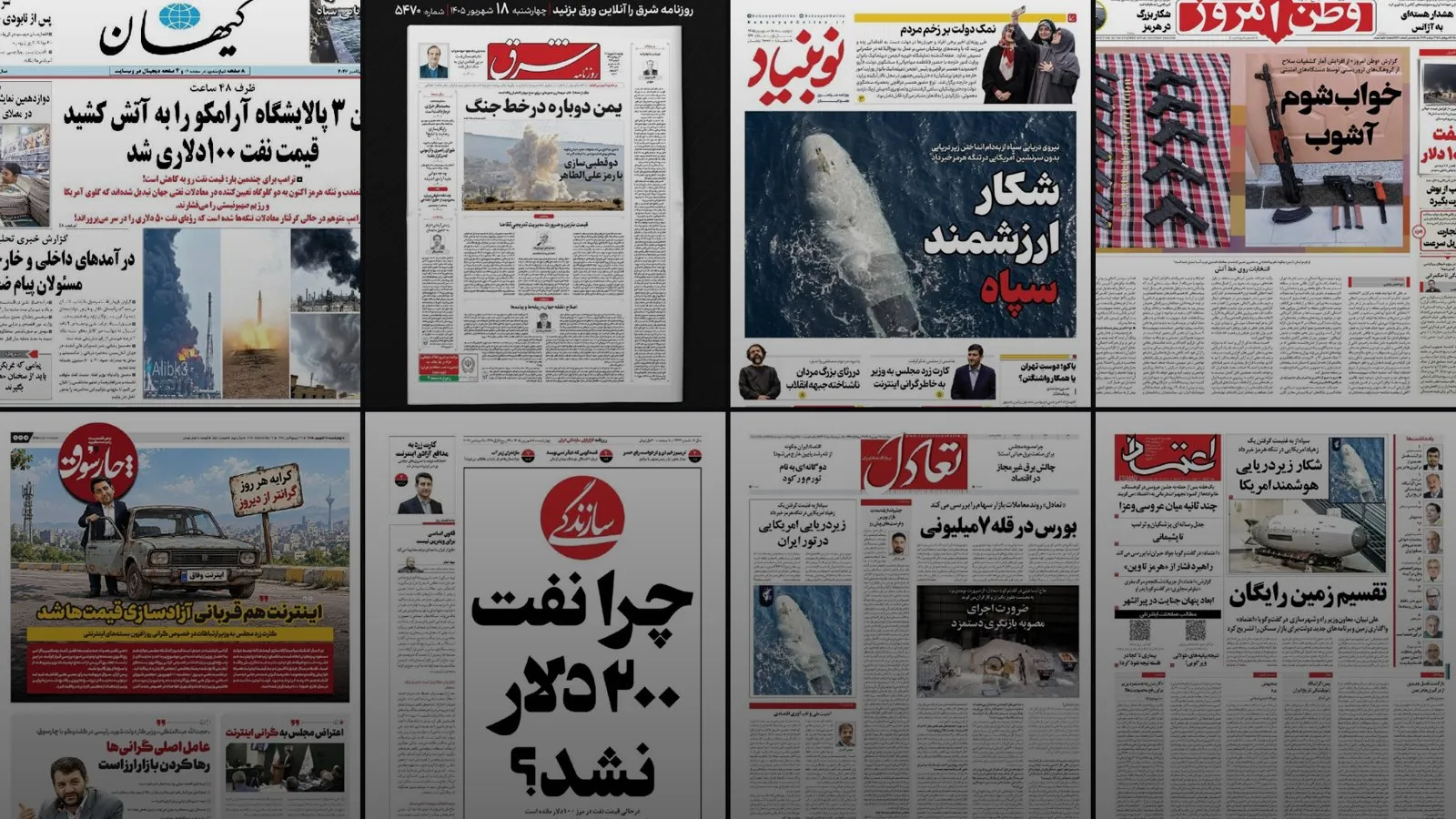
Bottom line: On the morning Iran’s navy claimed an American underwater drone and eighteen vessels, the hardline flagship led instead with a partner’s burning of three Saudi refineries and printed the oil price as the war’s scoreboard, and the reformist daily of the Kargozaran party audited that scoreboard on its own front page and found the weapon capped by Riyadh, Abu Dhabi, Baghdad and Beijing, while the escalation that actually matters, a published order to tanker crews in Kuwaiti and Bahraini berths to abandon their ships, appeared on no front page at all.
Executive Summary
The lead judgment of the cycle is that the Iranian press has stopped presenting the oil price as a consequence of the war and started presenting it as the war’s instrument, and that this framing was contested in print on the same morning by name. Kayhan gives its main headline not to Iran’s own claimed operations but to Yemen’s: ‘within 48 hours, Yemen set three Aramco refineries ablaze; the oil price became 100 dollars’. Its own bullets state the doctrine plainly, that ‘Bab al-Mandab and the Strait of Hormuz have now become two decisive chokepoints in the world’s oil equations, which squeeze the throat of America and the Zionist regime’, and two further bullets address the American president directly over his stated hope for cheaper crude. Vatan-e Emrooz prints the same rounded figure in red in its headline box. Outside reporting places Brent near but below 100 dollars after strikes on Aramco installations at Jizan, Abha and Najran, so the number carried on two hardline fronts is a rounded-up framing rather than a settlement price, and the substance of the strikes and the fires is verified while the price is not.
The rebuttal is the most striking editorial act in this edition because it comes from an Iranian front page rather than from outside. Sazandegi, the daily of the Kargozaran-e Sazandegi party, devotes its entire front to one question set in outsized type, ‘Why did oil not reach 200 dollars?’, and its deck names the opposing camp: ‘while the price of oil has stopped at the 100-dollar border, some principlists and defenders of the war claimed that with the continuation of war conditions the price per barrel would pass even 200 dollars, but that did not happen’. The paper then states its research question, what prevented the rise and what the role of Saudi Arabia, the UAE, Iraq and even China was in capping it. That converts the flagship’s scoreboard into evidence of Iran’s isolation, and it is the only quantitative and testable claim any Iranian front page makes this morning. Two papers of two factions read the same price and reach opposite conclusions about who is being squeezed.
The day’s military claim was ranked below the price argument almost everywhere. The IRGC announced the seizure at dawn on 8 September of an American unmanned underwater vehicle at the approaches to the Strait of Hormuz, described in its own vocabulary as spoils of war; outside reporting identifies the vehicle as an Anduril Dive-LD autonomous system and records that the American military had issued no confirmation. Nobonyad gives it the whole upper page under ‘The IRGC’s valuable catch’; Etemad and Ta’adol give it a banner and a column; Chahar Sough places it at the foot of the page beneath a dispute about internet tariffs; Kayhan gives it a top-right banner rather than the lead. The reputational payload is not the vehicle but the inference drawn from it, stated by the IRGC spokesman on the Defa Press wire, that no advanced technology can pass the surveillance layers in the Strait, together with the taunt that mastery of the Persian Gulf belongs to Iran’s technologist youth and that the Americans should return to the Bay of Pigs.
The escalation that outranks everything printed did not reach a front page, because it postdated the deadline. The IRGC Navy published a warning to all tanker crews within the berths of Kuwait and Bahrain, described as hosts of and partners in American wrongdoing, to leave their vessels immediately whether at anchorage or alongside, because they will be targeted. IRGC public relations claims strikes on two American vessels, eight tankers and ten further ships intending to cross the prohibited and unsafe zone, in response to what it calls an American attack on five Iranian tankers, and outside reporting records an accompanying Iranian claim of ballistic-missile hits on two named destroyers that Washington has not confirmed. The commander of the Khatam al-Anbia Central Headquarters, Major General Abdollahi, states the ladder in advance: any assault on Iranian tankers will cause American bases and interests in the region to be targeted. Missiles over the American bases in Jordan, carried as video by Sobh-e No and Jam-e Jam, show that ladder already being climbed.
The Lebanese front entered the edition as a domestic Iranian argument rather than as a battlefield report, and both sides of it were printed the same morning. Shargh’s lead photograph carries the standing head ‘Bipolarisation with the codeword Ali al-Taher’ over the line ‘how the developments of south Lebanon became an instrument for renewed pressure on the negotiators’. Ali al-Taher is the ridge above the Litani near Nabatieh whose underground complex Israel declared under operational control on 3 September. Kayhan’s editorial devotes two of its seven numbered sections to rebutting exactly that reading, insisting the Israeli 36th Division has been pinned at the foot of the 600-metre hill for over two months, alleging the use of phosphorus shells and cluster bombs around Nabatieh and Deir al-Zahrani, and denouncing by name the domestic analysts who tie the hill’s fall to ‘the first article of the Islamabad Memorandum’, the article requiring the immediate cessation of military operations on all fronts including Lebanon. A Lebanese hilltop has become an Iranian loyalty test, and the terms of that test are now published on both sides.
The flagship’s own campaign at home changed shape with its byline, which answers the tracking cue this monitor set yesterday in the negative. Kayhan’s ‘Yadasht-e Rooz’, translated in full in Appendix B, is signed today by Hassan Rashvand rather than by Hossein Shariatmadari. Hassan Rouhani is named and attacked at length for producing the false dichotomy of war and its termination and for proposing to consult the people; Mohammad Khatami, named yesterday alongside him, is not mentioned. The demand on the judiciary changed with the target: yesterday it was that the judicial and security centres should not pass lightly over two former presidents, today it is that the government and the judiciary must deal with economic disruptors, naming Iran Khodro for raising vehicle prices by an average of 30 per cent immediately after the petrol change. The escalation of 8 September did not continue into a third day in the same form; the register is unchanged and the object has moved from the political class to the economic one.
A domestic security contingency was pre-positioned on the hardline front and named in the editorial. Vatan-e Emrooz leads not on the war but on two large photographs of seized pistols, magazines and an assault rifle under ‘The sinister dream of unrest’, reporting a rise in weapons seizures from what it calls terrorist grouplets. Kayhan’s editorial supplies the calendar: it warns that the enemy seeks to push society toward violent behaviour ‘on the eve of the anniversary of the failed Woman, Life, Freedom project’ and to repeat the bitter events of the years 1401 and 1404. Read together, the two pages describe a single anticipated internal contingency and a security response prepared in advance of it, and they place a domestic axis in the regime’s threat model alongside the naval one.
The cost-of-living file consolidated across three factions at once. Chahar Sough leads with ‘The internet too has become a victim of price liberalisation’ over the Majlis’s yellow card to the communications minister, filing the internet increase in the same category as the third-tier petrol rise recorded on 8 September; Nobonyad prints the same censure as a consumer grievance; Sazandegi prints it as ‘Yellow card to the defender of internet freedom’ and reframes it as the government’s quarrel with Majlis hardliners. Chahar Sough recruits Hojjatollah Abdolmaleki, labour minister of the previous principlist cabinet, to blame the abandonment of the currency market. Ta’adol meanwhile prints a record equity index at the seven-million peak beside an admitted ‘duality called inflation and recession’ and declines to connect them. One parliamentary censure carried by three papers of three orientations on one morning is the clearest evidence in this edition that the domestic price file is no longer factionally owned.
Net assessment: this is a coalition-and-consequences edition rather than an operations edition. Its centre of gravity is not the captured drone but the argument about whether the economic instrument works, and for the first time in this run that argument was conducted on Iranian front pages in quantitative terms, with one paper naming the Gulf states, Iraq and China as the reason the price stalled. Against that, the state’s own English-facing daily published an expert case that the Strait cannot be routed around, giving the coercion policy its analytic foundation in English, and the wires published a threat to commercial crews inside two third states’ ports that no front page carried. The gap between what the fronts argue and what the wires threaten is the widest this monitor has recorded, and it is the gap, rather than either side of it, that should be watched.
Key Points
- KJ-1 [HIGH] The Iranian press is now presenting the war as a coalition enterprise whose principal instrument is economic rather than military. Kayhan’s lead is a partner’s operation, not Iran’s, and its bullets state the two-chokepoint formula as achieved doctrine rather than as advocacy: Bab al-Mandab and Hormuz together squeezing the throat of America and Israel. Vatan-e Emrooz’s headline box carries the same rounded oil figure in red, and Iran Daily in English frames the Yemeni strikes as retaliation for a Saudi bombing campaign, which assigns Riyadh the role of belligerent. Significance: an escalation that yields a price movement can be claimed as success without any battle-damage assertion that would have to be defended, which lowers the cost of continuing it and makes further strikes on Gulf energy infrastructure the cheapest available form of pressure.
- KJ-2 [HIGH] Maritime coercion has been extended, in published form, from the Strait itself into the ports of two third states. The IRGC Navy’s warning instructs all tanker crews within the berths of Kuwait and Bahrain to leave their vessels immediately, at anchorage or alongside, because they will be targeted, on the stated ground that those states host and are complicit with American forces. The Khatam al-Anbia Central Headquarters, through its commander Major General Abdollahi and its spokesman, states that any assault on Iranian tankers will cause American bases and interests in the region to be targeted. Significance: this is the first time in this run that the coercion instrument has been aimed at civilian crews inside sovereign Gulf harbours rather than at transiting vessels, and it converts Kuwait and Bahrain from mediators and hosts into declared targets, which is a materially different escalation from anything in the prohibited-zone declaration.
- KJ-3 [MODERATE-HIGH] The oil weapon’s effectiveness is now openly disputed inside Iran, and the dispute has moved to quantitative ground. Sazandegi’s entire front is the question ‘Why did oil not reach 200 dollars?’, with a deck that names ‘some principlists and defenders of the war’ as the source of the failed forecast and identifies Saudi Arabia, the UAE, Iraq and China as the parties that capped the price. Iran Daily’s own interview concedes that Iraq exported around 3.6 million barrels per day before the disruption, with roughly 3.4 million through the southern Basra terminals, which is a published acknowledgement that the disruption has cost a neighbour its principal export route. Significance: the argument for continuing the maritime campaign now has to survive an Iranian counter-argument that the campaign’s own measure of success has stalled, and the reformist camp has found a line of attack that does not require it to defend the enemy.
- KJ-4 [MODERATE-HIGH] The Ali al-Taher ridge has become a domestic Iranian political object rather than a Lebanese battlefield report, and both sides of that argument were printed on the same morning. Shargh’s lead carries ‘Bipolarisation with the codeword Ali al-Taher’ over the assertion that south Lebanon is being used as an instrument of renewed pressure on Iran’s negotiators; Kayhan’s editorial spends two numbered sections rebutting exactly that, insisting Israel’s 36th Division has been pinned at the foot of the hill for more than two months and denouncing the domestic analysts who tie the outcome to the first article of the Islamabad Memorandum. Outside reporting records that Israel declared operational control of the underground complex on 3 September. Significance: a verified battlefield loss is being metabolised as a test of negotiating loyalty, which narrows the latitude of Iran’s negotiators independently of anything happening on the ground in Lebanon.
- KJ-5 [MODERATE-HIGH] The regime’s published threat model now carries a domestic axis that the hardline press ranks above the naval one. Vatan-e Emrooz, the daily most reliably devoted to the war, led instead on rising weapons seizures from what it calls terrorist grouplets under the headline ‘The sinister dream of unrest’, with two large photographs of the seized weapons. Kayhan’s editorial supplies the timing, warning of an enemy effort to push society toward violent behaviour on the eve of the anniversary of the failed Woman, Life, Freedom project and to repeat the bitter events of 1401 and 1404, and it demands that executive managers stop describing budget, currency and energy shortfalls from public podiums. Significance: the security apparatus is pre-positioning against an anticipated autumn protest cycle, and the instruction to officials to stop naming economic problems in public is an early indicator that the tolerance for admitted hardship is narrowing.
- KJ-6 [MODERATE] Kayhan’s campaign against named former presidents is authored rather than institutional, and it did not continue into a third day in the form this monitor flagged. The tracking cue set on 8 September was whether the flagship would sustain its demand that the judicial and security centres act against Hassan Rouhani and Mohammad Khatami. Today’s Yadasht-e Rooz is signed by Hassan Rashvand rather than Hossein Shariatmadari; Rouhani is named and attacked at length, Khatami is not named at all, and the demand on the judiciary is redirected to economic disruptors, with Iran Khodro named for an average 30 per cent price increase following the petrol change. Significance: the escalation that appeared to be building toward prosecution of two former presidents tracks the columnist rather than the institution, which lowers the near-term probability of judicial action against them while leaving the register intact for whenever the byline returns.
- KJ-7 [MODERATE] Negative evidence: the Leader remains editorially invisible for a fourth consecutive edition, and his authority is being exercised by citation rather than by publication. No message, speech, photograph or quotation from him appears on any of the nine front pages. The only textual reference in the entire edition is inside Kayhan’s editorial, which attacks the effort to make ‘the uncompromising guidance of Imam Sayyid Mojtaba Khamenei (may his shadow endure)’ appear ineffectual, using the honorific reserved for a living Leader; a leadership-website poster marking the Persian Gulf operation is single-sourced to a channel relay. Significance: on a day carrying a claimed naval victory, a partner’s strategic success and a contested oil price, the office that would ordinarily arbitrate between the flagship’s reading and the reformist audit issued nothing, and the resulting vacuum is what allows two Iranian front pages to reach opposite conclusions about the same number without correction.
- KJ-8 [MODERATE] The state’s English-facing output is doing analytic work its Persian counterparts are not, and it is aimed at foreign decision-makers rather than domestic readers. Iran Daily leads with the president rather than the IRGC, renders his formula as resistance ‘until aggressors’ defeat’ where the Persian pages print ‘until the aggressors’ complete regret’, assigns Saudi Arabia the first move in the Yemen exchange, and devotes its lower half to an expert case that alternative oil routes cannot make Hormuz irrelevant because the Strait is an integral part of the Gulf’s energy architecture rather than merely a geographic chokepoint, citing the Kirkuk to Baniyas revival as roughly four years and at least fifteen billion dollars away. Significance: Tehran is building the argument that the chokepoint is structural and permanent while its own intentions are defensive, which is the case a mediator would need in order to press for a negotiated transit regime rather than for the zone’s removal.
Macro Trends
- The oil price becomes a contested scoreboard rather than a shared premise. For the first time in this run, two Iranian front pages print the same crude price and draw opposite conclusions from it on the same morning. Kayhan and Vatan-e Emrooz carry 100 dollars as proof that the two chokepoints are squeezing America; Sazandegi asks in outsized type why the figure is not 200 and answers by naming Saudi Arabia, the UAE, Iraq and China as the states that capped it. The economic instrument has moved from assertion to audit, and the audit is being conducted in public by an Iranian party daily.
- Coercion migrates from the waterway into third states’ harbours. The Hormuz thread this monitor has tracked since the prohibited-zone declaration advanced materially in this cycle, and not in the direction of a written instrument. The IRGC Navy published a warning to tanker crews inside Kuwaiti and Bahraini berths to abandon their vessels because they will be targeted, and a Defa Press analysis states the enforcement logic explicitly: the aim is to move pressure out of the military field into trade, shipping, insurance and maritime logistics, so that a vessel must decide about route, ownership, destination, insurance and cooperation long before it reaches the Strait. The instrument is now described as commercial and extraterritorial rather than naval and local.
- A Lebanese hilltop is converted into an Iranian loyalty test. Shargh asserts that the developments at Ali al-Taher are being used at home as an instrument of renewed pressure on Iran’s negotiators, and Kayhan’s editorial rebuts precisely that reading in two numbered sections, naming the first article of the Islamabad Memorandum as the clause the critics invoke. Both papers are arguing about domestic negotiating latitude rather than about the ridge, which means a verified battlefield outcome in Lebanon now functions primarily as a factional resource in Tehran.
- The flagship’s editorial changes hands and changes target. Yadasht-e Rooz is signed today by Hassan Rashvand rather than Hossein Shariatmadari. Hassan Rouhani is named and attacked, Mohammad Khatami is not named, and the demand on the judiciary moves from action against two former presidents to action against car pricing and currency rumour networks, with Iran Khodro named for a 30 per cent average increase. The register of the column is unchanged; only its object has moved, which indicates the campaign against the political class is authored rather than institutional.
- The domestic price file loses its factional ownership. One parliamentary censure of the communications minister over internet package prices appears on three front pages of three orientations on the same morning, as a consumer grievance in Nobonyad, as evidence of an unannounced price liberalisation in Chahar Sough, and as the government’s quarrel with Majlis hardliners in Sazandegi. Chahar Sough additionally recruits a labour minister of the previous principlist cabinet to blame the currency market. Cost-of-living grievance is no longer available to one camp as a weapon against the other.
- An internal contingency is pre-positioned against a protest anniversary. Vatan-e Emrooz leads on rising weapons seizures under ‘The sinister dream of unrest’ while Kayhan’s editorial names the calendar, warning of a push toward violent behaviour on the eve of the anniversary of the failed Woman, Life, Freedom project and of a repetition of the events of 1401 and 1404. The hardline daily most reliably devoted to the war led instead on domestic security, which places a home-front axis alongside the naval one in the regime’s published threat model.
Front-Page Snapshot
- Kayhan - “Within 48 hours, Yemen set three Aramco refineries ablaze; the oil price became 100 dollars” (Hardline, the Leader’s flagship daily) - Yemen, Aramco and the oil price as the war’s scoreboard [SEVERE]
- Vatan-e Emrooz - “The sinister dream of unrest” (Hardline / principlist) - Weapons seizures ahead of a protest anniversary; a calibrated nuclear warning to the IAEA [HIGH]
- Nobonyad - “The IRGC’s valuable catch” (Conservative / principlist) - The captured American underwater drone as proof of total surveillance of the Strait [HIGH]
- Iran Daily - “Pezeshkian: Iran not seeking war but will resist until aggressors’ defeat” (English-language government daily) - Hormuz argued as structurally unbypassable while intent is framed as defensive [MODERATE-HIGH]
- Shargh - “Yemen is on the war line again” (Reformist) - The Ali al-Taher ridge used at home as pressure on Iran’s negotiators [MODERATE-HIGH]
- Etemad - “Free distribution of land” (Reformist) - Hormuz as leverage on Vienna; the civilian cost of the strikes near the Strait [MODERATE]
- Ta’adol - “The bourse at the seven-million peak” (Economic daily) - A record index and admitted stagflation printed with no causal link drawn [LOW]
- Chahar Sough - “The internet too has become a victim of price liberalisation” (Economic daily) - Petrol then internet assembled into an unannounced price liberalisation [LOW]
- Sazandegi - “Why did oil not reach 200 dollars?” (Reformist, the Kargozaran-e Sazandegi party daily) - The oil weapon audited and found capped by Riyadh, Abu Dhabi, Baghdad and Beijing [LOW-MODERATE]
Full report
The complete edition - per-paper front-page analysis and full translation appendices - is available as a PDF: Download the full report.
Compiled from Iranian front pages and outlet channels via open-source monitoring. Translations are editorial; named-figure attributions are verified against the source pages where possible.