Iranian Press Monitor - Thursday, 3 September 2026 (Day 184)
Thursday, 3 September 2026 · 12 Shahrivar 1405 · 21 Rabi al-Awwal 1448 - Front pages published the morning of 3 September, reflecting events through late 2 September local, dominated by the US strike on a wedding in Kuhestak, Sirik, the overnight Iranian retaliation on US bases, and the collapse of the memorandum track on both sides. Updated later the same day with a second survey covering eighteen front pages, and again with a review of the economic dailies
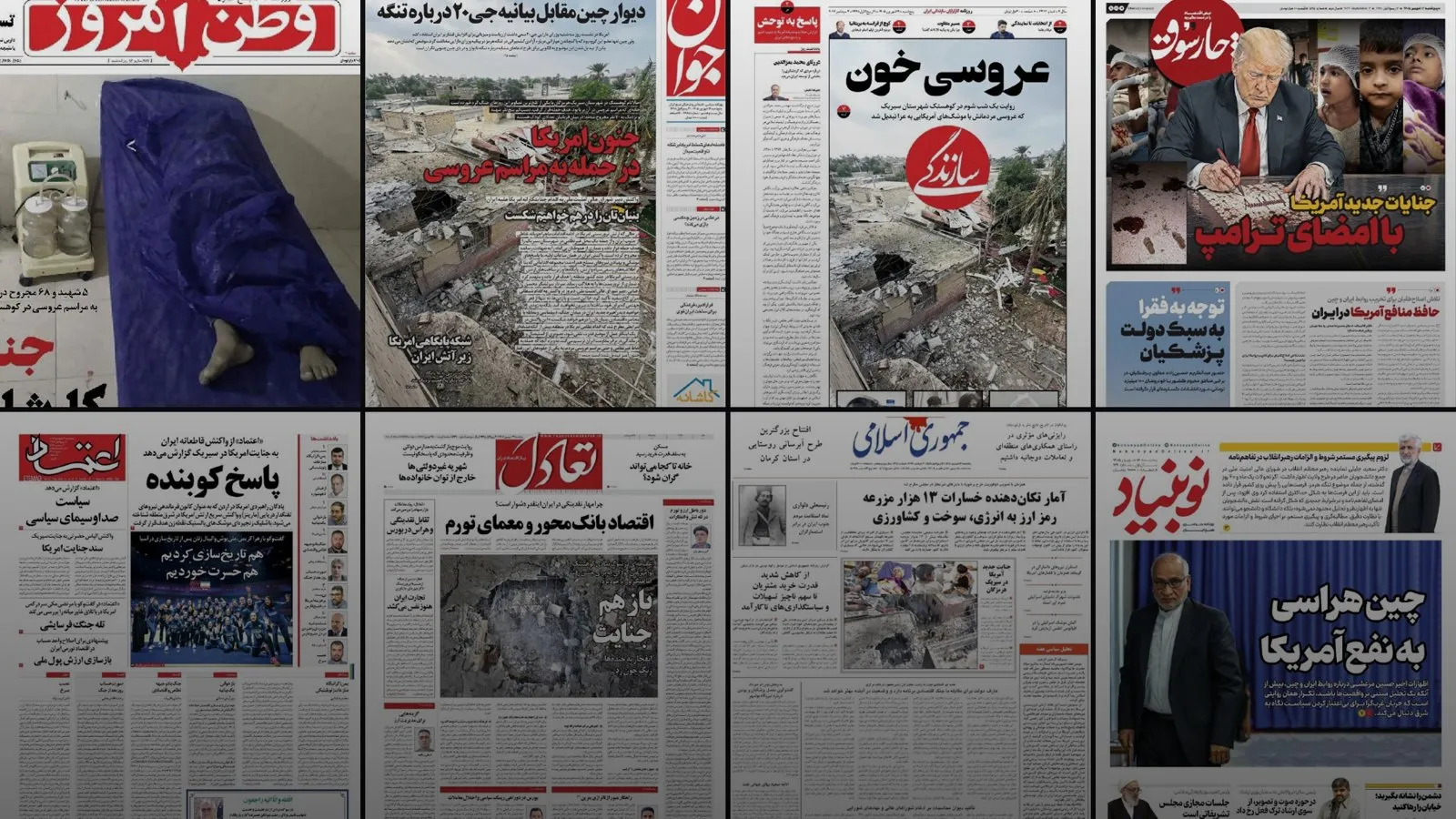
Bottom line: The Kuhestak wedding strike has collapsed the two-track posture of the last two editions into a single atrocity-and-retaliation frame across every faction, the memorandum off-ramp that the Leader was placed behind on 2 September has vanished from the pages within a day as Washington declares it expired, and the Leader’s flagship has used the moment to propose a new lever, sabotage of the Gulf’s undersea internet cables, that no official has yet endorsed. A second survey of eighteen front pages, folded in below, adds two findings. The campaign against Hossein Marashi runs across five titles and reaches, through Kayhan’s satirical column, the President and the Speaker of Parliament. And economic strain now appears on the front pages of every faction, including the hardline flagship.
Executive Summary
The lead judgment of the cycle is that a single event has unified the Iranian press across factional lines. The US strikes of the night of 1 to 2 September, the heaviest in a month, hit a house in Kuhestak in Sirik county, Hormozgan, where a wedding was under way; five people including a child were killed and more than 60 wounded, figures the international record supports. Every one of the eight scanned Persian fronts carries the strike, and the overnight retaliation on US bases in Jordan, Kuwait, Bahrain and Erbil is reported approvingly by titles that two days ago were arguing over whether a US signature was worth anything. Vatan-e Emrooz runs one photograph and one word, ‘the Kuhestak crime’; Javan calls it ‘America’s madness’; Sazandegi ‘the wedding of blood’; Chahar Sough draws Trump signing with a blood-dipped pen; and the reformist flagship Etemad leads with ‘a crushing response’, naming the ballistic-missile strike on the US garrison in Jordan as its lead fact.
The single most consequential item is what is missing. On 2 September this monitor recorded Etemad placing the sitting Leader, Mojtaba Khamenei, behind a memorandum-conditional policy and Jomhouri Eslami printing ‘Washington should return to the Islamabad memorandum’ as Iran’s proposal. Twenty-four hours later neither line appears anywhere. Secretary of State Rubio has said the memorandum ‘has expired’, the Iran newspaper channel reports it as ‘the memorandum no longer exists’, and the only Persian fronts that mention the document are hostile to it: Nobonyad attacks officials ‘still busy defending the memorandum’ while Washington calls it ‘a scrap of paper’, and prints Saeed Jalili telling students to police ‘the Leader’s conditions and requirements in the memorandum’. The off-ramp has not been argued down; it has been withdrawn from the page.
The second consequential item is Kayhan’s editorial. Hossein Shariatmadari, who has spent weeks calling the Strait a lever ‘more powerful than missiles’, today names a second lever: the roughly seven international fiber-optic cable systems on the floor of the Persian Gulf and the Strait of Hormuz, and asks ‘is it not our undeniable right’ to obstruct them, ‘by creating serious disruption in the cables’ functioning and even cutting them’, closing with a direct appeal to ‘the proud Army and IRGC’. This is advocacy by an editor, not policy, and no official has taken it up. But Kayhan’s dual-chokepoint editorial of mid-July preceded official use of that language, so the cable proposal is the priority tracking item of the edition. Its front-page headline, ‘track, identify, fire’, puts the paper in kill-chain register.
The retaliation is real in outline and unverified in detail. Sobh-e No’s channel described ‘one of Iran’s most extensive missile salvos’ on the evening of 1 September; the IRGC named Camp Titin in Jordan and US bases in Erbil; Kayhan’s channel reported explosions at US facilities in Kuwait early Thursday and the Kuwait airport suspending operations; Jordan, Kuwait and Bahrain confirmed interceptions. Javan’s claim that Iran has ended ‘access to 15 bases’ and Etemad’s precision-strike deck are Iranian claims and are logged as such. The health ministry’s own toll for the three days from 8 to 11 Shahrivar is 18 dead and 142 wounded, carried by Kayhan, Fars, Nour News and Etemad. SNSC secretary Mohsen Rezaei, in the batch’s authoritative threat text carried by Javan, promises that ‘Iran’s new strategy on the battlefield, in diplomacy and in confronting the economic blockade will shatter your foundations’, the first time the secretariat has spoken of a strategy rather than a reaction since his 9 August appointment.
Trump’s own words are the hardline lane’s second asset. His 1 September post asking ‘when are the Iranian people going to rise up and fight?’, his ‘Trump Strait’ renaming, and his claim that the US has ‘almost total control’ of Hormuz are read by Vatan-e Emrooz as ‘Trump’s return to point zero’, by Sobh-e No as ‘desperation in solving the Hormuz equation’ and ‘military attack and economic siege did not work, so he called for riots’, and by Nour News as ‘an unwitting confession of inability’. The frame converts the heaviest US strikes in a month into evidence of American exhaustion before the midterms rather than pressure on Tehran. Sobh-e No’s ‘not one barrel in 72 hours without Iran’s permission’ is the maximalist Hormuz-control claim of the batch and is contradicted by tracking data showing limited escorted transits.
The eastern-alignment thread has turned inward. Three principlist titles, Nobonyad in its lead (‘Sinophobia to America’s benefit’), Chahar Sough with an Uncle Sam hat montaged onto his photograph (‘the guardian of America’s interests in Iran’), and Javan in a column (‘whose field is Marashi playing on?’), attack Kargozaran secretary-general Hossein Marashi for claiming Beijing set four conditions for a Ghalibaf visit, a claim the office of Iran’s special representative for China has denied. China’s lone dissent from the G20 finance ministers’ Hormuz language at Asheville is offered by Javan and, tellingly, by Marashi’s own party paper Sazandegi as proof that the pivot East pays. The Bishkek summit’s only concrete deliverable, Putin-Pezeshkian talks on Bushehr and Rosatom’s interest in small reactors, is carried by Jomhouri Eslami and Iran Daily.
Two titles declined to be mobilized, and their refusal is evidence. Jomhouri Eslami leads on the grid damage from 13,000 crypto farms and places the strike mid-page as ‘America’s new crime’, printing an anti-profiteering quotation from Beheshti and a housing-collapse report; Ta’adol leads on the liquidity-and-inflation puzzle and treats Kuhestak as an elegy for a child named Amir-Ali, with housing at ‘the ceiling of purchasing power’ and private tuition beyond families’ means in its rail. Iran Daily, for foreign readers, chooses ‘sovereignty’ over ‘crime’, prints no retaliation headline, and offers an economist’s plan for surviving the US sanctions campaign through China and land routes.
Net assessment: this is a mobilization edition, not a doctrine edition. The ‘language of power’ synthesis of 2 September, in which leverage existed to be converted into terms, has been overtaken by an atrocity that every faction agrees must be answered and by a memorandum that Washington has declared dead and Tehran’s papers have stopped defending. The consequential findings are that the reformist flagship now leads with retaliation; that the Leader-anchored off-ramp has disappeared from the page rather than being contested; that the flagship editor has proposed undersea-cable sabotage as a new lever; that the pivot East is now being enforced domestically against a reformist elder; and that only the economic and establishment titles are still pricing the war rather than prosecuting it. The threads to watch are whether any official echoes the cable proposal, whether the memorandum or the Iran-Oman channel resurfaces once the retaliation cycle cools, whether the ‘15 bases’ claim is repeated or dropped, and whether Israel and Lebanon, still confined to the wires on the day of maximum escalation, return to the fronts.
Update: What the Eighteen-Front Survey Adds
Added later on 3 September. The first pass above scanned eight Persian fronts and Iran Daily. A second survey of the same morning’s papers covered sixteen Persian-language dailies and two English-language Tehran titles. The findings below extend the edition, and the earlier judgments stand except where noted. The same report’s assessment of the Hormuz and Axis of Resistance files is summarized separately in the day’s Hormuz-axis daily.
A prepared information operation, aimed outward
Sixteen of the eighteen fronts lead on the Kuhestak strike, and the imagery is the same across rival papers: a bride’s bandaged hand, a child’s body under a sheet, a cratered courtyard. The additional titles sharpen the personalization already noted on Vatan-e Emrooz and Chahar Sough. Hamshahri, the Tehran municipality’s daily, prints a bride holding a dead child under the kicker ‘Uncle Trump’s wedding gift.’ Farhikhtegan leads with a resident’s curse on Trump over a photograph of a henna-painted hand in a cast. Kayhan’s red subhead calls the attackers the child-devourers of Epstein Island, the first time this survey has seen an American domestic scandal imported into a war headline. The two English-language titles package the case for foreign pickup. Tehran Times leads with a headline built for the wires, and Kayhan International sets Kuhestak beside the 28 February strike on the Shajareh Tayyebeh school in Minab to construct a documented pattern.
Two details point to central coordination. Foreign Ministry spokesman Esmail Baghaei is quoted on Hamshahri’s front page saying the published videos are not products of artificial intelligence, which pre-empts an authenticity challenge that Washington has not yet made. At the same time, Chahar Sough illustrated its own front page with a plainly synthetic image of Trump signing in blood, which would hand US officials an easy counterexample if the two sets of images were conflated. The report judges that the uniform imagery, the instant construction of a pattern back to Minab, the English-language packaging, and the pre-emptive denial together indicate a prepared campaign directed at UN human-rights mechanisms and Western rights organizations rather than at domestic readers. Netanyahu is present but secondary. The strike is attributed to Washington alone on every front, which keeps the legal case focused on the United States, and the report reads this as a deliberate choice to hold Israel in reserve on this file.
Casualty figures printed in Tehran still vary. The Red Crescent gives four killed and 67 wounded at the wedding, Vatan-e Emrooz and Kayhan International five and 68, and the government daily Iran four and 65. The spread suggests the numbers are still being assembled from provincial sources. The health minister’s overall figure for Tuesday night is reported in the second survey as 18 killed and 108 wounded, against the three-day toll of 18 dead and 142 wounded carried by Kayhan, Fars, Nour News, and Etemad in the first pass. Both are logged as reported.
The Marashi campaign is five titles, not three
The wider survey shows the campaign against Kargozaran spokesman Hossein Marashi running simultaneously on the fronts of Farhikhtegan, Chahar Sough, Quds, Jam-e Jam, and Nobonyad, with Javan’s column and a Kayhan special box (‘Mr. Marashi, your news source is full of holes’) in support. Farhikhtegan asks whether Kargozaran serves Iran or Trump. Quds calls his remarks the repeated mistake of the elders in wartime and prints the item directly beneath its G20 lead, so that Beijing’s support and Marashi’s skepticism sit side by side. Jam-e Jam, the state broadcaster’s paper, leads on China breaking the anti-Iranian consensus and folds the ‘false statements by certain political activists’ into the same story. Synchronization on this scale points to central direction, and the report assesses that the real target is the negotiating position itself. The hardline camp is trying to foreclose the option of trading the Strait for sanctions relief before it can be tabled. KJ-6 is raised accordingly.
The memorandum argument reaches the President and the Speaker
The first pass recorded the memorandum off-ramp vanishing from the eight fronts scanned. The wider survey qualifies that finding without reversing it. The document survives in two places. Shargh’s page-one interview with Ali Motahari argues that Iran has no path except reviving the memorandum and compelling Washington to honor it, the clearest public statement of the position the hardline papers spent the day attacking. In addition, the government daily Iran and Jomhouri Eslami both carry President Pezeshkian’s account of the Bishkek summit, where he said Iran would reciprocate immediately if Washington returned to its commitments.
The hardline answer is the more significant development. Kayhan’s unsigned satirical column, Goft-o Shonud, ridicules Pezeshkian’s offer by setting it against Trump’s statements that the memorandum is dead and that what he signed was a piece of paper. It then turns on Speaker Ghalibaf for telling a Hamas official that the Strait would be opened once the Americans honor their commitments. The column closes with a folk parable about a swindler who will not pay even the man hired to denounce him. Public criticism of Ghalibaf by the Leader’s flagship indicates that the reopening question is genuinely contested inside the system, and that the Speaker has moved far enough toward a transactional position to attract attack. Nobonyad’s Jalili item and its ‘beyond a miscalculation’ piece, noted in the first pass, make the same argument in a lower key. The report judges that this internal seam is more likely to produce a change in Iranian policy than any development in the currency market.
Retaliation across five countries, and Camp Titin
The second survey adds detail to the retaliation the first pass verified only in outline. Hamshahri states that US bases in five countries were targeted on Wednesday night. Kayhan International’s lead, under the standing banner ‘Operation Punishment of the Aggressor,’ lists Jordan, Kuwait, Bahrain, Iraq, and the UAE, names the operation Ya Rasulallah, and claims a second ballistic strike on hangars housing long-range unmanned aircraft at Prince Hassan Air Base. Kayhan’s lead names Bahrain, the Emirates, Kuwait, Erbil, and Jordan, which is coercive signaling aimed at host governments rather than at Washington. Camp Titin sits at the northern end of the Gulf of Aqaba, near Jordan’s only Red Sea port and within reach of Eilat and the Saudi border. Tehran Times treats the strike as proof of a geographic expansion of Iranian options, and Etemad describes the facility as the command hub for Marine and rapid-reaction forces in the east of the region. Jordan says it intercepted ten of thirteen missiles. The IRGC claims US personnel killed and helicopters destroyed. The conflicting accounts make any damage assessment premature, and the base-count and casualty claims remain single-source Iranian claims. Shargh makes the political point openly: repeated strikes expose the gap between the Jordanian government’s dependence on Washington and Jordanian public opinion. Army commander Amir Hatami’s warning of a response several times stronger, on Kayhan International’s masthead, and Yemen’s foreign ministry pledge to stand by Iran, given front-page placement on the same title, complete the official layer.
Economic strain is now on every faction’s front page
The first pass found the economic titles refusing mobilization. The wider survey shows the strain reaching the front pages of every faction, including the hardline flagship. Kayhan opens its own front page with the Energy Ministry answering complaints about abnormal electricity bills, the day’s clearest sign that consumer grievance has reached the hardline press. ISNA, citing Shargh, documents long gasoline queues across Tehran, and Shargh’s editorial, ‘Petrol and Benz,’ is written by former vice president Mostafa Hashemi-Taba. Iran reports parliament approving a double-urgency measure against unlicensed crypto mining, the same 13,000 farms that lead Jomhouri Eslami. Jam-e Jam runs the expansion of the food-coupon subsidy as a promise deferred. Quds reports that half of Iran’s insurance companies have been warned of suspension. Etemad carries a proposal to redenominate the currency, a debate that historically surfaces when inflation expectations become unmanageable. First Vice President Aref’s assurance that essential goods will be supplied under any circumstances runs in the government daily. Behind the fronts, the free-market dollar stood at about 221,000 tomans on 2 September, a fall of roughly ten percent in a week, and Hamshahri’s economic lead carries major banks forecasting $120 crude.
The report’s assessment is that economic pain is deepening faster than any political evidence of collapse. Kayhan printing electricity complaints beside its war coverage suggests the system judges the cost of ignoring these grievances to be higher than the cost of acknowledging them. There is still no observable transmission chain. The survey finds no sustained mass mobilization, no elite defection, no security-force disobedience, and no visible inability to pay coercive institutions. The indicators to watch instead are wage arrears, rationing changes, and provincial protest.
Hormuz through the fronts
The press treatment of the Strait tracks the operational picture the Hormuz-axis daily covers in full. Javan and Quds both lead on Beijing’s refusal to accept freedom-of-navigation language at the G20 finance ministers’ meeting in Asheville, which closed without a communiqué, and Jam-e Jam and Tehran Times feature the same outcome. Javan links the Chinese position to concern about a Taiwan Strait precedent. Tehran Times gives front-page placement to the IRGC claim that two tankers were disabled by sea mines after being escorted through an unauthorized route, and Kayhan’s lead adds that the Guards will also take revenge for the mine incident. Vatan-e Emrooz’s report on the myth of zero oil sales and Javan’s note on the gap between American claims of control and the reality on the ground continue the falsification frame recorded in the first pass. Kayhan International markets the European energy shock, with Dutch gas above 75 euros per megawatt hour for the first time since January 2023, directly to European readers.
Update: What the Economic Press Adds
Added later on 3 September from a review of the same morning’s economic dailies. Monaghesat, Jahan-e Sanat, Donyaye Eghtesad, Eghtesad Melli, and Afkar were read from their front pages, and Taadol and Arman Emrooz were located online. The eighteen-front survey above found economic strain reaching every faction’s front page. The economic press explains how that strain is being transmitted and who is arguing over the response.
The rial as the organizing fact
The economic press converges on a single diagnosis. Sanctions, renewed military risk, and maritime disruption are now being transmitted through the exchange rate into prices, working capital, trade finance, and household purchasing power. Mehr’s morning roundup characterizes the day’s economic coverage as focused on volatility in the currency market, and Monaghesat gives the market signal its starkest form with a front page reporting the dollar above 220,000 tomans. The review treats that headline less as a precise tick than as a statement of confidence. The free-market rate has become a compressed indicator of expectations about sanctions enforcement, access to export earnings, war duration, and the government’s fiscal position. Eghtesad Melli takes the next step by asking whether Iran is one step from triple-digit inflation. The review cautions that the headline should not be read as evidence that nationwide inflation is already above 100 percent. It reflects an environment in which food inflation has entered triple digits in some measures, some provincial point-to-point readings have crossed 100 percent, and the rial’s decline is feeding expectations of a broader acceleration. Official rhetoric reinforces the sense of constraint. Executive Vice President Mohammad Jafar Ghaempanah has publicly acknowledged that the budget is unbalanced and that the state is forced to create money, while blaming banking-system imbalances for a large share of inflation. That admission narrows the credibility gap between critical commentary and official diagnosis, even though it has not produced a stabilization program.
Adaptation under tighter sanctions and maritime pressure
Iranian economic commentary does not describe sanctions as having stopped commerce. It describes a more expensive, slower, and riskier trading system. Taadol’s report, headlined to say that Iran’s trade is still breathing, argues that war and sanctions have raised shipping, insurance, and transfer costs without halting foreign trade. It prescribes greater reliance on neighboring markets, routes such as Dayyer to Qatar, regional agreements, alternative payment systems, and reduced dependence on intermediary currencies. Afkar pairs a security headline on a new phase of the war with a large feature asking whether a maritime blockade can become an economic opportunity. Its answer is accelerated East-West and North-South rail and road corridors, stronger links through Central Asia, and more border terminals, so that disruption in the Persian Gulf does not paralyze external trade. Current coverage also points to the easing of some import-order restrictions for basic goods and production inputs, which the review reads as classic wartime allocation. Food, feed, medicine, and industrial raw materials come first, at the cost of tighter controls elsewhere.
The same scarcity is producing heavier enforcement. Jahan-e Sanat’s main economic headline, on a currency lock on exports, describes private exporters facing suspended commercial cards, judicial referrals, and pressure over the repatriation of export earnings. The state’s goal is to capture scarce foreign exchange. The commercial effect can be self-defeating if it reduces the incentive or the ability of private exporters to sell abroad. System-aligned commentary, meanwhile, increasingly frames the economy as a wartime system requiring unified command and real-time monitoring of currency, energy, strategic goods, production dependencies, and alternative supply routes. That approach falls short of full state control, but it expands the role of security-style coordination in economic decision-making.
Four competing economic logics
The review reads the day’s press as a contest among four policy logics rather than as a single strategy. An emergency-management camp treats sanctions and maritime pressure as an economic war and favors centralized coordination, strategic stock management, route diversification, and state protection of economic chokepoints. Its political advantage is that it fits the security environment and requires no external de-escalation as a precondition. The technocratic government acknowledges severe fiscal and banking imbalances and the need for energy-price, banking, and exchange-rate reform. However, senior officials themselves say durable reform is difficult in a society exposed to continuing war risk, which leaves the government trapped between reform rhetoric and emergency financing. The private-sector and business press, with Jahan-e Sanat as its clearest voice, accepts the need to earn and repatriate foreign exchange but argues that unpredictable rules, suspended cards, multiple exchange rates, and administrative enforcement are damaging the exporters and producers the state needs. De-escalation-first reformers, represented by Arman Emrooz, argue that banking and fiscal repair will remain incomplete until military tension is reduced and sanctions relief becomes possible. The review judges this last position to be the most politically consequential challenge to the emergency-management model, because it links economic stabilization to a change in the external environment. It is the economic counterpart of the memorandum argument that Shargh’s Motahari interview carries on the political pages. The balance currently favors emergency management, since the external threat gives the state a strong rationale for centralized allocation. At the same time, the economic press shows a widening coalition of technocrats, business associations, and market-oriented economists arguing that controls are becoming part of the problem. Their leverage will grow if the rial keeps weakening and if shortages increasingly reflect financing and regulation rather than physical scarcity.
Sectoral pressure points
Donyaye Eghtesad’s main warning concerns medicine. Exchange-rate reform in pharmaceuticals can raise the cost of imported inputs and working capital while insurers are already late in paying pharmacies, so that medicine may exist in the national inventory while pharmacies lack the liquidity to replenish stocks. The review flags this gap between inventory and patient access as the clearest example of adaptation costs turning social. Eghtesad Melli’s secondary headlines describe mining as under a multi-sided siege, and broader industry coverage stresses energy constraints, financing, and logistics. Business outlets are tracking a sharp dollar impact on lower-end smartphones and a doubling of vehicle prices over the past year. The Tehran Stock Exchange ended a 20-session rally as renewed fighting in southern Iran increased risk and encouraged profit-taking, another sign that domestic asset pricing is highly sensitive to escalation even when the authorities maintain nominal market functioning. Above all, the press increasingly distinguishes between the availability of goods and the ability to buy them. The state can claim success if shelves remain stocked while households experience a real shortage through collapsing purchasing power.
The review’s bottom line is resilience without normalization. Iran’s economic press is not describing imminent collapse. It is describing a system that is adapting under increasingly unfavorable terms, through more expensive routes and more complicated payment arrangements, with tools that impose growing costs on the private sector. The rial’s decline is turning those institutional frictions into a broader inflation and legitimacy problem. The sequencing question, whether to tighten controls first, reform the domestic system first, or reduce external tension first, is becoming the central economic-political contest inside Iran.
Key Points
- KJ-1 [HIGH] The Kuhestak wedding strike has unified the Iranian press into a single atrocity-and-retaliation frame, closing the two-track posture of the previous two editions for this cycle. Evidence: all eight scanned Persian fronts carry the strike; the reformist flagship Etemad leads with ‘a crushing response’ naming the ballistic-missile strike on the US garrison in Jordan, Javan with ‘America’s madness’, Vatan-e Emrooz with ‘the Kuhestak crime’, Sazandegi with ‘wedding of blood’ and Chahar Sough with Trump signing in blood; SNSC secretary Mohsen Rezaei’s ‘shatter your foundations’ supplies the official text. Significance: when the reformist and hardline titles carry the same retaliation approvingly, the intra-system argument over leverage-for-terms is suspended; understating this convergence would miss the moment at which the diplomatic lane lost its own newspapers.
- KJ-2 [HIGH] The memorandum off-ramp printed on 2 September has been withdrawn from the page within a day, and the document now survives on the fronts only as a target. Evidence: Rubio’s statement that the memorandum ‘has expired’ is relayed by the Iran newspaper channel; Etemad’s Leader-anchored ‘fulfillment of the memorandum’s conditions’ and Jomhouri Eslami’s ‘return to the Islamabad memorandum’ do not recur; Nobonyad attacks officials ‘still busy defending the memorandum’ and prints Jalili turning the Leader’s ‘conditions and requirements’ into obligations to be policed; Sobh-e No names the Iran-Oman track instead. Significance: the Leader’s authority, cited yesterday for fulfilling the memorandum, is cited today for enforcing its conditions, which shows the authority is being read by factions rather than exercised in print; the off-ramp’s return, if any, will most likely come first through the Oman channel or through Jomhouri Eslami. Second-pass qualification: on the wider eighteen-front survey the off-ramp survives on Shargh’s front, in the Motahari interview, and in the President’s own Bishkek remarks as carried by Iran and Jomhouri Eslami, so it has narrowed to one reformist title and the government’s own account rather than disappeared. The more significant new evidence is Kayhan’s satirical column ridiculing both Pezeshkian and Ghalibaf for treating the memorandum as live, which shows the reopening question contested at the top of the system. Confidence unchanged.
- KJ-3 [MODERATE-HIGH] Kayhan’s managing editor has extended the Hormuz-coercion doctrine from navigation to infrastructure by publicly calling on the Army and IRGC to disrupt or cut the Gulf’s undersea internet cables. Evidence: the Yadasht-e Rooz ‘The cables are waving at us’ names roughly seven cable systems, calls their obstruction Iran’s ‘undeniable right’, answers the legal objection with the wedding dead and the assassinated Leader, and closes with a direct appeal to the armed forces. Significance: this is advocacy by an editor and no official has endorsed it, so overstating it as policy would inflate the signal; but Kayhan’s mid-July dual-chokepoint editorial preceded official use of that language, so any echo by a commander, the SNSC or the Majlis national-security committee should be treated as an escalation of the highest order.
- KJ-4 [MODERATE-HIGH] The overnight retaliation is real in outline and inflated in detail, and the papers’ specificity is not evidence of damage. Evidence: the IRGC’s Camp Titin and Erbil claims, Kayhan’s Kuwait explosions and airport suspension, and the host governments’ interception reports establish that a multi-country salvo occurred; Javan’s ‘access to 15 bases ended’, Etemad’s precision-strike deck and the ‘killed a number of terrorists’ line are single-source Iranian claims; the confirmed Iranian toll is the health ministry’s 18 dead and 142 wounded over three days. Significance: Rezaei’s promise of a ‘new strategy’ spanning battlefield, diplomacy and blockade is the first strategic language from the secretariat since his 9 August appointment and should be tracked for content; the ‘15 bases’ figure should be watched for repetition or quiet withdrawal.
- KJ-5 [MODERATE] The hardline lane is converting Trump’s own posts into proof of American failure, a more durable morale narrative than battle-damage claims. Evidence: Vatan-e Emrooz’s ‘return to point zero’, Sobh-e No’s ‘desperation’ editorial and ‘siege did not work, so he called for riots’, Nour News’s ‘unwitting confession of inability’ on the ‘Trump Strait’ renaming, and the Vatan-e Emrooz channel’s mockery all rest on confirmed Trump statements (‘when are the Iranian people going to rise up’, ‘almost total control of the Hormuz Strait’). Significance: as with last edition’s use of the Driscoll resignation, the events are real and the causal reading is the outlets’ inference, not adopted here; Sobh-e No’s ‘not one barrel in 72 hours’ is contradicted by tracking data and marks the ceiling of the control claim.
- KJ-6 [MODERATE-HIGH, raised on the second pass] The pivot East is now being enforced domestically through a coordinated principlist campaign against a reformist elder, with China’s G20 dissent as the proof text. Evidence: Nobonyad’s lead ‘Sinophobia to America’s benefit’, Chahar Sough’s Uncle Sam montage captioned ‘the guardian of America’s interests in Iran’, and Javan’s ‘whose field is Marashi playing on?’ target Hossein Marashi for a denied claim of four Chinese conditions; Javan and Sazandegi both present Beijing’s lone G20 objection as vindication; Jomhouri Eslami and Iran Daily carry the Bishkek Bushehr and Rosatom items. Significance: three titles on one day indicate coordination rather than one paper’s polemic, and Sazandegi’s praise of Beijing without a defense of its own secretary-general suggests the campaign is working; the East’s deliverable remains nuclear-energy cooperation, not a security commitment. Second-pass evidence: the campaign runs on five fronts (Farhikhtegan, Chahar Sough, Quds, Jam-e Jam, and Nobonyad) with Javan’s column and a Kayhan box in support, which the report reads as central direction aimed at the negotiating position itself.
- KJ-7 [LOW-MODERATE] Negative-evidence finding: Israel and Lebanon stay off the fronts on the day of maximum escalation, and no fresh Leader message appears despite foreign reports of one. Evidence: the only Israel items on the fronts are foreign-press pieces on Jomhouri Eslami (French settler-violence remark, German missile test); the Lebanon material (Israeli strikes on Nabatieh al-Fawqa, Hezbollah’s denial of a security-cell link, Nujaba’s 30 September ultimatum in Iraq, Trump’s ‘Israel shouldn’t worry’) runs only on the Vatan-e Emrooz and Fars channels; the ‘unforgettable lessons’ line reported abroad as a new Leader statement is, on Defa Press’s own posting, the 17 July text. Significance: the Israel-Lebanon front is being held off the page even while the wires carry it, so its return to a lead would be a deliberate editorial elevation; and the absence of a Leader message on the largest single-day loss of civilian life in weeks is itself a finding, consistent with the pattern of the Leader appearing through intermediaries (Jalili, Shariatmadari’s ‘present Imam’) rather than in his own voice.
- KJ-8 [HIGH, added on the second pass] The Kuhestak strike has been converted into a coordinated international legal and humanitarian campaign aimed well beyond the domestic audience. Evidence: sixteen of eighteen fronts lead on the strike with identical imagery; Tehran Times and Kayhan International carry the case in English; Kayhan International and Hamshahri build a documented pattern back to the Minab school strike of 28 February; Foreign Ministry spokesman Baghaei pre-empts the argument that the footage is synthetic; the strike is attributed to Washington alone on every front. Significance: the reputational risk to Washington is real and largely independent of the underlying targeting facts, and submissions to UN human-rights mechanisms and outreach to Western rights organizations should be expected within days. Chahar Sough’s synthetic Trump illustration is the campaign’s one self-inflicted vulnerability.
- KJ-9 [HIGH, added on the second pass] Domestic economic distress is now visible on front pages across the factional spectrum, including hardline and government-aligned titles. Evidence: electricity billing complaints on Kayhan’s front, gasoline queues documented by ISNA and Shargh, a redenomination proposal in Etemad, insurance suspension warnings in Quds, the deferred food-coupon expansion in Jam-e Jam, and Aref’s reassurance in Iran, against a rial near 2.2 million to the dollar after a fall of roughly ten percent in a week. Significance: pain is deepening faster than any political evidence of collapse, and the transmission chain Washington would need (mass mobilization, elite defection, security-force disobedience, inability to pay coercive institutions) has no observable link yet; wage arrears, rationing changes, and provincial protest are the indicators to track.
- KJ-10 [HIGH, added on the second pass] Iranian retaliation is now explicitly multi-country and repeatable, and the Camp Titin strike extends the demonstrated reach to the Red Sea approaches. Evidence: Hamshahri, Kayhan, and Kayhan International describe combined missile and drone waves against US positions in Jordan, Kuwait, Bahrain, Iraq, and the UAE; Kuwait reported overnight interceptions; Jordan says ten of thirteen missiles were intercepted; the claimed strike on Prince Hassan Air Base and the IRGC’s casualty claims are single-source. Significance: the report judges the pattern to be calibrated to demonstrate reach while avoiding a mass-casualty event that would justify a decisive US escalation, and the political effect on host governments matters more than the physical damage, which cannot yet be assessed.
- KJ-11 [MODERATE-HIGH, added with the economic press review] The exchange rate has become the mechanism through which military and diplomatic developments immediately alter domestic political pressure, and the internal argument is now over sequencing rather than over whether sanctions bite. Evidence: Monaghesat’s dollar above 220,000 tomans and Eghtesad Melli’s triple-digit inflation question on the fronts; Ghaempanah’s acknowledgment of an unbalanced budget financed by money creation; Jahan-e Sanat’s account of suspended commercial cards and judicial referrals for exporters; Arman Emrooz’s argument that structural reform is impossible without easing external tensions; the end of the Tehran Stock Exchange’s 20-session rally on renewed fighting. Significance: the review describes adaptation at rising cost rather than collapse, which is consistent with KJ-9, and the leverage of the technocratic and business critics of emergency management will grow if shortages come to reflect financing and regulation rather than physical scarcity. The triple-digit inflation headline is a warning about food and provincial readings rather than a nationwide figure and should not be reported as one.
Macro Trends
- One atrocity, one frame, every faction. All eight scanned Persian fronts carry the Kuhestak wedding strike, and the retaliation is reported approvingly across the spectrum: Vatan-e Emrooz’s ‘the Kuhestak crime’, Javan’s ‘America’s madness’, Sazandegi’s ‘wedding of blood’, Chahar Sough’s blood-pen Trump, and above all Etemad’s ‘crushing response’ lead naming the Jordan garrison strike. The two-track posture the last two editions tracked, deterrent claim on one page and memorandum-conditional diplomacy on another, has collapsed into a single track for this cycle. The differences that remain are of register (elegy on Ta’adol, kill-chain on Kayhan), not of direction.
- The memorandum off-ramp vanishes from the page in a day. Rubio’s statement that the memorandum ‘has expired’, relayed by the Iran newspaper channel as ‘the memorandum no longer exists’, coincides with the disappearance of every pro-memorandum line printed on 2 September. Etemad’s Leader-anchored ‘fulfillment of the memorandum’s conditions’ and Jomhouri Eslami’s ‘Washington should return to the Islamabad memorandum’ do not reappear. The document survives on the fronts only as a target: Nobonyad’s ‘beyond a miscalculation’ attacks officials still defending ‘a scrap of paper’, and Jalili’s banner turns the Leader’s ‘conditions and requirements’ into obligations for students to police. Sobh-e No names the Iran-Oman negotiations as the live channel instead.
- Kayhan proposes a second Hormuz lever: the undersea cables. Shariatmadari’s Yadasht-e Rooz moves from shipping to infrastructure: roughly seven international fiber-optic systems on the Gulf floor, ‘the backbone of the global internet’, whose disruption or cutting he calls Iran’s ‘undeniable right’ and a duty of reciprocity for the wedding dead and the assassinated Leader, addressed explicitly to ‘the proud Army and IRGC’. Continuing the standing Hormuz-as-coercion thread from the dual-chokepoint editorial of mid-July, this is the thread’s first extension beyond navigation. It is advocacy, not policy; whether any official echoes it is the edition’s priority tracking cue.
- Retaliation reported in kill-chain register, verified in outline only. Kayhan’s ‘track, identify, fire’, Etemad’s precision-ballistic deck on Camp Titin, Javan’s ‘network of US bases under Iran’s fire’ with ‘access to 15 bases ended’, and the IRGC’s Erbil claim carried by Fars describe the overnight response; Jordan, Kuwait and Bahrain confirmed interceptions and Kuwait’s airport suspended operations. SNSC secretary Mohsen Rezaei’s ‘new strategy’ that ‘will shatter your foundations’ gives the cycle its official threat text. The base count and casualty claims remain single-source Iranian claims; the confirmed Iranian toll is the health ministry’s 18 dead and 142 wounded over three days.
- Trump’s ‘rise up’ and ‘Trump Strait’ posts harvested as proof of failure. Vatan-e Emrooz’s ‘Trump’s return to point zero’, Sobh-e No’s ‘desperation in solving the Hormuz equation’ and ‘siege did not work, so he called for riots’, Nour News’s ‘unwitting confession of inability’, and the Vatan-e Emrooz channel’s obscene mockery of the renaming all read the US president’s own words as an admission that strikes and blockade have not moved Tehran. The frame lets the hardline lane present the heaviest US strikes in a month as American exhaustion before the midterms. Sobh-e No’s ‘not one barrel in 72 hours’ is the batch’s maximal Hormuz-control claim and is contradicted by transit data.
- The pivot East is enforced at home: the Marashi campaign. Nobonyad’s lead, Chahar Sough’s Uncle Sam montage and Javan’s column converge on Kargozaran secretary-general Hossein Marashi for his denied claim of four Chinese conditions on a Ghalibaf visit, branding China skepticism as service to America. China’s G20 dissent on Hormuz is the campaign’s proof, offered by Javan and by Marashi’s own party paper Sazandegi. The Bishkek summit’s one concrete item, Putin-Pezeshkian talks on Bushehr and Rosatom’s small-reactor interest, is carried by Jomhouri Eslami and Iran Daily, answering last edition’s question of whether the East would deliver anything with a nuclear-energy line rather than a security one.
- The titles that refused mobilization still price the war. Jomhouri Eslami leads on 13,000 crypto farms and the grid, boxes Beheshti against wartime profiteering, and reports a housing market of collapsed purchasing power; Ta’adol leads on the liquidity-and-inflation puzzle with housing at the purchasing-power ceiling, unaffordable private tuition and a fearful bourse in the rail; Chahar Sough keeps a jab at a vice president’s 100-billion-toman convoy on its atrocity page. The domestic-cost lane flagged in prior editions holds its space even on the day of maximum escalation, and Ta’adol’s decision to print no retaliation item is the clearest negative evidence that the economic press has not been enrolled.
- Second pass: the war’s cost reaches every faction’s front page, and the price of any deal is being fought over in public. The eighteen-front survey qualifies the previous bullet. The economic titles still lead on markets, but the strain now appears on Kayhan (electricity bills), Shargh (gasoline queues and the ‘Petrol and Benz’ editorial), Iran (the crypto-mining measure and Aref’s reassurance), Jam-e Jam (the deferred food coupon), Quds (insurers facing suspension), and Etemad (redenomination). At the same time, the five-title campaign against Marashi and Kayhan’s ridicule of the President and the Speaker show that the terms of any future memorandum, and whether the Strait can be traded for sanctions relief at all, are being contested on the front pages while the war continues.
Front-Page Snapshot
- Vatan-e Emrooz - “The Kuhestak Crime” (Hardline / principlist) - Wedding strike as war crime; Trump’s ‘rise up’ post as ‘return to point zero’ [HIGH]
- Javan - “America’s Madness in Attacking a Wedding Ceremony” (Hardline, IRGC-affiliated) - Rezaei’s ‘shatter your foundations’; ‘15 bases’ retaliation claim; China’s G20 dissent [HIGH]
- Etemad - “A Crushing Response” (Reformist) - Reformist flagship leads with the Jordan garrison strike; no memorandum off-ramp [MODERATE-HIGH]
- Sazandegi - “Wedding of Blood” (Reformist / Kargozaran) - Human-interest atrocity narrative; Beijing’s G20 ‘no’ praised [MODERATE]
- Chahar Sough - “America’s New Crimes, Signed by Trump” (Economic, principlist-leaning) - Trump personally indicted; Marashi as ‘guardian of US interests’ [MODERATE-HIGH]
- Kayhan - “Track, Identify, Fire! Iran’s Blow to the American Terrorists” (Ultra-hardline flagship) - Retaliation as kill-chain; editorial advocacy of undersea-cable sabotage [SEVERE]
- Sobh-e No - “Trump’s Desperation in Solving the Strait of Hormuz Equation” (Principlist) - US exhaustion thesis; ‘not one barrel in 72 hours’; Oman track as live channel [MODERATE-HIGH]
- Nobonyad - “Sinophobia to America’s Benefit” (Principlist) - Marashi attacked; Jalili on the Leader’s memorandum ‘conditions’; memorandum defenders ‘beyond miscalculation’ [MODERATE-HIGH]
- Jomhouri Eslami - “Shocking Statistics on the Damage of 13,000 Crypto Farms” (Traditional / establishment) - Grid damage lead; Sirik as ‘new crime’; Putin-Bushehr deliverable [MODERATE]
- Ta’adol - “A Bank-Centered Economy and the Inflation Puzzle” (Economic / business) - Liquidity and inflation; housing and tuition; Kuhestak as elegy [LOW-MODERATE]
- Iran Daily - “Iran reaffirms willpower to defend sovereignty after renewed US attacks” (Official English-language daily) - Sovereignty framing for foreign readers; economic diversification via China [MODERATE]
Added from the eighteen-front survey:
- Farhikhtegan - “Damn You and Your Uncles” (Principlist, Azad University) - Survivor’s curse as lead; ‘Titin under TNT’; US censorship office; Kargozaran ‘Iran’s or Trump’s?’ [HIGH]
- Hamshahri - “Sirik’s Small Wedding, Iran’s Great Mourning” (Tehran municipality daily) - Most composed image of the day; Baghaei’s denial that the footage is AI; five-country retaliation; $120 oil forecast [HIGH]
- Iran - “A Trail of Blood at the Port Wedding” (Official government daily) - Pattern framing from Minab and Lamerd; Pezeshkian’s Bishkek gains; Aref on essential goods; crypto-mining measure [MODERATE]
- Shargh - “A Wedding of Blood” (Reformist) - Motahari interview arguing for reviving the memorandum; gasoline editorial; Jordan ‘under pressure and at the front’ [MODERATE-HIGH]
- Quds - “Washington’s Exhibition of Divergence” (Traditional principlist, Mashhad) - G20 without a communiqué as lead; Marashi attacked beneath it; half of insurers warned [MODERATE-HIGH]
- Jam-e Jam - “China Broke the Anti-Iranian Consensus” (State broadcaster daily) - G20 lead folds in the anti-Marashi line; ‘regret in the Oval Office’; food coupon deferred [MODERATE-HIGH]
- Haft-e Sobh - “Kuhestak’s Joy Drowned in Blood” (Popular social daily) - Eyewitness account paired with a consumer-market investigation [LOW-MODERATE]
- Tehran Times - “They Came for a Wedding Dance, Trump Gave Them the Dance of Death” (English-language daily) - Wire-ready packaging; Camp Titin analysis; sea-mine claim; ICCIMA on trade under siege [MODERATE-HIGH]
- Kayhan International - “Heavier, Broader, More Devastating: Iran Unleashes Hell on U.S. Forces” (English-language hardline daily) - Five-country retaliation with Minab pattern; European energy shock marketed to Europe; Yemen’s pledge [HIGH]
Added from the economic press review:
- Monaghesat - “The Dollar Crossed 220,000 Tomans” (Economic daily) - Market pricing continued sanctions and political risk faster than stabilization measures can absorb [MODERATE-HIGH]
- Jahan-e Sanat - “Currency Lock on Exports” (Economic / private-sector) - Exporters facing suspended commercial cards and judicial referrals over repatriation rules; economic policy set beside visible war damage [MODERATE-HIGH]
- Donyaye Eghtesad - “The Double-Edged Sword of the Drug Market” (Economic / business) - Exchange-rate reform and insurer arrears threatening pharmacy liquidity and access to medicine [MODERATE]
- Eghtesad Melli - “One Step to Triple-Digit Inflation?” (Economic daily) - Near-crisis inflation framing; mining under siege; currency, logistics, energy, and financing pressure at once [MODERATE-HIGH]
- Afkar - “Iran and the Great Trade Test” (Principlist-leaning daily) - New phase of the war beside a feature on turning the maritime blockade into a land-corridor opportunity [MODERATE]
What to Watch
- Whether any official, commander, or Majlis committee echoes Kayhan’s undersea-cable proposal. This remains the edition’s priority tracking item.
- Whether the anti-Marashi campaign widens into direct attacks on Pezeshkian or Ghalibaf in more than one title. Kayhan alone is satire. Two or three titles naming the Speaker would signal a genuine move against the reopening option.
- Whether the memorandum or the Iran-Oman channel resurfaces once the retaliation cycle cools, and whether any exchange through Pakistan, Oman, or Qatar introduces an actual bargaining formula.
- Whether the Kuhestak file reaches formal international mechanisms, such as a UN special rapporteur statement, a Human Rights Council submission, or a position from a major Western rights organization, and whether Washington disputes the authenticity of the imagery.
- Whether Iran repeats strike waves against Kuwait, Bahrain, Jordan, the UAE, or Iraq, whether host governments report casualties or infrastructure damage, and whether the ‘15 bases’ claim is repeated or dropped.
- The free-market rial. A sustained move materially beyond 2.2 million per dollar would indicate accelerating loss of confidence. Alongside it, whether gasoline congestion spreads, rationing changes, and whether reformist and economic papers sharpen their criticism of government management.
- Hormuz enforcement. Whether Iran detains, fines, or seizes a vessel from the 56-ship list would matter more than further additions. Brent approaching $100 and Asian LNG holding above $23 per mmBtu would sharpen pressure on Washington and its allies.
- The Axis. Any Naim Qassem speech or formal Hezbollah response to the Lebanese security allegations; whether Kataib Hezbollah or Asaib Ahl al-Haq endorse Nujaba’s 30 September deadline; any new Houthi claim against shipping or Saudi facilities.
- Whether Israel and Lebanon return to the fronts from the wires, which would be a deliberate editorial elevation.
- Any Treasury, OFAC, or FinCEN action against a major foreign bank, airline, or shipping company, which would test Rubio’s secondary-sanctions threat.
- Foreign-exchange enforcement against exporters. Whether the Central Bank widens suspensions of commercial cards and judicial referrals over repatriation, and whether business associations escalate their objections in print.
- Pharmacy liquidity. Whether insurer arrears and exchange-rate reform in pharmaceuticals produce reported gaps between national medicine inventory and patient access.
- Whether the government eases import-order restrictions further or formalizes centralized economic command, which would show which of the four policy logics is winning the sequencing debate.
Full report
The complete edition - per-paper front-page analysis and full translation appendices - is available as a PDF: Download the full report.
Compiled from Iranian front pages and outlet channels via open-source monitoring. Translations are editorial; named-figure attributions are verified against the source pages where possible. Updated on 3 September with a second survey of the same edition covering sixteen Persian-language dailies and two English-language Tehran titles, which contributed the Update section, KJ-8 to KJ-10, the additional front-page entries, and the What to Watch indicators. Updated again on 3 September with a review of the day’s economic dailies, which contributed the economic press section, KJ-11, the economic front-page entries, and three further What to Watch indicators.