Iranian Press Monitor - Monday, 13 July 2026 (Day 132)
Monday, 13 July 2026 · 22 Tir 1405 · 28 Muharram 1448 - nine Persian front-page scans (Hamshahri, Vatan-e Emrooz, Kayhan, Javan, Sobh-e No, Sazandegi, Chaharsoo, Ta’adol, Etemad), one English print (Iran Daily, 12 July), six outlet Telegram channels (Kayhan, Vatan-e Emrooz, Jam-e Jam, Etemad, Iran, Sobh-e No), with international corroboration; Tehran Times and kayhan.ir were unavailable at the time.
Executive Summary
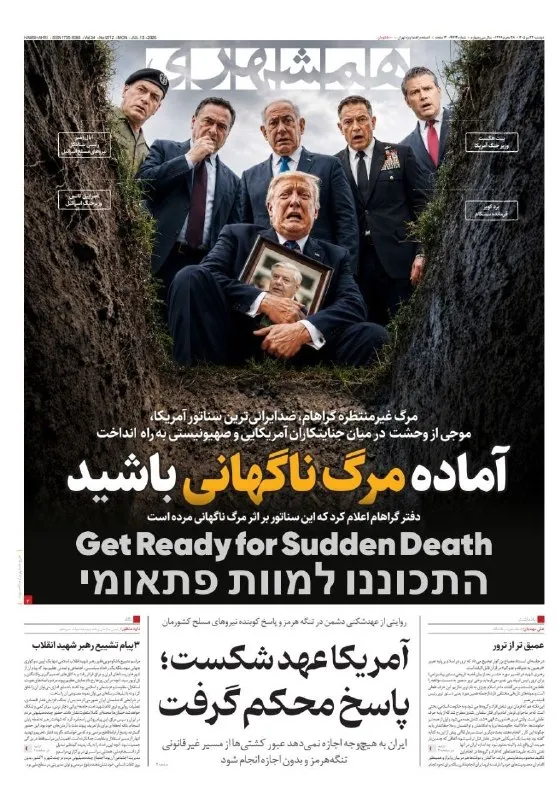
Day 132 is dominated by a single death and a single chokepoint. The sudden death of US Senator Lindsey Graham, one of Washington’s most prominent Iran hawks and a close ally of Netanyahu, has been seized across the Iranian press as apparent proof that the successor Leader’s vengeance threat is already coming true. The highest-significance point is interpretive rather than factual: Graham died of natural causes (preliminary cause aortic dissection, per the DC medical examiner and Western reporting), yet nearly every front, from centrist Hamshahri and the hardline Kayhan and Vatan-e Emrooz to reformist Sazandegi, folds the loss into Mojtaba Khamenei’s funeral-day vow that the ‘criminals’ on Iran’s list will never die peacefully in bed. Hamshahri’s trilingual splash ‘Get Ready for Sudden Death,’ printed in Persian, English and Hebrew over an image of Trump in an open grave, is the day’s defining artifact; Kayhan’s ‘Iran has updated its target bank’ makes the list imagery explicit.
Beneath the triumphalism, the war itself has not paused. The 17 June ceasefire remains collapsed: the IRGC’s closure of the Strait of Hormuz ‘until further notice’ holds, the US has carried out further strikes on Iranian positions (both corroborated internationally), and the strait is the organizing story for the economic and IRGC-aligned press alike, from Javan’s ‘sails of power raised in the Iranian strait’ to Etemad’s ‘the power of Hormuz.’ Chaharsoo prints the epitaph plainly again: ‘the end of the paper agreement with America.’ Running underneath is the same two-track posture the monitor has tracked all week: Foreign Minister Araghchi was in Muscat on 11 July pressing ‘mutual compliance’ on the MoU with Oman’s foreign minister, and Speaker Ghalibaf frames the rupture as the end of ‘one-sided agreements’ rather than the end of all diplomacy, while the state broadcaster’s paper quietly concedes a 4,200-megawatt cut to the national grid from the strikes.
The ideological split is intact but narrower than usual: the day’s story is unifying. Hardline titles (Kayhan, Vatan-e Emrooz, Javan) render Graham’s death and Hormuz as vindication and divine retribution; reformist titles (Sazandegi, Etemad) accept the same facts but strip out the celebration, with Sazandegi’s editorial pressing for ‘legal follow-up’ over vengeance and Sobh-e No’s note warning that ‘the end must not justify the means.’ The economic press (Chaharsoo, Ta’adol) reads the crisis through leverage and market stress. What no outlet disputes is that a leading architect of pressure on Iran is dead and that Hormuz is, for now, Tehran’s to close.
Key Judgments
- HIGH - Graham’s death is real and corroborated, but the ‘vengeance fulfilled’ framing is propaganda, not evidence of an Iranian operation. Western reporting and the DC medical examiner attribute the 11 July death to aortic dissection; the near-uniform Iranian read that it validated the Leader’s ‘no peaceful death in bed’ threat is narrative opportunism layered onto a coincidental cardiac event. Treat the death as fact and the causal claim as messaging.
- HIGH - The war remains active and Hormuz remains the center of gravity. The collapsed 17 June MoU, the IRGC’s standing closure of the strait, and continued US strikes on Iranian positions are all internationally corroborated. Day 130’s ‘managed reopening’ read stays reversed; the operative frame is open, if bounded, conflict around the chokepoint.
- MODERATE-HIGH - The declared Hormuz ‘closure’ is more leverage than a demonstrated total blockade. Iran’s strikes on shipping and its closure declaration are real, but as on Day 131 the claim functions as signalling and economic pressure; absent independent confirmation of a sealed strait, read transit as contested and intermittent rather than physically shut.
- MODERATE-HIGH - Two tracks are still running by design. Araghchi’s Muscat diplomacy on ‘mutual compliance’ and Ghalibaf’s ‘end of one-sided agreements’ framing sit alongside Kayhan’s ‘new phase of war.’ Tehran is bargaining from force, which makes early de-escalation unlikely but keeps a reciprocal-deal path open; the diplomatic thread is a hedge, not a pivot.
- MODERATE - The domestic economic cost of the closure-and-retaliation posture is mounting and increasingly admitted. Jam-e Jam’s grid-damage figures, the FX and bourse stress in Ta’adol, and the oil-price rise point to a bill the political class has not fully confronted; watch the business press for whether Hormuz-as-leverage starts to read as Hormuz-as-liability.
- LOW - Several sensational claims should be held at arm’s length. Vatan-e Emrooz’s line that Senator McConnell was hospitalized, the IRGC’s Prince Hassan air-base strike claim relayed by Sobh-e No, and Javan’s casualty figures are single-source or attacker-sourced and unconfirmed; they fit the deterrence-messaging pattern rather than the corroborated record.
Macro Trends
- A natural death becomes ‘vengeance fulfilled’. The pivot of the day is the press converting Lindsey Graham’s natural-causes death into apparent proof of the Leader’s threat. Hamshahri (‘Get Ready for Sudden Death,’ trilingual over Trump in a grave), Vatan-e Emrooz (‘Death of the Broker of Death’), Kayhan (‘sent to hell’), Sobh-e No (‘Uncle Lindsey went to hell’) and even reformist Sazandegi (‘Death of a warmonger’) all lead on it. The through-line to Mojtaba Khamenei’s funeral message is deliberate: the ‘complete list from top to bottom’ and ‘no peaceful death in bed’ language is being read back onto a cardiac event, turning coincidence into claimed retribution.
- Hormuz stays shut and central. The IRGC’s ‘until further notice’ closure of the Strait of Hormuz is the day’s second organizing story and holds across the spectrum: Javan’s naval imagery (‘the sails of power raised in the Iranian strait’), Chaharsoo’s IRGC-closed-the-strait deck, Ta’adol’s ‘Iran’s red line at Hormuz,’ Etemad’s ‘power of Hormuz,’ and Iran’s ‘the strait is our territory.’ The corroborated record is a closure declaration plus mutual strikes; the fronts treat control of the chokepoint as settled fact and decisive leverage over the world economy.
- The vengeance doctrine turns outward and multilingual. As on Day 131, the retaliation frame is addressed to foreign readers. Hamshahri prints its death-threat banner in Persian, English and Hebrew; Kayhan escalates openly to ‘a new phase of war’ and an updated ‘target bank’; Vatan-e Emrooz leads on ‘shock to Netanyahu.’ The register remains religious-obligation rather than policy, binding the campaign to the funeral’s emotional charge and projecting it at Washington and Tel Aviv.
- The diplomatic back-channel has not closed. Underneath the war liturgy, contact persists. Iran Daily reports Araghchi in Muscat on 11 July pressing ‘mutual compliance’ to implement the Iran-US memo with Oman’s Badr al-Busaidi; Speaker Ghalibaf frames the breach as the end of ‘one-sided agreements,’ a conditional stance that leaves room for a reciprocal deal rather than a total rupture. The two-track posture, escalating and probing at once, is deliberate bargaining from a stance of force.
- The economic bill breaks through. The cost of the war is now visible even in state media. Jam-e Jam concedes a 4,200-megawatt cut in grid capacity with over 2,000 network points damaged and losses above 60 trillion tomans; Ta’adol tracks an FX rally ‘in danger,’ liquidity fleeing the bourse and Bitcoin at resistance; Iran and others note oil up about 4 percent. The technocratic press reads Hormuz as leverage but will not let the closure appear cost-free at home.
- A reformist counter-current: legality over vengeance. The reformist and some principlist titles accept the day’s facts but resist the celebration. Sazandegi’s front-page editorial argues for pursuing Iran’s grievances through a ‘legal follow-up’ and juridical framework; Sobh-e No’s note warns ‘the end must not justify the means’; Etemad foregrounds diplomacy, public opinion on talks with America, and domestic governance failures. The dissent is one of register and method, not of the underlying Hormuz-and-Graham agenda.
Front-Page Snapshot
- Hamshahri - “Get Ready for Sudden Death” (Centrist (Tehran municipality)) - Graham’s death read as vengeance fulfilled; trilingual threat
- Vatan-e Emrooz - “Death of the Broker of Death” (Hardline / principlist) - Graham obituary as triumph; ‘shock to Netanyahu’
- Kayhan - “Iran Updated Its Target Bank; a New Phase of War Has Begun” (Hardline (Leader’s office / IRGC)) - Ceasefire breach answered by expanded target list
- Javan - “The Sails of Power Raised in the Iranian Strait” (Hardline (IRGC-affiliated)) - Naval control of Hormuz; Graham as ‘Israel’s stroke’
- Sobh-e No - “The Era of One-Sided Agreements Is Over” (Principlist) - Ghalibaf on the MoU breach; ‘end must not justify means’
- Sazandegi - “Death of a Warmonger” (Reformist (Kargozaran)) - Neutral Graham obituary; editorial for ‘legal follow-up’
- Chaharsoo - “The End of the Paper Agreement With America” (Economic / business) - IRGC closes Hormuz; Trump tears the deal
- Ta’adol - “Iran’s Red Line at Hormuz” (Economic) - Strait as economic front; FX and bourse stress
- Etemad - “The Power of Hormuz: Closure Until Further Notice” (Reformist) - Hormuz closure with a diplomacy-and-opinion frame
- Iran Daily (12 July) - “Ayatollah Khamenei Pledges Vengeance for Martyred Leader” (State English daily) - Leader’s vow; Araghchi-Oman MoU compliance talks
- Jam-e Jam - “The Second War Is Over Sovereignty of the Strait of Hormuz” (State broadcaster (IRIB, channel)) - Hormuz sovereignty; rare grid-damage admission
- Iran - “The Strait of Hormuz Is Our Territory” (Government daily (channel)) - Official sovereigntist line; strikes ‘concluded’
Full report
The complete edition - per-paper front-page analysis and full translation appendices - is available as a PDF: Download the full report.
Compiled from Iranian front pages and outlet channels via open-source monitoring. Translations are editorial; named-figure attributions are verified against the source pages where possible.