Iranian Press Monitor - Sunday, 12 July 2026 (Day 131)
Sunday, 12 July 2026 · 21 Tir 1405 · 27 Muharram 1448 - ten Persian front-page scans (Sobh-e No, Hamshahri, Shargh, Jam-e Jam, Farhikhtegan, Jomhouri Eslami, Etemad, Ta’adol, Chaharsough, Sazandegi), one English print carry-over (Iran Daily, 11 July), six outlet Telegram channels (Kayhan, Vatan-e Emrooz, Jam-e Jam, Etemad, Iran, Sobh-e No), with international corroboration; Tehran Times online was unavailable at the time.
Executive Summary
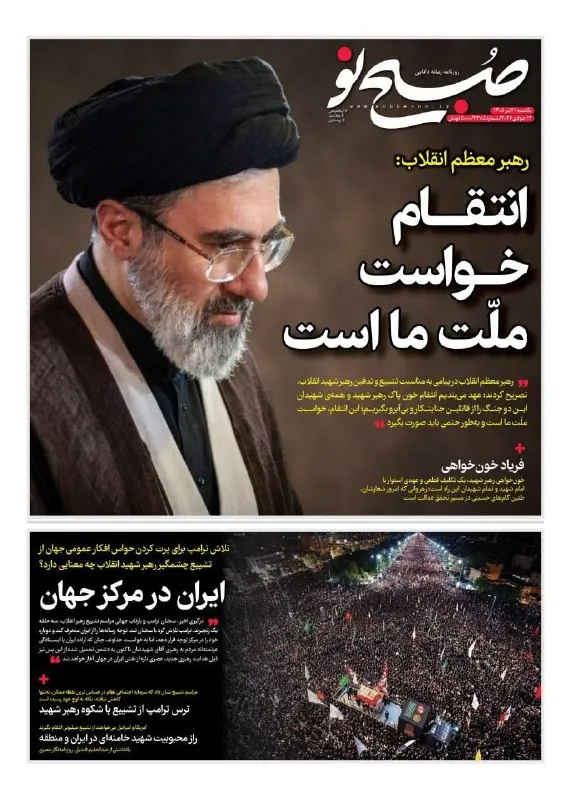
Day 131 turns on two developments the monitor has been waiting for. First, and of the highest significance, the successor Leader has broken his silence: for the first time since his father’s assassination on 28 February, Seyyed Mojtaba Khamenei has issued a public message, and it dominates the fronts. Released on the occasion of the burial, it thanks the tens of millions who marched and pledges that revenge for the martyred Leader ‘is the demand of our nation and must certainly take place,’ warning that the killers ‘from the top to the bottom of the list’ will carry to their graves the wish for a quiet death in bed, and that even if he and other officials are gone, ‘the free people of the world will each carry out a part of this divine mission.’ Sobh-e No, Hamshahri, Jam-e Jam, Farhikhtegan, Etemad, Ta’adol and Chaharsough all lead with it; Farhikhtegan names the author in full as Ayatollah Seyyed Mojtaba Khamenei, ending, at least for one day, the pattern of governing through the dead father’s doctrine alone.
Second, the fragile 17 June ceasefire has effectively collapsed after roughly three weeks. The IRGC attacked a Cyprus-flagged container ship (the GFS Galaxy) in the Strait of Hormuz, US Central Command answered with a ‘third round’ of strikes on Iran this week (about 140 targets in the round, more than 300 across three rounds), and Iran re-declared the strait ‘closed until further notice and until the end of America’s interference’ - reversing Day 130’s read of a managed, partial reopening. Chaharsough prints the epitaph plainly: ‘the understanding with America lasted only three weeks.’ Beneath the vengeance liturgy the pages split as before: the hardline flank (Kayhan, Sobh-e No, Jam-e Jam, and the cleric Seyyed Ali Khomeini’s ‘negotiation is treason’) stacks largely unverified claims of strikes on US bases across Jordan, Kuwait, Bahrain, Qatar, Oman and the UAE, while the reformist and government outlets keep a diplomatic thread alive - Araghchi shuttling to Oman over a two-corridor passage proposal, Pezeshkian telling Pakistan that ‘actors’ are blocking regional calm, and Etemad arguing ‘negotiation is part of the war.‘
Key Judgments
- HIGH - The successor has entered the public record. Seyyed Mojtaba Khamenei’s first named message since 28 February is a genuine inflection point: the state is no longer governing solely through the dead father’s doctrine and the President’s voice. Expect the fronts to treat the message as the canonical text of the moment; whether it marks a sustained turn to a visible leadership, or a single ceremonial exception, is the open question the next editions should settle.
- HIGH - The 17 June ceasefire has effectively failed. The GFS Galaxy attack, the US ‘third round’ of strikes on Iran, and the renewed Iranian closure of Hormuz - all corroborated internationally - mark a return to active hostilities after roughly three weeks. The operative frame reverts from ‘managed reopening and possible talks’ (Day 130) to open conflict around the strait, even though a diplomatic back-channel via Oman persists.
- MODERATE-HIGH - The Strait of Hormuz is again a live battlefield, but the declared ‘closure’ is more political than physical. Iran’s ship seizures and warning shots are real and CENTCOM’s strikes are real; yet CENTCOM says commercial traffic continues, so the ‘closed until further notice’ declaration functions as leverage and signalling rather than a demonstrated total blockade. Read transit as contested and intermittent, not sealed.
- MODERATE-HIGH - The hardline strike claims are inflated for domestic deterrence and should not be treated as fact. The IRGC/Army assertions of destroying US bases across Jordan, Kuwait, Bahrain, Qatar, Oman and the UAE far outrun what any independent source confirms; the corroborated record extends to the ship attack, the US strikes on Iranian soil, and projectile impacts in Khuzestan, not to the claimed damage to US forces.
- MODERATE-HIGH - Two tracks are running at once by design, not confusion. Tehran is simultaneously escalating (closure, retaliation rhetoric, ‘negotiation is treason’) and probing (Araghchi in Oman, Pezeshkian’s Pakistan call, reformist advocacy for talks). This is a deliberate posture - bargaining from a stance of force - which makes an early de-escalation unlikely even as contact continues; the diplomatic thread is a hedge, not a pivot.
- MODERATE - The Trump assassination-plot claim should be held at arm’s length. Sourced to an Israeli intelligence warning relayed by Ambassador Huckabee and unvetted by US officials - some of whom suspect it is meant to draw Washington deeper in - it is unconfirmed, even as it resonates with the fronts’ ‘we will kill Trump’ messaging. Treat the messaging as deliberate psychological signalling and the specific plot as an attributed, unverified claim.
Macro Trends
- The successor breaks his silence, and it leads every front. The single change that reorganises the monitor’s running story is that Seyyed Mojtaba Khamenei has, for the first time since the assassination, spoken in his own name. His burial-day message - vengeance as the nation’s binding demand, the killers denied a peaceful death, the mission delegated to ‘the free people of the world’ should he and other officials fall - is carried across the ideological spectrum, from principlist Sobh-e No and Farhikhtegan to reformist Etemad and business papers Ta’adol and Chaharsough. Farhikhtegan’s full naming of the author closes the identification loop the monitor has flagged for weeks. Whether this is a one-off funeral text or the start of a more visible leadership will be the question to watch.
- The three-week truce collapses into a fresh Hormuz war. The 17 June memorandum is, in practice, dead. The IRGC struck the container ship GFS Galaxy in the strait; CENTCOM ran a ‘third round’ of strikes on Iran this week; Iran re-declared the strait closed ‘until the end of America’s interference.’ Chaharsough’s ‘the understanding with America lasted only three weeks’ is the clearest admission. This is a sharp reversal of Day 130’s managed-reopening picture, and it puts the maritime chokepoint back at the centre of the war rather than at the edge of a negotiation.
- Vengeance sacralised and aimed outward, including in Hebrew. The fronts convert mourning directly into a deterrent posture. Jam-e Jam, the state broadcaster’s paper, runs its threat trilingually - Persian, English ‘Revenge Is Coming Soon,’ and Hebrew lines reading ‘revenge soon’ and ‘we will kill you, Trump’ - explicitly addressing an Israeli and American readership. Hamshahri calls the revenge ‘global’; Farhikhtegan makes ‘blood-vengeance the guarantee of independence.’ The register is religious obligation (a ‘divine mission’), not policy choice, binding the retaliation to the funeral’s emotional charge.
- The two-track split hardens: treason-talk versus shuttle diplomacy. Even as the fighting resumes, the diplomatic channel is not dead. Foreign Minister Araghchi is shuttling to Oman over a floated two-corridor passage proposal for Hormuz; Pezeshkian tells Pakistan’s premier that unnamed ‘actors’ are trying to prevent regional calm; Etemad and Sazandegi argue for talks as, respectively, ‘part of the war’ and a set of manageable scenarios. Against them, the cleric Seyyed Ali Khomeini brands anyone seeking peace with America ‘a traitor’ and negotiation itself ‘war in a different form.’ The government daily Iran threads between the two, confirming the US strikes and ship seizures without the hardliners’ triumphalism.
- Unverified maximalism from the hardline channels. Kayhan, Sobh-e No, Jam-e Jam and Iran’s channels stack claims of Iranian strikes on US bases across the region - the Prince Hassan airbase in Jordan, Patriot and radar sites in Kuwait and Bahrain, carrier refuelling docks at Duqm in Oman, explosions in Kuwait, Qatar, Bahrain and the UAE. These are IRGC/Army assertions with no independent corroboration; what international reporting confirms is narrower - the ship attack, the US strikes on Iran, and the closure declaration. The gap between the claimed offensive and the verifiable facts is itself the signal: the audience is domestic and the aim is deterrence.
- The economic bill starts to show through the martial front pages. The business press will not let the war be cost-free. Ta’adol reports a ‘surprising collapse’ of the Tehran bourse and asks whether the moment is an opportunity to reform or a return to the inflation cycle; even hardline Vatan-e Emrooz argues for converting Hormuz ‘from military deterrence into economic value creation.’ Reformist Shargh reframes the whole conflict as ‘the unequal distribution of the war’s effects,’ foregrounding the burden on workers. The technocratic anxiety is that the vengeance-and-closure posture carries a domestic price the political class has not confronted.
- Great-power cover and a contested assassination claim frame the edges. Jomhouri Eslami reports that China and Russia blocked UN Security Council action on Iran’s nuclear file, the diplomatic shield behind Tehran’s posture. On the Israel front, the claim of an Iranian plot to assassinate Trump - relayed by US Ambassador Huckabee from Israeli intelligence and echoed in the fronts’ ‘we will kill Trump’ messaging - remains unvetted by US officials and possibly aimed at shaping Trump’s decisions, while Israeli strikes and airspace violations in south Lebanon keep that secondary front simmering.
Front-Page Snapshot
- Sobh-e No - “Vengeance is the demand of our nation” (Principlist) - The Leader’s first message; vengeance as national covenant
- Hamshahri - “We pledge, we take revenge” (Centrist (Tehran municipality)) - Burial-day covenant of certain, global revenge
- Jam-e Jam - “Revenge is coming soon; the nation’s demand, a divine mission” (State broadcaster (IRIB)) - Bilingual/Hebrew threats at Trump; Hormuz closure
- Farhikhtegan - “Blood-vengeance, the guarantee of independence” (Principlist (Azad University)) - Succession codified; Leader named as Mojtaba Khamenei
- Etemad - “Negotiation is part of the war” (Reformist) - Diplomacy under bombardment; US wants talks kept alive
- Sazandegi - “The ambiguous future of Hormuz” (Reformist (Kargozaran)) - Araghchi’s Oman diplomacy; three strait scenarios
- Jomhouri Eslami - “Actors are seeking to prevent the establishment of calm in the region” (Traditional establishment) - Pezeshkian-Pakistan call; Russia-China UN cover
- Shargh - “The unequal distribution of the war’s effects” (Reformist) - War’s burden on workers; restorative justice
- Ta’adol - “An opportunity to reform, or a repeat of the inflation cycle?” (Economic) - Bourse collapse; the war’s economic bill
- Chaharsough - “Revenge against the criminals is certain” (Economic / capital-market) - The truce is dead; negotiation branded treason
- Kayhan - “Revenge is the nation’s will and will certainly happen” (Hardline (channel only)) - Sweeping unverified strike claims on US bases
- Vatan-e Emrooz - “Trump’s burnt gamble” (Hardline (channel only)) - Reframing Hormuz as economic leverage; Ashura framing
- Iran - “CENTCOM ends its third round of attacks as Iran disables a second violating ship” (Government daily (channel only)) - Escalation-managing confirmation of US strikes, ship seizures
- Iran Daily (11 July carry-over) - “Mashhad opens eternal embrace to Martyr Khamenei” (English-language state daily) - Day-behind: interment and a standing retaliation warning
Full report
The complete edition - per-paper front-page analysis and full translation appendices - is available as a PDF: Download the full report.
Compiled from Iranian front pages and outlet channels via open-source monitoring. Translations are editorial; named-figure attributions are verified against the source pages where possible.