Iranian Press Monitor - Saturday, 11 July 2026 (Day 130)
Saturday, 11 July 2026 · 20 Tir 1405 · 26 Muharram 1448 - eight Persian front-page scans (Kayhan, Hamshahri, Jomhouri Eslami, Etemad, Iran, Ta’adol, Farhikhtegan, Sobh-e No), one English print carry-over (Iran Daily, 8 July), six outlet Telegram channels (Kayhan, Vatan-e Emrooz, Jam-e Jam, Etemad, Iran, Sobh-e No), and Tehran Times online
Executive Summary
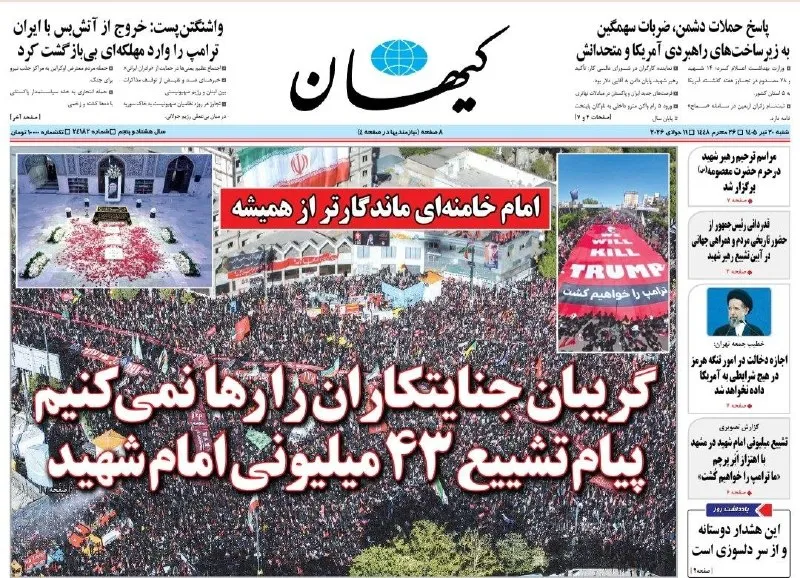
Day 130 closes the arc the monitor has followed since the assassination: the martyred Leader of the Revolution, named on the government fronts as Seyyed Ali Khamenei, was interred at the Imam Reza shrine in Mashhad, ending an unprecedented multi-city, multi-nation funeral. All eight Persian fronts and Tehran Times online carry the burial, and they read it in one voice as legitimacy and as a mandate for revenge: Jomhouri Eslami’s ‘the end of a historic farewell,’ Iran’s ‘Guardian of Islam and Iran,’ Sobh-e No’s three petal-covered graves, Etemad’s elegiac ‘Toward the meeting with God,’ and Hamshahri’s superlative ‘the largest funeral procession in history.’ Turnout is advertised as a weapon and the figures do not agree, Kayhan prints 43 million while Hamshahri claims 61-62 million, so the numbers are propaganda claims, not counts.
The single highest-significance finding is that beneath the mourning a diplomatic channel has quietly flickered back on, reversing Day 128’s ‘the deal is dead.’ The reformist and government channels now carry a possible Iran-US meeting (Geneva, Islamabad or Doha) brokered by Qatari-Pakistani mediation, Foreign Minister Abbas Araghchi travelling to Oman on the Strait of Hormuz, and a US request that Iran publicly declare the strait open. The hardline fronts talk past this: Kayhan’s streets read ‘WE WILL KILL TRUMP,’ Speaker Ghalibaf tells Indonesia’s parliament speaker that ‘only someone ready for war can negotiate with America,’ and the maritime picture is one of partial reopening on Iran’s terms (a claimed transit restored to roughly 50 percent; 21 of 22 ships using the Iran-designated corridor). The successor, Seyyed Mojtaba Khamenei, again neither appeared nor spoke; the day’s canonical text is his martyred father’s doctrine, which Farhikhtegan codifies as ‘Khamenei-ism.‘
Key Judgments
- HIGH - The funeral cycle is over. With the interment at Mashhad completed and the state pivoting to three nights of commemoration, the burial as an organising event has ended; the operative questions now move to whether the mediated diplomatic contact matures and whether the strait’s partial reopening holds. Expect the fronts to shift within days from pure mourning to the aftermath (retaliation, negotiation, economy).
- MODERATE-HIGH - The diplomatic track is reopening, not dead. The convergence of a floated Iran-US meeting, Qatari-Pakistani mediation, Araghchi’s Oman trip, and a concrete US ask on Hormuz indicates a real back-channel is being arranged; Baghaei’s public denial of any request to negotiate is face-saving positioning ahead of contact, not evidence of closure. This reverses the Day 128 read that the memorandum was repudiated.
- MODERATE-HIGH - The Strait of Hormuz is settling into a managed, partial reopening that Tehran controls as leverage. The claimed restoration to roughly 50 percent transit and the 21-of-22-ships-in-the-Iran-corridor figure, alongside the US request for a public ‘strait is open’ declaration, together indicate Iran is trading passage for concessions rather than pursuing sustained closure; that transit is partially restored is more solid than any specific percentage.
- MODERATE-HIGH - The retaliation and battlefield claims are inflated for domestic deterrence and should be treated as unverified. The IRGC claim of strikes on named US bases in Kuwait and Bahrain, Kayhan’s ‘heavy blows to US strategic infrastructure’ and ‘14 martyrs,’ and the ‘WE WILL KILL TRUMP’ messaging are aimed at the mourning audience; independent corroboration on this run extends only to the fact of a mass burial and to shipping signals, not to targets hit or casualties inflicted on the US side.
- MODERATE-HIGH - Concealment of the successor is settled policy, not indecision. Seyyed Mojtaba Khamenei will remain absent and voiceless, and the state will keep governing through the martyred father’s codified doctrine (‘Khamenei-ism’), the President’s voice, and decrees rather than any address by the new Leader; this has now held unbroken from the Iraqi leg through the interment.
- MODERATE - Any negotiation will be framed by Tehran as bargaining from strength. Ghalibaf’s ‘only the war-ready may negotiate’ and the new US sanctions designation of 8 individuals and 6 entities set the terms: talks, if they occur, will be paired with maximalist rhetoric and continued pressure on both sides, making early breakthroughs unlikely even as contact resumes.
Macro Trends
- The burial concludes, and the state banks the turnout as legitimacy. After a six-day, multi-nation procession, the martyred Ali Khamenei was interred at the Imam Reza shrine in Mashhad, with his martyred family, in the Freedom Courtyard nearest the Golden Portico. Every front reads the mass turnout as proof of legitimacy at a moment of maximum external pressure, Iran’s ‘an enduring display of loyalty and national solidarity,’ Jomhouri Eslami’s ‘the end of a historic farewell,’ Tehran Times’s tally of more than 5,000 foreign guests from 30 countries. The turnout claims are the day’s currency and they do not reconcile: Kayhan 43 million, Hamshahri 61-62 million.
- Under the mourning, a diplomatic channel flickers back on. The sharpest reversal from Day 128 is that the diplomatic track, declared dead a week ago, is quietly live again. The channels carry a possible Iran-US meeting in Geneva, Islamabad or Doha contingent on Qatari-Pakistani mediation, Araghchi’s travel to Oman for Strait consultations, a phone call between Pakistan’s premier and Qatar’s emir, and a US request that Iran publicly confirm Hormuz is open. Spokesman Baghaei’s insistence that ‘we had no request to negotiate’ is best read not as closure but as pre-negotiation positioning, denying supplication while a mediated contact is arranged.
- Vengeance as the funeral’s official meaning. The hardline and government fronts fuse mourning and retaliation: Hamshahri’s ‘the people’s cry for vengeance,’ Kayhan’s ‘we will not release our grip on the criminals’ over street banners reading ‘WE WILL KILL TRUMP,’ Iran’s ‘the price of Trump’s treaty-breaking.’ Revenge against ‘the killers of the martyred Imam’ is treated as a settled certainty rather than a threat, the emotional charge of the burial converted directly into a deterrent posture.
- Hormuz reopens partially, on Iran’s terms. The maritime picture has shifted from Day 128’s near-total halt to a managed, partial reopening that Tehran presents as its own dispensation. Vatan-e Emrooz relays a naval claim that transit is restored to roughly 50 percent of pre-conflict levels; Kayhan’s channel cites Fox News that 21 of 22 ships used the Iran-designated corridor; the Tehran Friday-prayer leader warns the US will not be ‘permitted to interfere’ in the strait. The US ask that Iran declare the strait open, carried on Jam-e Jam, shows Washington seeking exactly the reassurance Tehran is monetising.
- Negotiate only from strength: the hardline precondition. Even as the channel reopens, the principlist fronts set a maximalist frame. Ghalibaf tells Indonesia’s parliament speaker that ‘only someone who is ready for war can negotiate with America’ and that Iran told US officials ‘we have no trust in you’; Jomhouri Eslami’s editorial argues Iran holds ‘a weapon stronger than missiles and the Strait of Hormuz.’ The message is that any talks will proceed under an explicit posture of force, not as a concession.
- Succession by doctrine while the successor stays silent. Seyyed Mojtaba Khamenei again attended nothing and said nothing; the commemoration order and the day’s meaning are carried by the President and the fronts, not by the successor’s voice. Farhikhtegan makes the substitution explicit, launching ‘Khamenei-ism’ as a named analytical project over the iconic young portrait of the martyred father, codifying the predecessor’s ideology as the governing template. The pattern the monitor has tracked holds: the martyred father’s charisma is spent in public while the new Leader governs, so far as the pages show, only through the liturgy and the occasional decree.
- Lebanon returns to the margins of the page. The Israel-Lebanon front, largely crowded out by the funeral, surfaces mainly on Jam-e Jam’s channel: an Israeli drone strike on a vehicle in Kfar Rumman in the Nabatieh region and jets violating southern Lebanese airspace over Nabatieh and Iqlim al-Tuffah. Etemad’s channel adds that Washington asked Israel to avoid ‘non-routine operations’ in south Lebanon pending a resolution of US-Iran tensions, a hint that the Lebanese front is being deliberately dampened while the strait and the mediation play out.
Front-Page Snapshot
- Kayhan - “We will not release our grip on the criminals; the martyred Imam’s 43-million funeral” (Hardline) - Burial as vengeance mandate; ‘WE WILL KILL TRUMP’ banners; claimed blows to US infrastructure; Hormuz on Iran’s terms
- Hamshahri - “The largest funeral procession in history” (Centrist (Tehran municipality)) - Record-scale turnout (claimed 61-62 million); ‘the people’s cry for vengeance’; interment coverage
- Jomhouri Eslami - “The body of the martyred Leader of the Revolution was laid to rest at the Razavi shrine” (Traditional establishment) - Interment at Mashhad; editorial ‘a weapon stronger than missiles and Hormuz’; Russia and China reject Emirati strait guarantees
- Iran - “Guardian of Islam and Iran” (Official government daily) - State funeral as national solidarity; ‘the price of Trump’s treaty-breaking’; Baghaei denies seeking talks; Araghchi to Muscat
- Etemad - “Toward the meeting with God” (Reformist) - Diplomacy as the only exit; possible Iran-US meeting floated; Araghchi to Oman on Hormuz; US curbs Israeli ops in south Lebanon
- Sobh-e No - “Let us make your clenched fist a flag” (Principlist) - Interment of the Leader and family; Ghalibaf: only the war-ready may negotiate with America; new US sanctions
- Farhikhtegan - “Khamenei-ism is alive” (Principlist (Azad University)) - Succession by doctrine: the predecessor’s ideology codified while the living successor stays absent
- Ta’adol - “Exports in the shadow of crisis” (Economic) - Trade and inflation under the war shock; counting the economic cost of Hormuz; burial imagery even on the business front
- Vatan-e Emrooz - “(channel only, no scan in today’s batch)” (Hardline) - IRGC claims strikes on US bases in Kuwait and Bahrain; Hormuz transit restored to ~50%; Trump cast as desperate
- Jam-e Jam - “(channel only, no scan in today’s batch)” (State broadcaster (IRIB)) - Burial logistics at Imam Reza shrine; Israeli drone strike and airspace violations in south Lebanon; US asks Iran to declare Hormuz open
- Tehran Times - “Millions flood Mashhad as Iran’s martyred Leader is laid to rest at Holy Imam Reza Shrine” (English-language state daily) - English-facing confirmation of the interment; multi-nation farewell; 5,000 foreign guests from 30 countries
- Iran Daily (8 July carry-over) - “Mourners bid farewell to Leader in holy city of Qom” (English-language state daily) - Three-day-old English scan: the Qom farewell leg and a codified foreign-policy doctrine essay; predates the Mashhad burial
Full report
The complete edition - per-paper front-page analysis and full translation appendices - is available as a PDF: Download the full report.
Compiled from Iranian front pages and outlet channels via open-source monitoring. Translations are editorial; named-figure attributions are verified against the source pages where possible.