Iranian Press Monitor - Thursday, 9 July 2026 (Day 128)
Thursday, 9 July 2026 · 18 Tir 1405 · 24 Muharram 1448 - Eight Persian front-page scans (Vatan-e Emrooz, Kayhan, Jam-e Jam, Sazandegi, Chaharsoo, Etemad, Ta’adol, Iran), one English carry-over (Iran Daily, 8 July), and six outlet Telegram channels (Kayhan, Vatan-e Emrooz, Jam-e Jam, Etemad, Iran, Sobh-e No); Tehran Times were unavailable at the time. Overnight battlefield claims are outlet-sourced and treated as unverified.
Executive Summary
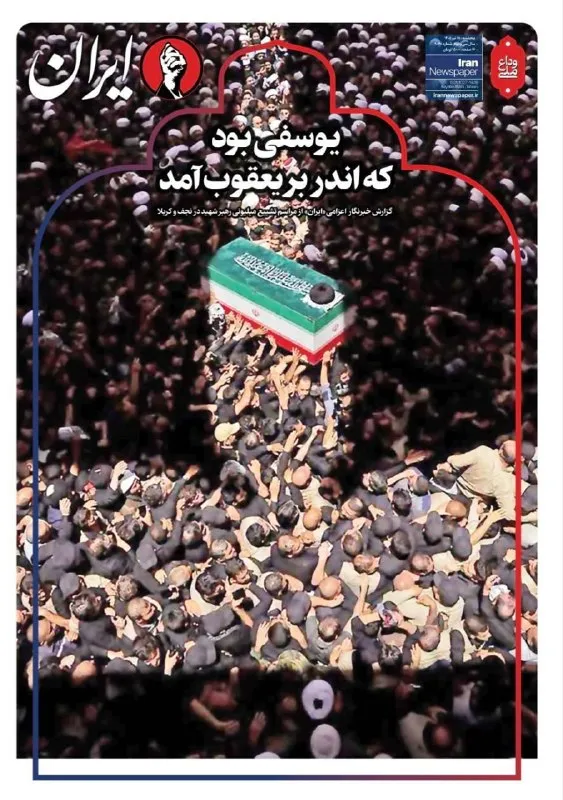
Day 128 sharpens the split the monitor has tracked since the burial began. On paper it is still the funeral, and it has crossed a border: all eight Persian fronts and the English carry-over are locked on the Iraqi leg of the rites, the millions-strong Najaf and Karbala procession that Kayhan captions ‘Iraq too stood in respect for Mr. Martyr,’ that Jam-e Jam banners in Arabic as ‘Iran and Iraq cannot be parted,’ and that Vatan-e Emrooz calls ‘love without borders.’ The government’s Iran runs a single poetic line, ‘a Joseph who came into Jacob’s embrace,’ over a full-bleed coffin. But the print run again closed before the night’s real news. Between the Wednesday edition and Thursday morning the war moved onto Iranian home soil: outlet channels relay a second CENTCOM wave, described as completed strikes on roughly ninety Iranian coastal military sites, and, for the first time in this cycle, strikes inland and on the southeast coast, three reported killed near Ahvaz in Khuzestan, a firefighter killed at Iranshahr airport, and a control tower and warehouse hit at the Chabahar free zone. Iran’s outlets claim retaliatory strikes on US bases in Kuwait and against the Fifth Fleet in Bahrain, and report air-raid sirens in Jordan.
The single highest-significance finding is that the confrontation has shifted from the coast and the Gulf bases into Iran proper while the strait itself is closing. Bloomberg, cited across the channels, reports Hormuz shipping has nearly halted, confined to Iran-approved northern lanes, and Brent crude has jumped past 78 dollars; the hardline press advertises the leverage openly, Vatan-e Emrooz’s masthead ‘We have a firm grip on the Strait’ and Speaker Ghalibaf’s warning that ‘the Strait of Hormuz will open only with Iranian arrangements, not American threats.’ The diplomatic track is now declared dead rather than paused: Kayhan’s front strip reads ‘the memorandum has come to an end, continuing negotiations has no justification,’ Ghalibaf says ‘the era of bullying and extortion is over,’ and Iran has filed formal complaints to the UN Security Council. The Leader, Seyyed Mojtaba Khamenei, remains invisible and voiceless; the day’s canonical text is his martyred father’s foreign-policy doctrine, codified for foreign readers in Iran Daily. The burial itinerary now runs through the Iraqi shrines with the interment still pending, superseding the Day-127 expectation of a 9 July Mashhad burial.
Key Judgments
- HIGH - The confrontation has escalated qualitatively: the reported second US wave strikes Iranian home soil (Ahvaz, Iranshahr, Chabahar) rather than only the coast and the Gulf bases, and the June ceasefire is now succeeded by an open, widening strike campaign rather than merely a lapsed truce. Kayhan’s front-page declaration that ‘the memorandum has ended and negotiations are unjustified’ is the print catching up to that rupture, and the diplomatic track should be treated as repudiated, not paused, until the strike cycle stabilizes.
- HIGH - The Strait of Hormuz is now Iran’s decisive lever. The Bloomberg-sourced near-halt of shipping, the hardline ‘firm grip on the Strait,’ Ghalibaf’s ‘opens only on Iranian terms,’ and Brent past 78 dollars together indicate Tehran is using closure and the threat of closure as its principal coercive instrument; that the disruption is real is high-confidence, but whether it reflects active Iranian interdiction or a risk-driven shipping withdrawal is not yet established.
- MODERATE-HIGH - Iran’s retaliation claims, strikes on US bases in Kuwait and the Fifth Fleet in Bahrain, sirens in Jordan, and the recurring ‘85 targets’ figure, are inflated for domestic deterrence and should be treated as unverified outlet claims; independent corroboration on this run extends only to shipping data and oil prices, not to targets hit, damage, or casualties on the US side, and the more likely near-term US posture remains a claim of no significant losses.
- MODERATE-HIGH - Concealment of the Leader is settled policy, not indecision: Seyyed Mojtaba Khamenei will stay absent and voiceless through the interment, and the state will keep substituting the martyred father’s doctrine and liturgy (the Iran Daily foreign-policy essay, the ‘Joseph to Jacob’ framing, the Iraqi shrine visitations) for any address by the successor, governing where visible through decrees rather than a public voice.
- MODERATE - The negotiating track is dead for the near term. With Kayhan declaring the memorandum void, Ghalibaf pronouncing the era of extortion over, and Iran filing UN Security Council complaints, there is no diplomatic off-ramp available until both the strike exchange stabilizes and the burial concludes; any resumption will now be conditioned on a halt to strikes and, given Hormuz’s new centrality, on the strait’s status.
- MODERATE - The casualty and strike reports on Iranian soil (three near Ahvaz, the Iranshahr firefighter, the Chabahar hits) are single-source Iranian official or outlet claims and may be revised, but their geographic spread across Khuzestan and Sistan-Baluchestan is itself evidence that the US campaign is genuinely wider than the late-June coastal pattern rather than a repeat of it.
Macro Trends
- The war moves onto Iranian home soil while the fronts mourn. The defining fact of the day is that the second US wave, as reported by the channels, no longer confines itself to naval targets and Gulf bases but strikes inside Iran: Ahvaz in Khuzestan, Iranshahr airport, and the Chabahar free zone on the southeast coast. The eight Persian fronts show none of it, running pure Najaf-Karbala funeral iconography, so the divergence between the printed page and the ground is now not just rhetorical but geographic, the mourning screen printed the same morning that Iranian towns report their own casualties.
- Hormuz becomes the central weapon. Iran’s principal instrument has shifted from missile counterstrikes to control of the strait. Bloomberg, cited across the outlets, reports Hormuz shipping has nearly halted; Vatan-e Emrooz prints ‘We have a firm grip on the Strait’ on its masthead; Ghalibaf tells Washington the strait ‘will open only with Iranian arrangements.’ Brent past 78 dollars shows the market pricing the threat. Whether this is active Iranian closure or a shipping-industry flight from risk is unresolved, but the coercive intent is being advertised.
- The funeral crosses the border and is read as deterrence. The rites have moved to Iraq, and every front weaponizes the Iraqi turnout as proof of transnational legitimacy: Kayhan’s ‘Iraq too stood,’ Jam-e Jam’s Arabic ‘Iran and Iraq cannot be parted,’ Vatan’s ‘love without borders,’ Etemad’s ‘a vast throng of Iraqis,’ with Bahraini mourning added on the channels. The mass cross-border participation is presented not as grief alone but as a demonstration of the Axis of Resistance’s reach at the moment of maximum pressure.
- Kayhan buries the deal; the establishment hardens across the spectrum. The flagship hardline sheet moves from ‘paused’ to ‘dead’: ‘the memorandum has come to an end, continuing negotiations has no justification.’ It is not alone. Speaker Ghalibaf, quoted in reformist Etemad, declares ‘the era of bullying and extortion is over,’ and Iran has taken the rupture to the UN Security Council. The diplomatic off-ramp the monitor tracked as merely frozen on Day 127 is now being formally repudiated in print.
- The economic press splits over how to read the shock. The two economic fronts diverge. Chaharsoo surrenders its entire page to funeral imagery, printing no market data at all, a measure of the enforced mourning discipline. Ta’adol instead reads the crisis through trade, ‘the lesson of war for Iran’s trade,’ arguing that ‘a return to Hormuz does not mean forgetting the alternative corridors’ and warning that the shadow of war hangs over international markets. It is the clearest sign that parts of the system are already counting the economic cost of the strait’s closure.
- The invisible Leader; the martyred father supplies the message. Seyyed Mojtaba Khamenei again attends nothing and says nothing. The day’s canonical text is not his but his assassinated father’s, whose foreign-policy doctrine Iran Daily codifies for foreign audiences (Axis of Resistance, looking East, rejecting hegemony). Iran’s poetic ‘Joseph to Jacob’ front continues the pattern of spending the predecessor’s charisma in public while the successor governs, so far as the pages show, only through the liturgy and the occasional decree.
- Reformist doubt survives only in the margins and the channels. Sazandegi is the one printed front to ask the forbidden question, ‘return to war, or only tension?’, and to read the memorandum’s breakdown as a diplomatic failure. Etemad’s front stays on the funeral, but its channel carries the day’s sharpest war ledger. The pattern holds from Day 127: the reformist press can register the war and the danger only in its digital feed and its op-ed columns, never in the mandated printed lead.
Front-Page Snapshot
- Kayhan - “Iraq too stood in respect for the martyr; the millions-strong funeral of the Leader of the Islamic world in Najaf and Karbala” (Hardline) - Front strip declares the ceasefire memorandum dead (‘negotiations unjustified’); ‘today the world will change’; channel claims three killed near Ahvaz
- Vatan-e Emrooz - “Love without borders” (Hardline / principlist) - Iraqi mass funeral as borderless devotion; masthead ‘We have a firm grip on the Strait’; red-flag vengeance and ‘Trump’s nightmare’
- Jam-e Jam - “Iran and Iraq cannot be parted” (State broadcaster (IRIB)) - Arabic-language appeal to Iraq; channel relays IRGC Gulf-base strike claim and the Hormuz shipping halt
- Iran - “A Joseph who came into Jacob’s embrace” (Official government daily) - Poetic funeral front with own correspondent in Iraq; the war (CENTCOM ~90 sites, Kuwait/Bahrain, Hamas in Cairo) confined to the channel
- Etemad - “A millions-strong funeral in Iraq” (Reformist) - Ghalibaf: ‘the era of bullying is over’; channel is the day’s fullest war ledger (Ahvaz, Iranshahr, Chabahar, Hormuz halt, oil past $78)
- Sazandegi - “Circumambulation of the shrines” (Reformist / Kargozaran) - The one front to ask ‘return to war, or only tension?’; editorial reads the memorandum’s collapse as a diplomatic failure
- Ta’adol - “The lesson of war for Iran’s trade” (Economic) - Reads the crisis as a trade shock; ‘Hormuz is not the only corridor’; markets under the shadow of political tension
- Chaharsoo - “A farewell that shook the skies of Najaf and Karbala” (Economic) - An economic paper wholly given over to funeral imagery, no market data, a measure of enforced mourning discipline
- Sobh-e No - “Your pilgrimage is accepted, Sir” (Principlist) - Funeral as Karbala visitation; channel carries Ghalibaf’s Hormuz warning, claimed strikes on Kuwait/Bahrain, and Iran’s UN complaint (channel only, no scan)
- Iran Daily (8 July carry-over) - “Mourners bid farewell to Leader in holy city of Qom” (English-language state daily) - English-facing Qom farewell and a doctrinal essay codifying the martyred Leader’s foreign policy; predates the overnight strikes
Full report
The complete edition - per-paper front-page analysis and full translation appendices - is available as a PDF: Download the full report.
Compiled from Iranian front pages and outlet channels via open-source monitoring. Translations are editorial; named-figure attributions are verified against the source pages where possible.