Iranian Press Monitor - Thursday, 2 July 2026 (Day 121)
Thursday, 2 July 2026 · 11 Tir 1405 · 17 Muharram 1448 - 14 outlets, 9 front-page scans (8 Persian, 1 English) plus 5 text channels and web sources; translation annex
Executive Summary
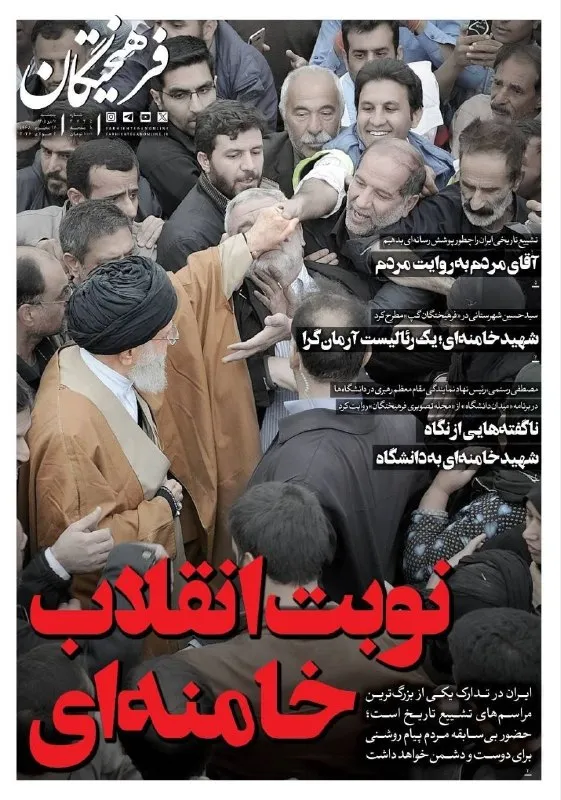
The Iranian press on 11 Tir 1405 (2 July 2026), Day 121, is consumed by the eve of the martyred former Leader Ali Khamenei’s funeral: the largest state mobilization since the war began. The machinery is now fully visible in print: 150,000 police on alert (Kayhan), the Red Crescent staged for 4 million mourners with 2,500 ambulances, 21 helicopters and 100 drones across Tehran, Qom and Mashhad (Iran), special trains, public holidays 13-16 Tir in Tehran and 15 Tir nationwide, 600 accredited foreign journalists, 30 attending countries, a reported Medvedev delegation as Putin’s envoy, and a finalized procession route ending in Mashhad. Etemad calls it ‘the largest gathering in Iran’s history’; Farhikhtegan’s full-page cover declares ‘Now it is the Khamenei revolution’s turn’ and states outright that the unprecedented turnout ‘will carry a clear message for friend and foe’, confirming the procession’s function as a deterrence-signaling event, not only a rite.
The single highest-significance political finding is an open information war inside the establishment over the understanding with Washington: state broadcaster IRIB cut off parliament speaker and negotiating-team chief Mohammad-Bagher Ghalibaf mid-interview, and the press revolted across factional lines. Sazandegi leads with ‘The understanding under the censor’s blade’ and reconstructs the censored passages (more than 40 million barrels exported since the blockade was lifted, oil selling at roughly a 20 percent premium ‘without middlemen and corruption’, and a warning not to ‘turn the Strait against ourselves’); Shargh brands IRIB’s move ‘hostage-taking of the narrative in the glass building’; and, tellingly, the principlist Sobh-e No also defends Ghalibaf, relaying his retort that had he not gone to Switzerland the same critics would ask what happened to Iran’s conditions. Kayhan counter-programs by foregrounding Ghalibaf’s other register: ‘If the commitments are not implemented, we are ready for war.’ The chief negotiator is simultaneously the deal’s salesman and its designated enforcer, and the fight over who narrates the deal has moved inside the state’s own broadcaster.
On the war-and-diplomacy track, the papers codify what can now be called a Hormuz toll doctrine. Kayhan’s Day-124 war report amplifies Reuters, citing a senior Iranian official, that Iran seeks permanent control of the Strait: under the understanding, shipping transits toll-free for 60 days while Iran retains monitoring authority, after which Tehran intends to collect fees from foreign shipping. Deputy foreign minister Kazem Gharibabadi supplies the doctrine’s political formula, ‘the Strait of Hormuz is defined under Iran’s command, not CENTCOM’s’, while rejecting military meetings in Bahrain, and Tehran Times wraps it in an ‘Indigenous Persian Gulf Security Framework’ marketed during an Iraq visit. The countervailing data points run in the same papers: Bloomberg’s report of Hormuz transit above 10 million barrels per day, Trump’s boast of record transits, and US Vice President Vance’s explicit threat of renewed strikes if the nuclear program resumes or commercial shipping is attacked. The toll window’s expiry is being set up as the next scheduled collision point of the ceasefire.
The ceasefire’s periphery is turning kinetic even as its center holds. Kayhan’s channel claims a ballistic missile destroyed the Erbil headquarters of the ‘Party of Freedom’ terrorist group; the government daily Iran independently reports unconfirmed explosions in Erbil and Sulaymaniyah, consistent with international reporting of IRGC operations against Iranian-Kurdish opposition bases, and the strike follows a week of border-region attacks in print: the 28 June Paveh shooting that killed two IRGC members, a police officer’s death in Baneh three days after a terrorist attack, and another officer martyred in Sistan-Baluchestan. Meanwhile the diplomatic center advances: Jomhouri-e Eslami reports indirect Iran-US talks in Qatar with ‘working groups for the final agreement’ formed, and Iran Daily leads on Qatar-mediated talks over blocked funds while denying any direct US meeting. On Lebanon, the rejection front hardens: Tehran Times attacks the 26 June Washington framework as ‘a trap of demographic erasure and endless war’, Jam-e Jam frames Beirut’s weapons-monopoly push as ‘insistence on disarming the resistance’, and Sazandegi’s editorialist Seyyed Jalal Sadatian warns that Israel’s continuing strikes on southern Lebanon can derail de-escalation regardless of what Tehran and Washington agree.
Beneath the mourning, the economic press is quietly repositioning for engagement. Ta’adol asks ‘Why did America come to the negotiating table?’ (answer: two pressures, political and economic) and runs economist Peyman Molavi’s column ‘Economic opportunities in expanding trade with America’, a trial balloon that would have been unprintable before the ceasefire; Iran Daily projects the capital market as a regional investment hotspot; the oil ministry’s stated priority is emptying storage and restoring production capacity. The dissenting notes are about partners, not principle: Vatan-e Emrooz attacks a proposed Turkish operator for the Ab Teymour oilfield as a ‘mirage’, and Shargh leads on Turkey squeezing Iranian residents (‘The end of the Istanbul dream’), a two-front cooling toward Ankara. Charsooq, an economic daily, gave its entire front to a memorial biography: the funeral has crowded out even the business pages.
Key Judgments
- HIGH - The funeral (peak days 13-16 Tir / 4-7 July) is a centrally engineered legitimacy-transfer and deterrence-signaling operation, and the regime will treat turnout as a strategic metric. The whole-of-state logistics (150,000 police, 4-million-mourner capacity, national holidays, 30 foreign delegations, 600 accredited journalists) and Farhikhtegan’s explicit ‘message for friend and foe’ framing indicate the crowd itself is the intended signal, aimed simultaneously at Washington, Tel Aviv and any domestic doubters of the Mojtaba Khamenei succession.
- MODERATE-HIGH - The IRIB censorship of Ghalibaf marks a real fight over control of the deal narrative, and the pro-talks coalition currently holds the upper hand. A principlist paper (Sobh-e No) defending the speaker alongside reformist outlets, while Kayhan attacks the deal’s implementation rather than Ghalibaf personally, suggests the negotiating track retains protection from the leadership level; the broadcaster’s gatekeepers, not the negotiators, absorbed the blame. Expect continued hardline pressure through the implementation-failure file rather than through open attacks on the negotiating team.
- MODERATE-HIGH - Iran is converting wartime leverage over Hormuz into a permanent sovereignty-and-revenue regime, and the expiry of the 60-day toll-free window is the next scheduled ceasefire stress point. The convergence of the Reuters permanent-control report, Gharibabadi’s ‘under Iran’s command, not CENTCOM’s’ doctrine, and Ghalibaf’s keep-it-commercial argument indicates a settled intent to charge foreign shipping after the window; Vance’s threat to strike over attacks on commercial shipping defines the collision course if toll collection is enforced against resistant carriers.
- MODERATE - The ceasefire will hold at the center while both sides tolerate peripheral kinetics. Qatar working groups ‘for the final agreement’ and the blocked-funds track continue uninterrupted by the same-night Erbil strike, the border-province attacks, or Israel’s strikes in southern Lebanon; Tehran appears to be prosecuting an internal-security campaign against Kurdish and Baluch armed groups under the ceasefire’s cover, calculating correctly so far that Washington will not treat it as a violation.
- MODERATE - The Lebanon framework of 26 June is headed toward failure in its current form. The Iranian press consensus (state, IRIB, hardline and English-facing alike) has settled on the disarmament clause as illegitimate, Lebanese rejection is widening in Tehran’s telling, and Salam’s own ‘framework, not final agreement’ hedge is being read as vindication; with Israeli strikes continuing in the south, Tehran will keep backing Hezbollah’s refusal and expects the framework to collapse without Iran having to act against it directly.
- LOW-MODERATE - A constituency for commercial normalization with the United States is consolidating in the economic press and parts of the negotiating establishment, and will surface more openly if the funeral passes without escalation. Molavi’s trade-opportunities column, Ta’adol’s two-pressures analysis, the capital-market promotion and Ghalibaf’s oil-premium claims are mutually reinforcing engagement arguments; the constraint is not ideology but sequencing, since every such piece is still wrapped in compliance-first and strength-position caveats.
Macro Trends
- The funeral machine reaches full mobilization. Day 121 is the logistics edition: 150,000 police on alert (Kayhan), Red Crescent capacity for 4 million mourners with 2,500 ambulances, 21 helicopters and 100 drones staged across Tehran, Qom and Mashhad, 6,000 mist sprayers at Imam Khomeini Square (Iran), 138 fire stations on alert and bank and postal closures (Etemad), special trains and public holidays 13-16 Tir in Tehran and 15 Tir nationwide (Sobh-e No), a finalized route in Mashhad (Kayhan channel), 600 foreign journalists accredited, 30 countries attending (Iran Daily) and a reported Medvedev delegation. Jomhouri-e Eslami carries the joint invitation of the three branches under Pezeshkian’s directive that the procession ‘must be a symbol of national unity and cohesion’. The state has effectively scheduled its own shutdown for the ceremony days.
- Canonization completes its capture of the press spectrum. The martyr cult now spans every orientation: Farhikhtegan’s full-page ‘Now it is the Khamenei revolution’s turn’ frames the succession as a new revolutionary phase whose mass turnout signals ‘friend and foe’; the economic daily Charsooq converts its front into an illustrated biography ending at the 28 February assassination; Etemad, the reformist flagship, publishes Saeed Leylaz on ‘the martyred Leader’s legacy’; Tehran Times reports the funeral ceremonies will be nominated for national heritage status; and Kayhan’s Muharram column ‘This time Hossein will not be borne to burial forlorn’ fuses the procession with Ashura. Where Day 120 showed allegiance-renewal toward the new Leader, Day 121 shows the commemoration operating as a whole-of-press legitimacy engine with no dissenting register anywhere in the corpus.
- The censored negotiator: IRIB versus Ghalibaf goes public. IRIB’s unexplained cutting of Ghalibaf’s broadcast interview about the Islamabad accord and the Swiss channel has produced a rare cross-factional backlash: Sazandegi’s lead ‘The understanding under the censor’s blade’ reconstructs the censored economics of the deal (40 million barrels exported, a 20 percent price premium, oil sold without middlemen), Shargh brands the incident ‘hostage-taking of the narrative in the glass building’, and principlist Sobh-e No defends the speaker with his own words: ‘If I had not gone to Switzerland, the same critics would ask what happened to our conditions.’ Kayhan, for its part, publishes only his hawkish register (‘If the commitments are not implemented, we are ready for war’) while Jomhouri-e Eslami relays his doctrinal bridge, ‘negotiation is a method of struggle’. The dispute is no longer over whether to talk but over who owns the narrative of the talks, and the broadcaster’s gatekeepers have been publicly overruled by the print spectrum.
- A Hormuz toll doctrine is being codified. Kayhan amplifies Reuters, via a senior Iranian official, that Iran seeks permanent control of the Strait: a 60-day toll-free transit window under the understanding, Iranian monitoring authority retained, and transit fees on foreign shipping afterward. Gharibabadi supplies the formula, ‘the Strait of Hormuz is defined under Iran’s command, not CENTCOM’s’, rejecting military meetings in Bahrain, and Tehran Times packages it as an ‘Indigenous Persian Gulf Security Framework’ pitched in Baghdad. Ghalibaf’s censored remarks pull the same doctrine commercial: the Strait is valuable only if traffic grows, so ‘we must not turn it against ourselves’. Against this, Bloomberg’s 10-million-barrel transit figure, Trump’s record-transit boast, and Vance’s threat to strike if commercial shipping is attacked all run in the same day’s Iranian media, setting up the toll window’s expiry as the ceasefire’s next scheduled stress test.
- Kinetics migrate to the periphery: Kurdistan and the border provinces. While the Doha and Qatar tracks advance, force is being applied at the edges. Kayhan’s channel claims a ballistic missile leveled the Erbil headquarters of the ‘Party of Freedom’ group; Iran reports unconfirmed explosions in Erbil and Sulaymaniyah the same night; and international feeds describe IRGC operations against Iranian-Kurdish opposition bases in northern Iraq. The strike caps a week of border violence carried in print: the Paveh attack that killed two IRGC members on 28 June, the Baneh officer who died three days after a terrorist attack, and a Sistan-Baluchestan policeman’s martyrdom. The pattern suggests Tehran is using the ceasefire’s cover to prosecute an internal-security campaign against Kurdish and Baluch armed opposition, and framing the casualties as continuity with the war’s martyrology.
- Lebanon: the framework-rejection front hardens around the disarmament clause. Tehran Times mounts the day’s most systematic attack on the 26 June Washington framework, calling it ‘a crude instrument of asymmetric warfare designed to secure an indefinite Israeli military presence’ and cataloguing Lebanese figures rejecting it; Jam-e Jam distills Beirut’s position, Prime Minister Nawaf Salam’s timeline-for-withdrawal plus weapons-monopoly formula, as ‘insistence on disarming the resistance’; and Iran’s channel quotes Salam himself that Washington produced ‘a framework, not a final agreement’. Sazandegi’s editorialist Sadatian supplies the analytic frame: Israel’s continuing strikes on southern Lebanon prove that third actors can derail Iran-US de-escalation, while Kayhan circulates Foreign Policy on Hezbollah’s drones as the unsolved Israeli problem. The Iranian consensus treats Lebanese disarmament as the framework’s poison pill and Hezbollah’s arsenal as non-negotiable.
- Economic reopening trial balloons, with Turkey as the designated bad partner. The economic press is testing engagement language: Ta’adol explains US participation in talks as the product of political and economic exhaustion and runs Peyman Molavi’s ‘Economic opportunities in expanding trade with America’; Iran Daily markets the capital market as a regional hotspot and reports billions in frozen assets deposited; the oil ministry prioritizes emptying storage and restoring production; Tehran Times adds Africa as an import partner. The counter-current targets Ankara, not Washington: Vatan-e Emrooz calls the proposed Turkish operator for the Ab Teymour oilfield a ‘mirage’ lacking upstream competence, while Shargh’s lead documents Turkey forcing Iranian residents out (‘The end of the Istanbul dream’). A quiet realignment is visible in which commercial engagement with the US becomes discussable while Turkey absorbs the nationalist backlash.
Front-Page Snapshot
- Kayhan - “Iran Is in a Position of Strength; Send No Message of Weakness to the Enemy” (Hardline / principlist (ultra-conservative)) - Strength framing; permanent Hormuz control; Ghalibaf’s ready-for-war register
- Shargh - “The End of the Istanbul Dream” (Reformist) - Turkey squeezing Iranian residents; IRIB’s censorship of Ghalibaf
- Farhikhtegan - “Now It Is the Khamenei Revolution’s Turn” (Principlist (Azad University)) - Funeral as revolutionary relaunch; turnout as a message to friend and foe
- Sazandegi - “The Understanding Under the Censor’s Blade” (Reformist / technocratic (Kargozaran)) - IRIB censors the chief negotiator; the deal’s economic dividend
- Charsooq - “Mourning and Epic” (Economic daily) - Full-page memorial biography of the martyred Leader
- Jomhouri-e Eslami - “President: The Martyred Leader’s Procession Must Be a Symbol of National Unity and Cohesion” (Traditional revolutionary establishment / clerical) - Unity funeral; Qatar working groups toward a final agreement
- Ta’adol - “Farewell to the Martyred Imam” (Business / economic daily) - Why America came to the table; trade-with-America trial balloon
- Etemad - “The Capital Ready to Bid Farewell to the Martyred Leader” (Reformist) - Largest-gathering logistics; Leylaz on the martyred Leader’s legacy
- Iran Daily - “Iran to Hold Talks with Qatar on Blocked Funds; Denies US Meeting” (English-language government daily (pro-administration)) - Qatar funds track; 30 countries at the funeral; market optimism
- Iran - “Red Crescent Ready for 4 Million Mourners; Hormuz ‘Under Iran’s Command, Not CENTCOM’” (Government / state daily (Pezeshkian line)) - Funeral logistics at national scale; Hormuz command doctrine
- Jam-e Jam - “Lebanese Government Insists on Disarming the Resistance” (Conservative / state broadcaster (IRIB)) - Lebanon disarmament pressure; resistance-axis framing
- Sobh-e No - “Ghalibaf’s Interview Cut Without Explanation” (Principlist / hardline) - Principlist defense of the negotiator; martyr’s blood as deterrent
- Vatan-e Emrooz - “The Turkish Company Mirage for the Ab Teymour Oilfield” (Hardline / principlist) - Resource nationalism against a Turkish oilfield operator
- Tehran Times - “Behind the New Lebanon Framework Lies the Trap of Demographic Erasure, Endless War” (English-language; state-aligned conservative) - Lebanon framework as a trap; MoU compliance before technical talks
Full report
The complete edition - per-paper front-page analysis and full translation appendices - is available as a PDF: Download the full report.
Compiled from Iranian front pages and outlet channels via open-source monitoring. Translations are editorial; named-figure attributions are verified against the source pages where possible.