Iranian Press Monitor - Wednesday, 1 July 2026 (Day 120)
Wednesday, 1 July 2026 · 10 Tir 1405 · 16 Muharram 1448 - 13 Iranian front pages (Persian + English); translation annex
Executive Summary
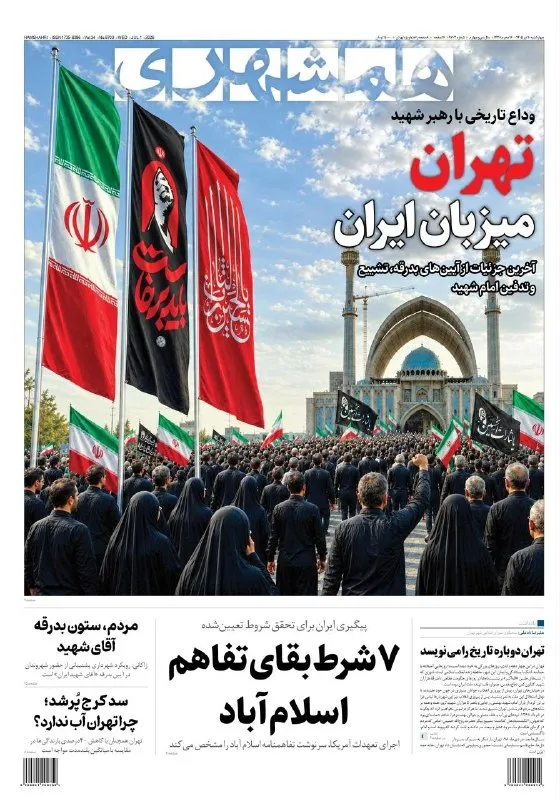
The Iranian press on 10 Tir 1405 (1 July 2026), Day 120, is dominated by a single, unifying event: the state farewell and funeral rites for the martyred former Supreme Leader Ali Khamenei, staged as a national and cross-border act of mobilization. Hamshahri’s full-bleed cover, the day’s strongest artifact, shows a black-clad mourning crowd massed before the domes and minarets of the Imam Khomeini shrine, ranks of the Iranian tricolor rising beside black-and-red memorial banners, under the banner «تهران میزبان ایران» (Tehran, Host to Iran) and «وداع تاریخی با رهبر شهید» (a historic farewell to the martyred Leader). Sobh-e No calls the nation to mourn «امام امت» (the Imam of the Ummah) in unison; Javan frames the moment as «وداع قرن» (a century’s farewell) that summons everyone to their post; and Sobh-e No and Ta’adol both report Iran and Iraq preparing what they call the largest funeral procession in Shia history. The prosecution-and-revenge drive that defined Day 119 has now been channeled almost entirely into this funeral mobilization: the vengeance register survives (Javan’s «انتقام خون راندهشد» / avenging the slain Leader’s blood), but the dominant mode is mourning-as-legitimation rather than crosshairs.
The single highest-significance finding is the open, print-normalized consolidation of the succession: the martyred Ali Khamenei is being venerated and buried as «رهبر شهید» / «شهید سیدعلی», while the sitting Supreme Leader Mojtaba Khamenei receives a mass, staged renewal of allegiance. Jam-e Jam (IRIB) makes this explicit, pairing a portrait of «رهبر انقلاب» (Mojtaba) with a vast crowd under the headline «تمدن ایرانی آماده تجدید عهد با رهبر تاریخی» (Iranian civilization ready to renew its covenant with the historic Leader). The recurring calligraphic slogan «باید برخاست» (one must rise up), appearing on Hamshahri’s memorial flag, on Iran’s raised-fist graphic and across the mourning coverage, functions as the mobilization motto that fuses grief for the father with fealty to the son. The funeral is thus operating as a legitimacy-transfer ceremony: the assassinated predecessor’s martyrdom is the emotional engine, and the outcome being manufactured is uncontested authority for the new Leader.
Beneath the mourning, a sharpening pro-talks versus principlist-rejectionist split over the Doha/Islamabad track is the day’s principal political story. Kayhan leads with a demand that the negotiating team explain «چرا شروط تفاهمنامه محقق نشده است؟» (why have the memorandum’s terms not been fulfilled?), amplifying that Secretary Rubio says no blocked funds were transferred and that sanctions were only suspended, not lifted, and casting the 14-point Islamabad Accord as a renewed American deception. Vatan-e Emrooz declares a «شکست دستهجمعی» (Collective Defeat) of a NATO-backed US coalition, hanging its front on a claimed NATO Secretary-General admission that alliance members helped the US in the war. Against the rejectionists, the official Iran daily insists all negotiation phases are being pursued «با هماهنگی کامل و مستمر با رهبر معظم انقلاب» (in full and continuous coordination with the Leader), and Iran Daily and Tehran Times carry the conditional-engagement line: no final deal until Washington does its part. Hamshahri splits the difference with «7 شرط بقای تفاهم اسلامآباد» (seven conditions for the accord’s survival), and Javan leads its accord coverage with «اول اجرای تفاهمنامه» (first, implementation of the memorandum). The operative debate has shifted from Day 119’s ‘no talks until compliance’ to ‘is the deal even worth defending’, with implementation failure now the shared grievance across the spectrum.
Intra-elite friction is unusually raw. Nobonyad devotes its entire front to «طغیان جعفر» (Jafar’s insurrection), a hardline attack on Jafar Ghaem-Panah, Pezeshkian’s executive deputy, accusing him of using ‘improper language regarding the Supreme Leader’ and branding it revolt and near-blasphemy against the office now held by Mojtaba. Jomhouri Eslami runs the mirror image, leading with the President’s «انتقاد شدید» (sharp criticism) of the factions sabotaging the negotiating team and national decisions. Sobh-e No adds a Ghalibaf feature warning that political disputes with the Speaker must not be allowed to strip the nation of its rights. Loyalty-policing of the executive by principlist outlets, and the executive’s counter-charge that hardliners are wrecking diplomacy, are running simultaneously under the surface unity of the funeral.
Two secondary threads persist in direct continuity with Day 119. On Lebanon, the red line holds across orientations: Sobh-e No headlines Nabih Berri’s firm rejection of the proposed trilateral deal and frames Lebanon as caught in American-engineered sedition; Jomhouri Eslami insists any Israel-Lebanon agreement concluded without Hezbollah is doomed; and Kayhan brands President Joseph Aoun a possible ‘Mossad agent’ for signing a one-sided deal while Israeli jets keep bombing Nabatieh. On the economy, Ta’adol leads on the effects of raising the benchmark interest rate and asks whether housing or a liquidity crisis is the greater inflation driver, framing monetary policy against ‘negotiations on an ambiguous path’, while Iran Daily projects the capital market as a regional investment hotspot and floats Qatar-mediated recovery of blocked funds. The economic optimism of the English-facing outlets sits in visible tension with Kayhan’s insistence that not a dollar has actually moved.
Key Judgments
- HIGH - The Mojtaba Khamenei succession is settled, operational and being actively legitimized through the funeral. The state farewell for the martyred Ali Khamenei is functioning as a legitimacy-transfer ceremony: martyr veneration of the father and mass renewal of allegiance to the son run in parallel across rival outlets (Jam-e Jam’s ‘renewing the covenant’, Hamshahri’s and Iran’s «باید برخاست», Jomhouri Eslami’s continuity framing), with no contestation of the transition anywhere in the open-source record.
- HIGH - The funeral mobilization is a deliberate demonstration of regime cohesion and popular loyalty, and will be sustained as a multi-day, cross-border event. The ‘largest procession in Shia history’ framing, the Iran-Iraq coordination, the multi-million-strong crowd protocols and the civil-affairs machinery (security posture, participant insurance) indicate a centrally managed mobilization designed to project unity and to consolidate the new Leader’s authority, absorbing the prior week’s revenge messaging into a controlled commemorative register.
- MODERATE-HIGH - The Islamabad Accord is entering a credibility crisis over non-implementation, and the domestic debate has shifted from ‘no talks until compliance’ to ‘is the deal worth defending’. With Kayhan (funds not transferred, sanctions only suspended), Vatan-e Emrooz (‘Collective Defeat’), Hamshahri (seven survival conditions) and Ta’adol (‘ambiguous path’) all foregrounding US non-performance, the fragile 60-day window is likely to be dominated by disputes over whether Washington has delivered, raising the risk that a rejectionist bloc consolidates around abandoning the track.
- MODERATE-HIGH - The executive will keep binding diplomacy tightly to the new Leader to inoculate it against hardline attack. The uniform ‘fully coordinated with the Leader’ line (Iran, Iran Daily) paired with Pezeshkian’s public rebuke of ‘saboteurs’ (Jomhouri Eslami) indicates a defensive strategy: the administration is pre-empting the loyalty-policing seen in Nobonyad’s Ghaem-Panah attack by casting every negotiating step as leadership-sanctioned, keeping the talks alive but conditional and reversible.
- MODERATE - Intra-elite friction will intensify once the funeral’s enforced unity passes. The simultaneous Nobonyad assault on Pezeshkian’s deputy for ‘insulting the Leader’, the President’s counter-charge against ‘destructive factions’, and the Ghalibaf-linked warnings point to unresolved rivalries between the executive, the principlist press and the parliamentary leadership that the commemoration is temporarily suppressing rather than resolving.
- MODERATE - The Lebanon file will persist as a durable proxy flashpoint. The cross-orientation rejection of the trilateral deal (Berri’s refusal, the ‘no deal without Hezbollah’ line, the Aoun ‘Mossad agent’ charge) combined with continued reported Israeli strikes on Nabatieh signals that Tehran will treat any Beirut-Tel Aviv arrangement excluding Hezbollah as illegitimate and will keep the resistance-axis veto central, sustaining escalation risk independent of the Iran-US track.
Macro Trends
- The martyr’s funeral as a national and cross-border mobilization. The state farewell for the assassinated Ali Khamenei is the day’s organizing event, staged for maximum scale and reach. Hamshahri turns Tehran into the ‘host to Iran’ with a full-bleed shrine-and-crowd cover and reports citizens forming «ستون بدرقه» (the backbone of the farewell); Sobh-e No calls the nation to mourn «امام امت» in unison and announces Iran and Iraq preparing the largest funeral procession in Shia history; Ta’adol echoes the same cross-border framing; Javan frames it as «وداع قرن» (a century’s farewell) with multi-million-strong crowd security protocols; and Iran, Jam-e Jam and Jomhouri Eslami all carry the procession schedule and arrangements. Etemad supplies the civil-affairs underside: the Tehran governor’s ‘very favorable’ security posture and participant insurance caps (about 2.8 billion tomans). The commemoration is being engineered as a demonstration of mass loyalty, not merely a rite of grief.
- Succession legitimacy: mass renewal of allegiance to Mojtaba. The funeral doubles as a legitimacy-transfer ceremony for the new Supreme Leader. Jam-e Jam (IRIB) pairs a portrait of «رهبر انقلاب» (Mojtaba) with a vast crowd under «تجدید عهد با رهبر تاریخی» (renewing the covenant with the historic Leader) and runs a chorus of establishment figures endorsing continuity. Iran renders «باید برخاست» over a raised-fist motif and argues «پیام رهبری، قدرت چانهزنی ما را بالا برده است» (the Leader’s messaging has raised Iran’s bargaining power). The «باید برخاست» slogan recurs across Hamshahri, Iran and the mourning coverage as the mobilization motto fusing grief for the father with fealty to the son. The transition is uncontested in the open-source record and is being actively normalized in print.
- The Islamabad Accord on trial: implementation failure as the shared grievance. The pro-talks vs rejectionist split now turns on whether the accord is delivering. Kayhan leads by demanding the negotiators explain why the memorandum’s terms are unmet, citing Rubio that no funds moved and that sanctions were only suspended, and casting Article 11’s promised release of USD 24-100bn as a token credit line for buying US corn and soy. Vatan-e Emrooz declares a ‘Collective Defeat’ of a NATO-backed coalition on a claimed NATO admission. Hamshahri sets ‘seven conditions for the accord’s survival’; Javan leads with ‘first, implementation’; Ta’adol frames talks as being on ‘an ambiguous path’ with the US ‘changing its position’. The common thread across hardline, centrist and business outlets is that the US has not delivered; they differ only on whether to walk away or hold the line.
- Diplomacy under leadership control, conditioned on US performance. The official and English-facing outlets subordinate the talks to the new Leader and to a compliance test. Iran’s banner has Pezeshkian stressing all negotiation phases are pursued ‘in full and continuous coordination with the Leader’; Iran Daily quotes him that talks are ‘fully coordinated with the Leader’ and that ‘Tehran will stand by and deal only if Washington does’, while denying any direct US meeting and pointing to Qatar-mediated talks on blocked funds; Tehran Times runs ‘no final deal until the US does its part’, pairs it with the acting defense minister’s ‘decisive’ warning against any ceasefire breach, and reports Araghchi pursuing legal action over the IRIS Dena attack. Diplomacy is framed as leadership-sanctioned, conditional and reversible rather than as a concession.
- Intra-elite friction: loyalty-policing vs the executive’s counter-charge. Elite score-settling runs openly beneath the funeral unity. Nobonyad’s entire front, «طغیان جعفر» (Jafar’s insurrection), accuses Pezeshkian’s executive deputy Jafar Ghaem-Panah of insulting the Supreme Leader and frames it as revolt bordering on blasphemy against Mojtaba’s office. Jomhouri Eslami runs the reverse, leading with the President’s sharp rebuke of the factions sabotaging the negotiating team and national decisions. Sobh-e No’s Ghalibaf feature warns that political disputes with the Speaker must not strip the nation of its rights, and Javan’s boxed piece argues internal disputes weaken national power and embolden the enemy. Principlist loyalty enforcement and executive counter-fire coexist, each invoking national strength.
- The Lebanon red line holds. The Beirut-Tel Aviv framework is delegitimized across orientations in continuity with prior editions. Sobh-e No headlines Nabih Berri’s firm rejection of the proposed trilateral agreement and frames Lebanon as caught in American-engineered sedition; Jomhouri Eslami insists any Israel-Lebanon deal concluded without Hezbollah’s approval is doomed and that Israel is the source of the region’s crises; Kayhan brands President Joseph Aoun a possible ‘Mossad agent’ for signing a one-sided deal that pits the Lebanese army against Hezbollah while Israeli jets keep bombing Nabatieh; and Nobonyad’s Khoshnevis column calls the Israel accord ‘a naive agreement for the retreat of the land-grabbing regime’. Hezbollah remains cast as the indispensable veto on the Lebanese file.
- Economy: monetary strain versus managed post-war optimism. Economic coverage splits between domestic caution and outward-facing optimism. Ta’adol leads on the effects of raising the benchmark interest rate and asks whether the housing market or a liquidity/monetary crisis is the greater inflation trigger, flagging falling domestic production and cars pulled from sale over quality tests, all against ‘negotiations on an ambiguous path’. Iran bundles oil-projects, currency and auto-market briefs beneath the mourning. The English-facing Iran Daily projects the capital market as a regional investment hotspot and reports Qatar-mediated talks to recover blocked funds. The optimism sits in visible tension with Kayhan’s insistence that not a dollar of the promised assets has actually moved and that sanctions relief is only a suspension.
Front-Page Snapshot
- Hamshahri - “Tehran, Host to Iran: A Historic Farewell to the Martyred Leader” (Centrist (Tehran municipality)) - Capital as national mourning stage; seven conditions for the accord’s survival
- Jam-e Jam - “Iranian Civilization Ready to Renew Its Covenant with the Historic Leader” (Conservative / state broadcaster (IRIB)) - Succession legitimacy; mass renewal of allegiance to the new Leader Mojtaba
- Sobh-e No - “In Unison, Mourning the Imam of the Ummah” (Principlist / hardline) - Martyrdom mobilization; Berri rejects the Lebanon deal; Ghalibaf and the nation’s rights
- Javan - “Everyone at Their Post: A Century’s Farewell” (Hardline / IRGC-affiliated) - Century-defining martyr’s funeral; vengeance narrative; ‘first, implement the memorandum’
- Iran - “All Stages of the Negotiations Pursued in Full and Continuous Coordination with the Supreme Leader” (Government / state daily (Pezeshkian line)) - Diplomacy under leadership control; funeral schedule; «باید برخاست» mobilization
- Iran Daily - “Iran to Hold Talks with Qatar on Blocked Funds; Denies US Meeting” (English-language government daily (pro-administration)) - Qatar-mediated funds recovery; Leader-coordinated talks; market optimism
- Tehran Times - “Iran Says ‘No Final Deal’ Until US Does Its Part” (English-language; state-aligned conservative) - Implementation-first stance; deterrent warnings; legal action over the IRIS Dena
- Kayhan - “Negotiating Team Must Answer: Why Have the Terms of the Memorandum Not Been Fulfilled?” (Hardline / principlist (ultra-conservative)) - Accord as American deception; assert Hormuz sovereignty; Aoun as a possible ‘Mossad agent’
- Vatan-e Emrooz - “Collective Defeat” (Hardline / principlist) - Victory narrative; claimed NATO admission of aiding the US in the imposed war
- Nobonyad - “Jafar’s Insurrection” (Conservative / principlist) - Loyalty enforcement; accusing Pezeshkian’s deputy Ghaem-Panah of insulting the Leader
- Jomhouri-e Eslami - “President Sharply Criticizes the Factions Sabotaging the Negotiating Team and National Decisions” (Traditional revolutionary establishment / clerical) - Executive rebukes hardline saboteurs; no Lebanon deal without Hezbollah; continuity messaging
- Ta’adol - “The Effects of Raising the Interest Rate” (Business / economic daily) - Monetary policy and inflation risk framed against uncertain, US-driven negotiations
- Etemad - “UN Chief Seeks Immediate UNRWA Funding to Support Palestinians” (Reformist) - Humanitarian and civil-affairs framing; orderly management of the state ceremonies
Full report
The complete edition - per-paper front-page analysis and full translation appendices - is available as a PDF: Download the full report.
Compiled from Iranian front pages and outlet channels via open-source monitoring. Translations are editorial; named-figure attributions are verified against the source pages where possible.