Iranian Press Monitor - Tuesday, 30 June 2026 (Day 119)
Tuesday, 30 June 2026 · 9 Tir 1405 · 15 Muharram 1448 - 13 Iranian front pages (Persian + English); translation annex
Executive Summary
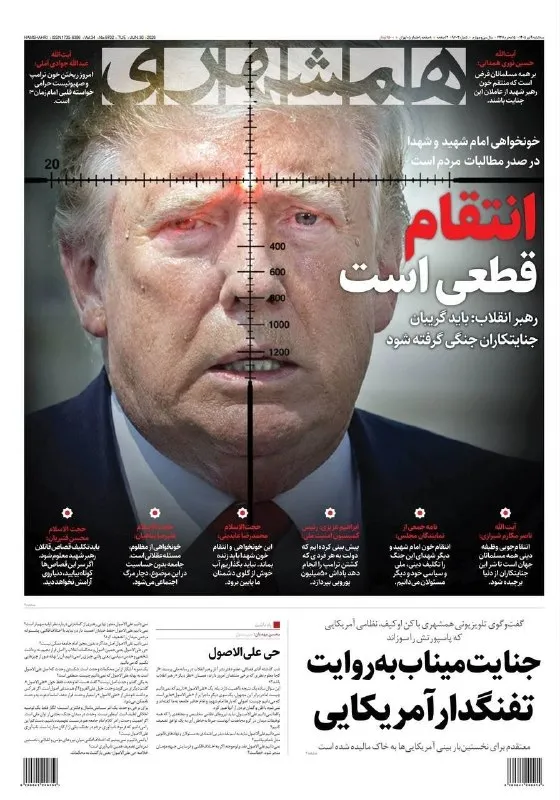
The Iranian press on 9 Tir 1405 (30 June 2026), Day 119, carries forward the post-war ‘accountability and revenge’ line set in motion by Supreme Leader Mojtaba Khamenei’s Judiciary Week directive, but sharpens it from a legal-prosecution message into an explicit threat of retribution. Hamshahri’s full-bleed cover - the day’s single most significant artifact - overlays the face of the US president with a sniper-scope reticle, ranging numerals (400–1200) and a red aiming dot on the forehead under the giant banner «انتقام قطعی است» (Revenge Is Certain), attributing to the Leader the demand that ‘the war criminals must be seized’ and casting the avenging of ‘the martyred Imam and the fallen’ as the people’s foremost demand. The official Iran Daily (English) and Tehran Times keep the institutional version of the same theme - the Leader’s order to pursue US-Israeli war crimes in domestic and international courts, with the Sardasht chemical-attack anniversary and a Kharrazi memorial supplying the victim-and-accountability framing. The day thus runs the prosecution drive (continuity from Day 118) and an escalated, personalized revenge register side by side.
The second dominant thread is diplomacy on a knife-edge: reports of imminent US-Iran technical talks in Doha collide with an across-the-board Iranian insistence that Washington must implement the Islamabad Memorandum before any contact. Jomhouri Eslami heralds the resumption of technical talks ‘soon’; Sobh-e No specifies ‘Doha without face-to-face talks’; but Tehran Times has the deputy foreign minister rejecting reports of imminent talks outright and accusing the US of breaching the MoU during Hormuz fire exchanges, and Kayhan amplifies a petition by ~2,000 university and seminary professors demanding talks be suspended until the US complies. The hardline frame - that the MoU is a trap being violated pre-emptively - is articulated most fully in Kayhan’s ‘Yadasht-e Rooz’ editorial by Mohammad Imani (titled «اعلام خاتمه جنگ یا نقض پیشاپیش توافق؟!»), while Javan pleads for factional unity so internal disputes do not undercut Iran’s leverage at Doha. The consistent operative demand across orientations is procedural: compliance first, contact second, and no direct face-to-face meetings.
The Strait of Hormuz remains the kinetic and diplomatic center of gravity, in direct continuity with Day 118. Vatan-e Emrooz leads with «همان موضع ایران» (The Very Same Iranian Position) over an Iran-Oman coordination to design ‘executive arrangements’ for passage through the strait; Jomhouri Eslami reports the first session of the joint Iran-Oman Hormuz committee and Iran’s readiness for a Persian Gulf collective-security mechanism; the Iran Daily warns in an exclusive that ‘parallel Hormuz corridors’ would erode Iran’s strategic leverage; and Tehran Times reports a second consecutive night of fire exchange with US forces in the Gulf and threatens a ‘more forceful’ response to further breaches. Iran is simultaneously institutionalizing its claimed governance of the waterway (with Oman) and treating it as the principal proving ground for whether the US honors the accord.
Secondary but consistent threads run beneath the war coverage. The Lebanon-Israel framework is again rejected across orientations: Kayhan quotes Speaker Berri that Beirut will ‘neither ratify nor implement’ the deal, and Tehran Times reports ‘more Lebanese figures’ rejecting it as legitimizing occupation. The return of roughly $6 billion in blocked Iranian assets from Qatar features in Etemad, the Iran Daily and Tehran Times, tied to Pezeshkian’s Qom meeting with the Grand Ayatollahs. A distinct domestic strand surfaces: Chaharsoo’s data lead pins a record post-war liquidity surge on the Pezeshkian (fourteenth) government while production stagnates, and Etemad’s lead - sociologist Hamidreza Jalaeipour asking whether the wartime nightly gatherings were ‘national defense or state-run Basij’ - opens unusually direct reformist scrutiny of how the war is being narrated and mobilized. Sazandegi frames Pezeshkian’s Qom visit as the clergy granting religious cover for a fragile ceasefire.
Cross-cutting the hard messaging is sports-and-narrative warfare. Sedaye Iran, a Khamenei.ir-branded bulletin, devotes a full-page allegorical cartoon, «جام دشمنی!» (The Cup of Enmity!), to Iran besting US/Western adversaries on the football pitch, while Sobh-e No reviews a new US-authored ‘Regime Change’ book to argue the 2026 war ended as a defeat for Trump and Netanyahu and a vindication of Iranian endurance and negotiating leverage. The single highest-significance finding remains the now-uncontested editorial treatment of Mojtaba Khamenei as Supreme Leader: every page attributing today’s directives to «رهبر انقلاب» means Mojtaba, while his assassinated father Ali Khamenei is venerated as «شهید» (e.g. Sedaye Iran’s memorial panel and Chaharsoo’s mourning montage) - the succession is settled, operational, and being normalized in print, now layered with an explicit revenge mandate aimed at the US leadership.
Key Judgments
- HIGH - The Mojtaba Khamenei succession is settled and operational. Across rival factions, binding directives are attributed uniformly and without qualification to ‘the Leader of the Revolution,’ while the assassinated Ali Khamenei is venerated as a martyr; there is no contestation of the transition in the open-source record. The Day 119 escalation - a Leader-attributed revenge mandate carried on Hamshahri’s cover - indicates the new Leader is consolidating authority by issuing increasingly assertive directives, not facing visible challenge.
- HIGH - The war-crimes accountability drive will be sustained as a long-running legal and information campaign, and is now being layered with an explicit retribution register. With the Leader’s directive, reported international-court preparation, anniversary hooks (Sardasht) and victim memorials (Kharrazi) all in play, expect recurring coverage of ‘documented crimes,’ named cases, and - as Hamshahri signals - rhetoric escalating from prosecution toward threatened personal retribution against US/Israeli leaders.
- MODERATE-HIGH - The Doha track will remain conditional and slow, with Iran insisting on US MoU compliance first and refusing face-to-face contact. The uniform ‘compliance before talks’ line across the official, establishment and hardline press - reinforced by the ~2,000-professor petition and the deputy FM’s rejection of ‘imminent talks’ reports - suggests any near-term Doha contact will be technical, indirect and easily disrupted by Hormuz incidents or perceived US breaches.
- MODERATE-HIGH - The ceasefire will stay fragile and prone to renewed Hormuz-centered clashes. A reported second consecutive night of fire exchange, Tehran Times’ threat of a ‘more forceful’ response, the ‘parallel corridors’ warning, and the institutionalization of Iran-Oman strait arrangements together point to continued limited kinetic risk; the diplomatic and consensus tracks are unlikely, near-term, to override the hardline conditioning of any concession on Hormuz.
- MODERATE - Reformist scrutiny of the regime’s wartime mobilization and economic record will grow as a distinct, if minority, strand. Etemad’s framing of the nightly gatherings as possible ‘state-run Basij’ and Chaharsoo’s data-driven indictment of record liquidity growth under the Pezeshkian government indicate that, with the immediate war over, reformist and independent outlets are reopening debate over war narration and economic management - likely drawing hardline pushback for ‘distorting’ the war story (echoed in Sazandegi’s «علیه تحریف» teaser).
- MODERATE - Partial economic relief (the ~$6bn Qatar release and potential resumed Asian crude purchases) will be foregrounded as evidence the accord is delivering, but will be contested at home. Official and reformist outlets treat asset recovery as a tangible post-war gain, while hardliners frame any US-mediated mechanism as a trap and reformists question whether monetary expansion is being managed; expect the ‘is the deal worth it’ debate to intensify as implementation milestones (Hormuz reopening, blockade lifting, the uranium file) approach within the 60-day window.
Macro Trends
- From legal prosecution to explicit revenge: the war-crimes line escalates. The Judiciary Week ‘accountability’ directive that unified Day 118 hardens on Day 119 into a personalized retribution message. Hamshahri’s cover literally places the US president in a sniper crosshair under «انتقام قطعی است» (Revenge Is Certain), with a row of clerical and official portrait-quotes (incl. National Security Commission chair Ebrahim Azizi) amplifying calls for retribution and a feature on ‘the Minab crime as told by an American Marine.’ The institutional channel continues in parallel: the Iran Daily and Tehran Times carry the Leader’s order to pursue US-Israeli war crimes in domestic and international courts, anchored to the Sardasht chemical-attack anniversary and the Kharrazi memorial. The drive is now dual-register - courts plus crosshairs.
- ‘No talks until the US complies’: procedural conditioning of the Doha track. Reports of imminent technical talks in Doha are met with a uniform Iranian precondition that Washington implement the Islamabad MoU first. Jomhouri Eslami announces resumption ‘soon’; Sobh-e No specifies ‘Doha without face-to-face talks’; Tehran Times has the deputy FM rejecting reports of imminent talks and accusing the US of MoU violations; Kayhan amplifies a ~2,000-professor petition to suspend negotiations until compliance. The shared operative line across factions is sequencing: compliance before contact, and no direct meetings - diplomacy framed as a test of US good faith rather than a concession.
- Strait of Hormuz: institutionalized leverage plus continued friction. Hormuz remains the post-war center of gravity. Vatan-e Emrooz leads on Iran-Oman coordination to design ‘executive arrangements’ for strait passage; Jomhouri Eslami reports the first joint Iran-Oman committee session and Iran’s readiness for a Persian Gulf collective-security mechanism; the Iran Daily warns that ‘parallel Hormuz corridors’ would erode Iran’s strategic position; Kayhan cites the WSJ to claim Iran is ‘also winning the Hormuz battle’; and Tehran Times reports a second consecutive night of fire exchange. Iran is simultaneously building an institutional claim to govern the waterway and keeping it a live pressure point - directly continuous with Day 118.
- Internal cohesion vs. reformist scrutiny of the war narrative. Hardline outlets press for unity behind the negotiating posture - Javan’s lead «این اختلافات «حتی موجه» تا کی؟!» demands that even ‘justified’ internal disputes over Doha be suspended lest factional infighting weaken Iran’s leverage. Against this, reformist Etemad leads with sociologist Hamidreza Jalaeipour interrogating whether the wartime nightly mass gatherings were genuine ‘national defense’ or ‘state-run Basij’ mobilization - an unusually direct challenge to the regime’s own war-mobilization narrative - while Sazandegi questions who the parties to the ‘Islamabad Accord’ actually are and how the deal can be guaranteed.
- Rejection of the Lebanon-Israel framework persists. The Beirut-Tel Aviv deal is again delegitimized across orientations. Kayhan quotes Speaker Berri that Lebanon will ‘neither ratify nor implement’ the agreement, casting it as externally imposed capitulation; Tehran Times reports ‘more Lebanese figures’ rejecting it as legitimizing occupation without legal standing; Vatan-e Emrooz warns Lebanon is being placed under a «توافق تحقیرآمیز» (humiliating accord). Jomhouri Eslami’s commentary insists any agreement with the ‘Zionist regime’ is ‘neither ratifiable nor implementable.’ Lebanon is held as a live grievance and proxy flashpoint, consistent with the prior edition.
- Asset recovery and a contested economic record. Two economic strands run beneath the war coverage. On the positive side, the return of roughly $6 billion in blocked Iranian assets from Qatar features in Etemad, the Iran Daily and Tehran Times, linked to Pezeshkian’s Qom meeting with the Grand Ayatollahs and to Asian buyers (South Korea, Japan) reportedly ready to resume crude purchases if banking sanctions lift. On the critical side, Chaharsoo’s data lead pins a record post-war liquidity surge (+24.9, the sharpest of any administration on its chart) on the Pezeshkian (fourteenth) government while production stagnates - framing monetary expansion as a structural failure fuelling inflation rather than output.
- Narrative and sports warfare as a morale vector. The contest over ‘who won’ the war is fought partly through culture and sport. Sedaye Iran, a Khamenei.ir-branded bulletin, runs a full-page allegorical cartoon «جام دشمنی!» (The Cup of Enmity!) depicting an Iranian footballer besting sprawled Western opponents, paired with a ‘great trust gap’ column arguing US-Iran trust is irreparably broken. Sobh-e No reviews a US-authored ‘Regime Change’ book to argue the war ended as a defeat for Trump and Netanyahu and a vindication of Iranian endurance, and amplifies a European heatwave (‘4,000 dead in 72 hours’) to underscore Western fragility. Morale and narrative dominance are managed alongside the harder war-and-justice messaging.
Front-Page Snapshot
- Hamshahri - “Revenge Is Certain” (Centrist (Tehran municipality)) - Leader-attributed revenge mandate; US leadership in the crosshairs
- Iran (Iran Daily) - “Leader orders legal pursuit of US-Israeli war crimes against Iran” (Government / state daily (IRNA; Pezeshkian line)) - Legal accountability for war crimes; guard Hormuz leverage; cautious diplomacy and asset recovery
- Kayhan - “2,000 university and seminary professors: halt negotiations until the US fulfills its commitments” (Hardline / principlist (ultra-conservative)) - Reject talks until US complies; the MoU is a trap being breached pre-emptively
- Tehran Times - “Tehran demands US adherence to MoU before any technical discussions begin” (English-language; state-aligned conservative) - No talks until US honors the MoU; pursue war crimes in court; Lebanon deal illegitimate
- Jomhouri Eslami - “Resumption of Iran-US Technical Talks, Soon” (Traditional principlist / establishment-clerical) - Imminent technical talks; no deal with Israel; Hormuz security and Iran-Oman committee
- Sobh-e No - “When Netanyahu’s Dream Became Trump’s Nightmare” (Principlist / hardline) - Post-war ‘Iran won’ narrative; Doha without face-to-face talks; Western fragility
- Vatan-e Emrooz - “The Very Same Iranian Position” (Hardline / principlist) - Strait of Hormuz leverage via Iran-Oman coordination; resist a ‘humiliating’ regional accord
- Javan - “These ‘Even Justified’ Disagreements - Until When?!” (Hardline / IRGC-affiliated) - Factional unity behind the Doha track; burden of compliance falls on the US
- Sedaye Iran - “The Cup of Enmity!” (Hardline (Khamenei.ir-branded bulletin)) - Defiant resistance messaging; martyr veneration; Iran besting US ‘on every field’
- Sazandegi - “Qom Backs the Agreement” (Reformist / Kargozaran) - Qom clergy endorse the Islamabad Accord; religious cover for a fragile ceasefire
- Etemad - “National Defense Movement, or State-Run Basij?” (Reformist) - Scrutiny of wartime mass mobilization; return of $6bn blocked assets from Qatar; the Doha test
- Chaharsoo - “The Fourteenth Government, Record-Holder for Liquidity Growth” (Economic / analytical (independent business daily)) - Record post-war liquidity growth blamed on the Pezeshkian government amid stagnant production
- Jam-e Jam - “Iran and France foreign ministers hold phone call on Islamabad Accord implementation” (Conservative / state broadcaster (IRIB)) - Diplomacy and Accord implementation foregrounded; ceasefire as operative reality
Full report
The complete edition - per-paper front-page analysis and full translation appendices - is available as a PDF: Download the full report.
Compiled from Iranian front pages and outlet channels via open-source monitoring. Translations are editorial; named-figure attributions are verified against the source pages where possible.