Iranian Press Monitor - Monday, 29 June 2026 (Day 118)
Monday, 29 June 2026 · 8 Tir 1405 · 14 Muharram 1448 - 15 Iranian front pages (Persian + English) plus the Iran Daily English edition; translation annex
Executive Summary
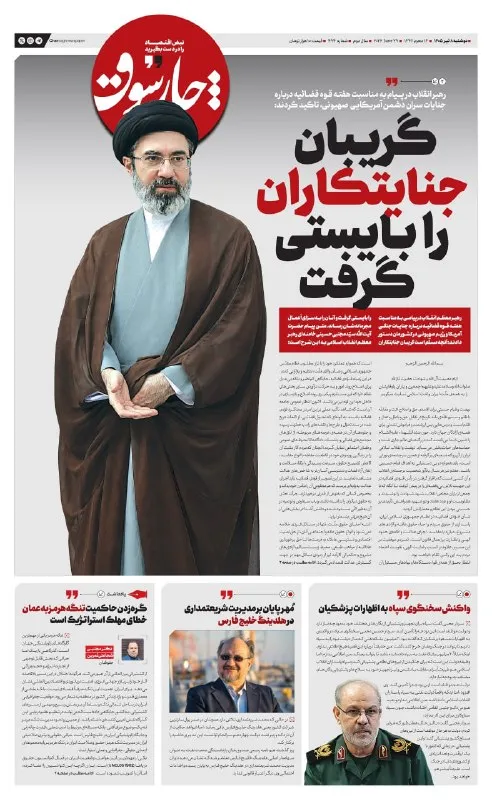
The Iranian press on 8 Tir 1405 (29 June 2026) speaks with a single organizing voice: a Judiciary Week message from Supreme Leader Mojtaba Khamenei ordering the prosecution of US and Israeli officials for war crimes committed during the 2026 war. The message is carried, paraphrased or printed in full across the great majority of front pages, from the hardline (Charso’s ‘The Criminals Must Be Seized by the Collar,’ Vatan-e Emrooz’s full-text reproduction, Hamshahri’s red-banner ‘War criminals will not go free’) to the establishment principlist titles (Farhikhtegan, Qods, Nobonyad, Asr-e Iranian) that frame the same message as a mandate for judicial ‘self-reform’ and post-war reconstruction. The English-facing Tehran Times packages it most explicitly for a Western audience, reporting that Judiciary Chief Mohseni Ejei is preparing international cases in coordination with the Foreign Ministry. The dual track - domestic prosecution plus internationalized legal action over the ‘crimes of 1402 and 1403’ - is the dominant narrative the regime is projecting at home and abroad.
The single highest-significance finding is the now-routine, uncontested editorial treatment of Mojtaba Khamenei as Supreme Leader. Multiple papers attribute the Judiciary Week directive to ‘the Leader of the Revolution’ / ‘رهبر معظم انقلاب’ while, in the same pages, covering the ongoing funeral rites for his father - the ‘martyred Leader’ Ayatollah Seyyed Ali Khamenei - being carried across four Iraqi cities. The succession is being normalized in print: the new Leader issues binding directives and presides over governance, while the assassinated predecessor is venerated through state mourning, an extended three-day funeral holiday (now extended to private-sector workers per the official Iran daily), and Mashhad pilgrimage logistics. This is the clearest open-source confirmation to date that the leadership transition is settled and operational.
A second major thread is a sharp internal cleavage over the fragile 17 June ceasefire and the diplomacy around it. Hardline outlets - led by Kayhan, whose ‘Yadasht-e Rooz’ editorial today is by Saadollah Zarei (not Shariatmadari) - argue Iran won the ‘Ramadan War’ militarily but is now losing the post-war ‘black-play’ campaign, accusing Iran’s own negotiators of conceding on Hormuz normalization, the ~$24bn in frozen assets, and the nuclear file, and demanding military rather than diplomatic responses. Reformist and centrist papers (Shargh, Etemad, Hamshahri) take the opposite tack, foregrounding Pezeshkian’s consensus-building, Baghdad as a diplomatic channel, sober economic costs, and domestic reform. The official Iran daily strikes an institutional-continuity tone. This is a visible elite contest over whether to consolidate the war’s gains by force or by negotiation.
Secondary but prominent threads run consistently across the day: near-universal rejection of the US-brokered Lebanon-Israel deal (Jam-e Jam citing Al-Akhbar that most Lebanese oppose the ‘imposed’ agreement; Vatan-e Emrooz’s ‘Betrayal of Lebanon’ amplifying Naim Qassem; the Iran daily quoting Berri that the deal is ‘ten times worse’ than 1983; Sobh-e No and Kayhan warning of a ‘Gaza 2.0’ South Lebanon); a second consecutive night of Iran-US clashes at the Strait of Hormuz coupled with the new Iran-Oman joint committee on strait management (Etemad, Iran, Jam-e Jam, Tehran Times, Vatan-e Emrooz); FM Araghchi’s Baghdad visit (Qods, Shargh, Sobh-e No, Tehran Times); a banking-network cyberattack (Qods); and clerical statements urging unity behind the government (Jomhouri Eslami, Nobonyad, Asr-e Iranian).
Cutting across the wartime coverage is an unexpected unifier: Iran’s emotional World Cup exit. Vatan-e Emrooz devotes its entire dramatic cover to it (‘Hold Your Head High’), Hamshahri leads with the team (‘Beyond Advancing,’ questioning the removal of the national flag), and Qods runs a dejected-squad box (‘Full of memory, but full of regret’). Sports nationalism is being deployed as a morale and unity vector alongside the harder war-and-justice messaging, illustrating how the press is managing a population simultaneously mourning, recovering, and seeking normalcy.
Key Judgments
- HIGH - The leadership succession to Mojtaba Khamenei is settled and operational. The uniform, unqualified attribution of binding directives to ‘the Leader of the Revolution’ across rival factions, combined with state-managed mourning for the martyred predecessor, indicates no live contestation of the transition in the open-source record; expect continued consolidation rather than visible challenge in coming editions.
- HIGH - The war-crimes prosecution drive will be sustained and institutionalized as a long-running information and legal campaign. With the Leader’s directive, Judiciary Chief Mohseni Ejei’s case preparation, and Foreign Ministry coordination already reported, anticipate recurring coverage of named indictments, international-court filings, and evidentiary ‘documentation’ of US/Israeli crimes as a durable narrative pillar.
- MODERATE-HIGH - The ceasefire will remain fragile and prone to renewed Hormuz-centered clashes. A second consecutive night of fire exchange, hardline demands for military responses to even verbal provocations, and contested strait-management arrangements create a high risk of further limited kinetic incidents; the Iran-Oman committee and Pezeshkian’s consensus track are unlikely, near-term, to override the hardline veto on diplomacy.
- MODERATE-HIGH - Iran will continue to treat the Lebanon-Israel deal as illegitimate and to support its rejection, raising the probability of escalation along the Lebanese front. The cross-factional unanimity in framing the deal as ‘imposed,’ ‘betrayal,’ and a violation of the Iran-US understanding suggests Tehran will back Hezbollah’s rejectionist posture rather than press for implementation.
- MODERATE - The factional contest between force-consolidation and diplomacy-consolidation will intensify and increasingly surface as open criticism of negotiators. Kayhan/Zarei’s explicit indictment of Iran’s negotiating team over Hormuz, frozen assets, and the nuclear working group is likely a leading indicator of a broader hardline campaign to constrain or discredit the Pezeshkian-aligned diplomatic track.
- MODERATE - Economic distress will become a growing pressure point that resilience messaging only partly masks. The combination of collapsed Hormuz shipping, bread-price and subsidy pressure, a housing-construction collapse, and a banking cyberattack points to mounting strain; expect more reformist and even principlist criticism of economic management even as official outlets emphasize wheat output and restored services.
Macro Trends
- The Judiciary-Week war-crimes directive as a unifying state narrative. Mojtaba Khamenei’s order to prosecute US and Israeli officials for war crimes is the day’s connective tissue, appearing on nearly every front page regardless of faction. Hardliners frame it as a demand to ‘seize the criminals by the collar’ (Charso) and pledge that ‘war criminals will not go free’ (Hamshahri); principlist titles fold it into a judicial self-reform and reconstruction agenda (Farhikhtegan, Qods, Nobonyad, Asr-e Iranian); Tehran Times operationalizes it for foreign readers by naming Mohseni Ejei and an international-case track. The breadth signals top-down message discipline: a single Leader directive is being amplified as the regime’s authoritative post-war posture.
- Normalization of the Mojtaba succession alongside martyr-cult mourning. The press simultaneously treats Mojtaba Khamenei as the binding source of authority and elevates his assassinated father through state ritual. The funeral procession across four Iraqi cities, an extended (now private-sector) three-day mourning holiday, Mashhad pilgrim logistics for 900 schools, and Beheshti/Seventh-of-Tir martyrdom commemorations all reinforce continuity-through-sacrifice. No outlet questions the transition; the dual framing (living Leader governs, martyred Leader is venerated) is now standard editorial practice.
- A factional split over the ceasefire: consolidate by force vs. by diplomacy. Kayhan/Zarei articulates the hardline thesis that Iran is squandering a military victory in a post-war ‘black-play’ contest, indicting Iran’s negotiators over Hormuz normalization, frozen assets, and the nuclear working group, and prescribing ‘regret-inducing’ military responses. Jomhouri Eslami and Nobonyad echo distrust of the framework while urging unity. Against them, Shargh frames Pezeshkian ‘on the path of consensus,’ Etemad reports sober diplomacy and economic cost, and the Iran daily projects institutional recovery. The cleavage is over method, not over claiming victory.
- Unanimous rejection of the US-brokered Lebanon-Israel deal. Across orientations the Beirut-Tel Aviv agreement is delegitimized: Jam-e Jam and Sobh-e No cite Al-Akhbar that most Lebanese oppose the ‘imposed’ deal; Vatan-e Emrooz runs ‘Betrayal of Lebanon’ amplifying Naim Qassem’s ‘null and shameful’ verdict; the Iran daily quotes Berri calling it ‘ten times worse’ than 1983; Kayhan and others warn of a ‘Gaza 2.0’ South Lebanon and continued Israeli ceasefire violations. The papers cast the deal as serving Israel and contradicting the Iran-US understanding, keeping Lebanon as a live grievance and proxy flashpoint.
- Strait of Hormuz as the kinetic and diplomatic center of gravity. A second consecutive night of Iran-US fire exchange at Hormuz dominates security coverage (Vatan-e Emrooz’s ‘Destruction of 7 Targets at 2 Bases,’ Tehran Times’ IRGC claims of strikes on eight US installations), while papers simultaneously report the first Iran-Oman joint committee on strait management (Etemad, Iran, Jam-e Jam). Iran is projecting both sustained operational control and an institutionalized claim to govern the waterway, with hardliners (Charso, Kayhan) attacking any concession of sovereignty to Oman or the southern Gulf states as strategic error and treachery.
- Economic strain and resilience messaging run beneath the war coverage. Even triumphalist pages carry the war’s real costs and the regime’s recovery narrative. Etemad quantifies the collapse of Hormuz shipping (≈50 tankers in June 2026 vs ≈1,150 in December 2025) and bread-price pressure on the poor; the Iran daily touts record 14m-ton wheat output and maintained telecoms despite 500+ damaged sites; Nobonyad and Qods flag a historic housing-construction collapse, automaker monopolies, a two-rate housing market, and a banking-network cyberattack with ‘cyber-resilience’ framing. Domestic economic dysfunction is acknowledged but wrapped in resilience messaging.
- Sports nationalism as a cross-factional morale vector. Iran’s last-minute World Cup elimination is deployed as a unifying, morale-boosting theme that cuts across the war narrative. Vatan-e Emrooz gives it the full cover (‘Hold Your Head High,’ blaming refereeing), Hamshahri leads with the team and the flag-removal controversy, and Qods runs a dejected-squad box. The choice to foreground football amid wartime signals an intent to project national pride and normalcy to a strained public.
Front-Page Snapshot
- Charso - “The Criminals Must Be Seized by the Collar” (Principlist / hardline) - Leader’s demand to prosecute U.S./Israeli war criminals
- Vatan-e Emrooz - “Hold Your Head High” (Hardline / principlist) - Defiant national pride; reject the Lebanon deal
- Kayhan - “The Enemy’s Deception and the Need to Change Our Outlook” (Hardline / ultra-conservative) - Distrust of diplomacy; consolidate war victory by force
- Sobh-e No - “One Night of Radicalism, the End of Eighty Nights of Devotion” (Hardline / principlist) - Mourning discipline; delegitimizing US and the Lebanon deal
- Hamshahri - “Beyond Advancing” (Centrist (Tehran municipality)) - Football qualification pride + ‘war criminals won’t go free’ accountability
- Farhikhtegan - “Awaiting the Rebuilding of the Judiciary” (Principlist (Azad University)) - Judiciary rebuilding + Velayati warns on Oman/Gulf mediation
- Qods - “Seven Steps to the Realization of Justice” (Conservative (Astan Quds Razavi, Mashhad)) - Judiciary Week justice message + Araghchi’s Baghdad trip
- Nobonyad - “Reform and Reconstruction” (Conservative / principlist) - Judiciary reform and post-war reconstruction
- Asr-e Iranian - “Effective Governance Is the Nation’s Right” (Principlist / conservative) - Judiciary Week - effective governance and clerical unity vs. the enemy
- Jomhouri Eslami - “Sources of Emulation Stress Following the State and the Need to Preserve Unity and Cohesion” (Traditional principlist / establishment) - Clerical backing for the state, unity, and martyr commemoration
- Jam-e Jam - “Al-Akhbar: Most of Lebanese Society Opposes the Imposed Agreement” (State broadcaster (IRIB); conservative establishment) - Lebanon deal rejected by its own public; Hormuz diplomacy
- Iran (daily) - “Martyred Leader’s Ceremony Holidays Extended to Private-Sector Workers” (Official government daily (IRNA); Pezeshkian line) - State mourning, governance continuity, post-war recovery
- Shargh - “Pezeshkian on the Path of Consensus” (Reformist) - Post-war consensus and Baghdad diplomatic channel
- Etemad - “Netanyahu: We Will Report Erdogan’s Threats Against Israel to America” (Reformist; pro-diplomacy) - Sober diplomacy and economic cost; domestic reform critique
- Tehran Times - “US and Israel must be brought to justice for their crimes” (English-language; state-aligned conservative) - War-crimes prosecution; forceful deterrence for foreign audience
Full report
The complete edition - per-paper front-page analysis and full translation appendices - is available as a PDF: Download the full report.
Compiled from Iranian front pages and outlet channels via open-source monitoring. Translations are editorial; named-figure attributions are verified against the source pages where possible.