Iran Press Summary - 28 June: While Beirut burns over a deal with Israel, Tehran tightens its grip on Hormuz
Sunday, 28 June 2026 (7 Tir 1405)
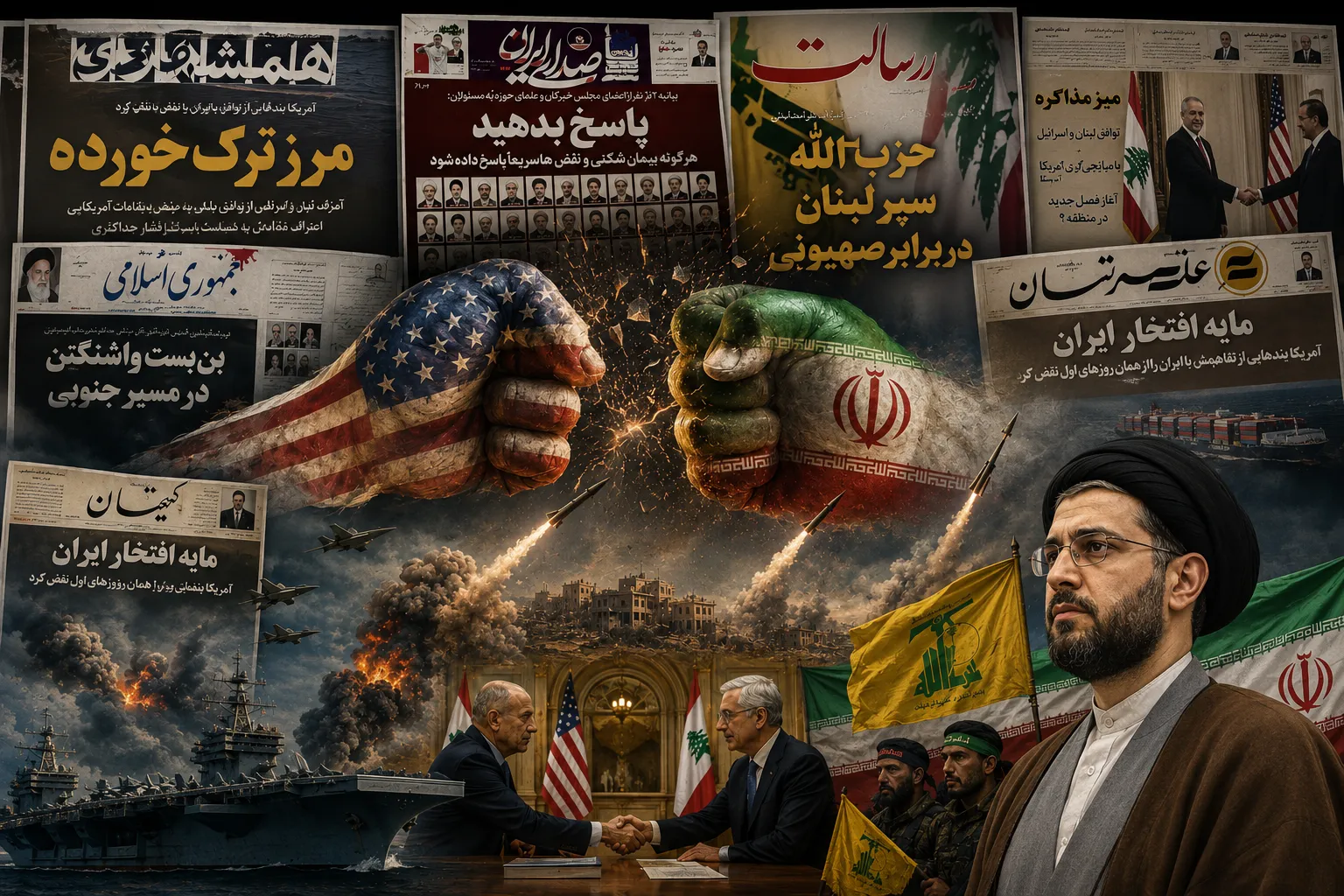
Iran woke up this morning to its second exchange of fire with the United States in roughly thirty-six hours — and its newspapers, printed on staggered overnight deadlines, are still sorting out which round they actually managed to cover.
Round One: A Warning Shot Over Hormuz
The trouble started overnight Friday into Saturday (26–27 June), when Iranian naval forces fired warning shots at, and restricted passage for, vessels attempting to transit the Strait of Hormuz via a route Tehran had not approved — reportedly an attempt by Washington to open an alternative corridor near Omani waters without going through Iran’s own permit regime. The United States answered with a strike on Sirik, the small Iranian port city that has emerged as a flashpoint in this slow-motion contest over who actually controls traffic through the world’s most important oil chokepoint.
By Iranian accounts, that round was over almost as soon as it started. It’s the one that actually made it into this morning’s papers, in one form or another, because reporters and editors had time before their print deadlines to fold it into front pages already built around the Strait.
Round Two: Five Coastal Posts, Two Foreign Bases
The second round broke in the dead of night, after most presses had already started running. In the early hours of Sunday, U.S. forces struck five Iranian coastal monitoring and surveillance posts along the southern coast. Iran’s response, according to the IRGC Navy and Aerospace Force, came fast: a joint missile-and-drone operation, launched between roughly 2:00 and 3:00 a.m., against eight targets at two U.S.-linked sites — Ali Al Salem airbase in Kuwait and the Fifth Fleet facility at Salman Port in Bahrain.
The paper trail for this round exists almost entirely outside the newsstands. Iran’s Foreign Ministry posted a statement on Telegram (channel @MFAIran, post 35650) condemning the strikes as a violation of Article 2(4) of the UN Charter and Article 1 of the Islamabad memorandum of understanding, which ended the broader war on 18 June. The IRGC Navy followed with its own statement — pointed, almost gleeful in tone — warning that “the Americans will experience hell in these coming days,” and that any future violation, however minor the target, “will be met with a crushing response.” Both statements invoke Article 51 of the UN Charter as Iran’s legal basis for continued self-defense.
None of that made it into the front pages reviewed this morning, with one possible exception: Jomhuri Eslami’s front-page sidebar uses language close enough to the Foreign Ministry’s wording that it may represent a last-minute insertion before the page closed. Everyone else, including the two English-language papers, is still working off Round One.
The Papers: Hormuz as Leverage, Lebanon as Betrayal
Strip away the two-round confusion, and a clear editorial consensus emerges across this morning’s press — one built less around the night’s specific events and more around a pair of themes Iranian media have been hammering for weeks.
Hormuz is not for negotiating. Kayhan’s lead editorial puts it as bluntly as Iranian state media gets: the Strait is “America’s breathing tube,” and Tehran should not “let go of the enemy’s throat.” The piece explicitly invokes Trump’s own admissions — that prolonging the war would have drained U.S. oil reserves within weeks, that a longer conflict risked a global recession — as proof that Hormuz is Iran’s one piece of real leverage, and that handing it back in any settlement would be tantamount to surrendering the only card that ever made Washington blink. Khorasan runs with “Yankees’ Last Efforts, Cornered in the Strait.” Quds frames the same theme as “Crossing Hormuz, Iranian-Style” — passage on Iran’s terms or not at all. Even the Khamenei.ir-linked Sedaye Iran outlet weighs in with “Washington’s Dead End on the Southern Route,” accusing the U.S. of repeatedly trying to engineer alternate smuggling and transit corridors specifically to strip Iran of this leverage.
It’s a remarkably unified front-to-back press operation: whatever else divides Iran’s reformist and hardline papers, nobody is arguing that Hormuz should be on the table.
Lebanon is the day’s other obsession — and it’s being used almost as a release valve. The new Lebanon-Israel-U.S. framework agreement, which Hezbollah’s Naim Qassem has already called “void and discredited,” is the subject of furious front-page coverage across nearly the entire spectrum: Jomhuri Eslami, Resalat, NoBonyad, Farhikhtegan, and Vatan Emruz all lead or sub-lead with Lebanese popular and party opposition to the deal, consistently framed as a Hezbollah-disarmament vehicle dressed up as diplomacy. Resalat’s headline calls Hezbollah “Lebanon’s Shield Against the Zionist Swallowing.” It’s hard not to notice how useful this narrative is for Tehran at this particular moment: outrage over an Israeli-brokered Lebanese “surrender” photographs well next to outrage over American strikes, and both feed the same broader story of Western bad faith — without requiring anyone to dwell too long on Iran’s own MOU compliance questions.
Hamshahri, the Tehran municipal daily, ties the threads together most explicitly with its lead headline: “Negotiating Table Cracks.” Drawing on the Round One narrative, it lists three specific U.S. failures — Israel’s non-withdrawal from southern Lebanon, renewed strikes on Iranian sites in the south, and continued threatening rhetoric out of Washington — to argue the MOU is fraying “from the very first days.” It’s the most pessimistic domestic read on the ceasefire’s durability among the papers sampled this morning, and, notably, it doesn’t even need Round Two to make that case.
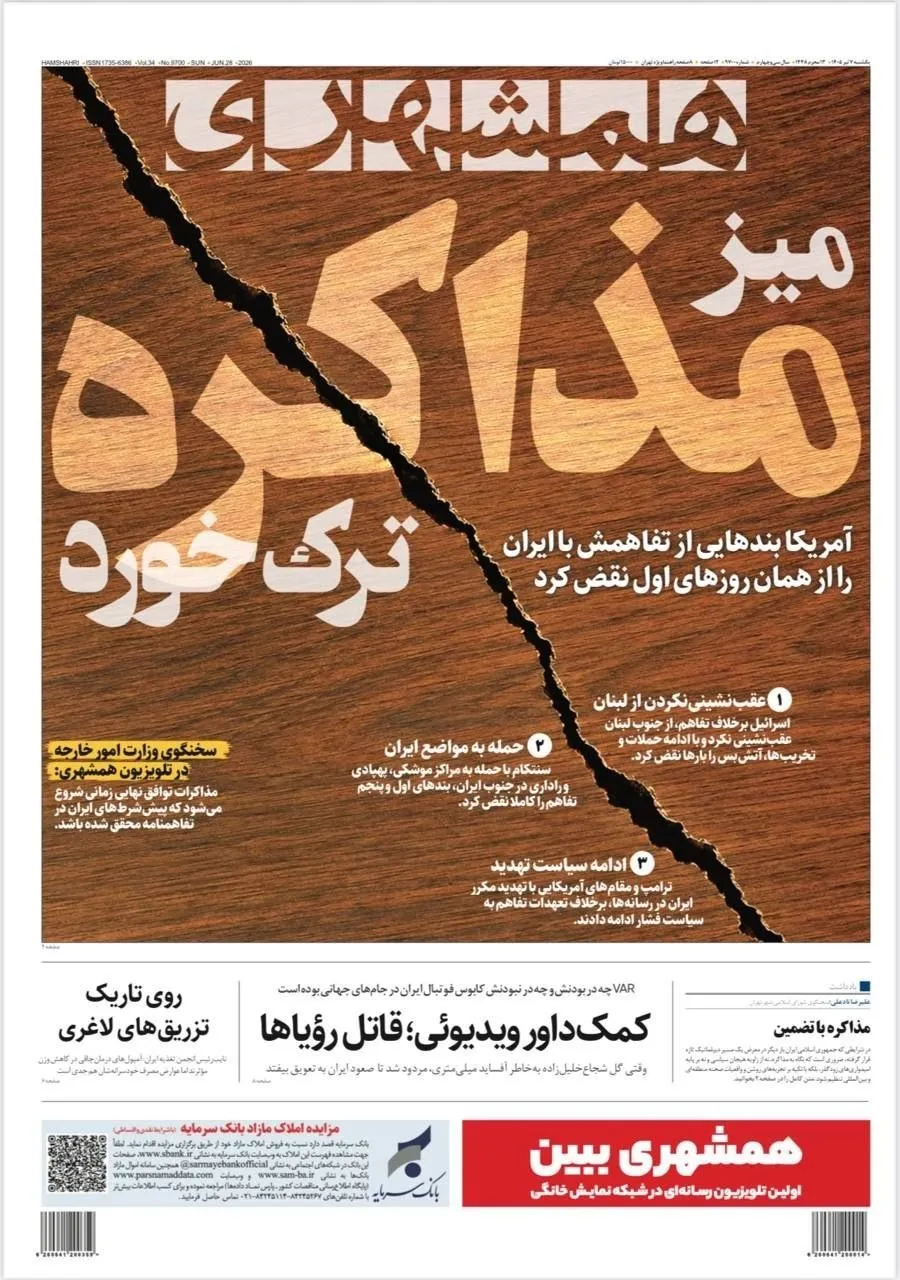
“Negotiating Table Cracks.”
The English-language press tells a slightly different, more international-facing story. Tehran Times runs “US Bombs MoU” — a headline broad enough to cover either round, though the body, as filed, describes Round One in detail. It also carries an interview with senior adviser Mohsen Rezaei announcing that Iran intends to start charging for Hormuz security and environmental protection, it claims to have provided “free” for 47 years — a notable shift in framing, from defending the Strait to monetizing it. Iran Daily, similarly, leads with the U.S. air raids and folds in a separate piece arguing the Lebanon deal is the product of a “domestic, regional and international conspiracy.”
Reading the Tea Leaves
Layer the official statements over the editorial mood, and a fairly coherent Iranian playbook comes into focus. Hold Hormuz as the one lever Washington actually respects. Use Lebanon as the unifying grievance that keeps hardliners and reformists rowing in the same direction. And whatever happens overnight — whether it’s warning shots near Oman or missiles toward Kuwait and Bahrain — frame it instantly as proportionate self-defense against a serial violator, never as escalation.
The risk, of course, is that this messaging discipline outruns the actual military restraint behind it. Two rounds of fire in thirty-six hours, the second one explicitly described by Iran’s own IRGC as still unfolding (“these coming days”), suggests the press cycle covering this conflict may need to run faster than the print deadlines that produced this morning’s papers.
Sources: Iranian Foreign Ministry (Telegram, @MFAIran, post 35650); IRGC Public Relations/Navy statements (via Nournews); front pages of Kayhan, Khorasan, Quds, Sedaye Iran, Hamshahri, Tehran Times, Iran Daily, Jomhuri Eslami, Resalat, NoBonyad, Farhikhtegan, Vatan Emruz, and others, 28 June 2026.